by Douglas Messerli
Rafael Sánchez Campo, Eloy de la Iglesia, and Gonzalo Goicoechea
(screenplay), Eloy de la Iglesia (director) Los placeres ocultos (Hidden
Pleasures) / 1977

Certainly, de la Iglesia does not have the rich textures and images of
Visconti, nor did he have the resources of the incredible acting team with whom
Fassbinder regularly worked, and his his output as not as monumental as
Fassbinder’s oeuvre. For 15 years after La Estanquera de vallecas in
1987, de la Iglesia stopped making films as he struggled with heroin addiction
before making his last work Los novios bulgaros in 2003. But his
importance as a gay, communist activist, and filmmaker, particularly in the
early post-Franco days, is extraordinarily significant even while it has been
basically ignored by many in the film world. De la Iglesia made it possible for
a director such as his fellow countryman Pedro Almodóvar to come into being in
the late 1980s, the very period when de la Iglesia grew silent.

Given his position as head of a major bank, Eduardo quickly arranges for
the boy to be hired by his former protégé Raúl (Antonio
Corencia), now an adult gay man who, unlike Eduardo, is involved as a gay
activist who attends liberation meetings, to whose invitations Eduardo
repeatedly rejects.
Gradually discovering that Miguel is heterosexual with a girlfriend
Carmen (Beatriz Rossat), Eduardo, nonetheless, becomes nearly infatuated with
the boy and attempts to keep him close to him by offering him a regular job in
his apartment to type up a manuscript upon which he is

Soon, Eduardo has also bought Miguel the motorbike in the window, and
when Miguel returns home with it, the local boys who gather round naturally
presume Miguel has provided plenty of sex for the gift.
Things are made even more complex given the fact that a married woman,
Rosa (Charo López), has long been regularly inviting the boy to her house to
help with “plumbing problems,” keeping him as a kind secret lover who weekly
satisfies the sexual needs which obviously her husband cannot.
As Eduardo grows more and more obsessed with Miguel—and simultaneously
is sexually frustrated by the situation—Miguel comes increasingly to admire the
man who almost inexplicably has chosen to help the willing and hardworking
young man, who refuses the alternatives chosen by many of his neighborhood
classmates. Indeed, we observe that gradually Miguel has turned his
patron/mentor, perhaps unknowingly to Eduardo, into a father figure.
Meanwhile, Eduardo’s elderly mother grows ill, confessing on her
deathbed to her son that she has long known he was “different” and pleading
with him not to remain alone. Eduardo’s brother Ignacio (Germán Cobos), also an
executive in the bank, knows of his brother’s homosexuality, and is willing to
ignore it as long as it does not become obvious to any of his business
associates.

Eduardo has no choice but to turn back to his old patterns, jacking off
boys in public lavatories, sucking off boys in movie theaters, and picking up
Nes on the street one night. But this time, mostly in anger for his many months
of rejection and Eduardo’s preference for Miguel, Nes has planned with his
hustler friends to rob and loot Eduardo’s apartment, beating him before they
leave.
Hearing of the beating, Miguel quickly returns to Eduardo, after beating
Nes severely for his treatment of the banker. Eduardo promises to accept the
boy as a heterosexual without attempting to ask for any sexual involvement and
even encourages Miguel to introduce him to Carmen, the three of them playing
out a different kind of family unit as they party and travel on short day trips
together, offering the older man, for the first time in his life, a sort of
replacement family unit.

Together they spread the rumor throughout the barrio that Miguel is gay,
and she personally visits Carmen’s father, convincing him that his daughter’s
boyfriend is queer. Nes and the others cut the tires of Miguel's motorbike and,
soon after, while the other’s hold Miguel, he beats the boy severely.

For both man and boy, the worst that can happen has. And the film, which
surely might have already disappointed LGBTQ audiences for its presentation—yet
again, centered on the abuse or failure of gay life as well as presenting its
audiences mostly with heterosexual love scenes instead of gay action—superficially
appears to be yet another well-intended film that displays the failures of gay
life. Indeed, many commentators have described de la Iglesia’s work as a sort
of more pallid Death in Venice.
But, in fact, those comparisons, I’d argue are mistaken. Unlike Gustav
von Aschenbach, Eduardo makes his interests and eventually his desires for his
Tadzio quite known, and accepts the consequences. At least a couple of times
along the way, moreover, when first Miguel and later Carmen confront him about
his sexuality—Miguel asking if there were a shot he might take to cure his
homosexuality, even if it cost him everything he had, wouldn’t he immediately
take it?
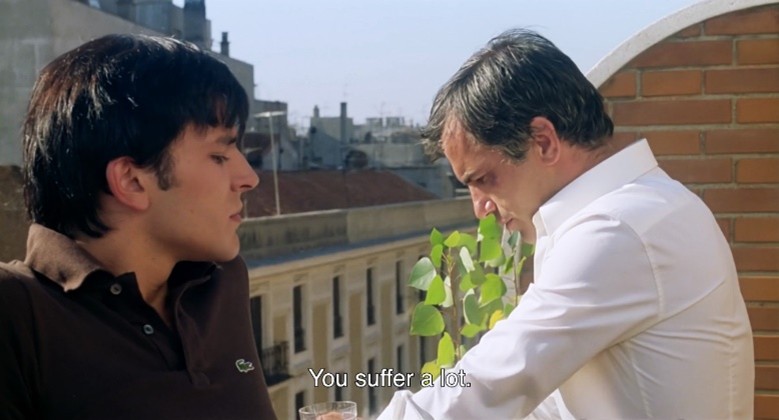
Eduardo
answers quite straightforwardly: “I wouldn’t take it even if it was free. When
I was your age I would’ve paid anything. It hurts to realize that you look at
other things than most boys. Or when sexy women on the screen don’t turn you
on. Or when you’re ashamed of last night’s dream. You suffer a lot. …We all
have a right to be what we are. And nobody has the right to change us.”
And
it is at that point that he promises Miguel that “Rest assured, I’ll never try
anything with you. I don’t have the right to change you.”
The original working title of the film was La acera de enfrente,
which means literally, “the other side of the street,” a pejorative expression
for “homosexual.” The title, perceived as far too controversial, was changed
upon release, but even then the picture was initially banned by the Spanish
censors. When it was finally released the critics, opposing censorship one year
after Franco’s death gave it mostly positive, if hardly gay-friendly reviews—El
Pueblo, for example, observing that the film focuses on “the sad problem of
homosexuality, but with little scandal.” Far more importantly, gay
liberationists gathered in the streets for massive pro-demonstrations on the
film’s opening night, de la Iglesia commenting, “It was the first time a
Spanish gay group came out in public, with its banners and presenting its
demands.”

We
can only imagine that such a look of pleasure can be provided through the
reappearance of Miguel. But if it is Miguel, we have to ask, for what reason
has he returned? Is he simply ready to resume his chaste friendship with
Eduardo, and what might or can their relationship now entail? Or has Miguel
accepted, far more problematic if so, the role to which he has been assigned, a
faggot who is willing, now without any alternatives, to begin a sexual
relationship with the older man? Surely that could not be among the writer’s
intentions. Yet, we have to imagine all the alternatives, or at least we are
encouraged to. Of course, those possibilities say more about us than about any
character in the film.
In
any event, this film does not end in a gay death. Both Eduardo and Miguel are
permitted go on to define their own lives in whatever manner that they are
afforded. If nothing else, we can say that Hidden Pleasures ends with
nearly endless potentialities, pleasure appearing where you might least might
have expected it.
Los Angeles, September 28, 2023
Reprinted from World Cinema Review (September
2023).


.png)
No comments:
Post a Comment