Wednesday, August 7, 2024

Federico Fellini | Il Bidone (The Swindlers) / 1955, USA 1962

selling death

by Douglas Messerli


Federico Fellini, Ennio Flainio, and Tullio Pinelli (screenplay) Federico Fellini (director) Il Bidone (The Swindlers) / 1955, USA 1962


A group of petty swindlers Augusto, Picasso, and Roberto (played by Broderick Crawford, Richard Basehart, and Franco Fabrizi) cheat poor farmers and slum-dwellers of their meagre savings. Their most popular swindle goes like this: arrive at a farm, Crawford dressed as a Monseigneur, the others as priests, proclaiming that a sinful murderer-robber has admitted to burying his victim and his stolen booty on the farm, near a tree. The church is interested only in the bones of the deceased, so that they might rebury him. The farmer can keep any buried treasure that might be discovered. Having buried bones and a box filled with cheap, artificial jewelry beforehand, they dig and, often with the help of the farmer, discover the bones and jewel case. Assessing the jewels, they proclaim them to be worth millions; but all they want is enough money to say masses for the dead man and the soul of his murderer. The poor farmer or farm-woman, with newly discovered greed, is so overwhelmed by the new wealth that he or she has no problem in handing over her life-savings to the church for prayers.


     Occasionally they vary swindles, showing up in the slums as city officials, demanding small payments from each to assure the slum-dwellers of new homes—in this instance selling hope instead of death. The only constant is that between capers the three quickly spend their ill-gotten wealth on lavish dinners and drinks. And in the midst of this comic film, Fellini arranges for Augusto to meet an old ally, who, has apparently grown wealthy from other forms of fraud, who invites the three to a party-orgy not unlike the all-night party of his La dolce vita. And just as in that film, none of them truly seem to enjoy the events. The most likeable figure, the Picasso (married to a woman, Iris, played by Giulietta Masina—the most subdued role perhaps of her career) would like to be an artist, but his talent is, quite obviously, negligible. Roberto would like to become the Italian Johnny Ray. Augusto, the eldest of them, is simply growing tired of the frauds, and has left behind a family life that once, clearly, represented something better. When he accidently runs into his daughter on the street, she pleads for money so that she might continue her education.


      In the last of their swindles, a repeat performance of the first one, they take the only money an old woman has saved up for her crippled daughter to survive after her death. And for a moment, it almost appears that in speaking with the lovely crippled girl, who refuses to complain about her lot in life, that he may abandon his vampirish profession. At least he proclaims to the others that he has returned the money. Frisking him, however, they discover the money in his shoe. Whether he had planned to steal the money from the others for his daughter's school-fees or was simply trying to out-swindle the swindlers, we never discover. They stone him, driving him down into a ravine by the side of the road, not so very different from the death of the hero of Malcolm Lowry’s 1947 novel Under the Volcano.


   In this case, however, the severely hurt man survives the night, gradually climbing up the side of the steep hill to watch a small religious procession pass by on the road. The procession, however, never notices him, and he dies—possibly having had, at least a view of redemption. But, it may be also Fellini’s way of suggesting that what might have saved him in life has passed him by.

     Il Bidone is one of the least known and unacclaimed of the movies near the apex of Fellini’s career. And one must admit that there is something muted about both the film’s humor and pathos. Even composer Nino Rota’s score is less mischievous than his other Fellini-based compositions. Despite the movie’s early portrayal of the trio as outrageous rapscallions, the three characters gradually drift, through Fellini’s inky pitch-black night-time landscapes, into disassociation and drunkenness. By the end of Il Bidone all three have transformed into figures who clearly no longer enjoy their fabrications, and in the end, those who survive, have become precisely what they have been selling, brutal murderers—but in their case without even an imitation treasure to be buried. While, for most of Fellini’s heroes and heroines—the street-walker of Cabira, the disenchanted journalist of La dolce vita, and the overwhelmed director of 8 ½, who even if bored by the pattern of their living, seem to enjoy the circus of life—these small-time criminals seemingly find no redemption, even in the absurdity of the living.


Los Angeles, March 22, 2014

Reprinted from International Cinema Review (March 2014).    

Wim Wenders | Der amerikanische Freund (The American Friend) / 1977

dying to kill

by Douglas Messerli


Wim Wenders (screenwriter, based on a novel by Patricia Highsmith, and director) Der amerikanische Freund (The American Friend) / 1977


In most of Patricia Highsmith’s works she explores how we might define the inner nature of any man. Would a well-off, much-loved tennis star suddenly be tempted to murder (Strangers on a Train)? Or, as she similarly poses the question in Ripley’s Game, adapted by Wim Wenders in his taut, moody film, The American Friend, might an everyday picture framer and astute observer of fine art agree to kill an unknown man in a local subway station and go further still to gavotte a mobster in a public train? Even more importantly, the question quickly arises, if one can go that far against one’s personal nature, where else might that take one? What else might a simple man be capable of?


    The slightly sleazy, always sinister Tom Ripley (Dennis Hopper)—a man who might be hired to do almost anything, as long as there is money in it—would never have bet that a loving, married man such as the Hamburg-native Jonathan Zimmermann (Bruno Ganz) would agree to become involved in such a brutally meaningless act as destroying the life of a man he has never met or even heard of. Ripley’s current scam is somewhat innocuous, as he shuttles between New York and Hamburg, couriering new paintings by the formally dead, but unceremoniously still-living, German artist Derwatt (Nicholas Ray) from his SoHo studio back to Germany to sell them as ever-diminishing remainders of the artist’s limited output. 

      It is at a local Hamburg auction where he meets the art framer Zimmerman, who not only suspects that Ripley is involved in a scam with Derwatt’s work (the blue in the newest painting, he suggests, is a color different from one that Derwatt has previously used), but apparently has heard rumors that Ripley has been involved in other illegal dealings. His refusal to shake Ripley’s hand, when introduced by a mutual friend, sets off Ripley’s game, which, in turn, is at the basis of his speculation about the nature of human beings. 

      When a former associate, Raoul Minot (Gérard Blain)—a man to whom he owes a “favor”—asks him to kill a fellow gangster, Ripley refuses with a kind of strangely principled emphasis:


                       Tom Ripley: Listen. I know rock musicians. I know lawyers.

                                            I know art dealers, pimps, politicians. But murder?

                                            I don’t want to be involved. Period.


Having heard that Zimmerman is sick with a serious blood disease (the reason, he has been told, why the framer has been so rude to him), however, he determines to test the situation by suggesting the artisan to Minot.

    Predictably, when approached by Minot, offering a large sum of money for the murder, Zimmerman utterly rejects the notion, shocked that anyone might even assume that he could be approached with such an absurd proposition. But when he discovers that Minot is in possession of information about his health, having heard that his condition is quite serious, Zimmerman is set into motion: first simply to discover who might have shared such a secret with others, and, more importantly, to determine whether what the unknown source has told Minot is, in fact, true. Zimmerman’s doctor has reassured him that his condition, although serious, is not yet fatal and his illness has not progressed, a statement he reiterates when Zimmerman suddenly accosts him, demanding further evidence. Another friend, the actual source of the information told to Ripley, also denies having said anything.


     But the rumor, particularly regarding the severity of his illness, sets everything into motion. Minot pays for Zimmerman to fly to Paris to see another doctor, who again puts the frightened framer under a series of painful tests to determine his condition. Minot also fabricates the records, turning the rumor suddenly into a fact that Zimmerman can no longer ignore. What’s to become of his wife and young son? If he is going to die so soon, what does it really matter if he takes another man’s life, particularly a man, who he is assured, is a criminal worthy of destroyed?

      Being a self-perceived moral man, Zimmerman does not take easily to the idea, even contemplating suicide before he is led through underground/underworld locations (all beautifully filmed in lurid greens, blues, and reds by Wenders) where he will encounter his target. Once there, he almost misses his prey by momentarily falling asleep, and injures himself in his attempt to catch up with his prey. At heart, it is clear, he is no murderer, and when he actually accomplishes the act, it is a clumsy affair as he shoots the man rising before him on an escalator in the back. Zimmerman’s race back down the up-moving steps reveals what will be the condition for the remaining period of his life, as he is attempts to go back against time in order to undo the consequences of his act.

     But once he has entered into such atrocious behavior, in a sense the outer narrative of his  life and of the movie is over. Like any man, Zimmerman suddenly has proven that every man is a murderer; he has become a being capable of things he might never have imagined he would or could enact. And it is that inexplicable fact that creates so much confusion in Ripley’s mind, as, tape recorder in hand, the seemingly born-to-sin, secret philosophizer can no longer make sense of the world; after all, he is a man, unlike Zimmerman, who can do nothing with his hands. If the framer is a builder, a kind of creator, Ripley, admittedly, can only make money.


                          I like this room. It’s got a good feel to it. It’s quiet and peaceful. 

                          Just like you. I envy you. The smell of paint and wood. Must

                          be good to work here. Then when you finish something, you can

                          see what you’ve done.


Or, as he later proves, all he can do is hit human beings over the head, strangle them, and throw them off of trains. Despite his stated “talents” (as Highsmith’s 1955 novel, The Talented Mr. Ripley, suggests), Ripley has the gift only to destroy or to take advantage of people, while Zimmerman has, through his family love, made “something” of his life. He is a “Zimmerman,” a carpenter, one who can build a room.


    Perhaps even more importantly, in the short time since he has first encountered the art framer, particularly after visiting him in his shop with the ruse of map that needs a frame—another contradiction in a film in which everything is presented in terms of oppositional forces—Ripley has immediately formed a bond with him. Indeed, these two men are opposites who, despite Zimmerman’s previous slight, are quickly attracted to one another, sharing ridiculous trinkets of heterosexual titillation which become almost a surrogate for what will soon reveal itself as an inexplicable camaraderie that borders on the sexual.

     By the time of their third meeting—after Zimmerman has been approached by Minot demanding yet another assassination—there is so much electric energy in the room that the two can do little but point at one another and laugh, captivating Zimmerman’s young son and slightly terrifying Zimmerman’s wife, Marianne (Lisa Kreuzer). It is like the giggle of lovers in denial of the possibility of their love: “I would like to be your friend. But friendship isn’t possible,” states Ripley. Zimmerman replies: That makes me feel very comfortable.”

     Clearly they are now “friends,” with every implication of that word. And henceforward in Wenders’ movie little else needs to be or is explained, even when Ripley shows up unexpectedly in the train where Zimmerman has been imported to garotte an American gangster (Samuel Fuller). Together the two make a mess of the task, killing the gangster’s two guards (or at least killing one of them and disposing of both by tossing them off the train), but apparently failing to do away with the target himself. If all of this seems a bit fuzzy in Wenders’ telling, once again, it is no accident. 

     And the fact that all of this takes place outside and within a bathroom—for a long space of the film the two take turns standing guard for each other in a kind of hilarious riff on what might happen if two gay males were attempting to explain their being stationed just outside the bathroom door—is part and parcel of this film’s wonderful absurdities. Nor is it any accident that, when Zimmerman returns home, he discovers that his wife and child have abandoned the place.

      Soon after, having discovered that Minot’s condo has been bombed, Ripley comes by to collect his chum, whisking him off to his own mansion where he forces his now utterly terrified “friend” to stand guard in a strange buttress-like trench surrounding his estate (a kind of guarded imprisonment), after which Ripley suddenly shows up with a plate of food, reporting, “I think of you all the time.”

     What they truly share, of course, is not a “real” relationship, but a hormonally-charged sense of danger; the plate of food is quickly spilled as the mobster’s henchman shows up. One by one they must do away with the henchman, the mobster, and the guard who evidently survived their attacks. To celebrate their survival and their achievements as a “team,” Zimmerman’s “American friend” becomes determined to take him on a short, final road trip to the sea where they will set afire the car with the mobster and his guard within—a kind of pyrrhic victory! 


       Like an avenging angel, however, Marianne suddenly shows up, forgiving her husband for all his mysterious actions, and determined to reassert her marital position by driving Zimmerman, in a parade to the ocean, with Ripley in the lead. The moment he sets fire to what clearly he perceives

as the inexplicable past through which they have both just passed, however, Zimmerman resumes control, turning against his “friend,” and speeding off back to Hamburg in a kind of mad release from the insanity that had possessed him. Sadly, he doesn’t get very far before, a kind of blindness overtaking him, he falls dead. 

     Suddenly we realize that everyone has lied to him: his own doctors, Minot, Ripley—perhaps even Zimmerman’s own wife!  As Ripley has so profoundly admitted early in the film: “I’m confused.” 

       Much of this film echoes other works, including Hitchcock’s Strangers on a Train, with elements of Ray’s and Fuller’s films thrown in for fun; and The American Friend, in turn, I suddenly perceived, was behind much of the humorous tension of Richard Shepard’s 2005 flick The Matador. That is what happens, after all, with all good art.


Los Angeles, September 3, 2014

Reprinted from My Queer Cinema blog and World Cinema Review (September 2014)

Reprinted from My Year 2013: Murderers and Angels (Los Angeles: Green Integer, 2021).


Amos Guttman | A Safe Place / 1977

reaching out for love

by Douglas Messerli


Danni Lachman (screenplay), Amos Guttman (director) A Safe Place / 1977


Surely one of the best films of 1977, a fascinating year for LGBTQ cinema given the release of so many international works outrageous and sublime, including Wolfgang Petterson’s The Consequence, Ettore Scola’s A Special Day, Paul Verhoven’s Soldier of Orange, Wim Wender’s An American Friend, Albert Bresson’s Gay USA, Eloy de la Iglesia’s Hidden Pleasures, and John Waters’ Desperate Living, not to forget the American premiere of a work devoted to all sexual deviations, Japanese director Nagisa Ōshima’s In the Realm of the Senses.

     That same year a 23-year-old Israeli director, Amos Guttman directed his third short film, a beautifully nuanced black-and-white, A Safe Place. This work is particularly fascinating to me since it is a “coming out” movie slightly ahead of its time, standing as a link between the early versions of this genre by mostly US writers from 1947-1965 (Curtis Harrington, Kenneth Anger, John Schmitz, Willard Maas, Gregory J. Markopoulos, A.J. Rose, Jr., Jacques Demy, and others) and the transformed genre beginning in the late 1990s (with works by Simon Shore, David Moreton, Jaime Babbit, and others) and continuing until the present. The 30 odd years between the two variances represent the difference between individuals coming to sadly recognize and painfully live with the fact of their isolating homosexuality as opposed to young men and women suddenly discovering the freedom, pleasures, and love of being queer.

     Within those years, of course, a couple of generations of younger and older men and women had come to recognize their voices and the social and political power they held, but for adolescents to realize that coming to terms with queer sexuality was, if as first painful, quickly something that was liberating and life-affirming took a long time even after stonewall—at least in terms of its cinematic representation.

      Guttman’s young Jewish high school student Danni (Doron Nesher) stands somewhere between the two extremes. In Guttman’s and writer Danni Lachman’s talented hands, Danni’s world is presented as being slightly disorienting in the way that the early German Expressionist sets were in films like Dr. Caligari or The Fall of the House Usher, only transmogrified by the cinematic landscapes of the 1960s almost as if the boy’s family were living in some imaginary world halfway between Ingmar Bergman and Federico Fellini. Everything is spiffy and up-to-date, but the details don’t quite seem to add up to the contemporary world of the Israeli 1977.


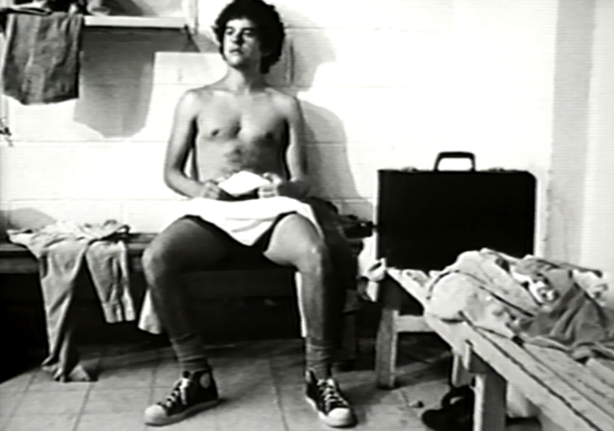
       The very first could be anywhere in the world where handsome young schoolboy jocks run round the track before breaking up into teams, stripping off their shirts and playing football (soccer). All except Danni, an attractive but slightly less athletic kid who bows out of the game by pretending to be sick. He returns to the locker room to sit out the game among their clothes heaped over the benches, as if simply enjoying the same air of the sweat off their shirts and pants. He does not pick up their slacks and sniff them, but there is something odd about the half-naked boy surrounded by piles of male clothing who runs off the minute his schoolmates return to shower and redress.

      His home is a spiffy modern house, with handsome black detailing on the staircase, large wooden desks, and fairly spacious rooms, but there is something odd about the way Guttman’s camera obsesses over those details, and even more oddly the way the mother, who hasn’t been able to move out of her bedroom to even greet her daughter, let alone her returning son, who arrives as his sister stands in the kitchen on a step-ladder to bring down something the cupboards so that she can eat. The boy helps her and the two sit down to the kitchen table while in the background, unknown to them, we see the mother, dressed a night gown, hovering.


     Throughout the film something inexplicably seems to be wrong with her emotionally. It may be that she is simply nervously overwrought since she seems to work as an actor. But we are never certain what is wrong with her, and evidently, as we see through Dani late-night actions, she is regularly taking pills.

       And something also seems strange about Dani. He retreats to his room only to leaf through what appears to be a naturalist picture book with middle-aged women with dropping breasts and overweight men in the nude, a few young ones posing as naturalist musclemen. But his room is posted with photographs of Marilyn Monroe.

       Dani soon escapes—apparently as he does most days since his mother criticizes him for attending too many films—to the local movie theater where that night they are showing Cary Grant and Audrey Hepburn in Stanley Donen 1963 film Charade.

       Dani sits alone, but watching one of his schoolmates kissing and embracing his girlfriend seems to disturb him, perhaps even making him ill since he immediately runs off to the bathroom. At night he can’t sleep, and we see him enter the bathroom to take his mother’s pill box back to his room, although he doesn’t appear to take any of the pills, but may be considering it since we see him replace an entire packet of what appear to be sleeping pills back into the box.


     His mother, once more, seems to be suffering emotional duress, walking about rooms alone, seemingly half in pain, half in complete distraction. Nothing is said about the family’s missing father.

      The next day, on which the mother who successfully undergoes an interview for a new role, becomes an even stranger day for Dani. He skips school entirely, showing up at his sister’s school to call her out of class in an attempt to invite her to join him at the movie show. Clearly, the most emotionally stable member of her family, she refuses, insisting that he has classes to attend.

       Dani spends several hours standing by the seashore watching a couple of nearby tables each with males joined by a female—the one made up of younger cute boys, the other of more mature men—and observing a nearby prostitute staring at her for long moments, she, understandably staring back. Does she have a young customer?

       Meanwhile, a handsome young man (Danni Lachman), also pretending to simply be enjoying the view, cruises Dani, the boy pretending to be oblivious of being watched.

        In the movie theater later we see the young man sitting a few rows behind Dani, and then moving into the same row before finally sitting next to him. The movie, we can hear from its score is The Sound of Music, Robert Wise’s hit film of 1965. It is surely the most unlikely film one could imagine to accompany a gay blow job.


     Dani waits breathlessly for something to happen, but suddenly terrified that it might, runs from the theater.

     In the middle of the night he suddenly awakens his sister as he sits on her bed. His confusion and suffering is made so apparent in the fact that he announces he’d like to talk with her, clearly having no mother or father to speak to, when we know that he cannot express any of the terrors he might be feeling to his grade school sibling.

    When morning comes and his sister does not find Dani waiting in the kitchen and troubled by his remaining in bed, she dares to call her mother down. The mother tries to rouse him, but he will not move. She asks to feel his forehead, but he won’t turn over for her to touch him. He has retreated, suddenly fully realizing his sexual own desires, to the role of a dead man—the role that each of the young filmmakers of the 1940s, 50s, and 60s performed in their films: the sleeping man whose dreams are too dangerous to explain even to himself or, by the end of the film, the man who is crucified, becomes a ghastly mummified face, walks into the lake, or lies down in the cold lawn of a cemetery in the snow to die.


    That night, however, he is back in movie house, Charade once again projected on the screen overhead. Too bad the beautiful boy didn’t show up for Charade instead of The Sound of Music; in the Donen film a wiser if older Cary grant keeps the young woman from jumping into bed with him throughout the film by transforming himself into an entirely different man every 15 or 20 minutes; and when he finally reveals his true self he is who has to be paid—as the representative of the government whose stolen money is what everyone has been truly seeking throughout the film.

       But tonight, alas, the beautiful boy does not show up, yet Dani, clearly having come to terms with his desires, reaches out for him in the dark. Heterosexual love seemingly has nothing to do with it.


Los Angeles, September 13, 2021

Reprinted from World Cinema Review (September 2021

Robert Altman | The Player / 1992

how to get away with murder

by Douglas Messerli


Michael Tolkin (writer, based on his fiction), Robert Altman (director) The Player / 1992


The other morning I watched Robert Altman’s excellent film The Player on a Netflix disk. I had seen the film when it first appeared in April or May in 1992, and I was now amazed by the fact that I could still call up the scenes in my memory so specifically; obviously the film had had a significant impact when I first witnessed it.


     By coincidence—a concept which, given the continual collision of parallel incidents my mind subconsciously and significantly interlinks, I no longer believe—that same evening I “accidentally” chose to watch Alfred Hitchcock’s The Trouble with Harry as our nightly TV fare. Almost immediately, I realized the obvious relationships between the two films: both deal with a murder (or, in Hitchcock’s case an accidental death) that results in good for almost all the characters—in Hitchcock’s case, nearly all the figures of a small local New England community. I have described it as regeneration of sorts (see My Queer Cinema 1950-1959); following the lead of critic Lesley Brill, who argues that in this film “Death passes and life renews without effort or anxiety.” I suggested that by continually burying and unburying the dead man, the entire community is eventually transformed into a world of new-found life and love.

     In recalling this, it struck me that some of that kind of same “regeneration” of life and love occurs in Altman’s Hollywood satire. Before murdering screenwriter David Kahane (Vincent D’Onofrio), in a furry of anger for being stalked and having his own life threatened, movie studio executive Griffin Mill (Tim Robbins)—a company guardian (half lion and half eagle, both logos for major studios) of the filmmaking “mill”—is suffering from a career that is on the skids. Mill, who serves the studio as the selector of 12 scripts annually from over 50,000 submissions, according to the rumor mill, is about to be replaced by former story executive Larry Levy (Peter Gallagher), a mindless hack who—like many a studio executive before him—argues that good stories can be obtained free through newspaper articles, which obviate the need for screenwriters. As Mill snaps back, why not get rid of actors and directors as well?

     Mill’s tepid love affair with his story editor, Bonnie Sherow (Cynthia Stevenson) is also near an end, despite her love and near-adulation of the slick “ass-whole” (as Bert Reynolds describes Mill, in an apparently ad-libbed remark).


     Even more troubling for Mill, however, is the postcards relaying threats upon his life he daily receives, some even without a postmark. Obviously, he has offended a would-be script-writer, but, given the vast number of well-meaning if self-deluded individuals he has abused—in true studio form, encouraged and ignored in the repeated phrase “I’ll get back to you”—who is the potential murderer? Leafing back into imaginary period of time in his daily schedule, he comes to the conclusion that it must be Kahane, and, looking up the man’s address, adventures out to Pasadena to confront him.

     After discovering that the would-be-writer is attending a showing of The Bicycle Thief (a film about the terrible effects of a thief upon a simple working-man who depends on his bicycle for his livelihood), Mill pretends to run into the writer with the intention of offering him another chance, in hopes that the threats will be ended. After a quick drink in local Japanese bar, Kahane makes it clear that not only is he on to Mill’s game, but that—despite his own desire for Mill’s death—the studio guardian has got the wrong man. After the two encounter each other again on the street, Kahane accidentally pushes Mill into a pool of water, angering Mill, who attacks the writer, pummeling and unintentionally drow


   Just previous to that series of events, Mill, outside the writer’s house, has a cellphone conservation with Kahane’s girlfriend, June Gudmundsdottir (Greta Scacchi), a painter to whom he immediately takes a liking. And despite the anxiety and efforts to remain out of range of police suspicion which Mill inevitably must face (as opposed to Hitchcock’s figures), an intense relationship between the two quickly begins to change his life. Although the death threats continue—culminating in an actual murder attempt in the form of a gift of a live rattlesnake—and Levy’s assault on the studio executive’s job intensifies, after the murder Mill suddenly seems to come alive, finally cutting off (although he takes the coward’s way out) his relationship with Bonnie and besting Levy by hooking him up an improbable script, Habeas Corpus (the story of which is revealed in a hilarious send-up of a film pitch by actors Richard E. Grant and Dean Stockwell).

     Although Kahane has previously described his girlfriend as the “ice queen,” Mill quickly melts her in a desert spa, as the two combine underwater sex with a far more shocking attempt at confession by the man who previously would admit nothing. Mill’s sudden quick-thinking and just plain luck (a would-be witness to the murder mistakenly choses the cop, played by Lyle Lovett, in a line-up), result, just as suddenly, in a turnaround in his career and in the marriage to and pregnancy of June Gudmundsdottir. She, clearly—given her own hazy view of moral precepts—is the perfect partner for the now redeemed “hero.”


      While Hitchcock’s townsfolk, however, were all true innocents, who feel real guilt for even being tangentially involved in the stranger’s death, Mill, as Altman’s pointed satire makes clear, is far from blameless, and is, in large, part of a system that depends upon the destruction of the lives and careers of individuals—a fact specifically reiterated by the Mill-inspired firing of his former lover, Bonnie by Levy. And while Hitchcock’s witnesses to a murder are saved by their embracement of a presentness that includes both present and past, Mill’s “happy ending” is merely a chronological development over linear time, with no possibilities of actually altering the past because in his world there can be no past. Mill’s world, like the films he makes, is not a thing of reality, but a mimetic pretense, a representation of the real thing that merely gives the illusion of real time or space—the fact of which Altman makes even more apparent through the theatricality of his film, with its overlong, ostentatiously uninterrupted tracking shots, its constant images of and references to cinema history, its garish night-colors (greens, blues, and yellows) and its daytime pastels.

     Just as his would-be killer ultimately rewards Mill with a story that is the very movie we are watching, so too does he truly kill him, by pointing out his role: he is not a real person, but a “player,” one of the cast of actors whom, as Altman so brilliantly reveals throughout his artwork, are just as unreal when they are playing themselves as they are when playing others. The vast cast of cameos roles (Steve Allen, Cher, Harry Belafonte, Robert Carradine, James Coburn, Peter Falk, Teri Garr, Jeff Goldblum, Buck Henry, Anjelica Huston, Malcolm McDowell, Julia Roberts, Nick Nolte, Lily Tomlin, and Bruce Willis among dozens of others) are even less fully-dimensional figures in their appearances in this work than they are in their performances in other films. Despite the titillation they may offer, they remain merely names. Just as Mills as Robbins is a player, so too is his “happy” life a myth (like a griffin) a concoction of the mind. Once “The End” is scrolled across the screen and the screen goes black, the player is dead.

     If that is also true, of course, of every figure in The Trouble with Harry; but the significance of these characters’ lives, I suggest, has the potential, at least, to remain in the mind and effect the viewers’ real-life being. And, in that sense, Harry’s survivors remain stolidly “alive,” despite the fact that we know they, too, are simply imitative figures dancing across the flickers of light we have just witnessed.

     After witnessing Griffin Mill’s life, I suggest, no one but the already dead among us (the future simple-minded studio executives-in-making) would want to emulate his experiences. While I’d gladly travel through time, if I could, to be “ignited” by that Vermont fall skyline. Howard even suggested that he would love to live in that little community for rest of his life.

     No, we won’t move to Vermont! With winter coming on we’ll stay warm in Los Angeles, living out a version of our own happy lives—without, one hopes, the lies involved in making motion pictures, and with the recognition that, mostly, it’s only in the movies that you can get away with murder.


Los Angeles, October 4, 2014, Howard’s birthday

Reprinted from World Cinema Review (October 2014).   

Index R-Z

Angelo Raaijmakers I, Adonis / 2021 Peeter Rabane Firebird / 2021   Tyler Rabinowitz Catalina / 2022 Tyler Rabinowitz See You Soon / 20...