Friday, April 25, 2025

Anne Fontaine | Tapin du soir (Night Hustler) / 1996

complications

by Douglas Messerli


Olivier Rouvièr and Anne Fontaine (scenario and screenplay), Anne Fontaine (director) Tapin du soir (Night Hustler) / 1996


As I’ve mentioned several times, in 1996 French Television showed a series of ten LGBTQ films, each presented on a different evening, by a wide range of international directors titled L’Amour est à réinventer. The 7th episode of the series, Tapin du soir (Night Hustler), a 5-minute short directed by Anne Fontaine, was aired on November 8, 1996.

     This is an extremely simple but lovely and rather disconcerting short film that charms one more in afterthought than upon first viewing.


      Voices begin to be heard even before we see the first image of a rather attractive young man (Franck Demules) walking the night streets of a city. We hear one voice offering a blow job for $40, so we presume immediately that we must be near a popular urban pick-up spot for gay prostitutes. And, accordingly, it is likely that the young man we follow is a hustler as well. When he passes a young black man who asks for a cigarette we discover, however, from questions that the black hustler asks—“You new here?” and “Are you working”—that our assumptions may be wrong. The young “hero” denies he is “working.”

     We see a car pull up and another young boy walk up to its window, presumably to discover the driver’s needs, as our young figure hunkers down on a nearby bench, taking out a cigarette.  Another car pulls up and the young man goes over to the window, the driver calling out “How much for a blow-job?” The young man replies, giving apparently the going rate, “$40.” And he soon joins the driver in the car as they drive off to a quieter location where the older but still handsome man (François Chatriot) hands him the money, the boy, putting a prophylactic on the driver’s cock, sucking him off.

        So it appears the boy is a hustler after all, and he is working the street that night, even if he’s new to it. But something happens once again that alters the way we perceive what we have just witnessed. The boy starts up a conversation, “It’s cold tonight...don’t you think?” 

        The man gruffly agrees and announces he’ll take the boy back to where he picked him up. But the boy asks the unthinkable: “You want to suck me off too?”

        “No, that’s enough,” replies his apparently satisfied customer.

       “I can be gentle, you know,” the boy adds, twisting the conversation into another dimension. Presumably, a true hustler wouldn’t want to cum simply because someone else might hire him later for the same pleasure. Another $40 or even more be made that evening. And “gentleness?” Perhaps for some customers but not for others. It is certainly not a general qualification. Some like it rough.

         His gentleman friend pretends to turn the tables, so to speak. “Really. You’d pay for it?”

         “Yes,” he immediately responds. “That would be funny.” But despite the man’s dismissal (“You’re wasting your time”), he’s serious: “I’ll give your forty dollars back.”

     “I’m not interested. I’ve got to get home.”

     A young boy is determined if nothing else. “I want you to suck me off.  I need it.”

     The gentleman finally realizes that something is strange here. “You’re a funny sort of hustler. Nothing better to do?”


   “I’m not a hustler. I’m lonely.”

   The customer starts up the car and begins to drive off. “Let’s go have a drink.”

  There is something so simply touching and honest about Fontaine’s film. Our young man clearly recognizes that in a transactional world the only way to find love or possible friendship is to pay or have someone else pay for it. And, strangely, his somewhat perverted logic appears to work. But in having a drink with the man, might he not also be perceived as a paid companion? Is any genuine relationship possible in a world in which everything is bought and sold, to be enjoyed for a limited time without any further complications? Our young man, if nothing else, has complicated things, has forced the consumer to pause in his busy schedule to possibly discover a new aspect in his sexually meaningless life. It’s important to note that even as he ejaculates there is little but a mild sense of release expressed upon his otherwise blank face. In expressing his loneliness, the boy has at least reached out to touch something deep in nearly every one of us. Perhaps before the night is out, the man might even manage a smile.


Los Angeles, April 4, 2021

Reprinted from My Queer Cinema blog and World Cinema Review (April 2021).


Merzak Allouache | Dans la décapotable (Burn Rubber) / 1996

youth in a hurry

by Douglas Messerli


Jean-Philippe Clarac and Olivier-Daniel Deloeuil (scenario), Merzak Allouache (director) Dans la décapotable (Burn Rubber) / 1996


When I was a Freshman in high school I played a small role, probably one of the dead souls in the Grover’s Corners cemetery, in Thornton Wilder’s Our Town. I remember the play well, but I recall only small bits and pieces of our rehearsals and our final production. What I do remember is the adolescent tittering of most of the cast members when Mrs. Webb, observing that her son was about to leave the house, was asked by the script to shout out: “George, don’t forget your rubbers!”

      I should imagine I remember their silly giggling because I didn’t quite comprehend why they were laughing. A mother had simply reminded her son that since it might rain that he should wear his galoshes. I never had never owned a pair of galoshes, and I had no idea that a rubber was how most people described a prophylactic, but then I didn’t know either what a prophylactic was and why you should wear one. I was so innocent for so long after that I can now finally admit that even today I never have once actually used a rubber, even during the years before my relationship with my now husband Howard—this despite the fact that for two or three years in the late 1960s I had regular sex with different partners almost every night, and that even after I met Howard I had sex outside our relationship for several years. Like so many young people of the time I lived out my youth in a hurry, unable to conceive that I might need more carefully to protect it. Miraculously, I somehow survived without contacting AIDS.


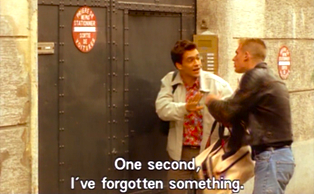
      I repeat this almost forgotten incident because the other night, after watching Dans la décapotable (Burn Rubber), a short film directed by Merzak Allouache as part of the French TV series from 1996, I realized that Mrs. Webb’s long-ago admonishment to her son to not leave to house without rubbers, applies directly to the central character’s situation. The front downstairs buzzer is ringing as a handsome young man, Axel (Julien Lambroschini) is packing up for a trip. It rings again and again as he hurries to pack up his toiletries and the rest of his clothing. Finally frustrated by the endless ringing, he zips up his bag and rushes downstairs to meet his friend Marc (Guillaume Depardieu). Axel suddenly reports that he’s forgotten something, determining to go back, but Marc refuses since, he argues, they have to beat the rush hour traffic.

    Axel is pissed but also irritated as the two begin to drive through Paris, Marc, obviously his boyfriend, attending particularly to every young beautiful woman they encounter along the way. It appears that he is either very flighty in his attentions or is simply attempting to get a rise from Axel, who increasingly grows irritable and disgusted by Marc’s immature actions.

      It quickly becomes apparent that the two are on their way to a weekend or perhaps weeklong retreat, mostly to enjoy one another’s company, and that what Marc has forgotten is his condoms.

      In a series of works mostly dedicated to love in the time of AIDS, hence the title Love Reinvented, Allouache’s work, the last of the 10 films to be aired, picks up the major theme of the sixth episode, Pierre Salvadori’s Un moment.... In this case, however, Axel is far more serious about his responsibility to maintain safe sex than the character in Salvadori’s movie, particularly as it becomes increasingly clear as they make their way across the city that Marc is carefree and rather irresponsible.

     At one point for example, he asks Axel to retrieve a cassette in the glove compartment. When Axel does so, he discovers a number of rubbers stuffed into the plastic case, and for a second seems relieved, but the very next moment Marc, taking the cassette in hand, declares, “oh I must have left these there when I bought the car three years ago,” and tosses the plastic case out the window.

      Axel is furious, demanding his friend stop the car, even though they are now on the freeway, determined to get out to recover the discarded item. But Marc insists it’s impossible and dangerous to stop of the freeway. “What do you think I’m crazy?” he asks, pulling down the visor to display a large set of condoms attached.

      So this one-liner film ends, Marc not having forgotten his rubbers. The two kiss as the car speeds up, the lovers headed to a wonderful weekend of sexual bliss.


Los Angeles, April 20, 2021

Reprinted from My Queer Cinema blog and World Cinema Review (April 2021).


Pierre Salvadori | Un moment... (A Moment) / 1996

what isn’t said, what isn’t done

by Douglas Messerli


Didier Seynave (scenario), Pierre Salvadori (adaptation and director) Un moment... (A Moment) / 1996

A man (Stéphane Höhn) again runs into a young lovely looking boy on his staircase, and this time he cannot resist the boy’s evident flirtation as he moves up to where Ludovic is now standing on the landing—“He’s gorgeous. I kept running into him. It was high time we spoke”—as he embraces him, the two engaging in deep kisses. The boy unlocks the door to his apartment, inviting in the man who we never see throughout this 7-minute film, into the room. The kid enters his bedroom, strips off his shirt and invites the man in to join him on his bed


     In the meantime, the man has searched his carrying bag, unable to find any rubbers, realizing in a voiceover of his thoughts that he cannot have sex. The boy, he observes from running shorts and other articles tossed to the floor, is obviously “into sports.”

     When the boy appears, half naked in the doorway, he perceives that the Ludovic (Adrien de Van Adrien) “is too young to have it.” At the same moment we realize that this entire film is about what isn’t said and what doesn’t happen, not what is inevitable, as the man, completely caught up in the lust of the moment, deludes himself by repeating almost as a mantra “I’ve gotta to stop. I better stop!” before he continues with a meaningless postponement—just a bit more, a bit more and then we’ll go to sleep.

     It is in those few “more moments” that the two grasp each other to intensely kiss, continuing, when the boy rolls over, with the man fucking him. There are a few silent seconds after the intense huffing and panting of the act, as we see the beautiful Ludovic laying on his side to face his momentary lover.

     It is clear that he sees something in the eyes of the observer: “Why are you staring at me? What is it?”


     “You fuck often without a rubber?”

     “Sometimes yeah...it depends. ...How about you?”

     “Not very often.”

     “But this time, right?”

     “Sure.”

     “All right. But...what?”

     There is no answer, and the boy turns away from the man who may be the cause of his death.

     Of the ten short films centering around issues of AIDS commissioned by French television, this film by Pierre Salvadori, aired as episode number 8 on December 9, 1996, perhaps best captures the angst of the continued AIDS crisis, which still exists today even if we pretend it no longer matters since we have a series of potent drugs to extend the life of those infected. Approximately 690,000 people died throughout the world of HIV-related infections in 2019.


Los Angeles, April 11, 2021

Reprinted from My Queer Cinema blog and World Cinema Review (April 2021).


Françoise Decaux-Thomelet | Enceinte ou lesbienne? (Pregnant or Lesbian) / 1996

guess

by Douglas Messerli


Françoise Decaux-Thomelet (screenwriter, based on a scenario by Pierre Guiho) Françoise Decaux-Thomelet (director) Enceinte ou lesbienne? (Pregnant or Lesbian) / 1996


Françoise Decaux-Thomelet’s five-minute film, Pregnant or Lesbian, shown as part of the 10 short film series Love Reinvented on French television in 1996, is a theatrical comic vision of a lesbian’s coming out to her parents.

     There have been a substantial number of such films, most recently the 2020 Hulu Christmas special broadcast The Happiest Season, directed by Clea DuVall, in which such an announcement results in a series of complications. But the Girl (Bérénice Bejoas) in this film appears to have few qualms about announcing the news to her folks, perhaps because she puts it in the form of a question, almost challenging them to express which is truly preferable.


      As the curtain opens, the suburban couple in Decaux-Thomelet’s little opéra-bouffe is apparently still very much in love as the Father (Gérard Touratieras) and Mother (Marina Toméas) are found joyfully singing to one another as she prepares fried eggs, he rubbing her ass before she turns, her husband kissing her above the breast. Their lovely teenage daughter, entering, wonders whether or not they might “do without the cracklings at breakfast?” Somewhat disappointed, they stop their stove-side love-making, each demanding a kiss from their daughter, as her mother whispers in her ear, “Antoine called.” “Sophie, too,” adds the father.

      The eggs are served up, as the girl plops a pill into her water glass and drinks it, a tennis match evidently being broadcast in the background. As a cuckoo-clock door opens, revealing a white plastic bird with green wings, the daughter turns to the two suddenly appearing to be several month’s pregnant. The parents stare at her in startlement, as she asks: “Pregnant or lesbian?” (“Enceinte ou lesbienne?”). The mother quickly stands, moves over to her child, and slaps her. The father switches off the TV set.


     The mother, sitting down again, turns to her husband flashing a brief smile before asking her daughter is she truly pregnant? “No. Lesbian.” the girl emphatically answers. She pulls out the pillow and tosses it to them.

       The father stares into his wife’s face intensely whispering: “It’s your fault. You never put your foot down. See where it leads?”

        The mother hisses back: “You always wanted a boy. You set a bad example! She’s afraid of men.”

      Both have been tightly holding on to the pillow from opposite ends, which the mother in anger finally pulls from his grasp. He suddenly smiles, as the two quickly make up by bringing their ringed hands together in sympathy, apparently, for the situation. They smile at one another, before the mother turns to the observing daughter reporting, “Honey, you’re a love child.” Clearly, she’s admitting that at her daughter’s age she chose the “pregnant” option, or perhaps, it made the decision for her.

      The girl smiles and sits down with them, her mother leaning over to say, “We’ll find a solution.” “But I’m not sick,” her daughter reacts.

       “Is it recent?” the mother asks.

       “Always,”

       “Is it Sophie?” Her daughter smiles in delight of the thought.

       “I was looking forward to grandchildren.”

       “But you may still have them. I’m a lesbian,” the girl answers as if clarify that one’s sexual identity and baby-making are not the same thing and do not necessarily contradict one another.

       “And that’s it,” the teen concludes with a giggle, the little red curtain closing again.

        This is a true bon-bon of a work, sweet but not terribly profound. And what it has to do with AIDS, which was evidently the overall theme of these commissioned films, is lost on me. Perhaps since she is a lesbian she has less chance of acquiring the disease than a heterosexual.

         We get another perspective of this issue, however, in François Dupeyron’s Et Alors? (So What?) in the same collation of films.


Los Angeles, April 9, 2021

Reprinted from My Queer Cinema blog and World Cinema Review (April 2021).

Saturday, April 19, 2025

Xavier Dolan | Tom à la ferme (Tom at the Farm) / 2013

i’m so tired of america

by Douglas Messerli


Xavier Dolan and Michel Marc Bouchard (screenplay, based on the play by Bouchard), Xavier Dolan (director) Tom à la ferme (Tom at the Farm) / 2013


This truly wonderful film is nearly impossible to watch if you are gay and have any empathy for others. I suffered through the film with tears.

      Tom Podowski (powerfully performed by director Dolan himself), a Canadian, has lost his lover Guillaume, and returns back to the farm where his body has been taken. This is somewhat reminiscent of A Single Man, where the former gay lover is not invited or wanted at the funeral of the man he has loved and lived with for years; except in this case the dead boy’s mother Agathe Longchamp (Lise Roy) has had no idea that her son was gay. Tom’s sudden appearance, however, immediately arouses the homophobic hate of the dead boy’s brother Francis (Pierre-Yves Cardinal), who quickly recognizes that this is his dead brother’s lover who intends to deliver a eulogy which might reveal his own love and bereavement for his former lover.


     Francis violently threatens Tom against delivering any expression of love so that he might protect his mother, who quite blindly believes her dead son was in love with a woman, who she is surprised she has not attended the funeral. And Tom gives in, refusing to deliver the eulogy with a lame excuse that he was dissatisfied with the quality of his writing. He is ready to leave, but is again forced by Francis to stay on the farm for a few days just to satisfy his mother Agathe, who he also admits is becoming somewhat dotty and will, as soon as he can, send off to a nursing home.

      What follows is a true psychological horror film, wherein Tom is suddenly confined to the farm, while also recognizing that the handsome farmer Francis, despite his homophobia, is attracted to him.

      One might describe Tom as rather naïve, and he engages in a frightful game of attempting to become part of the Longchamp family, Agathe so happy he has decided to stay on, and joyful in his presence. Tom, in fact, is trapped into remaining, helping in the birth of a new calve, milking and mucking up the place, and in the process actually discovering it a kind of source to become closer to his former lover.

      He eventually reads his eulogy to Agathe, pretending it is from the female lover of Guillaume, Sarah (Evelyne Brochu), although it is his love poem to her son. But the mother is delighted that at least the missing girlfriend has written.


    And there is a moment when Francis actually dances a tango with Tom when you think he might admit that he truly desires his brother’s lover. And we come to realize that, in fact, Francis was in love with his younger brother. Even Agathe comments that seeing the two men in the bedroom together she has reimagined the days of her son’s sharing a room, a joy to her, perhaps a terror of memories for the now homophobic Francis.

      But gradually, particularly when Tom invites a friend to impersonate Sarah, and arrives to explain why she wasn’t at the funeral, the real horror story begins to unweave. The friend actually confesses to him that she too has had sex with his former lover Guillaume, as had many others. And she is only too ready to make have sex with Francis, the couple ordering Tom out of the car.

      In a local bar into which he retreats, he asks the barman (Manuel Tadros) why Francis is not allowed into the bar and is told the horrible story from years before when a young man had told Francis that his brother was queer. Apparently he tore is mouth apart, the man surviving after surgery now working in a nearby city.

       After having now completely destroyed Tom’s car by removing its wheels and hoisting it up into a farm garage, Tom finally determines to escape, rushing as before he did through the sharp cornfields, this time into a woods, chased down by Francis, determined to destroy him for his attempt to express the truth of his life. But Tom runs back to the road, steals Francis’ car and drives off. As he stops by a gas station he spots a young man scarred on both sides of his mouth just as the barman described the brutal Francis’ actions.

      The final song, as Tom returns to Montreal, reveals another terribly brutal truth, particularly in these Trump days, that, in fact, the farm Tom has visited is in the USA, as we see Francis dressed in a USA coat, with the movie ends with Rufus Wainwright’s plaintive lyrics, “Going to a Town”:


I'm going to a town that has already been burnt down

I'm going to a place that has already been disgraced

I'm gonna see some folks who have already been let down

I'm so tired of America


I'm gonna make it up for all of The Sunday Times

I'm gonna make it up for all of the nursery rhymes

They never really seem to want to tell the truth

I'm so tired of you, America


Making my own way home

Ain't gonna be alone

I've got a life to lead, America

I've got a life to lead.


Tell me, do you really think you go to hell for having loved

Tell me, enough of thinking everything that you've done is good

I really need to know, after soaking the body of Jesus Christ in blood

I'm so tired of America.


    Today, many of us feel like Tom, ready to escape the dark lies of US living impossible to assimilate.


Los Angeles, April 19, 2025

Reprinted from My Queer Cinema blog (April 2025).

Friday, April 18, 2025

David Peter Bonetti and Eilidh Gow | Stum (Tongue-Tied) / 2018

the short goodbye

by Douglas Messerli


David Peter Bonetti and Eilidh Gow (screenwriters and directors) Stum (Tongue-Tied) / 2018 [9 minutes]


In this Norwegian film, the students are attending an international school in Stavanger, a small city in the southwest of Norway where I have actually been. It’s a simple, and often told tale that is nonetheless quite powerful in this obviously student film.


     Sondre (Tom Dart), an English boy, and Elias (Lars Kristian Gellein) are school-boy lovers, although Sondre is not yet fully able to assimilate himself as being a young gay man. Elias is more than sympathetic and attempts to comfort him, but also has some bad news. He’s been awarded an internship in London, and announces to Sondre that he will soon be leaving.

      Despite his not yet fully “out’ situation, Sondre is devastated. Yet Elias messages him that they should meet on the beach before he leaves, and Sondre—despite awakening far too late in the morning—rushes off the meet up with his would-be lover. The two spend a few moments of joy on the beach, and clearly Sondre begins to come to terms with his sexual identity.

       Perhaps the relationship won’t completely end. We at least are provided a hope that there is a future possibility in this quick short.


Los Angeles, April 18, 2025

Reprinted from My Queer Cinema blog (2025).

Xavier Dolan | J'ai tué ma mère (I Killed My Mother) / 2009

a whiny winding road

by Douglas Messerli


Xavier Dolan (screenwriter and director) J'ai tué ma mère (I Killed My Mother) / 2009


Xavier Dolan’s semi-autobiographical film, I Killed My Mother—written by him at the age of 16, and which he directed and self-produced at 19 or 20 (the reports vary) with himself starring in the central role of Hubert Minnel—is a film you desperately want to like.


    Since the film won awards at the Cannes Film Festival, the best Canadian film of the Vancouver Film Critics Circle, and numerous other awards, including one for his script, apparently a great many audiences and critics have done just that, not only “liked” the film, but loved it, the audience at Cannes’ Directors’ Fortnight awards giving it a standing ovation of 8 minutes. As Film Comment critic Genevieve Yue wrote: the film “demonstrates the kind of phenomenal precociousness that publicists adore.”

     Moreover, there is much to commend about the cinematography, accomplished by Stéphanie Weber Biron and Nicolas Canniccioni, but carefully overseen and, at moments, edited by Dolan—particularly the scene wherein he and his gay lover, Antonin Rimbaud (François Arnaud) drip-paint Antonin’s mother’s office with the two, at the end, falling into a sexual release after their highly physical Jackson Pollack-like artistic expressions. If the messy result of their arty attempts doesn’t live-up to their apparent mentor, the painting process clearly has represented a great deal of loving fun.

     The New York Times critic Rachel Saltz writes of Dolan’s visual tactics:


 “As a director, Mr. Dolan has a freewheeling style, and he’s self-dramatizing enough to want to call attention to it without being too much of a visual show-off. He likes extreme compositions—pushing characters to the side of the frame, or to the bottom—and he makes use of slow motion (and fast motion) and those black-and-white sequences of Hubert confiding to a video camera as if it were a diary (a diary whose moody visuals might seem a bit Gap ad-ish in another context). His second movie, the swoony charmer Heartbeats, takes its style even more seriously, both in its allusive execution—he draws giddily from things like the Nouvelle Vague and Wong Kar-wai—and its subject: self-fashioning and teasing, unfulfilled desire.”


     Finally, as the churlish young hero of his tale, Dolan is a cute curly mop haired young man in the manner of Timothée Chalamet (but with hair trimmed a bit shorter) who is so attractive that it’s hard to wish anything he might turn his hand to—and, in particular, something so closely linked to her own persona—might in any way be disliked.

     Nonetheless, for me the charm quickly wore away when I began thinking of the film I had just seen. The film is centered, first of all, on the hero’s relationship with his mother, an inexplicably hostile one that, after a while, simply doesn’t make sense. Obviously, as most young people in their last years of high school feel, parents are hopeless in their restrictive viewpoints and, often, just in the way their kids perceive almost all adults as being culturally out of touch. Those tensions were most definitely played out in my own high school parental relationships.

      Hubert, however, absurdly exaggerates those feelings regarding his mother, Chantale Lemming—presumably, Lemming being her maiden name to which she has returned after her husband, Hubert’s father and she divorced. Chantale (a wonderful Anne Dorval, who reminds me a great deal of the young Shirley MacLaine) is obviously bourgeois, their home (apparently filmed in Dolan’s real familial domicile) filled with bric-a-brac, while her life, when she isn’t busy working to support herself and Hubert, is consumed by trips with her friend on shopping excursions (during which she purchases clothing that is in outrageously bad taste) and to a local beauty shop to get “a complete redo”—in the latter of which she runs into Antonin’s far more hip mother (Patricia Tulasne) who accidentally reveals to Chantale that her son and Hubert have for some time been involved in a gay relationship.


      Chantale seemingly has little difficulty in dealing with her son’s sexuality, but is deeply hurt that he has not dared to tell her. But, in fact, that is Hubert’s problem throughout this work, outwardly dismissing his mother for nearly everything, from her daily eating habits to the way she applies makeup in the car while driving him to school each morning. And after a while, the constant disapproval of her son turns into one long whine that dominates what are the more serious issues which the work later attempts to explore: his sexual awkwardness and his frustration for not being able to recover the joyfully beautiful mother he recalls from his childhood.

      Even if we chalk up Hubert’s constant discomfort with his mother as part of what the character’s authorial voice is also mocking, it’s somewhat difficult to separate the two. And particularly, when most of the glimpses we have of Hubert is lying in bed with his lover while they smoke joints, we can only wonder at the sense of superiority this endless complainer seems to hint at. No, he does not go so far as to actually “kill” his mother, but spiritually he does, taping self-interviews as if being drilled by an unseen psychologist in which he memorializes his feelings: “Deep down I love her, but it’s not the love of a son.” Indeed, when assigned by a teacher to write about his parents, Hubert takes her aside to reveal that since he was a child he has seen his father only at holidays and that his mother has died, virtually assigning her to a coffin.

      Naturally outranged when Chantale discovers from her son’s teacher what he has done, the battle between the two switches from his simple whining to an outright war. He determines to get an apartment of his own, to which she at first agrees but almost immediately after refuses to permit, insisting that he is simply too young. For a couple of days, pretending to be staying with his friend Antonin, he sleeps on his teacher’s couch.

    An invitation by Hubert’s father for dinner further confuses the boy until both his parents, after conferring with each other, report they now intend to send him to a Catholic boarding school in another town, perhaps the only apparent example of bad parenting we have seen in this film to date.

      Now torn from his lover as well as from the routine of his previous school, Hubert discovers that even this stricter school, as Antonin has predicted, has plenty of gay and lesbian students, and temporarily he has a fling with a classmate named Éric (Niels Schneider), who invites him to join him at a night spot with other students where they openly kiss and take Speed.

       In his heighted focus of perception, Hubert suddenly regrets having betrayed Antonin and escapes his new school via the Metro to return home, talking endlessly—which is what one does on Speed—while poignantly admitting to his mother “I love you. I’m telling you so you won’t forget.” We know it will be a short-lived sensation.


      The next morning she drives him to Antonin’s home and they spend the morning painting the office, as described above, ending up in sex—the first time this movie has actually portrayed the boys’ love-making, a nice relief from the melodrama of the rest of the film.

      Back in his boarding school Hubert is attacked that evening by two of the school bullies. Confused, and feeling he has now completely lost touch with his past, Hubert disappears.

     Chantelle—receiving a telephone call at her office from the school principal about Hubert’s escape—quickly discerning that the administration is more worried about the irregularity of her son’s behavior than actually worrying about his well-being—suddenly spews out a torrent of anger which we recognize she has long been holding within, particularly after the administrator suggests that, as a single parent, she may be unfit.

   Her rage boils over as she catalogues the thousands of sacrifices she has made for the sake of her son, the hours she’s worked, the abuse she’s accepted in silence, and most importantly, the pride and admiration she still feels for her child, cutting off any further possible connections with a world she realizes will only attempt to replicate the sense of male privilege and exceptionalism the principal himself exudes. It is as if she has only now come to realize that the most remarkable thing is that she and her son have together come to be so extraordinary in their odd (we might say queer) differences.


     Leaving her a clue to his whereabouts—Hubert has left a note stating that he can be found “In his kingdom”—she rushes to her former husband’s country cabin, the location of both her and Hubert’s joy during his childhood.

      There, for the first time, she meets the legendary Antonin, acknowledging his love for her son, before the film, in a kind of breakdown into sentimental nostalgia infused with a yellow-colored lens, attempts to recover for the viewer her and Hubert’s loving past, the picture closing with a movie clip of Hubert the child playing by beach with his doting mother.

      I can forgive Dolan’s Hallmark Card tribute to the much maligned and symbolically buried mother, but am a bit impatient by the whiny winding road it took to get there. Even Antonin describes the man he loves as being more than a little selfish. Does it really take an old-fashioned homophobic bashing to knock some sense into this boy genius’ head?


Los Angeles, September 20, 2020

Reprinted from World Cinema Review and My Queer Cinema blog (September 2020).

Index R-Z

Angelo Raaijmakers I, Adonis / 2021 Peeter Rabane Firebird / 2021   Tyler Rabinowitz Catalina / 2022 Tyler Rabinowitz See You Soon / 20...