Sunday, June 1, 2025

John Waters | Serial Mom / 1994


THE PERFECT HOUSEWIFE


John Waters (screenwriter and director) Serial Mom / 1994


This black satirical comedy is, in some respects also a true horror film in the sense that this every day, perfect mom, Beverly Sutphin (Kathleen Turner) surrounded by her already somewhat maladjusted family Misty (Ricki Lake), Chip (Matthew Lillard), and her husband dentist Eugene (Sam Waterston), is on the verge of the perfection of Towson, Maryland suburban life, but on the side functions as a serial killer, knocking off the people who get under her skin. The first of these, after a series of pornographic calls and notes to neighbor Dottie Hinkle (Mink Stole), is the high school math teacher Mr. Stubbins, after he condemns Chip's obsession with horror films at a PTA meeting.


     Through a complete sense of guilelessness and duplicity, Beverly not only keeps the detectives Pike (Scott Wesley Morgan) and Gracey (Walt MacPherson), somewhat off her trail, but upon discovering that the young Carl, supposedly her daughter Misty’s boyfriend, is also dating a blond bimbo, kills him off in the men’s room with a fire poker just purchased by her neighbor.

     Eugene himself becomes so curious about the complex behavior of his wife that he investigates her nightly reading material, supposedly about birds, only to discover that Beverly had been communicating directly with the serial killer of the late 1970s, Ted Bundy.

      In the midst of one meal, Beverly simply leaves, leading the family to suspect that she is out to get Chip’s friend Scotty, who has mentioned to his friends that he finds Beverly a suspicious figure.

     In fact, it is his parents Ralph and Betty Sterner, she is after, mostly because of Ralph’s insistence for a dental appointment with Eugene on the morning she and her husband were to have gone bird-watching.

     She chooses a scissors to kill Betty and pushes an air conditioner upon the head of Ralph when he has presumed he has escaped.

     The other family members rushes to the constantly masturbating Scotty to find him midst arousal, but safe nonetheless. 

     Police follow the Sutphins to church that Sunday as Beverly is named as the prime suspect in the Sterners' murders. The service abruptly ends when everyone flees in panic after Beverly sneezes; in the confusion, Beverly escapes as police attempt to arrest her, she hiding in the video store in which Chip in employed.

     When a customer, who has refused to rewind a tape, refuses to pay the dollar fee and berates Beverly’s son, Beverly follows and fatally hits her over the head with a leg of lamb (a reference to a famous Alfred Hitchcock Presents episode).


     Scotty witnesses the act, a bit unbelievably, and Beverly is on the chase again, following him into a heavy metal bar featuring a lesbian trio. Eventually she joins him on the stage where she immolates him.

     Re-arrested, we have now entered director’s Waters canny realization the such horrific deeds lead not to shunning but to celebrity.

      No one in this film behaves as if those citizens killed meant anything (for the most part they are also despicable people), and her son and daughter are not involved in selling memorabilia, and other objects, as the crowd files into the October courthouse.


      The lawyer plans to plead insanity, but Beverly quickly fires him and defends herself, with her guiles and lies—with which through the film she has revealed—convincing the jury members that she is utterly innocent.


      A movie starring Suzanne Somers is already in her plans, and Somers appears as another distraction to any truth. Yet all this while, Beverly has been furious over the fact that one jury member, #8 (Patty Hearst) is wearing white shoes after labor day, and while she uncomfortably poses with Somers, she sneaks off to do in the juror. The juror’s body is uncovered in the midst of photographs, and Beverly, who seems uncomfortable with Somers, gives her a knowing link: perhaps she is next. Yet it is also hinted that Beverly is back in police custody.  


Los Angeles, June 1, 2025

Reprinted from My Queer blog (June 2025).

John Farrow | The Big Clock / 1946

the big clock

by Douglas Messerli


Jonathan Latimer (screenplay based on Kenneth Fearing’s fiction The Big Clock), John Farrow (director) / 1946


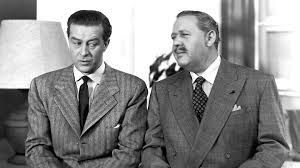
The Big Clock is another of the wonderful noirs which appear to be all about the heterosexual affairs of its lead villain, but is actually about hidden attractions to his staff members and others of his magazine Crimeways.


       The lead actor, in this case, is George Stroud, happily married and with a young son, but with some home problems since he has never been given time for a honeymoon, which his wife wants to celebrate in West Virginia. Stroud had finally purchased the tickets and the date set, except that his series is going hot, and the company owner, villain Earl Janoth is not about to lose his greatest writer to a honeymoon. Ultimately he fires Stroud, who finally accepts the situation. All would still be well if it were not for the fact that Janoth’s mistress is determined to enter into the situation, get Stroud drunk and then quickly ditch him as Janoth returns. Janoth sees a man leave, but doesn’t recognize him in the dark light.  


     Now attempting to make it up with his wife who has already bolted to Wheeling, Stroud is again forced to call off the honeymoon when Janoth calls him up to use his team of writers as researchers to discover what will be an innocent man. Knowing that he is the real “criminal,” George has no choice but return to work to help in saving an innocent.

        The night with Janoth’s mistress Pauline York has involved several bars, searches for a green clock, and an eccentric painter, Elsa Lancaster. Stroud must pretend to appear to lead the investigation diligently while preventing the truth to come out and reveal him as the culprit (although he himself is innocent as well). soon after, however, he discovers himself in a further dilemma and he uncovers the fact that Janoth’s mistress has been murdered.

        As Janoth’s goons and the local police force close down the large headquarters containing a big clock in its midst, Stroud is forced up into the fine workings of the clock where one of the suspects, Janoth’s masseur (Henry Morgan), attempts to check him out. Stroud is forced to kill him and also arranges for the elevator to be open without any insides.

         Eventually, Stroud, and a false cop, gets another Janoth favorite, Steve Hagen (George Macready) to almost admit to the crime, but when the real murderer Janoth says they will get him the best lawyer possible, Hagen refuses to further serve as Janoth’s cover Janoth runs for the open elevator to his death.

      By this time Stroud’s wife (Maureen O’Sullivan) has returned to become involved and the honeymoon is restored by film’s end.


         Not only is it quite apparent that Janoth is truly committed to his men, not Pauline York; but it becomes apparent that she is a mere trophy who has gotten in his way. Janoth incidentally is performed by the great gay actor and director Charles Laughton.


Los Angeles, May 30, 2025

Reprinted from My Queer Cinema blog and World Cinema Review (May 2025).

Joseph Mawra | Chained Girls / 1965


trash talk

by Douglas Messerli


Joseph Mawra (screenplay and director), Chained Girls / 1965


Melissa Sky, writing in Bright Lights Film Journal captures the tone of Joseph Mawra’s unenlightened lesbian pulp from of 1965, Chained Girls: “Lesbians have their variations from one group to another. There are those women who are cultured and refined who sneak away to some dirty bar in order to find a trampish-looking woman to make love to. Some women break up homes, forsake children for the love of another woman. Then there are the teenage lesbian or baby butch. They roam the big city streets in large gangs assaulting everyone who falls within their path. Some of the weapons they use run the gamut of fists, lead pipes, chains. Many of these girls eventually end up as drug addicts, alcoholics, and prostitutes . . . Regardless of what the lesbian does or where she goes, her life is a very difficult one. She, like her male counterpart, leads a very lonely and despairing life.”


      Sky finds much of this amusing, but the misogynist babble about how the queer world, in this case lesbianism, is a terribly sick one in which dykes run wild and brutal over their meeker femme lovers, its statements, which increase as time passes, about their need for a cure, and their general misinformed mockery of lesbian and gay sexuality strikes too close to home for someone like me, born in 1947.

     Sky makes clear how Mawra got away with this mumble-jumble at a fairly innovative juncture in the presentation of queer sexuality: “One of the ways authors and filmmakers of this conservative era avoided obscenity charges when dealing with homosexual subject matter was to couch their exploration of sexual deviance in scientific terms. Chained Girls writer-director Joseph Mawra uses this tactic, creating a film that is part pseudo-documentary and part pure pornography. Hence quotes from Freud and serious statistics compiled from medical journals are liberally interspersed with gratuitous shots of topless women rolling around on top of each other. The film’s stated purpose is to define the lesbian for the general public, for both “preventative education” (“Only through understanding the facts can we keep lesbianism from becoming a serious social problem”), and, more to the point, sheer titillation. Chained Girls begins by asking in an authoritative male voiceover, ‘Who and what is a lesbian? Is lesbianism a disease or a natural occurrence? Is lesbianism reserved for only a few people, or is it a common happening? How do lesbians live? Are they happy with their lives?’”

      At one point quoting the high suicide rate of lesbians—likely caused by such attitudes that he espouses—one wants to cry out for the outrageous lies he is telling us.


Los Angeles, May 30, 2025

Reprinted from My Queer Film (May 2025).

Monday, April 28, 2025

Narciso Nadal Santos Jr. | 14 Days / 2021

the long lens of the periscope of loving

by Douglas Messerli


Narciso Nadal Santos Jr. (screenwriter and director) 14 Days / 2021 [25 minutes]


The truly lovely Filippino film, directed by Narciso Santos, is about the lockdowns that occurred in the Philippines by the harsh, almost dictatorship of Rodrigo Duterte in 2020. The young tour guide and law student Arvin Ballageo (Shane Saweg) is quarantined for 14 days because one of his tourist visitors has evidently come down with COVID-19, and the young police trainee Elijah (Io Balanon) is sent to check up on him each day, checking his temperature and his basic condition.


   But we quickly realize that there is something more going on between them. Although they cannot interconnect, Arvin suggests Elijah sit outside his window to enjoy the coffee he brewed and the cheese bars he makes.

    Over the period of the 14 days, the two not only establish a true relationship, but Elijah brings him fresh vegetables, including three bulbs of cauliflower which he cooks up. Over just a period of a few days, the relationship becomes so intense that the two can longer bear their separation and join each other in a gratifying experience of sex.

    Arvin never becomes ill, yet still Elijhah retains the distance, finally having been promoted to the position of a policemen, which he has been seeking. And by the film’s end, despite their enjoyment of each other’s company, one realizes that the relationship can no further given Elijah’s new position, which demands responsibilities which cannot permit him such gay relationships.

     This is a film about love separated from what each most desires, the frustration of outside demands, particularly given the Duterte regime, and the political differences of their political views, that cannot go into the territory that they both so desire.

     They spend what appears to their last day together, sitting side by side, but now not even able to hold one another or kiss. The disease has reached into their lives and pulled them apart.


     Santos’ film is true tearjerker, in which we realize there is no longer any room for tears. These two lovers are doomed by so many circumstances that a true rapport is no longer possible: disease, class differences, political views, and simply the different directions which their lives are headed in the beautiful city of Baugio make it impossible for a true reconciliation. It is as if the distance they have so long had to keep because of COVID-19 in a condition for life, keeping two young men who truly love one another at the long lens of the periscope of loving.


Los Angeles, April 28, 2025

Reprinted from My Queer Cinema blog (April 2025).


Shaun Kitchener | Toothbrush / 2024

return to where he belongs

by Douglas Messerli


Shaun Kitchener (screenwriter and director) Toothbrush / 2024 [11 minutes]


Liam (Jack Armstrong) is about to be married to his girlfriend in a week and is celebrating his stag party in a local pub. But we also recognize that something is amiss, particularly when he shows up at the door of his long-ago gay partner Will (Alexander Mushore).


     He claims to have lost his wallet, keys, and cell-phone and had nowhere else to turn. What he doesn’t know is that Will has another sexual partner in his bed, Sam (Oliver Lintott), and that he is about to host his mother the very next morning.

     In a quick discussion between the two, Liam realizes that Will has broken with his boyfriend George, to whom he had been rather rude, feeling he was not up to Will’s qualities, telling him he was a “5” relative to Will beings a “10” to his face.


    In a rather stand-offish way, Will still offers him the couch, although he questions Liam’s reasons for the visit. (We later observe all objects laid beside the bed). He even suggests that he still has Liam’s old Toothbrush in his bathroom.

     In fact, Liam has suddenly come to his senses about his marriage, and once Sam leaves, both men come to realize that they still love one another and are ready to again engage in sex.

     British director Kitchener’s film is one of the few films where the gay boy suddenly comes to terms with his homosexuality just before making the tragic mistake of marrying himself into a situation that can only cause harm to both husband and wife, and possibly even children. 


   Liam’s true love is Will, and they will have to attempt to restore what has obviously been a previously contentious relationship given Liam’s clear inability to accept himself as a gay man.

   In a sense, this is kind of coming out movie, with the gay man finally admitting that he should not attempt to become an unhappy heterosexual husband. He has returned too where he truly belongs, the arms of his former lover.


Los Angeles, April 28, 2025

Reprinted from My Queer Cinema blog (April 2025).

Sunday, April 27, 2025

Thierry Malandain | L'Après-midi d'un faune (Afternoon of a Faun) / 1995

the faun atop a kleenex box

by Douglas Messerli


Thierry Malandain (choreography and performance) L'Après-midi d'un faune (Afternoon of a Faun) / 1995


Thierry Malandain’s version of The Afternoon of a Faun takes the famous ballet further into pure homoerotic and male homosexual directions. If in Vaslav Nijinsky’s original it was the nymphs with whom the faun was enchanted, in this case there are no classic dancers imitating the figures of Greek urns. The dancer Malandain appears only in his dance belt, otherwise nude, and no women are allowed into his imaginary world except as big bubbles of plastic.


    His is a pure male dance, displaying as much as his body as the theater of the day allowed. This work is totally symbolic, for when he reaches for the veil dropped my one of the visiting nymphs left behind, it is simply out of the Kleenex box upon which he apparently resides. The fetish becomes even more obvious as he lays down to have sex with the garment, actually being consumed by the Kleenex box itself.

     This takes the women out of the picture and centers our vision only on the male dancer, which Nureyev almost achieved but because of his attempt to recreate Nijinsky’s version could not be eliminated, although they become even in that version ephemeral illusions. In Malandain’s version they are missing, and we must comprehend his almost nude representation of the dance as an excitement to homoerotic desire.

     Malandain himself describes it:


"A faun is lying on a rock when nymphs appear. He observes them, then approaches. Frightened, they run away, except for one. But when he tries to grab her, she moves away, dropping a veil at her feet. The faun seizes it, carries it to his rock, and stretches out on the scarf in an act of love.

      From this argument, I primarily retain the faun's desire and the expression of his sensuality in dreams and fantasy. My proposal does not refer to ancient Greece and its sylvan landscapes, which is why the rock where he takes refuge is no longer the mound painted by Léon Bakst, but a Kleenex box. Due to the innovative nature of the choreography, but also to Nijinsky's gestures of ‘erotic bestiality,’ the first performance was disrupted by the audience's uproar. This carnal pleasure being at the very heart of the work, like the original, depicts my faun evolving in a fantastical and sensual world. Except that it's not a legendary creature, half-man, half-beast, but a solitary young man pouring out his desire to the same hazy memory of love.”


      Once more, like the Nureyev version, the focus is on the male, and the viewer can only explore deeply the body of male desire, making us realize just how truly gay this dance was.

       But, obviously, this is a very funny version of the classic, particularly when he falls into the Kleenex box in which he is clearly ready to clean-up from his cum.

       Malandain, born in 1959, followed a classical dance career, working with several companies that explored modern conceptions of dance. But in 1997 he created his own company Ballet Biarritz for which he created numerous original pieces and won several awards for his work.


Los Angeles, April 27, 2025

Reprinted from My Queer Cinema blog (2025).


Norman McLaren | Narcissus / 1983

the closeted narcissus

by Douglas Messerli


Fernand Nault (choreographer), Norman McLaren (director) Narcissus / 1983


For years Canadian film director/animator Norman McLaren, a gay man long living a semi-closeted life through years of public homophobia, had struggled to find a way to express in his films his homoerotic concerns, but felt that his conceptions would not be acceptable for his productions distributed through the National Film Board of Canada. I discuss some of his animations and films with coded images elsewhere in these volumes; but in the 1970s, when he was working on early sketches for a piece on the Narcissus legend, McLaren came upon a different version from the standard Echo-centered presentation of Narcissus. As McLaren writes:


“Around 1970, when I was making a 35mm b & w rough sketch of the film with Vincent Warren... I came across a version of the [Narcissus] legend that contained the homo episode (in fact it recounted that Narcissus was besieged by hosts of girls and young boys). The three or four other versions I had read until then had mentioned only Echo... When I discovered the encounter with Ameneius, I got very excited and dead set on including both the girl and youth encounters, as they would not only throw Narcissus’ auto-philia into even greater relief but would give me a very justifiable opportunity to portray a homosexual relationship on the screen. A thing I had often wished to do. I am not sure if at that time (1971) stirrings of gay lib had filtered into the backwoods of my secluded life!”


     Other projects intervened, however. And even though McLaren was now ready to finally come out, announcing his homosexuality to the world, he resisted due to the wishes of his partner NFB producer Guy Glover, with whom he had lived for 45 years.


      When in 1979 he returned to the Narcissus project, things had radically changed given the various gay liberation movements, and he felt not only emboldened to include the long scene of gay love between Amenieus and Narcissus, but believed that he would have been a traitor if he had deleted it from his work. McLaren, however, notes that the scene might have been even gayer had he had more control over the project:


“Choreographer, Fernand Nault [b. 1921] who is one of us [gay], handled that sequence of the film very gently. I would have wished for him to have done it a bit more boldly, but I didn’t see his choreography until the first days of rehearsal and it was impossible to ask for any radical changes, since we were so pressed for time...”


     The final result is a narrative of potential possibilities of love in three parts, two romantic pas de deux danced by Narcissus (Jean-Louis Morin), first with a nymph (Sylvie Kinal) and then with what the program describes as a “hunting partner,” Narcissus’ friend (Sylvain Lafortune). Although both are traditional representations of sexual possibilities, ending with the hero sadly rejecting both heterosexual and homosexual love, there are clearly important differences: “the male duet,” as MediaQueer commentator Thomas Waugh puts it, “has a stunning effect as an unprecedented representation [in film dance] of gay male sexuality.”

      To the music of Maurice Blackburn, Narcissus awakes very much in the manner of Nijinsky’s L'Après-midi d'un faune, lying flat upon the floor, gradually lifting himself up into a sitting position to reveal his beautiful face and chest, the latter of which he clearly takes self-adorating pleasure,  stroking his nipples and upper chest. Suddenly the nymph appears behind him, at first almost blocking her own vision apparently in the shock of the boy’s beauty, but gradually peeking out of him through her fingers, obviously intrigued. She quietly tiptoes toward him, reaching out to touch  his hair. For a moment Narcissus pulls her toward as if inspecting this new being, but immediately thrusts her away. She continues to try to entice him, pulling him again toward her, a gesture he pulls away from as she gracefully dances about him, he leaning back while still registering a look of curiosity.

     Finally pulling him into an upright position, she leans back to bring him forward, while he, in counter-turn, leans away, she pulling him again toward her, and he leaning away as they were playing a childish game of pull and drag. When she touches his face he shakes her hand off. Through gentle leg lifts and turns she eventually allures him into to mimicking her as they move into the more traditional holding and lifting motions of the standard pas de deux. Yet when they finally reach a moment of a face to face in which she ends a position a sitting on his lower stomach, he quickly pulls away, making it clear that he is disinterested in the traditional male-female position symbolizing sexual ecstasy.

      The nymph backs off, putting her hand to her face in both bewilderment and an expression of shame, much like the Renaissance painters portrayed Eve as she was expelled from the Garden. With a seeming mix of regret and sorrow she sadly drifts off only five minutes and thirty seconds into the ballet.

      Narcissus returns to his seated position, once more stroking his own breast. But at that very moment his friend leaps in a bit like a naughty Puck. This time Narcissus seems delighted and gladly takes his hand as they almost immediately move into an erotic duo, imitating and mocking each other’s moves as they twist and turn—the camera sometimes alternating between fast and stop motion. This time Narcissus gladly moves toward his friend, taking his arm and joyfully moving into some of the similarly erotic positions of traditional male and female dance movements. Yet their duet is far more playful, involving imitation rather than sexually assigned movements.


      Narcissus allows his friend to stroke his breast and hair, turning shyly away momentarily, only to allow him to repeat the gesture. Narcissus even allows, quivering with pleasure, as his friend runs his hands completely down the length of his body, springing away only when he reaches his feet, perhaps suddenly registering the fact of what has just happened.

      As the friend leaps back to continue his gestures of touch, Narcissus rejects them. Yet when the friend leaps into his arms, putting himself precisely in the same position as the nymph had, hanging on Narcissus’ waist just above his crotch, Narcissus allows him to remain in position undergoing what is quite clearly a moment of intense pleasure from coitus. When completed, however, he pushes the other away, and the friend soon after disappears.

      As if almost proud of his rejection of the other, Narcissus brushes his hand through his own hair and discovers his reflection in a nearby pool, peering into it what might almost be described as an intense gaze of lust, an erotic attention to the self that unlike all other depictions does not end there, but is expanded in McLaren’s work into an extravaganza of a male solo played out through mirrors and bifocal lens as an intense interchange of two images of the same self, challenging one another to athletic displays of various balletic positions, leaps, twists, spins, and imaginary lifts that last for about 10 minutes, about the same length of time that the other two duets added together. To the now electronically-inspired score, the two images of the Morin not only appear horizontally in tandem and in simultaneity, but are projected vertically in space that represents cinematic reversals of the dancer’s movements.


     This delightful portion of the work is, given the beauty of Morin’s body, obviously also highly homoerotic, but is missing almost all sexuality since the two parts of the same image can never truly touch except as they cross electronically through each other’s bodies.

     When finally Narcissus attempts to kiss the other, he discovers that he has given up his heart to a brick wall which, which, as turns toward us, is revealed to be the other side of a prison cell wherein he has locked himself away from all human communication. I cannot imagine a more potent visualization of Vito Russo’s celluloid closet.


     Waugh brilliantly summarizes McLaren’s work: 


 “It would be too easy to dismiss this film as yet another arty piece of closet beefcake, and to see  McLaren's lavish stylization as yet another mechanism of avoidance. Still the prison‑bar ending comes across as an image not so much of the tragedy of self‑absorption but of sexual repression, even of the thwarted self‑realization of the closet. As tragic as it is beautiful, Narcissus stands up well as the testament and the yearning of the shy Scottish‑Canadian civil servant who was one of the more isolated queer contemporaries of Visconti, Cadmus, and Burroughs.”


Los Angeles, March 17, 2021

Reprinted from My Queer Cinema blog and World Cinema Review (March 2021).


Index R-Z

Angelo Raaijmakers I, Adonis / 2021 Peeter Rabane Firebird / 2021   Tyler Rabinowitz Catalina / 2022 Tyler Rabinowitz See You Soon / 20...