Saturday, June 7, 2025

Michael Powell and Emeric Pressburger | I Know Where I'm Going! / 1945

going off track

by Douglas Messerli


Michael Powell and Emeric Pressburger (screenwriters and directors) I Know Where I'm Going! / 1945


One of the best productions of the duo of Michael Powell and Eric Pressburger, known together as The Archers, I Know Where I’m Going! can basically be described as a romantic heterosexual comedy-romance; but there is so much more going on in the background and within the wild swings of mind of the central figure, Joan Webster (Wendy Hiller) that the work takes the viewer into a far darker work than most heterosexual comedies dare to tred.


     Born with the belief that she always knows where she is going, Joan, the daughter of a banker, seems almost destined in her path to marry into wealth and live happily forever. One of her lightest appearances in the film takes place in a swank restaurant, to where she has invited her father, whom she keeps addressing as “darling.” She has asked him to bring the rest of the money in her saving account, an act with which “darling” (George Carney) disapproves of as well as the chic restaurant to which she has taken him.

     There also she announces, at age 25, that she is about to marry Robert Bellinger, the man who runs Consolidated Chemical Industries and “one of the wealthiest men in England”—and a man, as her “darling” points out is his age. The marriage is to take place on “his” Isle of Kiloran, located in the Hebrides, an archipelago off the west coast of the Scottish mainland. She displays an almost awed wonder of both the man and Kiloran as she describes the natural wonders of Kiloran, only to admit that she has only ever visited the island in her dreams. And indeed, since Bellinger never visually appears in this film, one might describe him also as a man of her dreams, brilliantly visualized by the directors by high hat, which quickly becomes denigrated to the small-topped engine outlet of a toy train she seems to be riding to her destination, entering into the Scottish highlands, also a world of her imagination.


     As many critics have pointed out, what began as a rather charming, spoiled, and determined girl—the stock of many a romantic comedy—has become a clearly venal and plotting gold-digger figure, a quite unlikeable character which colors Joan Webster throughout the rest of the film, who is redeemed only by Hiller’s likeableness and her meeting on upon her arrival on the island of Mull with a young and charming Royal Navy officer (Roger Livesay), home on leave, who immediately tries to convince her to join him at the large house at the port, since fog has made it impossible for her to proceed to Kiloran that day. Others move on toward the house, while she stubbornly remains until she realizes the futility of her wait and finally joins them.


     Writing in The Criterion Contraption, Michael Dessem summarizes our new perceptions of Joan and Hiller: “Hiller needs all the charm she can muster, because her character is pretty dreadful, at least at the start. And here's where we move away from the classic romantic comedy template: the ‘unstoppable force’ characters are usually on the side of the angels: they're the ones that are absolutely sure that love will conquer all. It's the other character who's allowed to have all the wrong goals. Usually those goals are understandable and innocuous, no matter how misguided….”

    At the large port house she meets not only the young Navy officer Torquil MacNeil, but other local eccentrics as well. In Rough-cut Williams summarizes the scene: “Joan’s suspended existence continues when a meteorological hindrance of another kind is encountered: a gale warning is issued, ‘blowing from every point of the compass at once’ and chopping up the sea to an untraversable degree. The lengthening of the delay allows Joan to see more of Mull and its people; eclectic inhabitants include a falconer who has been training a golden eagle for seven months, and a childhood friend of Torquil’s who breeds Irish wolfhounds and hunts wild animals for food to survive austerity conditions. Progressively, the residents’ ‘old-fashioned’ collectivist values begin to undermine her closely held individualism and ambitions. The private gives way to the public: Joan’s request to travel by car to the town of Tobermory, from which she will contact Robert, is overridden by Torquil’s insistence that there is no need; they can take the bus.”

      On the way, Torquil and Joan pass by a small castle, a curse cast upon it for the centuries daring the relatives of the Laird of Kiloran not to enter, a figure who Torquil finally admits he is. As the current Laird, Torquil is too poor to live on his island, which is why he has temporarily rented it to the wealthy Bellinger.

      Joan makes a call to Bellinger and is told by her finance to stay with the Robinson’s, while Torquil rents them two rooms in the local hotel. But the gale winds continue also the next day, continuing to frustrate Joan, determined to get to Kiloran and her marriage.

    She visits the upperclass Robinson’s who are boorish and completely disinterested in the local culture, putting down the locals as brutes. She is forced to join Mrs. Robinson and a luncheon party that represents the very opposite of the vibrant people she has already met. Joan asks, “People around here are quite poor, I take it?,” while a local answers “Not poor. They just don’t have any money.” The major activity of the Robinson’s and their kind is bridge.

      Fortunately, Torquil pulls her away from what she herself perceives, despite her own upper-class airs, a shallow and empty world. Once more, the critic Alex Williams nicely summarizes the shift in Joan’s personality.

      “Despite her best efforts, Joan finds herself attracted to the handsome naval officer, whose intense gaze seems, disarmingly, to see right through her. Equally, Torquil’s enchantment with her seemingly unflappable determination fans the embers of a growing physical and romantic desire, which reaches fever pitch at a cèilidh—an informal yet traditional gathering for singing, dancing, food, and drink.”

      The several days of the gale leave Joan in a wave of desire and confusion, which completely torture anyone like her who imagines they can more in a direct route through life. Not only is Joan utterly confused about her growing attraction to Torquil, but as some critics have argued is confused now by other sexual feelings.

     After Joan bribes a young boy Kenny with 20 pounds to take her across during the storm, Torquil attempts to halt the voyage, without success. But his friend, Catriona (Pamela Brown) finally wises him up that she is not simply anxious to meet with Bellinger, but is trying to escape the Navy Officer. Quickly running after, Torquil takes over the perilous voyage from Kenny.


     Once more, Williams nicely summarizes this chaotic and meaningless voyage: “The wind, rain, and sea are finally unleashed in their violent and untamable glory in the climactic whirlpool sequence, which finds Joan selfishly bribing the young Kenny (Murdo Morrison) to ferry her across the dangerously wild seas to Kiloran in a desperate bid to escape her attraction to Torquil. Prior to this, Joan hears of the Corryvreckan whirlpool, the second largest in Europe, which is infused with mythological associations and lies between her and Kiloran. The scene—which was constructed by intricately combining footage of the actual whirlpool, rear projection, exchanges shot in a giant tank at Denham studios, and miniatures—was directly inspired by the formidable whirlpool at the centre of Powell’s favourite short story, Edgar Allan Poe’s ‘A Descent into the Maelström’ (1841). Poe’s portrayal of the whirlpool as a monstrous entity that swallows humans, trees, boats, whales, and even bears evokes the powerful emotions arising from a confrontation with the awe and terror of nature. Joan’s volatile feelings resemble the whirlpool itself; both voids of unknowability threatening to destroy her whole identity and re-configure her perceived purpose, should she yield to them. 

     A near-death experience with the whirlpool is narrowly averted by Torquil’s last-minute repair of the boat’s faulty engine, and Joan returns to Mull rudderless. The embodiment of her carefully designed future, her silken wedding dress, has been lost to the sea.”


    Critic Jo Gabriel, writing in The Last Drive In points us in a possible other direction.  

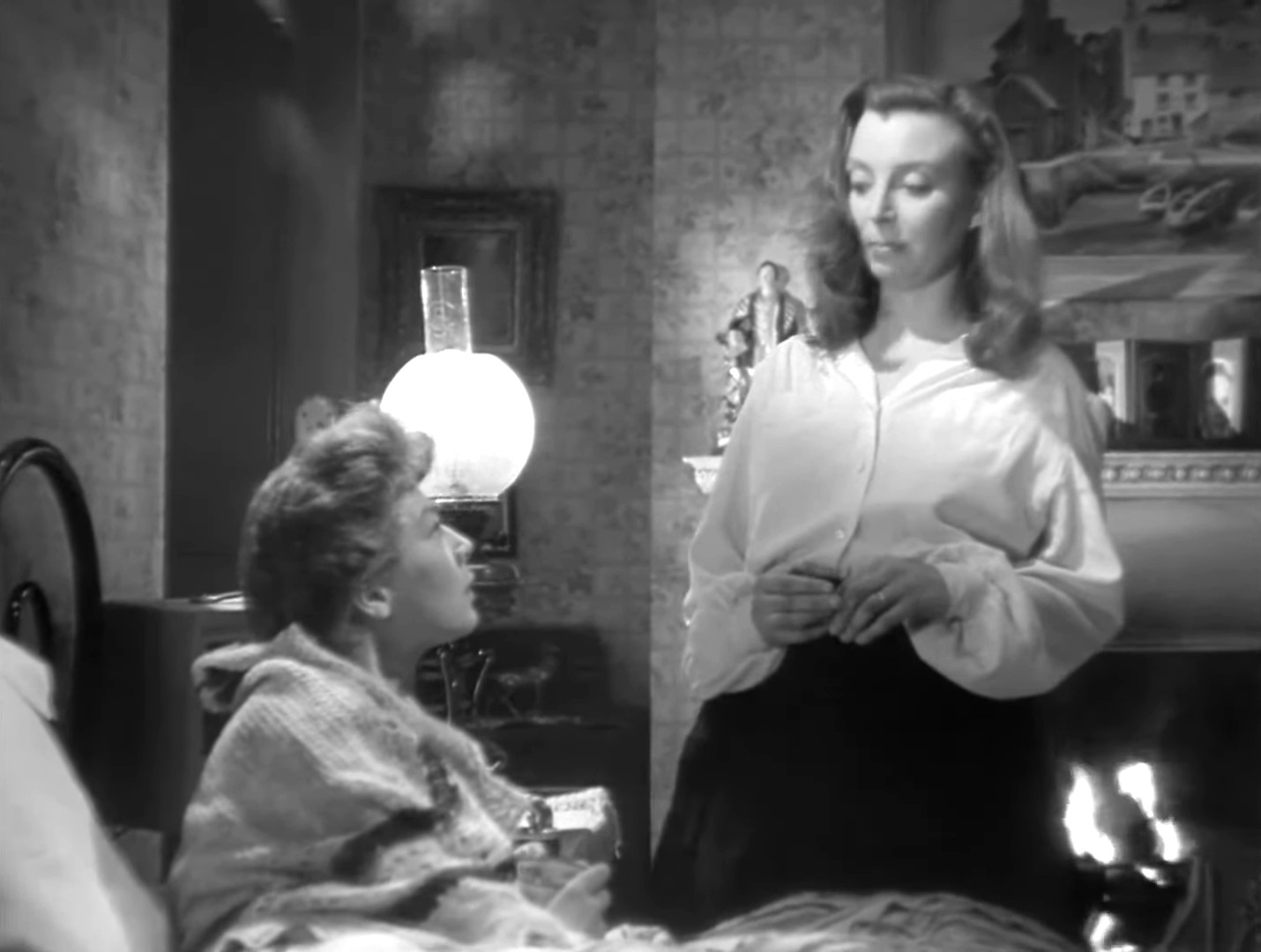
   “One of the analyses of the picture is that Joan has suppressed desires for women; though she believes she’s on the right path in her life, she, in fact, has not been seeking “heterosexual domesticity.” Joan’s plans are altered when she meets Torquil and Catriona, who is wild in spirit. Torquil refers to her as a ‘queer girl.’ There is a scene where Joan almost dies while getting through the storm, and Catriona takes her to her bedroom. “There’s a fire in my room, and that’s where you’ll sleep.” “We are left with the impression that the two women might have slept together. When morning comes, Joan transforms into an energy of being butch and less tense, as if she has been freed from oppression. It could be read as the uninhibited Catriona has liberated Joan. Joan falls in love with Torquil as the film must center on heterosexuality in the end, but before she goes off with Torquil, she leaves Catriona with this sentiment: ‘Goodbye Catriona. Thank you for everything.’”

       I’m not certain I would take Joan’s multiple sexual confusions that far, but in this deep work, it is certainly possible.

     Of course, this is a heterosexual love story, and at the end, each lover asks one another for a memory, in Torquil’s case, the three guest pipers which showed up to the cèilidh. She asks him for a kiss, and then walks off in the direction of the boat which will take her to Kiloran and Bellinger. But she soon returns with the three pipers, the two lovers coming together in a relationship that was previously off the charts.


Los Angeles, June 6, 2025

Reprinted from My Queer Cinema blog (June 2025).
Friday, June 6, 2025

Nacho G. Velilla | Fuera de carta (Chef's Special) / 2008

finding family

by Douglas Messerli


Nacho G. Velilla, David S. Olivas, Oriol Capel, and Antonio Sánchez (screenplay), Nacho G. Velilla (director) Fuera de carta (Chef’s Special) / 2008


This Spanish farce was a terribly popularly film at home in Spain, ending up at the 6th best-selling movie in 2008, while the critics demurred.

     Well, it is true that this is a sort of mock hysterical comedy, and its plot, written by 4 screenwriters weaves a sort of threadbare pattern that is as unbelievable as almost any film out there; but if you sit back and enjoy its broad humor you can certainly understand its audience appeal.


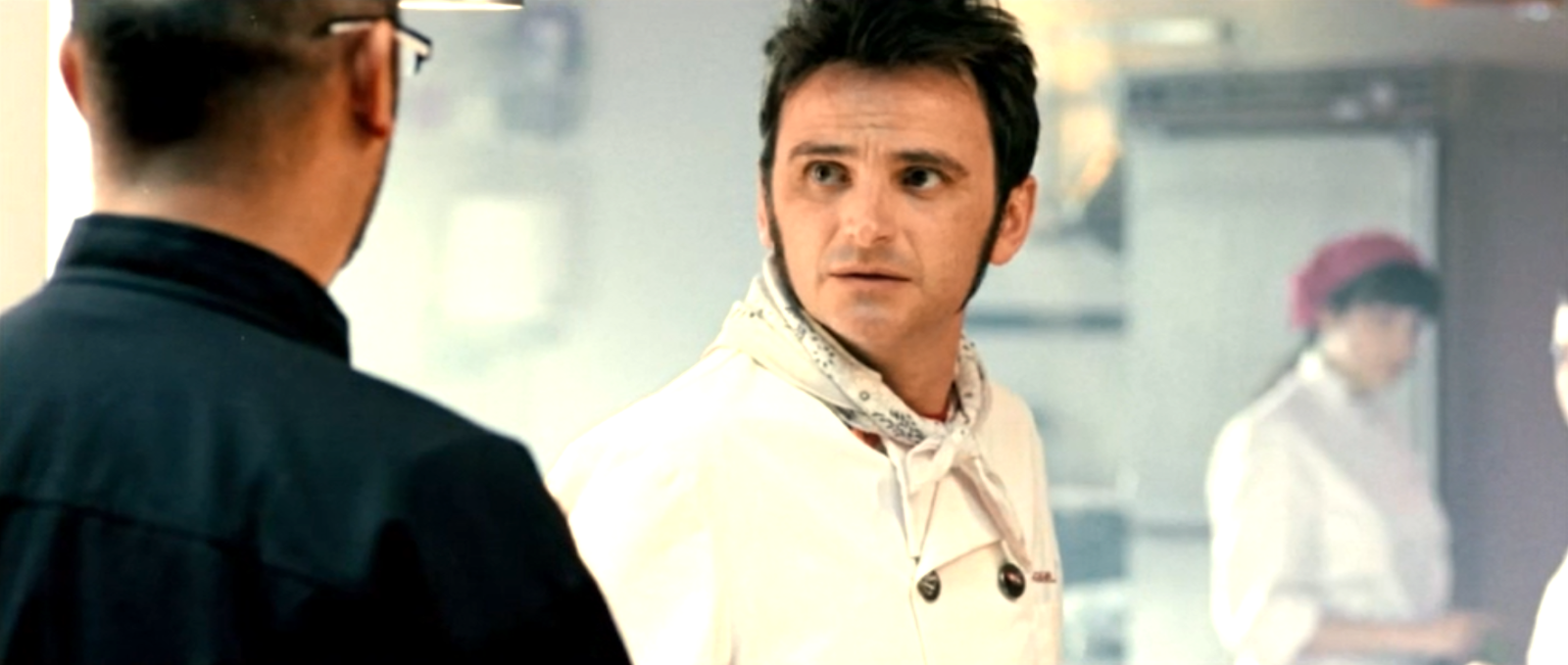
     Noted chef of the Xantarella Maxi (Javier Cámara) is a perfectionist when it comes to food, and like many an owner chef almost abuses his employees, some of whom such as Ramiro (Fernando Tejero) seem to almost deserve it. Maxi’s goal is to win a star from the Michelin Guide. Indeed, the film begins with Ramiro mistaking a Michelin tire salesman with a reviewer of restaurants, the staff cooking up a very special meal for no result.

      But things get “cooking” so to speak with Maxi’s maître d’ Alex (Lola Dueñas) arrives drunk and forlorn, having once more been dumped by a man. Maxi, a gay man, long out of the closet and openly homosexual, comforts the angry woman by taking her home and attempting to put her to sleep on his couch, mostly with little effect.   

   He also attempts to help Alex find a new love when Alex and he discover that the famed former Argentinian soccer player, Horacio (Benjamín Vicuña) is a regular customer. Joining her on what she defines as their first date, Maxi attempts to further Alex’s relationship, but in the process discovers that, in fact, Horacio is a closet gay man in love with Maxi himself.


       Horacio and Maxi go to bed, while Alex attributes Horacio’s failure to carry through sex as his chivalrous behavior. She continues to delude herself for many days until Horacio admits that she is not for him, Alex presuming he has another woman, and again becoming furious with the intent of tracking his bedmate down to destroy her. When she finally discovers that the other woman is actually her boss, she once more goes on a rampage.

       This craziness might have been enough for any one farce, but an even more important even occurs when his ex-wife dies and their children, Edu (Junio Valverde) and young sister, are forced to come live with him, both, particularly the angry young teenager Edu hating their father for his years of inattention. The boy’s anger is most palpable when he gets into a fight about homosexuality, bullying a young gay boy of his age, at school. Edu is expelled.

        Horacio, running a boys’ soccer group somewhat ameliorates his anger, and at a father son game he literally tales his revenge on his father in the name of game aggression. But when he discovers that, in fact, Horacio is his father’s lover, the situation for Maxi becomes impossible, and the chef is forced to take his children to his own unforgiving conservative and constantly arguing parents to live.    

      Maxi’s restaurant is near bankruptcy. But then he is secretly given the name of the true Michelin Guide reviewer, and is rejuvenated with possibilities. Indeed, the reviewer makes a dinner appointment, which happens also to be Edu’s birthday.


        Finally, realizing what a failure his has been, Maxi decides to drive to his parents to bring his son a special gift, believing he will be able to return before the reviewer arrives. He puts his saute-chef in charge, only to discover via telephone that she, who is pregnant, has gone into labor and the reviewer has arrived early. Although his daughter his happy to see him, Edu is still angry until Maxi admits that yes, he did dislike the fact of his children’s existence and that he has failed at everything. Suddenly, and quite unbelievably, Edu and he make up, while the foolish Ramiro is left to speak for Maxi’s excellent restaurant.

       The results are quite obvious, as in the last scene we observe the Xantarella having been turned into a small and cosy café, and finally Maxi, a changed man, determines to take off a day to share with Horacio, Edu and daughter on trip in the country, leaving the cooking to his able and no longer abused workers.

       The joy of the film is the farcical chaos it creates, but at the same time it is so stuffed with plot details which jut off in all directions (I have left out dozens of extraneous scenes), that anyone who desires a truly coherent message—critics obviously—will be confused and disappointed. One should leave this film to its appreciative everyday audiences who don’t mind, apparently, patching up the holes when the film goes awry.

      Frankly, I loved this rather old-fashioned comic treat. To describe it as anything else would be nearly impossible, but we need farce sometimes in our lives.


Los Angeles, June 5, 2025

Reprinted from My Queer Cinema blog (June 2025).  


Wednesday, June 4, 2025

Marco Ferreri | Storia de Piera (The Story of Piera) / 1983

the doomed

by Douglas Messerli


Piera Degli Esposti, Dacia Maraini, and Marco Ferreri (screenplay), Marc Ferreri (director) Storia di Piera (The Story of Piera) / 1983


In this highly eccentric and beautifully filmed work, director Marco Ferreri and his writers introduce us to a family in which each individual seems at some point or another to lose their minds or at least break all roots with conventional behavior. The most interesting of these, and winner of the Cannes Best Actress award at the 1983 Cannes film festival, is Eugenia (Fassbinder’s great actor, Hanna Schygulla), who, although married to the hard-working Lorenzo (Marcello Mastroianni), who has married her for love and remains quite blindly still in love with her.

     Eugenia might be described in several ways, as a kind of early hippie, a wild being who simply cannot be and will not be sexually contained, or a sexually obsessed woman who has no comprehension at all of how to raise her family, daughter Piera (Isabelle Huppert) and son, the latter of whom we hardly get to know, he being raised up by a conservative servant in the house.

     It is Piera who serves as the focus of the film, first serving as her mother’s caretaker as she follows her about the city during behavior the literature on the film generally describes as “unbalanced.” Surely a mother fucking with abandon nearly every man she meets might be described as “unbalanced” or even emotionally unstable.

     Piera, accordingly gets a stranger vision of female sexuality as she moves from kissing contests with the local boys to her first encounters with young males and finally into the arms of a lesbian friend, to say nothing of the almost incestuous relations between both her mother and father. Both seem almost blind and certainly passive about each other’s activities, and in his job high up in the Italian Communist Party (Partito Comunista or PC), Lorenzo is absent from home for long periods. But even when he is home, tucked away in the rich rooms which cinematographer Ennio Guarnieri, at times, has made to look like the interiors from a Dutch painting, he appears nearly oblivious of his wife’s actions.

     Eugenia is finally deemed so beyond the normal that she is hospitalized and given shock therapy. And Piera escapes to Milan where she becomes a well-known actress.


      Upon a visit back home to one to Italian city of Latina, founded in 1932 by Benito Mussolini, Piera discovers that her father, forced to give up his job in the PC, has also been institutionalized. She finds him in bed with another man and a small dog, an uncaring attendant describing them as faggots. Lorenzo seems to have given up on almost on meaning, but is heartened again to see his now successful daughter.

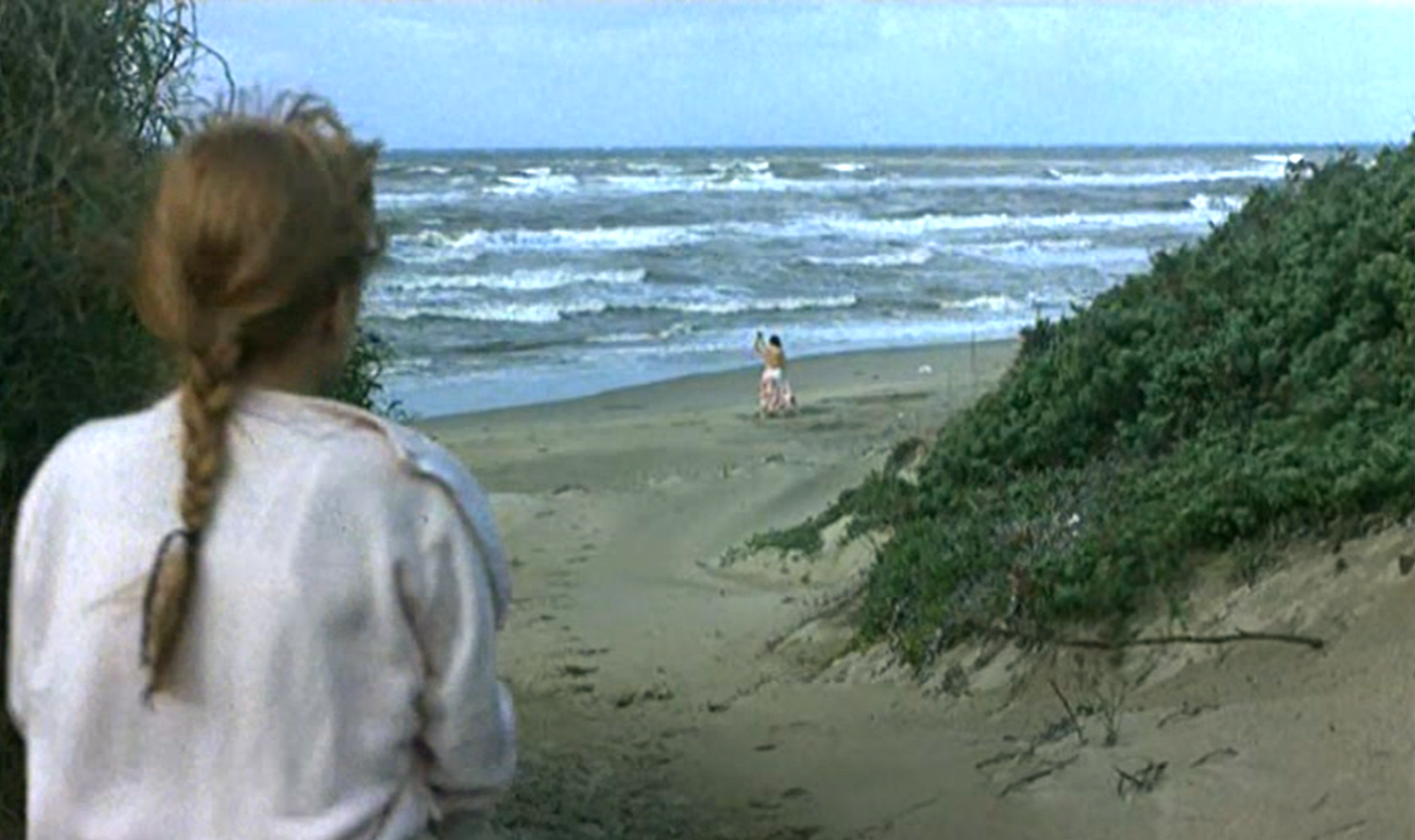
       Soon after, her mother’s mind is so deteriorated that she is also locked away, refusing to even allow her hair to be cut and checked for lice. The arrival of Piera calms her just enough for a cutting and a trip to the beach where we have seen her early in the film have sex with one of her endless male encounters. There, she strips herself naked and demands Piera do the same as the two embrace in a deep expression of the love, confusion, and disappointment they have endured throughout.


      This is a very loosely constructed—one might describe it as haphazard—work that focuses instead on the constantly shifting worlds of this doomed but fascinating family.


Los Angeles, June 4, 2025

Reprinted from My Queer Film blog (June 2025).   

Bruce LaBruce | No Skin Off My Ass / 1991

 playing roles

by Douglas Messerli


Bruce LaBruce (screenwriter and director) No Skin Off My Ass / 1991


With $14,000 and using himself and his then lover Klaus von Brücker as the major actors, now famed queer film director Bruce LaBruce created his first film, No Skin Off My Ass, which has since become a cult favorite and is recognized as an innovative, punk film, which Alexander Cavluzzo describes as “the voice of hardcore, tongue-in-cheek dissent with porn-packed political allegories.”

     It begins with LaBruce, described throughout as The Hairdresser, encountering for the second time in a day, what he believes to be a neo-Nazi skinhead (von Brücker), sitting a shiver at a local play yard bench.


     He offers him a room for the night, takes him home and provides him with a hot bath, while he explains that although he has a large clientele, and is successful businessman, he has grown less and less interested in his work as he has increasingly become obsessed by skinheads.

     Through this film, LaBruce gives us a close analysis of skinhead behavior, desires, differences, and purposes. What he doesn’t know is that actually this “skinhead” is not really a skinhead, but a young man who, as his sister Jonesy (G. B. Jones) reveals, often goes into his “bit,” in which for days at a time he grows mute, frustrating family and friends.

     LaBruce, not at all comprehending the strange boy his has picked up, despite his sexual desires, puts him into the guest room and retires for the night into his own room.

     The next morning the young “skinhead” escapes to visit his lesbian sister, Jonesy, who with her friends is making a documentary around the Symbionese Liberation Army.

     Von Brücker would also like to be in her film, for which she forces him to strip and seduce the lesbian women, all to utterly no success.

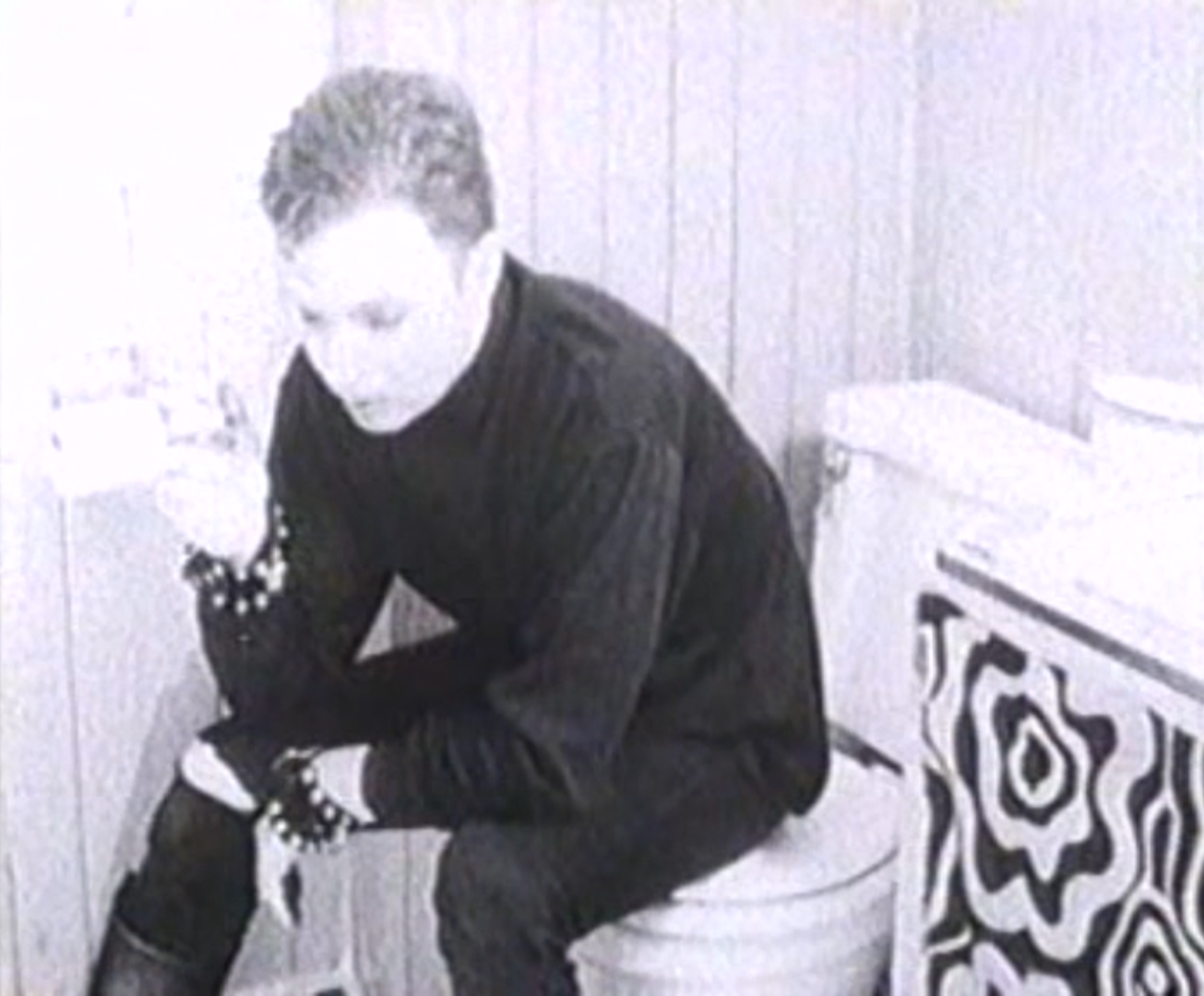
      Later, the “skinhead” has a dream about an S&M sexual situation involving The Hairdresser, who cuffs him and demands the young man roil around the bathroom stool. He returns to his so-called savior and again spends a sexless night, this happening for a period, before finally Jonesy makes a visit to the place, while The Hairdresser is entertaining a neighborhood or family child at the same play yard we saw earlier.

     He returns to encounter Jonesy berating her brother in his living room, she insisting that her brother is really gay and obviously is attracted to The Hairdresser, arguing they should simply admit that they are both gay, settle down and have sex.


      Some of LaBruce’s and von Brücker private sexual tapes follow, which in 1991 were considered pornography, but which today seem rather sexual tame. Yet, at least the two are finally a true couple, as the former Skinhead gets a moccasin hairdo while a punk band shouts out repeatedly, “Be a fag.

     The two are finally a true couple, as the former Skinhead gets a moccasin hairdo while a punk band shouts out repeatedly, “Be a fag.” Indeed, the score throughout is utterly fascinating.              

     Jonesy admits that her film as never made because there was no financial backing, and she is now in trouble with the police for her graffiti works. She will probably have to leave town, she reports.

    According to LaBruce the film is "a queer retelling of Robert Altman's That Cold Day in the Park (1969). Altman’s film is based on the novel by Peter Miles. As LaBruce describes it, “Altman de-queered it, so I decided to re-queer it... When I showed the film for the first time in Los Angeles in 1991, somebody brought Miles to my screening and he said my no-budget Super-8 movie was better than the Altman version! He gave me an autographed copy of his novel inscribed: ‘You got it right.’"


Los Angeles, June 3, 2025

Reprinted from My Queer Cinema blog (June 2025).

Tuesday, June 3, 2025

Antonio Capuano | Pianese Nunio, 14 anni a Maggio (Sacred Silence) / 1996

dirty heroes: body and soul

by Douglas Messerli


Antonio Capuano (screenwriter and director) Pianese Nunio, 14 anni a Maggio (Sacred Silence) / 1996


The local Naples priest, Don Lorenzo Borrelli (Fabrizio Bentivoglio), titled the blue jeans priest, is akin to the heroes of many a movie, including those represented in Matteo Garrone’s Gommorah and in the character of Father Pete Barry in Elia Kazan’s On the Waterfront (1954). Both characters Barry and Borrelli along with director Garrone are fighting war, so to speak, against the local mafia or in the Naples more particularly the Camorra, who controls Naples and is prevalent in Borrelli’s poor neighborhood. And Borrelli knows that he cannot save the young children he attempts to nurture as long as the parents accept the mafia and engage with them as a daily part of their lives.


      Yet like Father Barry, he speaks out, endangering his own life and sometimes even those of his parishioners, trying to convince families that accepting and participating with the Camorra will leave them all in the chaotic conditions in which they and their neighbors have been living for decades. Borrelli is what we might describe as a hero-priest, someone with high ideals living them out in real before the rollercoaster of a shabby world in which both live.

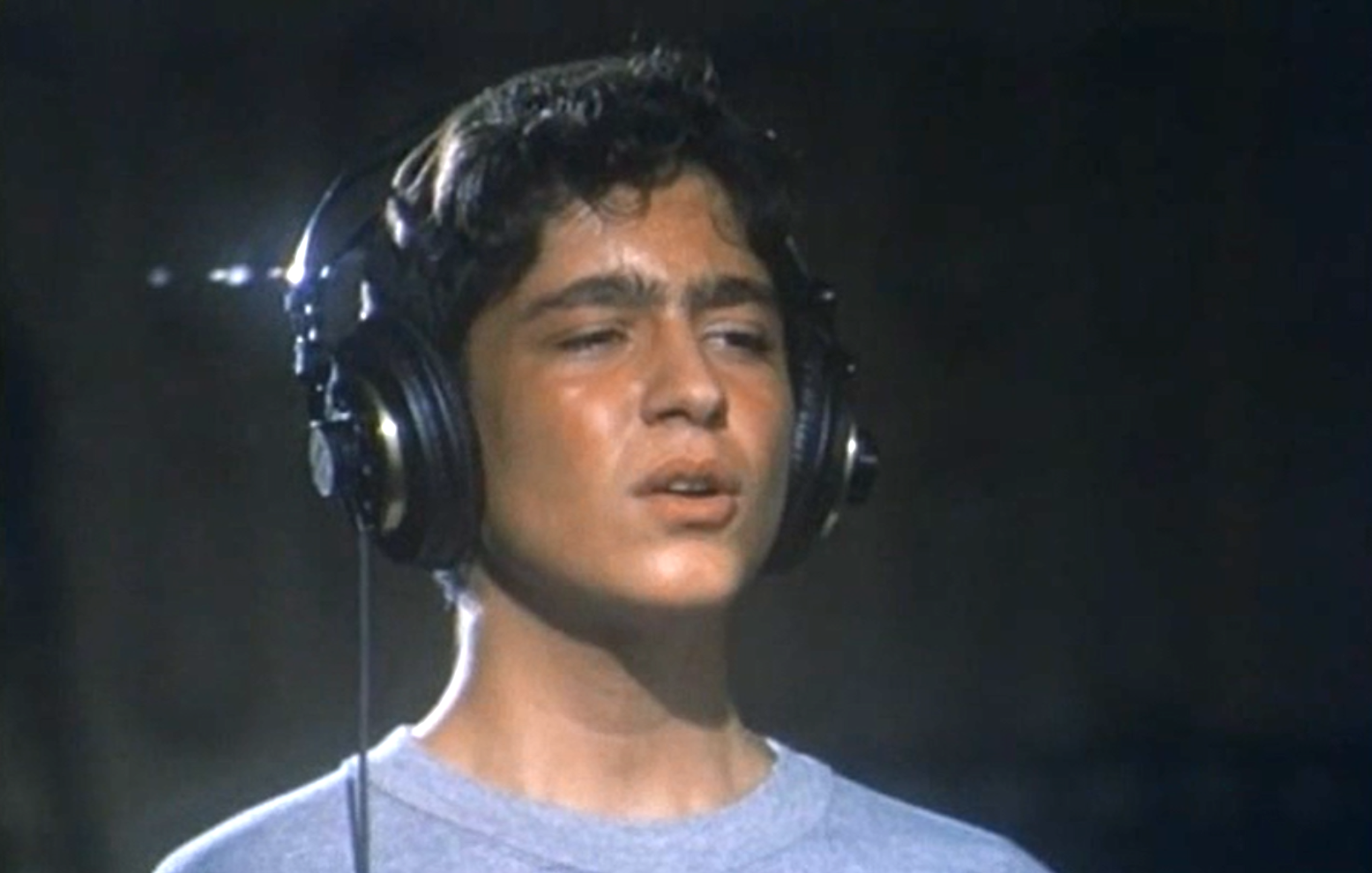
     Yet Borrelli has a serious flaw: he has uncovered a beautiful young 13-year-old, a talented singer who also plays the organ for his church, and himself wishes to become a priest, with whom he has he now spends his meals, his intellectual tutelage and, rather shockingly, his “personal affection.” In short, this hero-priest is also pedophile, trapped between his ideals and his body.


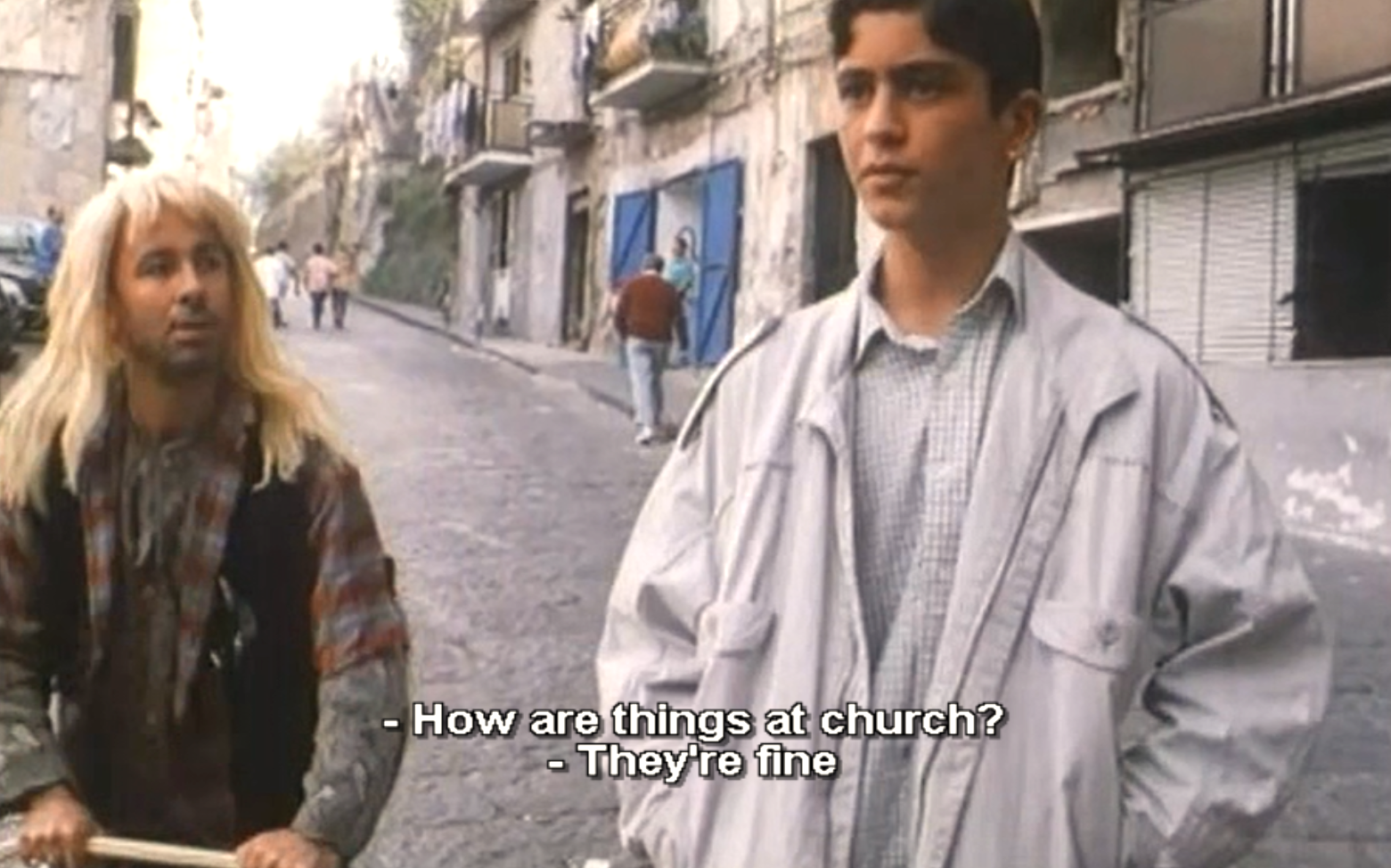
    The boy himself later admits that he was not averse to his priest’s “affections,” and knows that there is no one in his crazed society—his father, dressed in a blond wig, goes about the city with a cart selling eggs and other foodstuffs, while his mother is basically a whore, the boy’s own brother later proudly admitting he is now a Camorra member—and he truly loves Father Borrelli.


     The local mobsters, tired of the harangues against them and, for all their seeming strength, necessarily seeing the revealment of the priest’s secret life as their way to shut him up, begin their pressure on the young acolyte.

     In a perhaps overlong series of events and a great many verbal attacks against his social enemy, the Camorra, the movie makes it way surely to where we all know it must end.

     Director Capuano does not forgive his tragic hero for his awful sins of the flesh, but does reveal him in the final scenes as a kind of Christ, who refuses even a funereal in the church for one of the Camorra leaders who has just been killed.

     This is a swirling world of murder, injustice, and hate, in which there are no pure “heroes.” Borrelli, himself, has justified his pedophile behavior with a notion that “eroticism and sanctity” are the same thing.

      By film’s end, disgusted as we may be by his sexual behavior, the viewers themselves must ponder the same question.

      Increasingly, through local attacks (the film begins after an attack on Borrelli, where youths have stolen his watch and beaten him), the young Nunio is pressured by his father, brother, and others, as well as a team of a male and female policemen, visiting his school where they pretend to be social workers. Nunio is manipulated to become a kind of traitor, desiring freedom from Borrelli’s sexual bonds—he is, it appears actually a heterosexual—knowing at the same moment that there is no one else in this terrible stack of rubble who has cared more for him and given him his own identity.

     By the time of his last visit to Borrelli, the priest even permits the young boy to betray him to the police with the words, “If you report me, I’ll say nothing against you.”


      The boy does so, almost unwillingly, yet tired, as he puts it, of being a “sheep.” And the result is the silencing of one of the few social forces attempting to stand up to the Camorra.

      We recognize that even Nunio’s life will end disastrously, as in one professional gig he ends up with another boy singing in the subways.

      This movie could not probably me made or taken seriously today when instead of pondering such issues we simply dismiss them as immoral, but in 1996, Matt Blake writing in The Wild Eye, described it as “an amazingly courageous film, considering the fact that it’s essentially about a paedophile and, what’s more, a paedophile who is in many other ways so upstanding and heroic. Lorenzo certainly makes for a difficult protagonist, at the same part admirable and despicable; and the fact is that he takes advantage of a vulnerable young man in much the same way as the Camorra he so despises. But he’s a genuinely tragic protagonist, someone who tries to do good but fails because of fatal character flaw which not only undermines his cause but also his whole moral bearing.”

      This is the kind of film that one carries with one for months after seeing it, a work gnawing at the heart and mind. There is no easy answer for dirty heroes. 


Los Angeles, June 3, 2025

Reprinted from My Queer Cinema blog (June 2025).


Index R-Z

Angelo Raaijmakers I, Adonis / 2021 Peeter Rabane Firebird / 2021   Tyler Rabinowitz Catalina / 2022 Tyler Rabinowitz See You Soon / 20...