Monday, June 9, 2025

Sam Liddell | Orange Cheesecake / 2025

no resolution

by Douglas Messerli


Sam Liddell (screenwriter and director) Orange Cheesecake / 2025 [15 minutes]


After years of silence from his father, the gay college boy Joe (Harry Jenkins) is invited back home to have dinner with his estranged father, George (Adrian Yearsley). It has been his father’s girlfriend’s idea, who George orders about like the cruel misogynist he basically is, to invite Joe and thought it might help mend whatever problems to the had between one another.

   Even though Joe has brought an orange cheesecake, made by him in memories of the ones he and his father made during his childhood, nearly everything goes wrong. Phoebe serves up a wonderful-looking dinner of salmon, but either his father has forgotten or never cared to pay attention to the fact that Joe is and has always been allergic to all seafood. Phoebe offers to get him a sandwich, but George refuses to let her prepare it, and the boy goes hungry.

      The father’s real problem is that he remains a violent homophobe, unable, as it puts it, to accept his son’s “life style.” Evidently, Joe has failed to inform him or he refuses to believe that one’s queer sexuality is not a choice, but is simply part of who one is.

      In any event, George cannot accept any part of his son. And when Phoebe begins to try to link him up with a girl during dessert, Joe finally explains that he is with someone he loves, except she is a he.    


     His father grows even more furious in his son’s attempts to explain the problem to the more open-minded Phoebe (although she too seems to have rather stereotypical concepts about gay man, associating them immediate with drag), George demanding that his son stop the conversation which he describes as attention-seeking. But this time, Joe stands his ground pointing out to his father that it is he who is eaten by hatred, he one who cannot come to terms with reality, explaining that for much of his childhood he hated himself, and yet was loved by the family; but the moment he discovered his identity and begin realizing and coming to terms with himself, his family, particularly his father, turned on him.

     He leaves the “false” get-together, calling his friend back in the university to have a pizza ready for him, while waiting for the bus, eating a piece of his delicious orange cheesecake with delight.

      British director Liddell’s short film is certainly not original; we have gone over this territory of the unforgiving parent in almost endless queer films. Yet this short from 2025 reveals that despite all the growing openness and awareness that has been made in the general community, young gay men must often face years of rejection from those they most need and once loved. It is the disappointed homophobes at home, however, who unknowing suffer most, unable to wrap their minds around the notion of simple sexual difference.


Los Angeles, June 9, 2025

Reprinted from My Queer Cinema blog (June 2025).


Todd Solondz | Happiness / 1998

going off rail

by Douglas Messerli


Todd Solondz (screenwriter and director) Happiness / 1998


Todd Solondz’s Happiness, his black-and-bleak comedy of 1998, comes with a story that is about as outré as one can imagine. J. Hoberman, writing about it recently in The New York Times, begins his essay by describing just some of its perversions.

       “Playfully named Happiness, Todd Solondz’s painful, deadpan, burlesque of bourgeois mores encompasses murder, mutilation, rape, pedophilia, suicide, obscene phone calls and free-floating masochism, among syndromes yet to be named.”         

     Playing on Chekov, Solondz introduces us to three sisters, Helen Jordon (Lara Flynn Boyle), Joy (Jane Adams), and Trish Maplewood (Cynthia Stevenson), two of whom, at first glance may appear to live quite successful and normal lives, while the third, Joy—whom Hoberman describes as the “most sympathetic”—is seen by family, friends, and most importantly by herself as an utter failure in life, even though it is she who has composed the film’s theme song, “Happiness,” a work she shares with no one except the audience.


    The film begins with her on a date with Andy Kornbluth (Jon Lovitz), a big blubber of a human being who simply isn’t an appropriate mate for even the insecure Joy. Roger Ebert describes the evening’s end: “He gives her a present, an engraved reproduction ashtray he got through mail order, but after she thanks him (‘It almost makes me want to learn to smoke’) he viciously grabs it back: ‘This is for the girl who loves me for who I am.’ He proceeds to unload on her, calling her ‘shit’ and other such words.

      Andy goes on to kill himself, but even in death gets revenge by sending a telephone call in which he blames Joy for his acts.

    Joy, who has been working as telephone receptionist, leaves her job to do good, but, as Ebert describes it, “She gets hired as a scab worker, teaching at an immigrant-education center. Her students do not like her, and she begins to feel empty in that job as well. Joy is also constantly let down in her personal life.”


     Sadly, Joy goes on, as she walks down the street, to be picked up by a taxi-driver member of her class, a Russian named Vlad (Jared Harris) who is only too happy to drive her home back to New Jersey in turn for sex, which she totally enjoys, and the robbery of her guitar and sound system. Later, after being slapped in the face by Vlad’s live-in mate who refuses to marry him, Joy is forced to buy back her processions for quick cash ($1,000) paid to the desperate refugee from Russia.


     The most unlikeable of the sisters is Helen, who has become famous for her novel A Pornographic Childhood, a work that describes a character who has been raped as a child, even though nothing of the kind ever occurred to Helen. She is a narcissistic woman who must prove her superiority even over her married and seemingly happy sister, Trish.

     She is also loved from afar from an absolutely boring neighbor Allen (Philip Seymour Hoffman), who through his obscene phone calls, most of them random, becomes a central figure in Solondz’s fractured fairy-tale. When he actually gets up the nerve to call Helen, she promptly calls him back for more, actually redialing him night after night to get her fix. Even Allen turns away from the monstrous Helen, finally becoming fully drunk before turning to another neighbor, the overweight, sex-hating Kristina (Camryn Manheim), who later admits that she has murdered and cut up the body of their doorman Pedro, who raped her. The police later find a bag of his genitals in her freezer.

      In the sequel to this film, Life During Wartime, Joy has married Allen, who still can’t quite get over his desire to make obscene phone calls.


      Before I proceed on to the last sister, I might mention that these women’s own mother Mona (Louise Lasser) has just been told by her husband Lenny (Ben Gazzara) that he wants to leave her just to be alone. He discovers soon after that he no longer has any feeling for women and life in general. Terrified by the divorce and

separation, whatever she might call it, Mona seeks out a new apartment, the agent being Marla Maples, who in real life had just divorced Donald Trump, proclaiming that divorce is one of the best things in life.

      Trish, the married sister, seems to be the most normal of the three, herself having the post-war normative three children, Billy, Timmy, and Chloe. Her husband Bill (Dylan Baker) is a psychoanalyst.

       But Bill is also a pedophile, beginning with kiddie pop magazines and soon actualizing his desires by drugging his entire family and his eldest boy Jimmy’s overnight friend Johnny Grasso (Evan Silverberg), whose own father is a coach and is convinced his 11-year-old son is gay. 


      When Bill hears that one of his son’s classmate’s, Ronald Farber, is alone in the house while his parents are on vacation, he also rapes that boy.

       Of course, these incidents are horrific and despicable. But there is also something terribly human and painful about these incidents, at least as Solondz presents them. The majority of the film is presented as one-on-ones. Hoberman comments: “Often shot in close-up, these suggest acting exercises or skit comedy gone off the rails.”


      One of the last scenes in this film is an honest and strangely open discussion between the pedophile Bill, about to be arrested, and his son who is troubled by his classmates describing his father as a pervert and monster serial-rapist.

        “What did you do?”

        “I touched them.”

        “What do you mean, ‘touched’ them?”

        “I fondled them.”

        “What for?”

        “I couldn’t help myself.”


        “I unzipped myself.”

        “What do you mean, masturbated?”

        “No. …I fucked them.”

        “What was it like?

        “It was, it was great.”

        “Would you do it again?”

        “Yes”

        [now openly crying] “Would you ever fuck me?”

        “No. I’d jerk off instead.”

        Surely, numerous moviegoers of the day and readers of this essay will describe this passage as further evidence of the film’s moral decadence.

        Due to its adult themes, Happiness received an NC-17 rating from the MPAA, which caused the film to be limited in distribution. Sundance Film Festival refused to screen Solondz’ work, and the corporate parent of its distributor October Films, Seagram objected to the pedophilia plotline and refused further distribution. Lynn Hirschberg of The New York Times Magazine reported that Ronald Meyer, then the CEO of Universal Pictures, personally blocked October Films from releasing the film.

        Yet, when presented at Cannes Film Festival the movie received what one might describe as the second highest award, the FIPRESCI Prize for "its bold tracking of controversial contemporary themes, richly-layered subtext, and remarkable fluidity of visual style," and the cast received the National Board of Review award for best ensemble performance. Roger Ebert gave the film four out of four stars, and rated it number five in his top 10 films of 1998. (source: Wikipedia).

     Ebert’s summary aligns with a great many of the film’s positive reviews, including Hoberman’s recent reassessment of the film.

     “Todd Solondz’s “Happiness” is a film that perplexes its viewers, even those who admire it, because it challenges the ways we attempt to respond to it. Is it a portrait of desperate human sadness? Then why are we laughing? Is it an ironic comedy? Then why its tenderness with these lonely people? Is it about depravity? Yes, but why does it make us suspect, uneasily, that the depraved are only seeking what we all seek, but with a lack of ordinary moral vision? In a film that looks into the abyss of human despair, there is the horrifying suggestion that these characters may not be grotesque exceptions, but may in fact be part of the mainstream of humanity. Whenever a serial killer or a sex predator is arrested, we turn to the paper to find his neighbors saying that the monster “seemed just like anyone else.” Happiness is a movie about closed doors–apartment doors, bedroom doors and the doors of the unconscious. It moves back and forth between several stories, which often link up. It shows us people who want to be loved and who never will be–because of their emotional incompetence and arrested development. There are lots of people who do find love and fulfillment, but they are not in this movie.”

     You can add my name to admirers of this sometimes nearly unwatchable film. Despite the horror of observing my fellow human beings suffering some of the worst of human afflictions, I watched Happiness twice just to share in the director’s open-heartedness toward his misfit characters and obviously, in the process, his openness to the sins and suffering of the human race.


Los Angeles, June 9, 2025

Reprinted from My Queer Cinema blog (June 2025).     

Sunday, June 8, 2025

Frank Vitale | Montreal Main / 1974

the innocents

by Douglas Messerli


Frank Vitale, Allan Moyle, and Stephen Lack (screenplay), Frank Vitale (director) Montreal Main / 1974


I have to report that the quality of the DVD currently available for Frank Vitale’s 1974 film is quite bad, the film itself faded and the sound sometimes difficult to endure, let alone hear. But the film itself, described as a docufiction, is certainly worth watching, even though the plot consists mostly of events imagined rather than those that really happened. That doesn’t, however, diminish the effects of those imagined events, particularly upon the young 12-year-old Johnny (John Sutherland) and his adult friend Frank (Frank Vitale). The plot appears to have been partially autobiographical, which makes it all the stranger and somewhat inexplicable.


     Frank is friends with Bozo (Allan Moyle). Frank is quite obviously gay, while Bozo is clearly still in the closet, dating—if you can call it that—a woman named Jackie (Jackie Holden), who is both loved and abused simultaneously.

     It’s not that Bozo doesn’t imagine his own sexuality; he and Frank even try out a sexual fling near the docks early in the film; but it is uncertain what comes of that attempted sexual encounter, and in various ways, gently and violently, Bozo spends much of the rest of the film fighting against his own homosexual behavior, although he acquires new male friends along the way.

     John Charles, writing on Letterboxd nicely summarizes the situation:

     “One of the earliest and most notable Canadian underground movies, this finds director Frank Vitale and friends Stephen Lack and Allan ‘Bozo’ Moyle essentially playing themselves. Depressed after breaking up with his girlfriend, photographer Frank strikes up a friendship with a disaffected 12-year-old boy (John Sutherland, who comes across like a pre-teen, Canadian-accented Joe Dallesandro). While their interaction is strictly platonic, trouble still ensues. Meanwhile, Lack and Moyle come in and out of the narrative, the former a free-spirited observer, the latter an immature, self-absorbed trainwreck.”

     Even Frank cannot explain to himself his attraction to the beautiful long-haired boy. In part, Frank is still himself a boy, who plays in the parks with Johnny as if he were a 12-year-old, at one point the two planting rows of matches in the ground to observe their small pyrotechnical effects when lit. And the adult, turn, offers the boy information about radio waves and other facts about which Johnny would otherwise never discover, since he is also regularly skipping his school classes.


      Perhaps one might argue that Johnny loves to be in Frank’s company, even more than Frank in his; but the two equally share their sexually innocent relationship. Yet Frank, as an adult, should have known where this might end, and if more self-aware would have realized the dangers of their  relationship, particularly in a world of near hysteria about pedophilia. Today, such a film could not have been made, and if it was represented on film, legions of psychologists and law-officers would have quickly carted Frank off.

      One night, Johnny and his best friend of his age (whose relationship may actually be sexual) escape to another part of town to play in a game amusement parlor. There they encounter a true pedophile, who slips up to them ready to find a way into their confidences. It just happens, however, that Stephen Lack observes the scene and sends the man running with one of Lack’s endless rifts: "What are you doing down here exposing yourselves to this kind of decadent street janitorial paranoia, standing here on the tiled urinal of Babylon?"

      And from that moment on, he begins to suspect Frank’s relationship to the boy, accosting Johnny with insinuating questions and asking him what he feels about all the photographs (Frank works as a photographer) the elder is taking of him.

      Bozo now also turns against his former friend, often behaving violently against him. In fact, it is Bozo who almost molests two young girls who are riding in his car with Jackie.

      Frank and Johnny’s relationship remains innocent, even though it is quite clear that Frank is becoming more and more attracted to the boy. And, course any man who puts himself into such a relationship is to be questioned—his sanity if nothing else.

      Soon Johnny’s inattentive parents becomes involved, Johnny’s father insisting that his son no longer see Frank. This not only confuses the angry young boy but leads him directly back to Frank. But by this time Frank too has been told to stay away from Johnny, and as if waking from a dream, Frank begins to see the ridiculousness of his ways.      

     When Johnny suddenly appears at his ramshackle digs, he suggests a short walk. Sending the boy to a nearby store for a couple of cokes, Frank suddenly disappears from Johnny’s life. That scene is one of the most coherent and emotional of the entire film, as the boy must now face the betrayal of his only adult friend.


      The entire relationship reminds me somewhat of a later film about an immature adult and a child represented in Mike White and Miguel Arteta 2000 film, Chuck and Buck. Yet this is a far more intense relationship between child and man, and you can feel the deep sorrow and anger of the boy, who ends this underground film, in an amusement parlor, a large rifle in hand as he game-plays destruction. One only has to wonder, who is he imaginatively shooting at: all adults, his own father, Frank, a world that stands against innocent love? Fortunately, director Vitale leaves us simply with the image and our own imaginations.


Los Angeles, June 8, 2025

Reprinted from My Queer Cinema blog (June 2025).

Saturday, June 7, 2025

Michael Powell and Emeric Pressburger | I Know Where I'm Going! / 1945

going off track

by Douglas Messerli


Michael Powell and Emeric Pressburger (screenwriters and directors) I Know Where I'm Going! / 1945


One of the best productions of the duo of Michael Powell and Eric Pressburger, known together as The Archers, I Know Where I’m Going! can basically be described as a romantic heterosexual comedy-romance; but there is so much more going on in the background and within the wild swings of mind of the central figure, Joan Webster (Wendy Hiller) that the work takes the viewer into a far darker work than most heterosexual comedies dare to tred.


     Born with the belief that she always knows where she is going, Joan, the daughter of a banker, seems almost destined in her path to marry into wealth and live happily forever. One of her lightest appearances in the film takes place in a swank restaurant, to where she has invited her father, whom she keeps addressing as “darling.” She has asked him to bring the rest of the money in her saving account, an act with which “darling” (George Carney) disapproves of as well as the chic restaurant to which she has taken him.

     There also she announces, at age 25, that she is about to marry Robert Bellinger, the man who runs Consolidated Chemical Industries and “one of the wealthiest men in England”—and a man, as her “darling” points out is his age. The marriage is to take place on “his” Isle of Kiloran, located in the Hebrides, an archipelago off the west coast of the Scottish mainland. She displays an almost awed wonder of both the man and Kiloran as she describes the natural wonders of Kiloran, only to admit that she has only ever visited the island in her dreams. And indeed, since Bellinger never visually appears in this film, one might describe him also as a man of her dreams, brilliantly visualized by the directors by high hat, which quickly becomes denigrated to the small-topped engine outlet of a toy train she seems to be riding to her destination, entering into the Scottish highlands, also a world of her imagination.


     As many critics have pointed out, what began as a rather charming, spoiled, and determined girl—the stock of many a romantic comedy—has become a clearly venal and plotting gold-digger figure, a quite unlikeable character which colors Joan Webster throughout the rest of the film, who is redeemed only by Hiller’s likeableness and her meeting on upon her arrival on the island of Mull with a young and charming Royal Navy officer (Roger Livesay), home on leave, who immediately tries to convince her to join him at the large house at the port, since fog has made it impossible for her to proceed to Kiloran that day. Others move on toward the house, while she stubbornly remains until she realizes the futility of her wait and finally joins them.


     Writing in The Criterion Contraption, Michael Dessem summarizes our new perceptions of Joan and Hiller: “Hiller needs all the charm she can muster, because her character is pretty dreadful, at least at the start. And here's where we move away from the classic romantic comedy template: the ‘unstoppable force’ characters are usually on the side of the angels: they're the ones that are absolutely sure that love will conquer all. It's the other character who's allowed to have all the wrong goals. Usually those goals are understandable and innocuous, no matter how misguided….”

    At the large port house she meets not only the young Navy officer Torquil MacNeil, but other local eccentrics as well. In Rough-cut Williams summarizes the scene: “Joan’s suspended existence continues when a meteorological hindrance of another kind is encountered: a gale warning is issued, ‘blowing from every point of the compass at once’ and chopping up the sea to an untraversable degree. The lengthening of the delay allows Joan to see more of Mull and its people; eclectic inhabitants include a falconer who has been training a golden eagle for seven months, and a childhood friend of Torquil’s who breeds Irish wolfhounds and hunts wild animals for food to survive austerity conditions. Progressively, the residents’ ‘old-fashioned’ collectivist values begin to undermine her closely held individualism and ambitions. The private gives way to the public: Joan’s request to travel by car to the town of Tobermory, from which she will contact Robert, is overridden by Torquil’s insistence that there is no need; they can take the bus.”

      On the way, Torquil and Joan pass by a small castle, a curse cast upon it for the centuries daring the relatives of the Laird of Kiloran not to enter, a figure who Torquil finally admits he is. As the current Laird, Torquil is too poor to live on his island, which is why he has temporarily rented it to the wealthy Bellinger.

      Joan makes a call to Bellinger and is told by her finance to stay with the Robinson’s, while Torquil rents them two rooms in the local hotel. But the gale winds continue also the next day, continuing to frustrate Joan, determined to get to Kiloran and her marriage.

    She visits the upperclass Robinson’s who are boorish and completely disinterested in the local culture, putting down the locals as brutes. She is forced to join Mrs. Robinson and a luncheon party that represents the very opposite of the vibrant people she has already met. Joan asks, “People around here are quite poor, I take it?,” while a local answers “Not poor. They just don’t have any money.” The major activity of the Robinson’s and their kind is bridge.

      Fortunately, Torquil pulls her away from what she herself perceives, despite her own upper-class airs, a shallow and empty world. Once more, the critic Alex Williams nicely summarizes the shift in Joan’s personality.

      “Despite her best efforts, Joan finds herself attracted to the handsome naval officer, whose intense gaze seems, disarmingly, to see right through her. Equally, Torquil’s enchantment with her seemingly unflappable determination fans the embers of a growing physical and romantic desire, which reaches fever pitch at a cèilidh—an informal yet traditional gathering for singing, dancing, food, and drink.”

      The several days of the gale leave Joan in a wave of desire and confusion, which completely torture anyone like her who imagines they can more in a direct route through life. Not only is Joan utterly confused about her growing attraction to Torquil, but as some critics have argued is confused now by other sexual feelings.

     After Joan bribes a young boy Kenny with 20 pounds to take her across during the storm, Torquil attempts to halt the voyage, without success. But his friend, Catriona (Pamela Brown) finally wises him up that she is not simply anxious to meet with Bellinger, but is trying to escape the Navy Officer. Quickly running after, Torquil takes over the perilous voyage from Kenny.


     Once more, Williams nicely summarizes this chaotic and meaningless voyage: “The wind, rain, and sea are finally unleashed in their violent and untamable glory in the climactic whirlpool sequence, which finds Joan selfishly bribing the young Kenny (Murdo Morrison) to ferry her across the dangerously wild seas to Kiloran in a desperate bid to escape her attraction to Torquil. Prior to this, Joan hears of the Corryvreckan whirlpool, the second largest in Europe, which is infused with mythological associations and lies between her and Kiloran. The scene—which was constructed by intricately combining footage of the actual whirlpool, rear projection, exchanges shot in a giant tank at Denham studios, and miniatures—was directly inspired by the formidable whirlpool at the centre of Powell’s favourite short story, Edgar Allan Poe’s ‘A Descent into the Maelström’ (1841). Poe’s portrayal of the whirlpool as a monstrous entity that swallows humans, trees, boats, whales, and even bears evokes the powerful emotions arising from a confrontation with the awe and terror of nature. Joan’s volatile feelings resemble the whirlpool itself; both voids of unknowability threatening to destroy her whole identity and re-configure her perceived purpose, should she yield to them. 

     A near-death experience with the whirlpool is narrowly averted by Torquil’s last-minute repair of the boat’s faulty engine, and Joan returns to Mull rudderless. The embodiment of her carefully designed future, her silken wedding dress, has been lost to the sea.”


    Critic Jo Gabriel, writing in The Last Drive In points us in a possible other direction.  

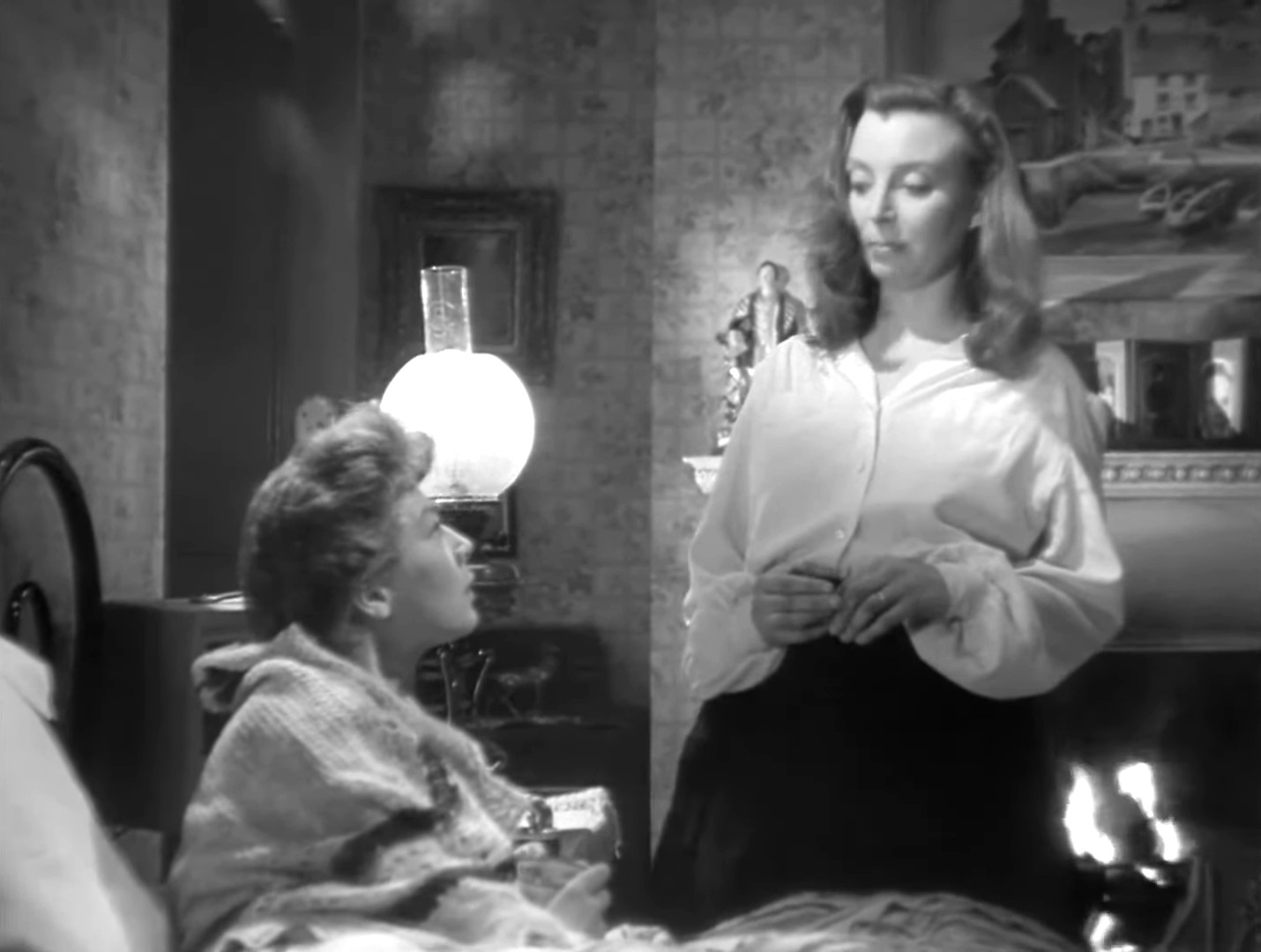
   “One of the analyses of the picture is that Joan has suppressed desires for women; though she believes she’s on the right path in her life, she, in fact, has not been seeking “heterosexual domesticity.” Joan’s plans are altered when she meets Torquil and Catriona, who is wild in spirit. Torquil refers to her as a ‘queer girl.’ There is a scene where Joan almost dies while getting through the storm, and Catriona takes her to her bedroom. “There’s a fire in my room, and that’s where you’ll sleep.” “We are left with the impression that the two women might have slept together. When morning comes, Joan transforms into an energy of being butch and less tense, as if she has been freed from oppression. It could be read as the uninhibited Catriona has liberated Joan. Joan falls in love with Torquil as the film must center on heterosexuality in the end, but before she goes off with Torquil, she leaves Catriona with this sentiment: ‘Goodbye Catriona. Thank you for everything.’”

       I’m not certain I would take Joan’s multiple sexual confusions that far, but in this deep work, it is certainly possible.

     Of course, this is a heterosexual love story, and at the end, each lover asks one another for a memory, in Torquil’s case, the three guest pipers which showed up to the cèilidh. She asks him for a kiss, and then walks off in the direction of the boat which will take her to Kiloran and Bellinger. But she soon returns with the three pipers, the two lovers coming together in a relationship that was previously off the charts.


Los Angeles, June 6, 2025

Reprinted from My Queer Cinema blog (June 2025).

Index R-Z

Angelo Raaijmakers I, Adonis / 2021 Peeter Rabane Firebird / 2021   Tyler Rabinowitz Catalina / 2022 Tyler Rabinowitz See You Soon / 20...