Friday, August 9, 2024

William Branden Blinn | Without a Mom / 2012

two dads with a heartbroken son

by Douglas Messerli


William Branden Blinn and Billy Bean (screenwriters), William Branden Blinn (director) Without a Mom / 2012 [14 minutes]


A man is sitting up in his bed obviously doing work when a car drives up the house, wheels screeching. The door is pulled open and slammed shut, and finally as the camera takes us downstairs we watch a young man, Brooklyn (Austin Stowell), emphatically toss down his keys, throw his basketball to the floor, and even set down his cased guitar with some anger. He pulls open the refrigerator door and peeps in, slams it shut, and pulls open a storage cabinet, taking out some peanut butter and closing it with more noise before pulling it open and shut again. He goes to the other side of a long counter and pulls open a drawer only to discover he can’t find what he’s looking for.

      All the noise and apparent anger has brought the man in his bathrobe downstairs to check out the problem as the young man shouts out the first line of the film: “There’s no fuckin’ bread in this house!”


     The older man sits as the younger continues to work out his anger in silence. Soon the boy comes and sits next to the elder, bends his head to his shoulder and breaks out into tears: “Maggie broke up with me!” The elder holds him quietly, a man we now recognize to be the father, Hank (Billy Bean). At the same moment we hear another door being opened to the kitchen. Another male enters: “Hello, I know I’m late. I brought dinner,” he declares as he throws down a box of large pizza.

     The other asks, “Did you remember the bread?”

     The newcomer asks what’s going on, told that Maggie broke up with Brooklyn. When he suggestion of eating something doesn’t work, he gets out some scotch and pours out a drink and drinks it, filling another small glass and handing it to the boy. Even he is a bit confused, reminding them that they are long argued for him not to drink, but are now openly offering it. Brooklyn drinks it.

      And who we now perceive to be his other father, Henry (Taymour Ghazi) puts out plates and serves the pizza.

       How are two gay males to deal with their son’s first breakup with a girl? Can they offer something that perhaps mothers are better explaining. As Brooklyn lays in his bed, he can hear the two arguing about their methods, their failures, and the difficulties all put within the context of their very different lives, Hank evidently the work-at-home father, while Henry is out 9-5 and probably many nights, such as this one, even later. Hank is pissed with Henry having given him alcohol, while Henry argues he needed it. He hadn’t given him alcohol last year when he didn’t make the basketball team, Hank argues. Henry suggests that he knows sports matters—Brooklyn has made the team this year—but neither of them know girl matters!

       When they look up, Brooklyn is standing in the doorway, asking them to stop. “I don’t need another mom. Everybody wants to be my mom,” he explains, “including my girlfriend.” So, they silently concur that’s the problem! “I want my girlfriend, he pushes his fist into his other hand, “just to be my girlfriend.” When they begin to question him, he addresses them, “Papa, Dad, stop. I can’t talk about this with you.”


     He needs to sleep he suggests, the strapping young 17- or 18-year-old boy (who looks older) climbing in between them as they, still sitting up, look around to find positions on the edges where they might sleep.

      Hanks rises first, perhaps to make breakfast, and Henry rises to ready himself for work. The two sit together at the kitchen counter for breakfast. The dads, however, have discovered that in the night their son received a text message from Maggie, and Henry, in particular, is almost ready to check it out over Hank’s insistence that he mustn’t. Brooklyn’s arrival forces Henry to put the cellphone down. Brooklyn sits, and they tell him he’s received a message. Checking it out, he discovers that she has apologized and now he has no time for breakfast; he speeds off to tell Maggie (Kristen Clement) that he loves her and of course he forgives her. They’ll get together after practice.

     This amusing and loving short film about the problems of many new all male (and all female) families throughout world is the work of director William Branden Blinn who since 2008 has produced a number of charming and interesting, if not profound LGBTQ movies, among them Thirteen or So Minutes (2008), Chased (2009), He She We (2010), Triple Standard (2010), À la Carte (2013), Derek and Cameron (2013), and Swell (2017).


Los Angeles, October 13, 2022

Reprinted from World Cinema Review (October 2022).

Paul Thomas Anderson | The Master / 2012

making it up

by Douglas Messerli


Paul Thomas Anderson (writer and director) The Master / 2012


In some respects, Paul Thomas Anderson’s The Master, like his other films before it—in particular Bogie Nights, Magnolia, and There Will Be Blood—is, affectionately speaking, an overstated, overacted mess of a movie, stuffed with often disconnected events. Part of the problem is that Anderson’s script, once it establishes its central character, Freddie Quell (Joaquin Phoenix)—an unpredictable, over-testosteroned ex-sailor, who, through the vicissitudes of war, his unhappy childhood, and his young girlfriend-back-home’s rejection, behaves like a time-bomb ready to explode—doesn’t quite know what to do with him. After mixing up a few drinks in the bowels of the department store in which he serves as a portrait photographer, Freddie harasses an overweight customer, beating him up and tearing apart some of the store furniture. His next job, that of a migrant-like worker in the cabbage fields ends, similarly, when one of the Mexican workers drinks too much of his moonshine concoction and goes into a coma; when his family accuses Freddie of poisoning him, the ex-sailor is again on the run, winding up this time on a yacht headed from San Francisco to New York. On board is the pompous “Master,” Lancaster Dodd (Philip Seymour Hoffman), who has created a new religion, The Cause, outlined in the first volume of his overweight opus that is a mish-mash of Freudian psychology, Jungian archetypes, science-fiction creatures from outer space, and a belief in a trillion-year history of mankind in which each of us has been housed temporarily in different bodies.* Like scientology, Dodd’s cult contains little real science, and a lot of bunkum centered on therapeutic encounters (similar to Scientology's "auditing") with church leaders, which supposedly frees them of their former selves, allowing them to become fuller beings in their present lives.


      Through the link of Freddie’s potent elixir of liquor, paint-thinner, and anything else he thinks might add a quick high, Dodd and he immediately bond, the “master” offering up private sessions with Freddie, after which he praises the young man’s bravery. Having seldom encountered such an assuring and friendly father-like figure, the young Freddie is hooked, and before he even comprehends why, becomes inculcated in the cult.

     So far, the story, accompanied by a kind of kitsch recreation of Schoenberg-like soundings (by composer Jonny Greenwood) which are repeated with portentous earnestness, and a sound-mixing in which the characters shout at one another instead of speaking (Phoenix, on the other hand, generally mumbling his lines), is interesting if only because it puts its audience vaguely on edge. What is going to happen to Freddie or, we might equally ask, to Dodd, as these two polar opposites are brought into long-time contact? Obviously, something is going to ignite them—along, perhaps, with the film itself.

      The problem is that Anderson seems to have no idea what he wants to say through the accident of their meeting. For a long spell, accordingly, the film merely repeats the two encountering and reencountering one another, circling round each other in moody suspicion. When Dodd is heckled at a New York party by a skeptical journalist, Freddie, with Dodd’s young son-in-law tagging along, makes a late night-visit to the inquisitor, assuring, through a beating or perhaps even a murder, that the man will never attack Dodd or his church again. Similarly, when Dodd is arrested in Philadelphia for absconding with a wealthy contributor’s money, Freddie explodes, attacking the police and, after being arrested, beating his own head against the bedposts and boxsprings before tearing out his toilet—a scene presented with cinematic brilliance by having Dodd, in the very next cell, stand in utter quietude before summarizing the obvious: Freddie has a horror of any cage.


     Family members and cult followers question Freddie’s participation in their group; is he a spy? someone sent to destroy their "Cause"? a potential robber? (he has, after all, asked how much the “master’s” unpublished papers are worth). If Freddie is to stay with them, he must certainly face a long re-indoctrination. Dodd determines to retain Freddie and personally oversees what we recognize as a slow, repetitive brainwashing. Family members, in particular Dodd’s wife, Peggy (a marvelous Amy Adams) and Dodd’s son-in-law, Clark (Rami Malek) spend hours in name-calling and tossing invectives at Freddie until he learns to control his temper and accept what he is told are “helpful” family observations. After hours and hours of such painful encounters, the outsider is once again brought into the fold.

      But why, we must ask? What does the film want to say about these cultists? To give Anderson credit, he proffers no easy answers. For, in fact, Freddie is better off under their care than he was previously, careening through a culture which might have, in the end, landed him, like his mother, in a mental institution. Moreover, Dodd, despite his absurd assertions, is, at heart, loveable. Even his loyal son, himself, sometimes wonders if his father isn’t just “making it up as he goes along?” When Dodd, at one meeting, steers in the direction of having the women of his congregation go naked while he sings a roving sailor song (perhaps merely a surrealist-like projection of Freddie’s own fantasies upon Dodd’s obviously sexual advances), his wife Peggy quickly shifts him away. These frightful believers are, in Anderson’s telling, human beings, despite Dodd’s huge ego and his followers’ absolute subservience to his beliefs.

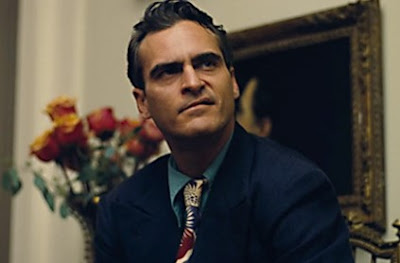
     And despite the film’s lack of direction or, I should say, the director’s refusal to pilot his film in any one direction, the wreck of Dodd’s perverse religion moves forward, often quite stunningly through the richness of Anderson’s images, shown in the version I saw in 70mm (shot in 65mm), and through the dexterous acting skills of all concerned. While one cannot deny Hoffman is not, at times, overacting—throughout much of the movie he seems to be channeling Orson Welles—he still creates a personable character who is always watchable. Phoenix’s eccentric performance does not permit us to take our eyes off him, particularly since Anderson focuses on his ever-changing face, at one moment a handsome young man, at the next a snarling mad-man; with the off-center scar running across the top of his lip, the actor has the ability to smile and sneer in the very same instant.
 

    While Freddie remains loyal to the increasingly off-kilter “master,” we begin to see doubts hovering, particularly when Dodd introduces his second volume of revelations at a Phoenix, Arizona conference of the devout. One member carefully brings up a crucial shift in the “master’s” teaching from a question of “remembrance” of past lives to asking if the interviewees might “imagine” something of their past—a change Dodd claims is simply more inclusive, but, as anyone acquainted with any church teachings knows, changes everything. Remembering asserts the event, while imagining merely permits it.

      We suddenly see Freddie, after Dodd’s speech, marching back and forth, a troubled look upon his face. When he queries one of Dodd’s most loyal followers, the man admits that the entire book seems fraudulent and might just as easily have been winnowed down into a three-page pamphlet. Freddie’s violent attack on the man a few minutes later says more about his own doubts, surely, than the follower’s aspersions. Freddie cannot afford to not believe anymore.

      Yet it comes as no surprise, after Dodd takes his closest followers into a flat desert expanse and challenges them each to pick a point in the far time and space and speed on a motorcycle furiously toward it, that Freddie will leave Dodd’s congregation. Returning to his Massachusetts hometown, he attempts to visit the 16-year girl he had left behind years earlier, only to be told that she is now married with two children. Once again, he has been left in the lurch without the possibility of love.

      Throughout the early part of Anderson’s film, Freddie has been portrayed as a macho woman’s man, desperately on the search for a quick moment of intercourse. Stationed away from women, he and others create an Amazonian-like sand sculpture of a woman, which he fervently fucks before curling up to the object’s mountainous breast. But slowly through the film’s uncoiling revelations, we grow to perceive that Freddie, far from loving women, is a desperate misogynist, at war with every woman from his mad mother on. Moreover, as we have sensed all along, there is more between these two men, Freddie and Dodd, than a love of raw-gut liquor. Receiving a telephone call from Dodd, who is now heading a religious school in England—or perhaps just dreaming up the call—Freddie takes the long voyage to visit the “master” once again. Peggy rejects him outright, arguing that he is unfit to try to rejoin their community. But Dodd is only too ready to accept his protégé back into the fold—if only he will agree to rejoin them. The young man’s answer is as inevitable as unpredictable is Dodd's singing, in several verses, the song “Slow Voyage to China,” offering Freddie up all his love, both patriarchal and, given the song’s lyrics, sexual.


                             I'd love to get you on a slow boat to China,

                             all to myself, alone.

                             Get you and keep you in my arms evermore,

                             leave all your lovers weeping on the far away shore.

                             Out on the briny with a moon big and shiny

                             melting your heart of stone

.                            I'd love to get you on a slow boat to China,

                             all to myself, alone.


 A tear falls from Freddie’s eye, reassuring us that the love, never acted upon, is quite mutual.

      In a local bar, Freddie picks up a girl, with whom he has sex while repeating the interrogation that he underwent with Dodd upon their first meeting. If he has learned nothing else, he now recognizes the hidden language of seduction. Certainly, the “master’s” involvement with a young man is not uncommon in such cult leaders. One only need think of Jim Jones’s love for several of his male followers with whom he was sexually involved; or of the accusations of David Koresch sodomizing several of his male congregants to prove their homosexuality.

      So Anderson’s seemingly misdirected film comes effectively to an end, as we discover that the cult Freddie (and perhaps all the others) was involved in represented for him not so much a religious awakening as an embracement of his being, a sense of meaning through family and love.

      Ultimately, if Anderson’s film is not a great piece of cinematic art, it is a work well worth seeing again and thinking about. For at its heart The Master is the realization that religion and human desire has never been fully separated—as hundreds of lusting priests, ministers, and cult leaders annually attest. Power—in every sense of that word—is always behind religious belief; belief—in every sense of that word—is generally behind a powerful sense of identity. And doesn't sex meet at those two avenues, a sense of identity with a sense of powerful interconnection? So how should we imagine we might separate the two? That is, obviously, what's behind nearly all religions' attempts to intervene in our sexual lives! Sex and religion, alas, have always been inextricably intertwined.


Los Angeles, September 21, 2012

Reprinted from Nth Position [England] (October 2012).


Cristian Mungiu | După dealuri (Beyond the Hills) / 2012

the do-gooders

by Douglas Messerli


Cristian Mungiu (screenplay and director, based on books by Tatiana Niculescu Bran) După dealuri (Beyond the Hills) / 2012


Cristian Mungiu’s film, Beyond the Hills begins at a train station where Voichiţa (Cosmina Stratan) is greeting Alina (Cristina Flutur), the latter, we later discover, returning to Moldavia from a stint as a bar maid in Germany. Alina intensely hugs her friend, as Voichiţa nervously pulls away, muttering that people will see them. Already we sense both the intensity of their relationship—they grew up together in an orphanage—and perceive that something has changed, that their friendship is now fraught. And we soon discover just what that alteration is when Alina takes her friend, with whom she quite obviously has had a lesbian relationship—neither the story nor the director ever confirm this, although a latter massage between the two women certainly reveals, as critic Manola Dargis notes, “complexities” in their relationship—to her new home, an orthodox monastery “beyond the hills,” run by a kindly, but strict, priest (whom the nuns call “Pappa,” Valeriu Andriuţă) and the gentle and submissive Mother Superior (whom they call “Mamma,” Dana Tapalagă). It is a place, we immediately realize, where the high strung and strong-minded will never feel at home. Despite the fact that Alina shares a room with her friend, Voichiţa’s love has been replaced by a love of God. The newcomer may also be pregnant.


     The monastery is an isolated and ramshackle place of small huts, a communal kitchen where most of the action occurs, and a church, attended by the locals. The girls living in its crowded quarters—others wish to join the order but are told that there is no room—work hard, raising chickens and caring for the gardens, gathering wood and water, cooking, and praying. They are all dressed alike in black. Rain and snow dominate the weather.


     Although, both Pappa and Mamma are soft-spoken and outwardly reasonable with their charges, as with most fundamentalists there is little room in this monastery for wavering beliefs or even hidden doubts. Alina has no faith, has seldom gone to confession, and, apparently, has been independent-thinking even in the orphanage, where she used her karate skills. It does not take long before she lashes out at the close-minded world in which she has suddenly discovered herself; but we recognize also that she is not as angry about their pious mission, as she is with the changes in her friend. As lonely as she has been in Germany, she is made even more lonely in the small community “beyond the hills,” and she quickly becomes paranoid even about the gentle eye-contact Voichiţa has with another nun. A violent outburst forces the women to tie her up and call the hospital. But the local hospital, evidently, has only one ambulance, currently in use, and the order is forced to call a friend, Mr. Valerică, who ferries them in his auto.

      Even in the hospital, Alina remains tied down; but gradually, with the help of drugs, she returns to normality. Recognizing the stranger’s unfitness for their order, Mamma attempts to have the hospital take charge of her, but they refuse. She will be better looked after at in the monastery, they argue. So the order has no choice but to take her back.

      Slowly Voichiţa attempts to accommodate Alina, medicating her and teaching her the sins of the world—of which, according to the Priest, there are more than 400. Alina confesses and even accepts the prostrations she must suffer for her sins. But eventually, when they discover her behind the altar in the church, rummaging for an icon that supposedly works miracles, she once again grows violent, breaking the glass in which the icon is kept. Once more, Mamma attempts to find another home for her, taking her to the house of a couple who had temporarily taken her in before her travels. But the family has brought in a new girl, and, although they are happy to put Alina up for a while, they cannot permanently take her back. Once one has left orphanage, moreover, there is no return. Alina has nowhere to go but to the small huts beyond the hills.


     It does not take long for Alina to lash out at the nuns and Priest once again; locked in her room, she attempts to set the place afire. Both Mamma and Voichiţa suggest an exorcism so that she can be freed of her stubborn ways, and Pappa finally gives in. Now furiously violent, Alina is tied to a wooden plank, in response to which she continues to thrash out; they place two pieces on either side in order to tie her hands as well, creating a kind of crude cross. 

     The exorcism takes days, during which the girl continues to struggle; she cannot eat and drinks little, with stool soiling her pants. When, a few nights later, Voichiţa can no longer bear her friend’s howls, she sneaks into the chapel where they have put her, unties her hands and legs, bidding Alina to leave.


    The next morning, a miracle has seemed to happen. Alina has “come back to herself,” but, just as the nuns, Priest, and Mother Superior rush to her side, her pulse suddenly becomes faint. An ambulance is called, but by the time they have reached the hospital, the girl has died. The head doctor brutally recounts the causes of death, noting the marks around her hands and legs, the girl’s obvious dehydration, etc. The police soon visit the monastery, taking the Priest and a couple of witnesses, including Voichiţa, to the prosecutor.

      The prosecutor is busy taking evidence for another crime that morning: a young boy has killed his mother. And the film ends with small group waiting in the police car, the snow falling around them, a passing vehicle splashing blackened slush and water across the front windshield.

      Based on two nonfiction novels by Romanian writer Tatiana Niculescu Bran and the real-life trials surrounding the works, Mungiu’s film is a long (at 155 minutes), starkly realistic work has been described by some critics as “lugubrious” and exhausting, similar to the reaction of some to  his previous film, 4 Months, 3 Weeks and 2 Days, a work I enthusiastically reviewed in 2007. Screen Daily critic Dan Fainaru predicted when the film won the best screenplay and both the lead actresses won for Best Actress Award at the 2012 Cannes Film Festival, that it was “bound to split both audience and critical opinions, some considering it a major achievement and others blaming it for overlong pretentious sensationalism.”

       Those who believe the latter are apparently not watching the same movie I saw. For this is not a work about evil events in an isolated monastery; Mungiu has made a film so straight-forward and honest that it blames no one in particular. While certainly a central battle in this film is between faith and free will, between submissiveness and passion, Beyond the Hills does, in fact, take us far away from the little monastery and its hills in the ramifications of its subject. Although the Priest and nuns may have unintentionally killed Alina, as Mungiu has suggested they are not alone guilty: Mungiu: “…It is difficult to say who is guilty, because the people who are really guilty are not in the film.”

     I would argue that some of guilty are portrayed or at least hinted at: certainly the hospital staff rebuffed her, the ambulance drivers criticized for having even attempted to save her; the family with whom she lived may have had good intentions, but they use girls like Alina as cheap labor; the entire orphanage system dumps their charges into the society at large without jobs or proper skills. Even the police dispassionately discuss events as if there were no humans behind them. In short, there is no place in this world for a young independent-thinking and passionate woman like Alina. In Beyond the Hills everyone means well; they are all do-gooders who cannot comprehend their own limitations and incompetence. The director suggests—like the image with which he closes his film—that his is a dirty society through which one can only see the world darkly, if at all. 


Los Angeles, November 8, 2012

Reprinted from Nth Position [England] (December 2012).

Budd Boetticher | Decision at Sundown / 1957

speaking up

by Douglas Messerli


Charles Lang (screenplay, based on a story by Vernon L. Fluharty), Budd Boetticher (director) Decision at Sundown / 1957


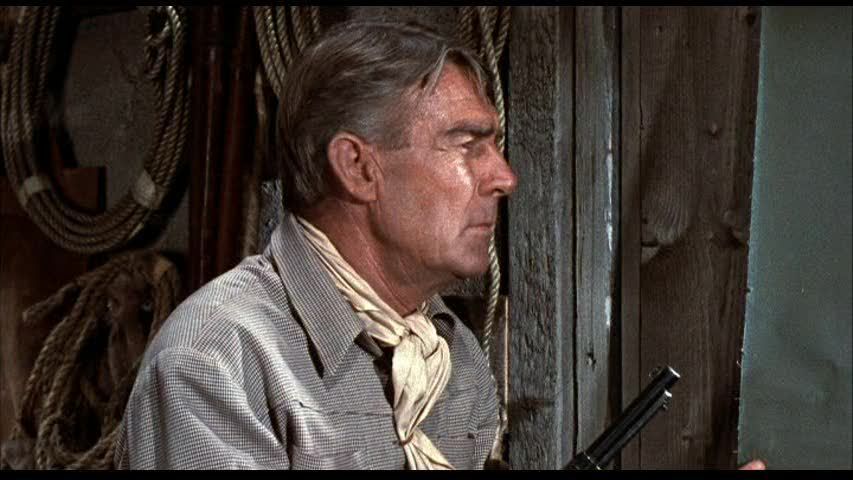
The seven films directed by Budd Boetticher starring Randolph Scott made between 1956 and 1960 are Westerns that behave like few other Western films. It’s hard to describe what is so different about these works; like most Westerns they feature a character who might be described as a “hero,” sometimes with a sidekick as in Decision at Sundown, and villains. There are horses, gunplay, rough desert landscapes, small Western towns, even Indians. There is often a saloon, a tough saloon moll, as in this film, and rigid sense of code that the hero is determined to uphold. On the surface Boetticher’s works sound perfectly in sync with the genre. Yet his films are significantly different.


      First of all the hero seldom behaves with the direct fortitude and surety of characters played, for example, by John Wayne. Wayne’s heroes generally know what they’re doing or, at least, what they’re trying to do, while Randolph Scott’s heroes, in this case Bart Allison, seem to be acting out of years of pain and vengeance based on the death of friends or, in this work and at least one other film, the wrongful death of his wife.

     Decision at Showdown begins rather strangely with Allison riding in a stagecoach, which he suddenly shanghaies, rifle in hand. For a few minutes the stage coach driver, his partner, and Allison seem almost confused as they wait for each other to act. Is Allison pulling a robbery? Is he suddenly determined to take over the coach? Boetticher simply keeps us in suspense until, finally, Allison’s partner, Sam (the humorous Noah Beery) comes riding forward with a second horse. Quite inexplicably, Allison bids the others farewell and rides off.

     Sam apparently has been scouting out the small town of Sundown, discovering the town is controlled by a ruthless businessman, Tate Kimbrough (John Carroll), with whom, apparently, Allison has old business; we recognize immediately that he intends to kill him, we simply don’t know why. By coincidence this day is also the celebration of Kimbrough’s wedding, and despite Sam’s complaining empty stomach, Allison is determined to feed the horses, get a shave, and attend the wedding to which he has clearly not been invited.

      The whole town, with the exception of the local doctor, is determined to attend the affair, and most of the stores are closed down for the event, the hotel bar busy serving free drinks paid for by Kimbrough. As Sam and Allison make their way through the place, various individuals take notice of their presence and speak up against their history—it seems apparent to most that Allison and Sam are Confederate Texans—and their possible intentions. Allison arouses even more suspicion when he refuses to accept Kimbrough’s free drinks, insisting upon paying. But Kimbrough’s sheriff, Swede Hansen (Andrew Duggan) is determined that Allison accept Kimbrough’s free offer, and the film begins with a kind of ridiculous standoff as the silver coins are thrown into a spittoon, neither man willing to give ground.

     When the justice of the peace asks if anyone has objections to the marriage at the church, Allison immediately speaks up, hinting at the despicable nature of Kimbrough and suggesting to Kimbrough’s soon-to-be bride, Lucy Summerton (Karen Steele), that he is saving her from being married to a man who will soon be dead. In short, Allison walks right into the serpent’s nest, stirring up the group of men obviously under Kimbrough’s thumb, and, as he anf Sam attempt to leave the church they are chased into the livery stable in a gunfight that most Westerns would save for the end.

      Accordingly, the hero and his friend are immediately locked up in a sense, and one finds it hard to make sense of Allison’s actions. As Sam, himself, suggests:


                         Sam: You just stood up in church and told Kimbrough you

                                   was goin’ to kill him? Bart, you must be plum crazy!

                         Bart: I’m doin’ this my own way, Sam. For three years I’ve

                                  hunted Kimbrough, but he didn’t know it. Before I

                                  settle with him, I want him to know he’s bein’ hunted.

                         Sam: [after a bullet shot through the window whistles near

                                  Sam’s head] You ain’t huntin’ him no more. He’s huntin’

                                  you.


Once again, Boetticher has turned the usual Western conventions on their head. The hero is all but captured after just a few frames.

     Yet perhaps Allison knows human behavior better than most. By simply speaking out, he commences a series of human reactions, beginning with Lucy’s decision to think for a while before marrying Kimbrough. Kimbrough’s former girlfriend, Ruby James (Valerie French) returns to him, while Kimbrough demands Sheriff Hansen move in on Allison. Hansen and his men are fearful of a direct assault, knowing that it might end in their deaths. Another deputy has already tried to climb in a window, resulting in his forearm being opened with a grapple hook. The doctor (John Archer) is called to provide him with iodine (Bart quipping: “Ain’t it lucky you brought the iodine, Doc?”).

     The two are offered freedom to leave if they ride out of town, an offer which the still-hungry Sam is only too willing to take. As he leaves his friend behind, having suddenly discovered that Allison’s revenge is based by Kimbrough’s affair with his wife, Mary, he attempts to reason with Allison, explaining that Mary was perhaps not the woman Allison saw her as. The comment ends in Allison slugging Sam. After a lunch in the nearby café, Sam is shot and killed by the Sheriff and his friends, the promise of release obviously being a lie.

     Suddenly the citizens camped out in the bar, witness to the murder, begin to realize that the man they have passively supported, Kimbrough, is a deceiver. The quietude they have for long maintained begins to raise feelings of guilt in many of them, and one group, in particular, attempts to make the fight between the Sheriff and Allison a fairer one by removing his deputies.

     A showdown between the two ends with the Sherriff’s death.

     Kimbrough is at his wit’s end, unable to remove the man from destroying his wedding day and possibly ruining his position in Sundown, while afraid to confront the man himself. Lucy herself visits Allison, repeating, in a different form, Sam’s assessment of Allison’s former wife:


                        Lucy: Look, when you’re in love the way you must have been,

                                  the truth isn’t an easy thing to face up to. No man, including

                                  Tate Kimbrough, can take another man’s wife away from

                                  him unless she really wants to be taken. So maybe you didn’t

                                  lose anything that was really very worthwhile.


Once more, the comment ends in a kind of violence, she slapping his face, he spanking her ass.      

     By the time Kimbrough has decided to face down Allison himself, his reputation, along with his power, has been destroyed. After a few drinks, he heads to the street to be met by Allison, but before Allison can kill him, Ruby—still in love in with Kimbrough—wounds her lover in the arm with a rifle, thus saving him from Allison’s wrath.

     One can hardly imagine a movie that ends with the “hero,” still angry over the long ago events, being met by the villain, Kimbrough, now on his way out of town. Everything has shifted, the citizens now ready and willing to retake the responsibilities for their community, vaguely hoping that they can somehow show their appreciation to the intruder.

     Always the loner, Allison refuses their gestures of good will, throwing his whisky into the saloon mirror. As he turns to also leave town, Lucy and the Doctor speak for everyone:


                                    Lucy: John, we just can’t let him ride away. If it wasn’t

                                              For him….

                                    Doc: Yes, he changed things for everybody in town. But,

                                             unfortunately, there’s nothing we can do for him.


    Seldom has a Western ended in a world so relativistic, with a hero who can help everyone but himself. His values, strangely, were perhaps the right ones provoked by the wrong situations. Accordingly, while moral values have been restored to Sundown, at sunup Allison will only be faced by a deeper quandary wherein justice, as he knows it, can no longer be served and wherein he himself has been duped by an innocent pride.


Los Angeles, October 10, 2012

Reprinted from International Cinema Review (October 2012).                                               


Index R-Z

Angelo Raaijmakers I, Adonis / 2021 Peeter Rabane Firebird / 2021   Tyler Rabinowitz Catalina / 2022 Tyler Rabinowitz See You Soon / 20...