Saturday, April 12, 2025

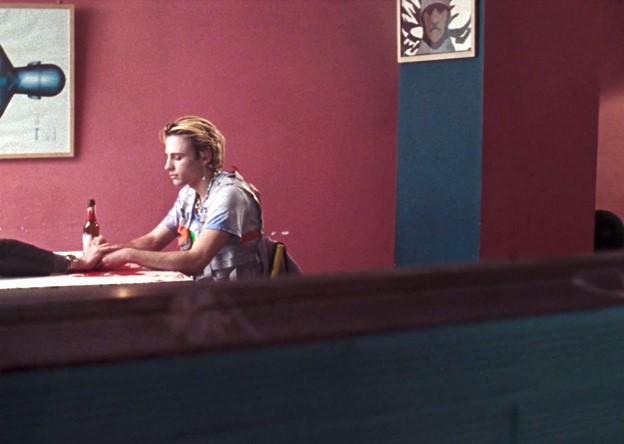
Matthew Allen | Sunday Morning / 2017

torturing the vulnerable

by Douglas Messerli


Matthew Allen (screenwriter and director) Sunday Morning / 2017 [45 minutes]


California-born Matthew Allen has written and directed a very personal and moving film of a young man going through the difficulties of many gay boys coming to terms with their sexuality at age 16 or 17. This young man Sean (Tristan McIntyre) has other problems facing him as well. He is adjusting also to life in a single-parent household, and trying help his two sisters Hayden (Francesca Calvo) and particularly his younger sister Molly (Molly Allen) also come to terms with a life without their father.


     Sean, fortunately, is popular and plays on the school lacrosse team, but finds his own teammates to be fairly homophobic when it comes to a new player who’s joined the team James (Ethan Haslam), whose parents are undergoing a brutal breakup with loud arguing every night. Sean’s mother, Heather (Summer Moore) asks her son to befriend the older boy James given her son’s own recent experiences, hoping that he might help the boy. Invited to a drunken sports party at team member’s Kyle’s (Edmond Truong) house, Sean surprises his friend by paying especial attention to James, and even accompanying him home.


     Indeed, Sean finds himself attracted to the supposed “gay” boy and even dreams about him, and the feeling seems to be mutual. In fact, their relationship might have developed into something positive, even a shared love with sex; but James is also a spoiled and impatient child used to getting what he wants, and as a pretense to help keep his parents’ evening fight from enveloping him, asks if Sean can stay over. The next morning, he makes a move on Sean, basically raping him.


    Allen, himself a survivor of just such an experience, sympathetically portrays the reactions of Sean who, after surviving simply the violence of such an act, must now face a very different James, who carefully manipulates him through threats to reveal Sean’s sexuality that will affect, so he claims, even his sister Molly, forcing Sean to return to him and provide him with further sexual acts. As James argues, “I don’t give a fuck at this point; people can know about me, but I know it matters so much more to you.”

    The previously well-adjusted young Sean becomes depressed and silent, crying himself asleep and being privately terrorized by what has suddenly happened to him. It is as if through his own sexual desires he has become entrapped in something much larger that threatens to divide him from his other friends and result in scandal for and hate from his own family.

     Eventually, even Sean’s mother begins to suspect that James has done something to her son. And when he runs to his room in anger one day, his older sister follows, allowing to confide in her that he’s gay. This loving event permits Sean to come to terms with himself in a beautifully-lit dream sequence. He finally is able to tell his mother, who not only supports him but still believing that James in involved in her son’s despair is ready to act upon it.


     Sean not only is able to come out to his mother but has now found the fortitude to face off with James himself, refusing any longer to be intimidated. Although it is clearly understandable, I do wish that Allen’s character needn’t have resorted to violence, punching out his rapist as he does. What about those of us who never learned how to fight?

     Moreover, what about those many young men and women who don’t have such supportive mothers and sisters (let alone father) as Sean has? Allen cannot answer for all situations. He has shown us an example, clearly, close to his own experience.

     But what we finally realize it is just not bad enough for such vulnerable individuals as young LGBTQ people coming terms with their sexuality, and who must then face rape and threats that makes it almost impossible for these people to come to terms with their own feelings. Even worse, we know statistically that such incidents as rape often occur within the family itself, wherein revelation of the self or other has even higher stakes.

     As Allen himself has noted, “isn’t something usually told.” But by keeping it secret, as this character himself does, it only permits others to abuse and manipulate young men like Sean.


Los Angeles, September 12, 2023

Reprinted from World Cinem Review (September 2023).


Atefeh Khademolreza | Meteor / 2023 [documentary]

speaking the truth

by Douglas Messerli


Atefeh Khademolreza (screenwriter and director) Meteor / 2023 [10 minutes] [documentary]


There are very few movies like this one, a surrealist film about a relationship between two individuals in the repressive Iran, from which the narrator escapes to Canada, leaving behind the friend who has apparently been struck down by AIDS.


     Through animation and other images, the film conveys the reality that such behavior is not only outlawed but that HIV-positive figures are given no permission to survive, that in fact the punishment is death. The narrator leaves the friend behind to find freedom somewhere else, but the sickened former partner stays behind, developing a relationship with a man, only to fall further into illness and die.

     This is a very short work, which because of its digitally-created images does not permit us easy entry to the couple’s former relationship, but movingly documents a world, nonetheless, of which we know so very little. The images themselves hint at a world so closed off and lost that we can have little entry into it.

     When the narrator’s friend dies, his parents claim he has suffered from COVID-19, failing evidently to reveal his true condition, which is quite apparently AIDS. Here, at least in a kind of sketch of the situation, we get a glimpse not only to that problem but through the lens of a culture that is utterly hostile to even recognizing the problem. Today, of course, one wonders whether it would be much different in the US. Speaking truth is nearly impossible today in so many countries.


Los Angeles, April 12, 2025

Reprinted from My Queer Cinema (April 2025).

Friday, April 11, 2025

Dominique Preusse | Un vrai mec (A Proper Man) / 2020

moving backwards into reality

by Douglas Messerli


Dominique Preusse (screenwriter and director) Un vrai mec (A Proper Man) / 2020 [22 minutes]


This lovely short film takes us through the life of a rather confused young man, Étienne (Adrian Lestrat) as he attempts to deal with the fact that despite his macho attempts to prove himself desirable to women he is not only attracted to males, but, in fact, himself loves being fucked.

     It’s a long-told story, but this film works backwards from the break-up of his current female affair as she declares she has contracted Chlamydia from him or perhaps her own outside affairs given his apparent disinterest in having sex with her.


    The film moves backwards, moving its central figure literally in a backward movement—far too obviously and not truly necessary—through an exploration of his many past affairs and relationships including with his male lover, with whom he usually performs as the “top,” but with whom he also discovers he would prefer to be the “bottom.” There are several women, an impossible mother (a regular trope in such films) and a surprising girl-boy with who he meets up evidently on a chat line. This female also challenges him to show her he is a “real” man.

     Everyone in this film seems to have a truly different notion of what it takes to be “a proper man.”

     Of course, it takes Étienne the length of the film to finally take the four pills he needs to begin to rid himself of the disease and to dance into the terms of his true sexuality.

     This French film is not subtle, and it’s been expressed in numerous other variations, but still it’s truly watchable and significant in the constant attempt of young men to try to balance notions of male virility (something I’ve never been interested in) with their desire for male sexual involvement.

      At least in this film it appears that the young hero escapes into his own identity.


Los Angeles, April 11, 2025 / Reprinted from My Queer Cinema blog (April 2025).

Matt Wolf | Another Hayride / 2021 [documentary]

healing without a cure

by Douglas Messerli


Matt Wolf (director) Another Hayride / 2021 [18 minutes] [documentary]


For those of you who never experienced rural life in mid-century US, a hayride, as described by the Merriam-Webster dictionary, is “pleasure ride usually at night by a group in a wagon, sleigh, or open truck partly filled with straw or hay.” In the small town in Iowa where I grew up, church groups commonly brought together young teenagers in such a festive evening, which involved some controlled flirtation perhaps between the sexes, but mostly consisting of a possibility of open-air if bodily contained conversation.


      Its later urban meanings take the term in all sorts of sexual directions, the most common being a sexual meeting up in a hayloft or barn between boys—just a couple or even more. But for me it also connotates the idea of being “taken” for what appears will be a pleasant ride which quickly becomes something far more nefarious and unpleasant. It might promise a pleasant social engagement but just as suddenly involve a robbery or even a rape for the naïve individual who has willingly agreed to take the journey.

      It’s ironic, accordingly, that such a term might be used by self-help guru Louise Hay, who in the mid-1980s, when gay men suddenly began dying from a new disease not yet fully comprehended and basically ignored by city, state, and the national authorities. Even most doctors could not yet fully explain the causes of or full effects of being HIV-positive or having contracted a full-out case of AIDS. Believing it to be a contagious epidemic or a disease that struck down only sexually active gay men, friends and family often turned away from those who stricken, family members often becoming aware of their son’s sexuality only through the pronouncement of what was generally perceived as a death sentence. As Albert J. Bresson’s film Buddies makes clear, by 1985 New York City was only beginning to have opened up AIDS clinics, which makes clear throughout the rest of US there was virtually no one to turn to.


       Matt Wolf’s truly informative documentary takes us on the real “hayride” journeys of Louise Hay, evidently a well-meaning woman, a former model, who felt that she had herself been cured of cervical cancer just by ridding herself of bad thoughts and focusing on forgiveness and love, along with good nutrition and other home-healing remedies. Already in 1976, she had written a pamphlet on her self-cure methods, Heal Your Body, listing different ailments and their supposedly metaphysical causes. And by 1984, just when gay communities were truly beginning to have to face the concerns of AIDS, she published You Can Heal Your Life, which quickly became a bestseller.

    Wolf’s film recounts how Hay immediately began to focus on helping members of the gay community at such a terrible moment, meeting with a few young men in her home, describing the sessions of her West Hollywood, Los Angeles home as “hayrides.”

      Without any medical possibilities of a cure, gay men begin to invite friends, even those not currently HIV-positive, to what Wolf’s film’s narrator, David Ault, describes as something that seemed close to a religious or church event. The narrator, having recently moved from a small town to Los Angeles and feeling quite alone, suddenly runs into an old school friend on Melrose who asks what he’s doing Wednesday night. “And I thought he was inviting me to church. Truth be told, I had enormous crush on him.”


       Before long her hayrides had expanded into large gay gatherings of 600 individuals with her leading healing sessions, with Hay arguing—just as she later did on talks shows with Oprah Winfrey and Phil Donahue—“I don’t heal anybody. That’s not what I do. I just provide a space where we can uncover how absolutely wonderful we really are. And they are able to heal themselves.”

        The narrator admits that he was immediately “hooked,” discovering the true meaning of cultivating your own family. He points out that, at first, he found it very empowering because if he could possibly, through his own thoughts, have given himself AIDS, then he might also be able to take it away.

        In times of desperation, logic was tossed out. Hays continued to argue against the current medical opinion that AIDS was simply fatal. She insisted that “we know that not to be true,” without providing, of course, any evidence of long-term survival other than those of her “hayride” who had felt stronger for periods of time, lasting even years. One figure, whose disease had evidently been reversed, did appear with her on her talk shows.


       The new age guru spoke primarily of the limitations of the mind, and the body to mind relationship, issues that have long been known to be actual factors in the longer survival of ill individuals. She spoke, moreover, authoritatively with a reassuring and motherly voice. In her signature method, the “mirror work,” the individual peering into the mirror while repeating “I am willing to change,” the very same exercise that the gay guru of Todd Haynes’ film Safe (1995) imposes upon his suffering disciples.

         Yet, watching her lift so many people out of an unprecedented despair, “a pandemic, a violation of humanity,” the narrator notes that it found it impossible not to admire Hay’s work. “Your savior is right here in the mirror,” repeats Hay, seemingly giving her “disciples” all the power. And how can one not be touched by seeing young handsome men realizing how many times they’ve told themselves to “hurry up and die,” finding new hope in Hay’s approach. The narrator became swept up in what he himself jokes was Hay’s “New Age boy band,” an act that proceeded her own entry into the auditorium, a technique well known by self-promotion evangelists as early as the 19th century and used in the 20th by figures such as Dwight L. Moody, Billy Sunday, and Aimee Semple McPherson. The narrator is further involved in that Hay became just like a mother to him, noting that he’d never had that kind of parental love before.

         As The New York Times reporter Mark Oppenheimer put it, if it hadn’t been for AIDS, Louise Hay would be just another woman teaching workshops on how to love yourself. And gradually as even her gay advocates began to perceive, their peers were still dying in large numbers. The film’s narrator remembers attending 70 memorials in a single year. All the self-healing in the world wasn’t stopping the horrific march of the dread disease.


         Even the narrator finally admits that there as a vast difference between “curing and healing,” and whatever pure intent Hay had in helping the community she couldn’t stop the medical realities which she had herself denied.

         One gets the sense, however, that even Wolf’s revealing documentary dares not explore the evils that Hay truly committed, that in partially blaming the victims themselves for their own disease and asking them to cure it, she deflected the attention these same individuals and others might have put into forcing the government to more fully fund research and demanding the medical profession become more transparent in their efforts to find a cure and resolve their seemingly unresolvable fears. Despite laying on a hospital bed dying, the focus of Bressan’s remarkable 1985 film Buddies was not self-blame, but justifiable anger that led to protests that might, in turn, lead to action which could help to save other lives. Upon the hero’s death, his new buddy, takes the first train to Washington, D.C. and, placard in hand, marches before the White House, an act that may have seemed meaningless, but in reality was the beginning of what changed everything.

         Hay died in her sleep in 2017 at age 90, without perhaps ever coming to terms with the fact that had she spent even 1/3 of energy she spent looking into the mirror by looking into the eyes of men like Reagan and promoting the activities of groups such as ACT UP she might have truly benefited all those sad young dying men.


Los Angeles, November 16, 2023

Reprinted from World Cinema Review (November 2023).


Osama Chami and Enrique Gimeno Pedrós | El joven Diego (Young Diego) / 2021

the cannibal

by Douglas Messerli


Osama Chami and Enrique Gimeno Pedrós (screenwriters and directors) El joven Diego (Young Diego) / 2021 [7 minutes] 


Living as we do in a world of the virtual, have we forgotten the realities of “real” or actual behavior with its often terrifying results? Do we now perceive true statements as being merely metaphors of experience?

     These are the kinds of questions that Spanish director Osama Chami, the former production assistant to Pedro Almodóvar and his filmmaking partner Enrique Gimeno Pedrós ask in their 2021 work Young Diego. As in their earlier film, According to Mateo, it is clear that these two writers/directors are interested in exploring the grey area between pleasure and pain, or even experiences of life and death.


     The titular young Diego (Iván Pellicer) is sitting in a café, evidently the meet-up place he has arranged with an older man (Quim Ramos). His cellphone rings and, as he picks it up, immediately cuts off, the voice the man heard without apparently even Diego being able to see him, since he asks if he is watching him?

     The man is surprised that the boy has remained, expecting him to go. But Diego explains that he is staying, the man having previously told him that if he ever gets truly depressed, he should look him up; he would know what to do. The man asks again if he remembers what he told him that he wanted to do. Yes, Diego recalls, “You want to eat me.”

      The man explores the statement. What did you think? Did it turn you on? Diego replies only that he thought it was “strange.”

      “Do you like me?"

      Diego responds, “I like your voice. Do you like me?"

    The man explains that he has been watching the boy since he arrived. He imagines his dry and bruised lips. His fingernails that are no longer there since he bitten them off. It turns him on. “I’m hard right now.”


     When the voice tells him that he really likes him, the depressed boy begins to sob, the man telling him not to make a scene, that he must stop.

      A man enters the shop and quickly moves to Diego’s table, sitting down across from him, explaining to him that he is there to calm him down. “We can’t draw attention.”

      Diego stops, apologizing. He didn’t imagine him like he is: tall and handsome.

      “Are you scared?”

      Diego pauses, but responds in the negative, the man reassuring himself of Diego’s resolve, “If you don’t want to go ahead we don’t have to do it now.” They agree, the man will leave first and Diego will follow.


     But suddenly we realize Diego’s lack of comprehension, asking if he might drop him off afterwards to pick up his bicycle. The man asks for the key to the lock to see if the bike might fit into the back of his grey car. Because of several clips interleaved into the scenes throughout this conversation, we already know that the bike does fit and that likely Diego will not return. But does he perceive that? What does he imagine their encounter might consist of? Does he imagine a kind of S&M experience? Certainly, he seems not to have taken the man’s words literally.

        The question remains: should we?


Los Angeles, December 18, 2022

Reprinted from World Cinema Review (December 2022).

Christian Flashman | Alfie in Love / 2020

queer seduction

by Douglas Messerli


Moss Perricone (screenplay), Christian Flashman (director) Alfie in Love / 2020 [19 minutes]


Perhaps one of the strangest of LGBTQ films I have seen is Orange County, California Christian Flashman’s 2020 short film, Alfie in Love.

     None of it is quite believable, but it’s nice to imagine a situation when, after breaking up with someone (the sex is never identified), a young man, Alfie (Matt Gomez Hidaka) retreats to a lovely Bed and Breakfast run by a rather bizarre woman, Talia (Mia Hjelte), a woman who evidently his mother knows.

     What Alfie doesn’t realize is that at the same Bed and Breakfast a slightly older man Leopold (Char Smith) is also residing. Leopold might be described as a Bed and Breakfast serial seducer since he picks out hosts and their residents to sexually seduce, Talia obviously representing his newest intended victim.


      If writer Moss Perricone’s script hasn’t already gone beyond rationality, it gets far stranger as we gradually discover that Talia is herself a kind of serial seducer, who likes to play strange psychological sexual games, beginning with one in which she demands Alfie get naked—he understandably only strips off his shirt—while insisting that Leopold take a knife, running its tip down the center from the forehead straight down to the groin of the young man. Quite inexplicably, these men follow her instructions. It is a game of trust.

      But Alfie is predictably nervous, and when the knife point reaches his stomach he jolts, permitting the knife to enter and serious wound him.

      Instead of immediately abandoning the nightmare Bed and Breakfast, however, he remains, quite obviously having fallen in love with the handsome Leopold.

       A day or so later, Talia introduces another game, where at the breakfast table to the two men must explain their first sexual awakening, Alfie describing that as a masturbatory youth he was sensitive to vibrations and since his room was over the garage he would click on and off the garage door—until one day it fell unto a man’s foot, breaking it.

       Leopold doesn’t wish to play, but is still forced by Talia to go face to face with Alfie. And soon after she plays a rather nonsensical game in which the two men are supposed to jump into the pool, blind-folded, to find a pearl, which places in her own ear.

       There, she kisses both of them on the lips, Alfie backing off, Leopold enjoying her attentions until suddenly he too realizes he is attracted to the young boy. They kiss and the film folds to its illogical conclusion. I presume the two might finally decide to share their beds, not only their breakfasts.

       Yet, somehow, for all its ridiculous plot twists, this film appears somewhat charming as Thalia seduces these men into each other’s presence. At least, she found away to push off Leopold’s advances. And Worn-Tin’s musical score lends this film a slightly sickening, disorienting experience that hints at the great movie-composer Bernard Herrmann’s collaborations with Hitchcock and others.


Los Angeles, April 11, 2025

Reprinted from My Queer Cinema blog (April 2025).


Wednesday, April 9, 2025

Ford Fairchild | Guilty as Sin / 2024

the halo don’t fit

by Douglas Messerli


Chris Housman (composer and performer), Ford Fairchild (director) Guilty as Sin / 2024 (3 minutes) [music video]


If you thought gay country performer’s Blueneck of 2024 was hot—and it was—then you need to hear and watch his music video of the same year, Guilty as Sin, in which he falls for an equally “blueneck” country boy (Gabe LaDuke).


     I can’t tell you what it means to a city boy to hear a country western singer express his love so very openly in a world that doesn’t truly want to accept that vision. It’s a wonderful sense of liberation to hear such lyrics as Housman croons out:


Tried to fight it

To deny it

But every single night it’s the same desire, same damn fire


Smoked a little

Tried to pray

Knew it was you the moment I felt this, baby I’m helpless


I can only resist for so long


I gave it my best

But this halo don’t fit

If I had to spend forever in heaven without you might as well be in hell

My verdict is in

Cause baby if loving you is wrong

Then I’m guilty as sin


I’m done pretending

Cut the tension

Ain’t no use in us acting like, this ain’t right


I need your body

Heavy on me

I’m always falling back to your gravity, it’s pulling me


And I can only resist for so long


I gave it my best

But this halo don’t fit

If I had to spend forever in heaven without you might as well be in hell

My verdict is in

Cause baby if loving you is wrong

Then I’m guilty as sin


I can only resist for so long

I found holy right here in your arms


    For a gay man to hear this in country western language is almost magical. These tattooed country men may not represent my style or way of living, but they mean so much more for their open expression of love. I find that increasingly interesting. People I might have before even imagined as speaking for gay, trans, and other LGBTQ causes, coming forward out of the dark woodwork of the red states, expressing something I had never imagined possible. The LGBTQ community exists everywhere in the cracks of our civilization, and now are coming out to sing and speak their desires. I cried with joy.


Los Angeles, April 9, 2025

Reprinted from My Queer Cinema blog (April 2025).


Index R-Z

Angelo Raaijmakers I, Adonis / 2021 Peeter Rabane Firebird / 2021   Tyler Rabinowitz Catalina / 2022 Tyler Rabinowitz See You Soon / 20...