Sunday, June 15, 2025

Izzy Sparber | Popeye the Sailor: Shape Ahoy / 1954

the charms of olive oyl

by Douglas Messerli


Jack Ward and Irving Dressler (screenplay), Izzy Sparber (director) Popeye the Sailor: Shape Ahoy / 1954


Bluto and Popeye have finally made a truce and are vacationing on their perfect misogynistic work, a garden of he-men, where you can pile up the beer can and remnants of former meals without even worrying. They share talk of their new Eden.


     But it’s just at that moment that Olive Oyl appears on a shipwrecked raft, and both are given the opportunity to reveal their hypocrisy. Olive is hungry, and together they tell her to find her own food, but separately both pour food down her invisible gullet, not even showing up as a limp in Olive’s stick-figure profile.

     When Olive goes swimming, singing “I’m in the mood for live,” both men dive in and apparently do some serious smooching before their rise to the surface in one another’s arms. Obviously Bluto and Popeye are the unexpected lovers.


      It doesn’t take long, even without Popeye’s Spinach, for the two to start battling it out, this time with the truck of a palm tree.

      Olive Oyl, however, is not even around to see their attempts to win her, as the camera pans to a young singer, clearly a cartoon version of a very young Frank Sinatra, before which Olive has already swooned.


      Presumably, with some regret, but with deeper commitment, Bluto and Popeye have no choice but to return to the Bachelor’s den, or as Ray on Letterboxd deems it, their “Garden of He-den.”


Los Angeles, June 15, 2025

Reprinted from My Queer Cinema blog (June 2025).


Ryosuke Hashiguchi | 渚のシンドバッド(Like Grains of Sand) / 1995

kicking up the sand

by Douglas Messerli


Ryosuke Hashiguchi (screenwriter and director) 渚のシンドバッド(Like Grains of Sand) / 1995


Perhaps the literal translation of the Japanese title, “Sindbad of the Seashore,” is more appropriate that the soap-operaish title it finally received, Like Grains of Sand. For Hashiguchi’s 1995 film about high-school youths is anything but sentimental or romantic, and it looks on nonjudgmentally for what seems, at times, an eternal whirlpool of confusions, chaos, and joys for which there appear to be no borders, little pause, and no end in sight. Adolescence, as Hashiguchi makes clear, is not a narrative with a beginning and an end, but a seeming mish-mash of events that hit and cut at all individuals from 15-18, affecting their entire lives.  

    Asian Movie Pulse reviewer Ritesh Sharma nicely summarizes the conditions of two of the major 5 figures of this film:


   “The story revolves around a group of five high school students in suburban Japan, each dealing with internal conflicts that society has neither the language nor the patience to understand. Shuji [Ito], (Yoshinori Okada) the central figure in this narrative constellation, is a quiet, introverted boy silently grappling with his attraction to his male best friend, Yoshida. His inner world is a terrain of shame and longing, two emotions that Hashiguchi portrays not through grand speeches or confessionals, but through lingering silences, loaded glances, and the unbearable awkwardness of unspoken truths."


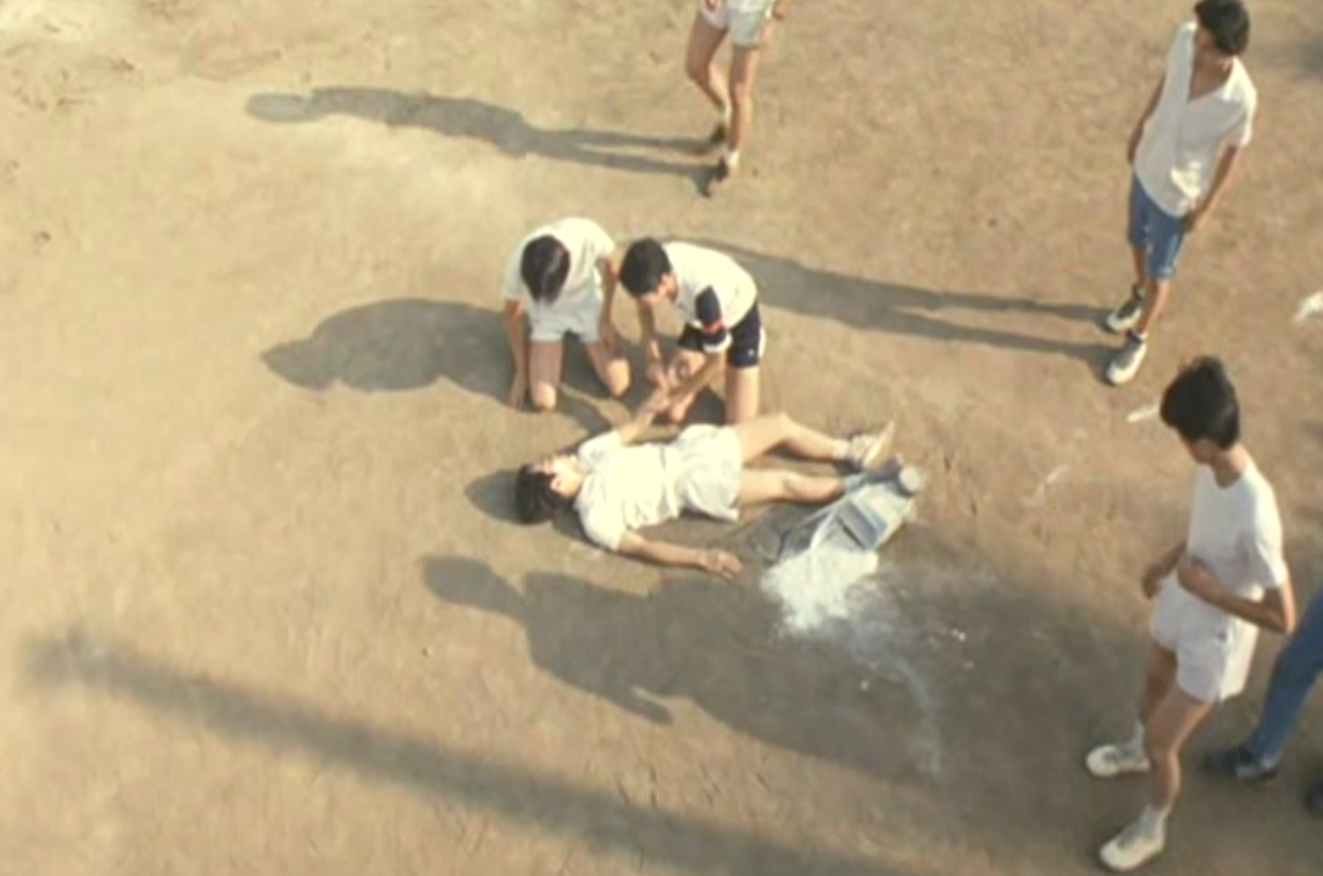
      Within four minutes of the beginning of this movie, Shuji has already passed out on account of his close proximity to his beloved friend and the chalk dust their coach as sent them to retrieve from a small storehouse.

      “Meanwhile, we meet Kasane, a new girl at school, who arrives with a guarded demeanor and carries with her the invisible baggage of a deeply scarring trauma. While most films might reduce such a character to her backstory, Hashiguchi is more interested in how trauma shapes a person’s interaction with the world in the present. Kasane is quiet, emotionally distanced, and often treated with suspicion or cruelty by her peers for being different. But through subtle narrative layering, we begin to understand the source of her guardedness and how much strength it takes for her to show up in the world every day.”

      The others include the boy with whom Shuji is in love, Yoshida (Kōta Kusano), unaware at first of Shuji’s feelings for him; the film’s awkwardly rambunctious comic figure, Tōru Kanbara (Kōji Yamaguchi), whose behavior often hides his truly tender and sensitive nature; and the insecure Shimizu (Kumi Takada), who Yoshida is currently dating.

       We also witness some of their home lives or at least the world outside of the school of the three major actors of this comic drama, but for the most part, as in West Side Story, with which this film might strangely be compared, there is little adult supervision or guidance, and when it appears it is inappropriate or utterly meaningless. This is a film about youths having to daily deal with vortex of waves of emotion (and bodies of water eventually become important to this movie) in which they feel they are daily drowning.

       For the most part, however, instead of becoming a loud screech of terror, Hashiguchi’s film, for the most part, is played out in evasion, uncompleted sentences, and silence.

       As Sharma’s insightful review observes: “There is no singular ‘plot’ in Like Grains of Sand in the conventional sense. The film isn’t concerned with propelling the story forward, but rather with allowing the characters’ lives to unfold in their own time. It’s not about finding a destination but about observing the quiet detours and dead ends that define teenage existence. In doing so, Hashiguchi captures something fundamentally true about adolescence: that it is not merely a phase of self-discovery, but often a prolonged state of confusion and invisibility… The pacing [of the film] is deliberately slow, almost stalling at times, and that works in its favor. Adolescence is often a time of inertia, where emotions swirl within but life on the outside appears deceptively still. Hashiguchi captures that tension with piercing clarity.”

     Since there is no real plot, I am freed from having to account for a logical narrative. What I need share with the reader is a few significant moments that help to explain and define the rest of the narrative-in-awash.

     Perhaps the most important moments of the film are when his fellow student peers begin to perceive Shuji’s puppy-love admiration of all things to do with his friend Yoshida. Their mutual awareness begins, as in many cases, with a satiric drawing in chalk upon the classroom blackboard, which quickly intensifies to the usual bullying of Shuji in front of the entire class, most of the others laughing and enjoying the scene or, in the case of Tōru or Yoshida, standing in terror apart from the others, afraid that any intervention might also label them as being gay, or particularly in Yoshida’s case of being a gay accomplice.

     It is Tōru who first moves to the fallen victim, advising him never to argue with such torturers, for they will always win, but to try to simply ignore them—a near impossibility in Shuji’s mind.


     Soon after, when the others all leave, Shuji finally faces Yoshida and reveals that it’s all true, that he doesn’t just “like” his friend, but “likes him in a special way,” not even having the full language yet to describe love. Yoshida attempts to accept the new love, finally, after some debate and embarrassment, allowing Shuji to kiss him, but his pushes back make it quite clear that his friend’s feelings are not fully accepted, or in contemporary parlance, that he is straight and intends to remain so.

      And a bit later, he discovers that someone has attached a trinket of a trombone, the band instrument Shuji plays, on his bicycle and he tosses the whole bicycle into the water as if he is totally disgusted.

     A short while after, Shuji’s father, raising him alone, drags him to the local psychiatric clinic where the doctor simply explains that they no longer treat homosexuality as a medical disease, in some ways forcing the inattentive father to back off, although Shuji does now regularly meet with the doctor—at one point asking the terrifying but necessary question, “Am I weird?”—and putting him, surprisingly, in the same space as fellow student Kasane, who he and Yoshida don’t discover until later has been raped the previous year in another school she attended, which explains some of her remote-seeming behavior.      Shuji and Kasane, certainly the outsiders of their school, develop a friendly rapport with one another, speaking words that they seem unable to share with the others, Kasane even describing how to visit her in her hometown, racing through the orange orchard to the ocean for a swim before finally returning home. Together they also mock the “ooo’s and ahhhs” seemingly required for true heterosexual love-making.


     What we may have forgotten is that earlier in this film, Tōru has expressed an interest in Shimizu and his friend Yoshida in the school new-comer Kasane. Either by accident or intention, Shuji now arranges to “accidentally” meet up, while pretending to date Kasane, with Yoshida and Shimizu, Yoshida at first quite confused by even seeing his friend date a woman, but also sharing more rapport with Kasane than with his movie-date Kasane, whom he basically ignores.

      A short time later, Shimizu ends up on the roof with Tōru, another “accident” one can presume that was arranged by Shuji.

      Yoshida now also visits Kasane, attempting to initiate sexual contact; but after his rejection of Shuji and his direct, almost brutal approach to her regarding his feelings, she explodes in a mad rejection of his behavior.

      It is the end of the year, and the school band director has chosen to abandon his plans to compete in a competition of local bands, instead serving to host the others. Of the seniors only a few, Yoshida and Shuji among them, are helping with the hosting.

     Since the event with Yoshida, Kasane has been missing, only Shuji aware that she has returned home. Overhearing other local school band-members talking about Kasane’s rape, Yoshida finally comprehends the girl’s behavior and wishes to simply apologize for his own near-rape. He confronts Shuji about her whereabouts, but refuses to even discuss his reasons for wanting to know.


    Nonetheless, Shuji finally insists he will take his dream-lover to her, as Yoshida follows, the two traveling by train to the town, running through the orchard and pausing at the seashore, leading Yoshida to believe Shuji has only taken him on a wild goose chase. He seeks out Kasane and finds her nearby, apologizing for his behavior.

     But that is not enough for the now much wiser Kasane, who perceives that Yoshida loves her only because she is a woman he can fuck, that real love, such as that expressed by Shuji, has been rejected, that Yoshida too is a mere male brute, like so many of the others of his age, just seeking out sex, not real love.

     She temporarily escapes him, going for a swim in the ocean waters, while nearby Shuji has put on her dress, the two of them temporarily reversing position in their searches for understanding of the shifting world around them.

    Yoshida comes across them, furious to see Shuji dressed as a woman, yet trying to plead again with Kasane for love, since she is a woman. Testing him, she finally gives herself up to him, lying passively in the nearby brush as he begins to mount her. But he soon finds it impossible to continue and, putting his head upon her belly, breaks into tears.


     Meanwhile, the Sindbad of our tale has entered the ocean, a frightening event since he clearly cannot swim and is fully clothed in Kasane’s dress.

      With Kasane’s insistence, Yoshida swims out to save him, bringing his body back to shore. Yet Shuji is still unresponsive, and Yoshida must enter air through his mouth, which in this case, appears more like a kiss. Only upon the third “kiss,” does Shuji “come back” to life, commenting about Yoshida finally being able to demonstrate his love.


     Now disgusted with both males for their self-deceptions, Kasane begins to kick and throw sand upon them, dropping it upon them through their hair and kicking it up with her feet almost as if it were a strange Christian rite related to the rending of ashes. She finally sits between them, doing the same thing to herself, all of them purging their bodies of the errors of their ways. The film ends in this surreal ritual, all of the three central figures realizing how they and the society which they live embrace delimited notions of love, that hatred and fear of homosexuality is directly connected to male abuse and misogyny of women.


     As the two males return via train back to their free summers, they are still confused, perhaps stunned by what they might have learned; yet Hashiguchi offers us no narrative catharsis, not even solutions to their feelings of love; but we know now that they will suffer through the rest of their adolescence with a wisdom the others do not and may never possess. If tears stream down our cheeks it is not simply in the recognition of what they have “come through,” but what we ourselves have needed to recognize in becoming full adults. Those without that recognition will perhaps not enjoy this film.


Los Angeles, June 15, 2025

Reprinted from My Queer Cinema blog (June 2025).

Friday, June 13, 2025

Sam Liddell | Blue Kiss / 2024

the cold goodbye

by Douglas Messerli


Sam Liddell (screenwriter and director) Blue Kiss / 2024 [11 minutes]


British director Sam Liddell’s 2024 film, Blue Kiss might be difficult to comprehend if one didn’t have an introductory statement, as my film provided me. It’s not that the short movie is complex—it is one of the simplest films I have watched in a long while. But, frankly this work is a bit incompetent in its revelation of connections.

     Gay dancer Joe (Harry Jenkins) has just had a sexually fulfilling night with a hookup (Brandon Rogers) and wonders if his bed mate might want a little breakfast before he leaves. The hookup makes it clear that he has no time for breakfast, but has no intention of meeting up again with Joe with lines such as “I’m not looking for anything serious,” and “I already have friends.” However, unable to find his own pair of socks, he borrows a pair from Joe, which of course requires him to meet up again with his one-night-stand.


     What Liddell’s short work is somehow unable to explain openly is that, as the publicist explains, his hookup also lives in the same “hoodie” where Joe last met up with his former lover, Henry (Harry Bailey), who, the director reveals in a flashback, on his way to London, seeming in a big hurry, leaving weeks before Joe has previously been told of his departure. Their rather rushed goodbye is so unsentimental on Henry’s part that you have to wonder whether or not he’s seeking to get away from Joe or being sent to London by his parents to get Joe out of his system.

      The cold goodbye, which would have perhaps been a fit title for this film, is so icy that Joe’s quick kiss is almost missed.

       At film’s end, accordingly, cute dancer Joe is once more alone and wondering why no one he meets is willing to invest themselves in even a part-time relationship.


       If some viewers seem to have loved this film, it seemed not only purposely vague to me, but covered ground that by 2024 one might have thought was yawn-inspiring. Only the dancing by Harry Jenkins saves this slight cinematic offering.


Los Angeles, June 13, 2025

Reprinted from My Queer Cinema blog (June 2025).

Lloyd Bacon (director), Busby Berkeley (dance numbers) | Footlight Parade / 1933

the vulgarians at the gate

by Douglas Messerli


Manuel Seff and James Seymour (writers, based on a story by Robert Lord and Peter Milne [uncredited]), Lloyd Bacon (director), Busby Berkeley (dance numbers) Footlight Parade / 1933


By coincidence, the same week in July when Howard and I attended a local large screen showing of James Cagney’s Yankee Doodle Dandy, Netflix sent me a DVD of Cagney’s 1933 film, Footlight Parade, enabling me to see Cagney as a hoofer twice. He got far more screen time and far better dances in Yankee, but as an actor Cagney is more energetic and far more frenetic in Footlight; when the camera’s on him, there’s hardly a moment when the former Broadway director, Chester Kent, isn’t cooking up a new dance, booking a new movie house for his “musical prologues,” interviewing a new cast member, or simply strutting from room to room wherein his mini-factory of rehearsal halls he tries out numerous numbers (both musical and human) simultaneously.


      Battered equally by his producer’s wife, Harriet Bowers Gould (Ruth Donnelly), who troops in an army of would-be protégés (including Dick Powell as Scotty Blair), and the same producer’s nay-saying brother, Charlie Bowers (Hugh Herbert), who would like to censor every act that Kent cooks up, Kent is caught up in a near whirlwind of moment-to-moment changes. The movie, filmed just before the establishment of the Film Production Code, joyfully makes fun of what clearly the writers and directors saw coming, as Bowers demands the dolls—toy dolls, not the real girls—sport brassieres ("...uh uh, you know Connecticut.") at the very same moment that Kent is transforming his scantily clad dancers into yowling cats and the film’s director is dishing out a gay satire in which Dick Powell sings of his love, arms about his cigar-munching musical director, a stand-in for any would-be lover.


      Fortunately, Kent has the level-headed and seemingly unflappable, Nan Prescott (Joan Blondell) by his side, a secretary so confident that the film suggests she could run the place, even if—given the machinations of Kent’s former wife, Cynthia (Renee Whitney) and Nan’s gold digger friend, Vivian Rich (Claire Dodd)—she can’t always be as sure of her man. Fortunately, he’s too busy to spend much time but a lunch date with other women.

      Besides, he has choruses of loving boys and girls at his at the flip of his wrist, and it’s those lovelies that are truly the focus of this film; just to make sure, plain-looking secretary, Bea Thorn (Ruby Keeler), who has secretly (even to her) fallen in love with Scotty Blair, decides to marcel her hair and jump into the larger pool.

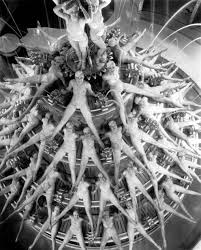
        Although the film was directed by the always sturdy Lloyd Bacon, the dance and musical numbers, at the heart of this extremely light-hearted work, came directly from the overheated imagination of Busby Berkeley, who in this movie went all out in the work’s featured three “prologues,” “Honeymoon Hotel” (Harry Warren, music and Al Dubin, lyrics), “Shanghai Lil” (by the same duo), and “By a Waterfall” (by Sammy Fain, music and Irving Kahal, lyrics). As if the numerous sexual innuendoes of the first song, performed supposedly on-stage in a hotel-sized set, were not enough, Bacon links up the three numbers by busing the girls from theater to theater, while we glimpse them openly changing costumes.


       Berkeley’s “Shanghai Lil” gives Cagney a terpsichorean turn with Ruby Keeler impersonating his Chinese prostitute girlfriend, much in the way that Gene Kelly courted Cyd Charisse in Singing in the Rain.

      But it is in “By a Waterfall,” with Dick Powell croons out his love to Keeler that really gets the full Berkeley treatment and presages his several later Ester Williams musicals. I could hardly describe the scene better that does John Wakeman’s World Film Directors, Volume One.

       “The camera then pulls back to reveal the waterfall itself

with Berkeley girls sliding down it like half-naked nymphs. retreating still further to disclose an immense pool where the girls dive, swim, and float to form geometric patterns that fold and unfold like flowers, separate and rejoin in new shapes, and finally assemble themselves into a multitiered human fountain from which water cascades into the pool.”


     As critic Arthur Knight summarizes, through the dance’s numerous fragmented shots, “It is the camera that is doing the dancing, not the chorines!”

      Strangely, by so forcefully featuring these supposedly “on stage” elaborated numbers, Footlight Parade makes it clear why the footlights of Broadway theater are no longer appealing. Instead of “real” dancers, the camera is now both spectator and spectacle, an observer who in the hands of someone like Berkeley, itself becomes the center of attention. Kent can longer direct his Broadway works because the “vulgarians” are at the gate, the talkies representing a kind of second-hand theatrics that speak in the language of technology instead of true singing and dancing human voice and bodies. Human beings have been collectivized to become the troops of war—a war, in this case, against the live actors featured on the stage.

      It’s strange that this and other Berkeley movies so clearly made it apparent that motion pictures were not what they pretended to be. Yet can any one of us easily turn our gazes away from such cinematic feats?


Los Angeles, July 11, 2017

Reprinted from World Cinema Review (July 2017).


Thursday, June 12, 2025

Sébastien Lifshitz | Les corps ouverts (Open Bodies) / 1998

exploring possibilities

by Douglas Messerli


Sébastien Lifshitz (screenwriter and director) Les corps ouverts (Open Bodies) 1998


This moving 44-minute film by noted filmmaker Sébastien Lifshitz follows the life of a gentle 18-year-old boy of North African heritage, whose mother is French which explains his name of Rémi (Yasmine Belmadi). He is close to his dying father, and gently puts him to bed each evening, as well as cooking for him when his sister is out for the night.


     Rémi, who is in his final year of high school, majoring in management and commerce, also works part-time in an Arab grocery.

     But it is his sex life which this film mostly follows, as he seeks sex mostly with older males, particularly Marc (Pierre-Loup Rajot), who appears to be primarily a wanna-be porn director, who when he comes across Rémi attempts to convince the boy that he is making a real movie, which gradually becomes a porn film, and which ultimately is also left unfinished. 


      Told in a non-linear method, the story makes clear that Marc and the boy end up in bed together, and become regular sexual partners until the older man begins to attempt to control Rémi’s exploration of the world around him, which includes bedding a female street-dancer (Margot Abascal).      

     Rémi finds that he is also attracted to women, but it is men and boys in which he is mostly interested as he now seeks out a porn store with back-room booths, meeting up with rather sweet boy closer to his age (Helmer Lifshitz), who despite the lurid location, with men swarming the halls in their activities of cruising, share a sweet sexual encounter that begins with kisses before it presumably turns into any sexual action, which in any event, we never witness.


    As Lisa Nesselson writes in Variety, “[This] elliptical, fragmented tale traces Remi’s tentative explorations and presumed emotional disarray with nonjudgmental candor. Remi finds himself arguing with Marc and, in one of brief pic’s most interesting scenes, casually reveals to a buddy that his main squeeze isn’t a chick.”

     Yet, despite the positiveness with which the young Rémi meets the challenge of a body open to many difference experiences, when Marc at an early point in the film’s narrative asks him what he plans to do with his life when he graduates, unlike what his dying father wishes for him, a college education, Rémi insists that he has no plans for further schooling, and appears to have no ideas about other future possibilities.

     The fact that the film ends with Marc asking him if he’d be willing to act in a porn film, perhaps asked earlier in their strange relationship, we suspect that given the boy’s societal position in French society as a North African, it may well be that the boy, who even his father suggests is not “tough enough” for the society in which he exists, may end up in the porn industry or some other occupation that would have been shameful to his doting father.


      Although seemingly open to all sorts of possibilities, the boy simply doesn’t have the imagination, it appears, to escape the closed doors of his future, which at moments, with tears flowing down his face, it appears the open and ready Rémi already perceives.

      Fortunately, Lifshitz’s work is not that film, but a peek into the life of a still sexually-fluid boy who is attempting openly to discover who he might be.

      The film won the prestigious Prix Jean Vigo for 1998.


Los Angeles, June 12, 2025

Reprinted from My Queer Review blog (June 2025).

Index R-Z

Angelo Raaijmakers I, Adonis / 2021 Peeter Rabane Firebird / 2021   Tyler Rabinowitz Catalina / 2022 Tyler Rabinowitz See You Soon / 20...