Sunday, November 17, 2024

Wallace Potts | Le beau mec / 1979

the sexual saturation of narcissus

by Douglas Messerli


Karl Forest and Wallace Potts (screenplay), Wallace Potts (director) Le beau mec / 1979


For those in the know, Wallace Potts, who directed this utterly fascinating documentary on one of the first of France’s gay porn superstars, is best known for his numerous films of Russian-born dancer Rudolf Nureyev’s performances. His ability to film all these important documentary movies came about because he was Rudy’s lover and close friend for 7 years. A soft-spoken, intensely handsome US Southern boy, Potts wowed not only Nureyev, whose immense ego he was able to balance with his gentle southern drawn and refusal to see himself at the center of events. After their breakup, he eventually attracted the great cinematographer Nestor Almendros into his bed while Almendros while he was shooting Truffaut’s The Last Metro  (previously having filmed Rohmer’s “Six Moral Tales” series, La Marquise d'O...,1976, Perceval le Gallois, 1978, and Pauline at the Beach, 1983, as well as Terence Mallick’s Days in Heaven, 1978 and François Truffaut’s The Wild Child  of 1970, and numerous Hollywood films.)


      The cinematographer Almendros also helped during the same period in filming Pott’s strange mix of a gay porn film and a truly revealing documentary into the make-up of his subject in Le beau mec, Karl Forest, with the additional help of François About who shot the great gay porn epic Equation to an Unknown, reviewed in these pages in the 1980 volume.

      Mixing recreated gay porn scenes with extant interviews this fascinating docufantasy, long available only on truncated VHS transfers (one of which I watched before I rented the new version), has now been reclaimed as a DVD restoration.


       Forest, serving as a co-writer, comes off sometimes as a brash, somewhat unthinking product of provincial France. He grew up in an area where the French underground had once inhabited, leaving their active rifles and ammunition in the caves. He and other boys behaved apparently somewhat like the boys in Italian director Matteo Garrone’s 2008 Italian crime film Gomorrah, where the young play with real rifles as if they were toys. Such behavior is seemingly always involved with sex, guns and sex being the standard associations in such sexually sublimated societies.

      Sex and guns become a major sub-theme of the film, as Forest joins the military, where as an officer, he refused, with some noted regret, to have sex with any of his military associates, terrified that he might be referred to in the strict system to which he was committed, as a faggot.

      The film early on asserts its significance through the deep sexual link between men and guns, with Forest, stark naked, sprawling on the nose of a large canon. Throughout this work Potts plays with the obvious sexual relationship between guns and cocks.

      Indeed, Forest willfully plays along moving on to other obvious sexual parallels as the self-willed porn star speaks often almost ironically of his life, keeping a slight distance between his role as a sex actor and an individual: “What I do at night I don’t do in the daytime. I see that film at night. I’m the actor.”


      Yet, increasingly Forest moves into a sexual world of fantasy with a bit a practical realism always embedded in the rifle of his constantly sperm-shooting life:


“I work out for myself, like preparing myself for other things. ….I use the mirror only to help me. When I see myself in the mirror I don’t fall in love with myself, shit no, if I fell in love with myself I wouldn’t be going to the gym.

    In ten years when the body’s gone I’ll have changed completely. But right now my life is dressing up and showing off and all that. …But right now, it’s the body, sex, and money.”


       Potts alternates these somewhat self-reflective comments with a large dose of open sex, something you can’t imagine even being possible today without it being described as pure porn. Yet we recognize this very sexy movie somehow as being also a kind of soft-porn eroticism. The director is able to manage this because of the sexual openness of the times, just before AIDS, and the irony in which Forest himself is able to capture his sexual allure.

        At one point, he states “What I really like is a well-developed boy.” And in the next moment he admits his sexual infatuation “Maybe it’s unfortunate, but I see people only for sex.” Moreover, unlike most later porn stars, hustlers, and sexual tricksters, Forest totally embraces his gay sexuality, admitting that “I’m a man for all seasons. I can do anything,” explaining that he likes to fuck, be fucked, to be sucked off, and move moreover into other sexual fetishes: “Yeah, I do fist fucking both ways, give and take.”


       Fantasy might be important--“Yeah, I have a ton of fantasies”--but he recognizes the dangers of where they might take him: “But fantasies are like playing with fire because sometimes when you let them out, they become disappointing.”

       It’s this honest sexual patter that keeps Potts’ film from taking all the lusting bodies of fucking and frotting too seriously. I truly don’t think you could make such an honest sexual film today, much like the next year’s Equation to an Unknown. It becomes so clear, in watching the entertainment that we have now grown so very conservative in the gay attempt to match heterosexual expectations that the raw difference this movie reveals is simply unacceptable.

       As I discussed with a friend of mine only yesterday, AIDS changed everything, politics behind it so that we can simply no longer totally enjoy our bodies, or the sexual differences between heterosexual caution and homosexual excess.

       Love clearly has nothing to do with it: “Yeah, once I was in love. As it turns out, he wasn’t in love with me. I was in love with a boy, but since he wasn’t in love with me, it didn’t work out. I don’t know why it didn’t, and didn’t try to understand why it didn’t.”

     Yet, even in this dreamscape of sexual abandonment there is a true comeuppance, a kind of inevitable sadness that we have come to expect in all gay films, alas.


     By the end of the film Forest is 27 years of age and wondering whether or not he is “sexually saturated.” And in the last scenes of the film, he makes love to himself in the mirror, becoming a true Narcissus.

      But then that myth was always been about the beauty of the body mirrored into a duo in which anyone might imagine himself (or herself) as the other. Nureyev, himself, was long rumored to have choreographed the striptease sequences.

    The great dancer died of complications of AIDS at age 54 in 1993. Potts himself died if complications of lymphoma in a Los Angeles hospital in 2006 at age 59.

       Vito Rosso was right, as usual. Beautiful gay boys are always destined to die. But in this movie we see the beauty of their sexual energy and the vitality of their lives.

       If you’re not squeamish about gay sex, Le beau mec is a film you have to see.


Los Angeles, November 17, 2024

Reprinted from My Queer Cinema (November 2024)


Bertrand Mandico | Ultra pulpe (Apocalypse After) / 2018

a lost planet

by Douglas Messerli


Bertrand Mandico (screenwriter and director) Ultra pulpe (Apocalypse After) / 2018 [37 minutes]


French director Bertrand Mandico has created in Apocalypse After a hot-sex art house film that is beautiful to look at but is frankly rather empty in its narrative about a film shoot in which the actress and director, Apocalypse and Joy D’Amato (Pauline Jacquard and Elina Löwensohn) end both their lesbian affair and their cinematic relationship in a series of surreal-like images.


    Pushing both the bond between the two and the actor to give her more of the “subliminal perversions” of film she is seeking, Joy makes films that are essentially filled with allusions from everyone to artist Henry Darger to filmmakers such as Jean Cocteau and Walerian Borowczyk. The images she captures—through Mandico’s camera—are, in fact, quite stunning, but the pop science fiction tale behind it is pure hokum and distracting.

      Critic Brandon Ledet nicely summarizes it: “The Apocalypse After short is a thematically cohesive but logically incoherent collection of all the stylistic flourishes & quirks sketched out in Mandico’s first two features: the plant life molestations of The Wild Boys, the hollow geode-face zombies of After Blue, and the practically achieved glamour that merges their aesthetics—gel lights, rear projections, body glitter, smoke, prosthetic nipples, etc.”


    He continues  “… In a way, the film shoot setting positions “Apocalypse After” as Mandico’s Knife+Heart (a movie he acted in as a porno cinematographer), but it’s even less of a coherent, linear story and even more of an expression of its director’s fascinations & frustrations with his artform.  Dialogue that declares details of the film shoot “magnificently hideous” or complain, “It’s beautiful, but at the same time I don’t know what he means,” function as meta commentary on the achievements & shortcomings of Mandico’s art.  No dialogue feels more essential to the piece than an actor’s monologue recalling watching forbidden, adult films as a child – compelled & mesmerized by the images on the screen but too young to fully comprehend them. Mandico has a way of turning pornographic indulgence into transcendent visual art, and even then he directs his avatar in Löwensohn to shout that the images are still not erotic enough.  Nothing ever could be.”


     Although Mandico’s film also calls up elements of Guy Maddin, Kenneth Anger, and James Bidgood, I’ll take their films any day over the layers of imitation that constitute Mandico’s cinematic world. Perhaps the true missing element here is his utter lack of humor. It’s one thing to imitate those figures I’ve mentioned along with Yann Gonzalez and even Peter Strickland, but it’s quite another to carry the viewer into the work’s narrative. Camp, which at times this film veers towards, is more about the audience than the auteur’s vision.

      I feel chocked, put off, restricted in watching Apocalypse After as if it were an LGBTQ science-fantasy that never once attempted to reach out to me. If Mandico has only paid a little less attention to his own cinematic self-satisfied images and just focused a little more on the viewer, I might have been able to share in his mad fantasies.


Los Angeles, November 17, 2024

Reprinted from My Queer Cinema blog (November 2024).  

Saturday, November 16, 2024

Richard Thorpe | The First Night / 1927

the spurned lover

by Douglas Messerli


Esther Shulkin (screenplay, based on a story by Frederica Sago Maas), Richard Thorpe (director) The First Night / 1927 [Difficult to obtain]


Although this film appears to still be available on Turner Classic Movies, it is rarely shown, and I have not yet found an opportunity to see it. But a rather succinct plot description is available, which I’ll recount.

      Upon the engagement announcement of Doris Frazer (Dorothy Devore) to Dr. Richard Bard (Bert Lytell), Doris receives a letter from the man to whom she was formerly engaged, Jack White (Frederick Ko Vert), threatening to prevent her marriage.


      Meanwhile, Mimi, in a role the script describes as “an adventuress,” by which we might assume she hopes to obtain money, claims that she has proof that Dr. Bard married her in France.

      Faced with these absurd threats, the couple decide to simply elope, and are married.

     But at the moment of their return home, on their first night together one of the doctor’s patients, Mrs. Cleveland (Lila Leslie), feigns illness. And Mimi arrives to claim the doctor as her husband.

     Eventually, they discover that Mimi is actually Jack White in drag, whereupon Doris and Dick admit their former affairs to one another and swear mutual devotion, putting to rest their curious pasts. What the synopsis does not reveal is whether or not the doctor had truly fallen in love with Dick in female costume long ago, or what transpired between them.

     Of course, anyone who has seen one of Frederick Ko Vert’s previous films might have easily guessed that Mimi was also Jack, despite Ko Vert’s remarkable ability to portray the female sex.


Los Angeles, July 17, 2022

Reprinted from World Cinema Review (July 2022).

Leo McCarey | Don't Tell Everything / 1927

my son the maid

by Douglas Messerli


Hal Roach (screenplay), Leo McCarey (director) Don’t Tell Everything / 1927


Max Davidson was an early popular silent film comedian who gained fame for playing a Jewish businessman, using many of the stock and stereotypical mannerisms that had long become famous in theater, but adding new depth to his depictions of a man seeking a new life but straddled and sometimes prevented in his search by his troublesome sons (often played by Spec O’Donnell or Jesse De Vorsky) and his beloved various daughters. Louis B. Meyer did not like his characterizations and allegedly put an end to Davidson’s early popularity.

      Yet in the early days Davidson’s work, particularly as produced by Hal Roach, was highly regarded. One of the best of his short comedies, Don’t Tell Everything (1927), was directed by Leo McCarey who later became the director of numerous acclaimed films including Duck Soup, Ruggles of Red Gap, The Awful Truth, My Favorite Wife, Going My Way, The Bells of St. Mary, and An Affair to Remember.


      His 1927 22-minute work might be said to be divided into two parts, almost defined by its two reels. In the first Papa Ginsberg (Davidson) is on his way to a party at the Doodlebaums with his bratty son Asher (Spec O’Donnell) when he begins to have car problems. Stopping by an auto repair shop, he encounters the incompetent mechanic Finkelheimer (Jesse De Vorska) who slinks up the car to fix what Ginsberg claims is “some little inexpensive thing,” and begins by taking it completely apart.

      Rather inexplicably Ginsberg has found a way to the party which up to this time has featured a comedic dance between a young boy and his overweight girlfriend and the corny magic tricks of Lawyer Goldblum (James Finlayson) which Asher keeps foiling by breaking the liquor glasses and balloons his magic trick requires with a sling-shot.

      His father, meanwhile, is attempting to woo the wealthy widow Finkelheimer (Lillian Elliott), which appears to be going nicely except for the interventions of Asher, a boy who the widow finds detestable, demanding to know from her would-be lover, who he is. Ginsberg insists “In all my life I never saw him before.”

      To escape Asher’s attempt to thwart his romancing, he suggests that the widow and he take a little automotive trip. In front of the Doodlebaum house the car sits, looking quite spiffy despite the fact that we have observed the incompetent mechanic toss away dozens of parts for which he could find no place when piecing the machine back to together again.

     As Ginsberg begins to wind up the starter, the car gradually falls apart beginning with headlights, and ending with every single piece of the machine collapsing upon the concrete. When a street cleaner comes back, the car pieces are suddenly swept away in flood of water that send the car parts into the sewer, Ginsberg managing to save only the license plate.

     As if to compound incompetence with theft, the mechanic visits Ginsberg’s clothing shop a few days later to select a new suit. He picks one out, hinting that his purchase will now square all his debts for the destruction of Ginsberg’s car, to which the shop owner reacts in such an outrage that the mechanic rushes from the store without paying, almost being hit by a passing car. Now, suggests Ginsberg, things are “squared.”

     If the first reel wasn’t all that funny, the second is better if not brilliant, and is why the piece appears in this volume.

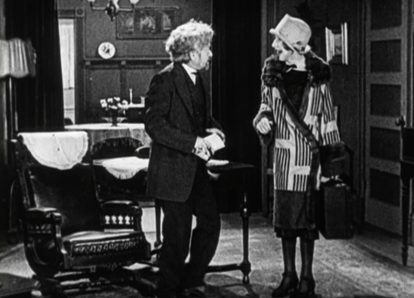
     Somehow, despite Asher’s attempts to thwart his father’s relationship with Widow Finkelheimer, the two have hit it off and are now married, Ginsberg having tossed his teenage son out of the house to protect his relationship. In order to return home, as Asher writes his father, he intends to return home dressed as a woman who intends to become the family maid.

       Dressed up in drag, the awkward freckle-faced kid actually looks quite convincing. With his peroxide blonde wig and a rather stylish coat the new girl in town even catches the eye of the widow on a shopping trip, who seems a bit scandalized by the arrival in their neighborhood of such an obvious hussy and follows her into her own home where, listening through the partially open door she hears Asher telling his father “Your wife won’t get wise to us—she’s too dumb.” Finally breaking in on their seeming romantic tête-à-tête, she demands to know what’s going on, while he convinces her he was just meeting with the new maid he has hired to help save his “Mama” from hard work.

      She pretends to be convinced and exits again to finish her shopping, but actually sneaks back in, finding that her husband and the maid have now retired to the bedroom, where, as she sneaks a peek over the transom, she observes Ginsberg, who has angrily begun to try to remove his son’s costume, is observing how smoothly his son has shaved his legs. Storming out, Finkelheimer is on her way this time to the lawyer.


      Finally feeling guilt for having ruined his father’s relationship, Asher attempts to chase after her to explain the situation, forgetting however, that he is now dressed only in his feminine underclothing. A stunned crowd of gawkers quickly gathers, and a cop (Budd Fine) appears out of nowhere, with Asher suddenly declaring to the policeman “Honest, Mister, I’m not a girl—I’m a boy!” as if that might better his absurd situation. But there is something truly close to camp in his statement, and for me it stands out as one of the better crossing-dressing scenes of silent filmmaking.

     The girl/boy runs off, jumping into a barrel of black paint to escape the pursuing cop. Rising from the barrel soon after, the film seems for a moment to be toying with racist humor, but quickly gets back on track as the now black Asher rushes back into the Ginsberg apartment when he observes his step-mother heading home this time in the company of her lawyer (Finlayson).

     Goldblum (in one of magic tricks from the first reel) tries to reassure her that Ginsberg could not be guilty of such behavior, that it all must be a misunderstanding. But when upon entering the bathroom he discovers Ginsberg giving a bubble bath to the maid, with his friend’s lame excuse “the maid needed a bath—awful,” things appear to be over for Ginsberg’s marriage.


      Finally confessing the truth to Finkelheimer, and providing the evidence of his half-naked scrawny son, all is reconciled. A knock at the door, however, interrupts their reunion. Sneaking a peak at who’s behind the door, the former widow sheepishly turns back to Ginsberg to admit that she too has not told her new husband “everything,” that “I also got a son.” The door opens to reveal the incompetent mechanic who destroyed Ginsberg’s auto.

      Today, with their new “blended” family, this work would probably be made into a successful television series; what if Asher rather enjoyed his role as the pretty maid and the mechanic Finkelheimer took a liking to “her?” It might almost be an early Schitt’s Creek, the Canadian TV series from 2015-2020.


Los Angeles, June 12, 2021

Reprinted from My Queer Cinema blog and World Cinema Review (June 2021).

Fred Guiol | Why Girls Like Sailors / 1927

nobody’s perfect

by Douglas Messerli


Hal Roach (screenplay), W. H. Walker (titles), Fred Guiol (director) Why Girls Like Sailors / 1927


Actually, neither of the two “girls” in this forgettable short directed by Fred Guiol for the Hal Roach Studios—and staring, before they had fully become a team, Stan Laurel and Oliver Hardy—ended up liking sailors. We have to presume that this work’s title, Why Girls Like Sailors, was ironic.

     Hardy, sporting a scruffy beard and described by an intertitle as "a bully, the nastiest crew member, after the captain of course," is almost a lookalike to that captain (Malcolm Waite), who is just a little taller and stouter, but also features a scruffy beard. Although this basically forgettable comic short of 1927 is generally only sited in lists of LBGTQ movies for the reason that Laurel plays a crossdressing woman (the second of the “girls” I mentioned), the mean men, who endlessly argue like a ship-marooned husband and wife, are a kind of same-sex couple. The “nastier than his nasty underling” captain of “The Merry Maiden” (a name. moreover, that reminds us of the silly sailors in W.S. Gilbert and Arthur Sullivan’s HMS Pinafore) even allows his first mate to occasionally use his razor and chastises him early in the film for using it too often, in short suggesting that his First Mate has become what one might describe as “too familiar.”


     If nothing much else is made of their relationship, the very fact that they look so much alike characterizes them as a highly temperamental “pair” from whom the other sailors on board try keep their distance. 

     Of course, that doesn’t mean that they are not both seeking out someone of the opposite sex. Even in the pre-code days of filmmaking, sailors, although known to bunk down with one another aboard ship, were generally stereotyped as womanizers once they had reached land. At one point the Captain, planting a kiss upon Willie’s face, even says “I haven’t kissed a woman since we left Africa,” probably an inside racist joke in 1927.

     But this film immediately has other gay fodder on its mind.  Inexplicably aboard a nearby boat in Sugar Bay, where the “Maiden” is now docked, are a seemingly heterosexual couple, Willie Brisling (Laurel) and his fiancée Nellie (Viola Richard).

     Surely this may present us with an image a loving couple—Willie has even just bought his Nellie a lovely necklace—but his gentle kiss of her cheek sends him immediately into a kind stupor that leaves him spinning through their cabin, knocking over a chair and falling into a bed where, with his eyes blinking into empty space and his tongue tied as tight as a noose that is so goofy that even a commentator on the “Laurel and Hardy Central” site describes him as being in “Pixie mode,” as he flits around and makes funny faces, my dictionary describing the word “pixie” as meaning a fairy or, as a second definition, a “petite vivacious woman or girl.”

     The intertitle suggests that “In little Nellie’s eyes, Willie Brisling was the most handsome man in the world. Others saw him in a slightly different light.”

     Prowling their boat is also the Captain of the “Maiden,” who once he spots Nellie is determined to kidnap her and take her back to his own quarters. Entering the loving couple’s room, he instantly begins to court Willie’s girl, who pulling away, introduces the stranger to her lover, who she declares has his own boat; “Show him Willie.”


      Willie pulls open his shirt to reveal a tattoo of his ship, “the Periwinkle.” A periwinkle, in case you’ve forgotten, is a blue flower, often described as the flower of death, supposedly because its glossy vines were often woven into headbands placed upon criminals on their way to execution and children who had recently died. We can only suspect that the filmmaker or his writers, at least, are telling us that any trip with Willie—even to the altar—can end only in a kind of frozen netherworld.

      The Captain quickly douses Willie’s dreams of any voyage by pouring an entire jug of water down his blouse, the liquid ballooning about his belly as if he suddenly had become pregnant.

      In fact, soon after the Captain does abscond with Nellie, Willie’s previously empty head—I should add that just before this he has attempted to scare away another would-be girlfriend poacher by portraying a “headless man”—conceives of a solution to his situation: he will dress as a woman, seducing the four sailors and then the captain himself.

       How he achieves this consists of a rather boring repetition of luring each sailor, one by one, around a corner where in conks them with a cudgel which sends them, in turn, spinning around the next corner to where the First Mate is standing watch. When they, in turn, collide with their superior he angrily tosses them into the ocean. When their own motions no longer take them around that corner, the “new girl” literally dances them toward the First Mate, sometimes posing them into positions of tentative attack. One by one the sailors are disposed of. And now Willie, reborn as a wild, flirting sex fiend, can turn her/his attentions to the Captain by sitting on his lap, recklessly tweaking his check, and even placing her arm around his shoulder.


     Enter the Captain’s wife, longing for more than a month of martial bickering, and just in time to observe his new sexual shenanigans. She’s ready to shoot him as well as the other woman, but Willie as the easy woman, tells her it’s all just been a test to make her jealous.

     Escaping, at least momentarily, the wife’s wrath, Willie hops off to save his Nellie, the two of them, now like girlfriends walking off into the future—but not before the wife, spotting them through the porthole, shoots the clothes off their back, leaving the two to walk away in their under garments both with an utter hatred of sailors and their landlubber wives.

     Rereading what I just wrote I realize I’ve made this double reeler sound much funnier than this movie truly is. The short was thought to have been lost until in 1971 the Cinémathèque Française announced they had a copy, but critic Roland Lacourbe, after reviewing it, found it simply “mediocre.”

     A private Danish collector later was also found to own a 16mm print, and helped it to be re-released in Copenhagen. After Laurel and Hardy author Glenn Mitchell saw that version he observed "Why Girls Love Sailors is one of several instances where the status of a 'lost' film has been reduced by its rediscovery."


Los Angeles, August 13, 2020

Reprinted from World Cinema Review (August 2020).

Thursday, November 14, 2024

Ben Benjamin | Where Does the Love Go: An Opera in Five Parts / 2019

where o where is love?

by Douglas Messerli


Lucas Tamaren (music with Thumpasurus), Ben Benjamin (director) Where Does the Love Go: An Opera in Five Parts / 2019 [17 minutes]


If you might have thought Lucas Tamaren’s strutting wide-open butt of the 2021 video Sruttin’ was sexually transgressive—which it most certainly was, as well as highly entertaining—but you also might want to go back a few years in time to visit their full 17-minute “opera” tribute to closeted gay actor John Travolta. This is not just a tribute to Travolta by a fan musical group, but a full statement of his career, as it moves in part 1 from its longingly sung lament about the lost love of his earliest years as an actor, re-enacted in the first part of this “opera,” wherein they sing almost endlessly of “Where does it go, where does the good love flow?” as the video presents numerous scenes from Travolta’s early works.


     The film reminds me of the rumors of how homosexual writer Gore Vidal moved just to be near to him. Whether true of not, Travolta was long rumored to be bisexual, with a great deal of evidence, despite his and other highly protective friends’ fierce denials.

     In this opera by Thumpasaurus it doesn’t truly matter. The operatic performance is in love with him, decrying the fact that the deep love has gone, and relating its history.


      The second act, “Without Your Love,” details the part of his career where Travolta’s love interests had turned entirely into the heterosexual world of Two of a Kind (1983), Staying Alive 1983), and other files of the decade in which he seemed to have lost his role as a slightly gay icon

in Saturday Night Live, Urban Cowboy, and The Boy in the Plastic Bubble of the 1970s. The dominant song here is “I’m in Love with Her, Where Did It Go, I Cannot Know.” We are presented with shots from his major films of that period

      It gets worse in Act III, “Hell…and the Abyss,” where we enter the nadar of Travolta’s 1990 films such as Look Who's Talking Too (1990), Look Who’s Talking Now (1994), and from the gay perspective even his successful films such as Pulp Fiction (1994) and Get Shorty (1995) and Battlefield Earth (2000). He now had become a clearly heteronormative figure, and the lover, at least from the Thumpasaurus perspective is seemingly forever lost as a Bosch-like figures. He had become so closeted as a member of the Church of Scientology that he now appeared truly in a hell where no gay person might love him, even when in 2012 when two former masseurs accused him of homosexual demands.


     There is only a kind of echo music in this section of the work, with the heavy thump of Henry Was’ drums. The visuals, however, from Ben Benjamin’s direction, are truly quite spectacular.

     The dog/duck sneaks back in for the Fourth Act, titled “I Will Get the Love Back,” in which Travolta returns to film as truly loveable figure through the film’s graphics, playing a French horn on the Ellen DeGeneres Show before he transforms in the last Act, titled “Love” as the heavyset worried Baltimore mamma of the musical version of John Waters’ absurdist musical, Hairspray, playing Edna Turnblad, the woman all transvestites wanted to be as overweight men.


       This love story to Travolta might be the sincerest, although quite campy and silly at moments, tribute to any Hollywood figure; I hope John, if he still can, jizzed into his tight bluejeans of decades before upon viewing it.

        The graphics in Benjamin’s film say everything except for the endless questioning chorus of lyrics: “Where does it go where does the good love go.” Evidently into just such a video.

       I’m still surprised that there is so little out there about Lucas Tamaren and Thumpasurus; Wikipedia does even provide a full entry.


Los Angeles, November 14, 2024

Reprinted from My Queer Cinema blog (November 2024).

Index R-Z

Angelo Raaijmakers I, Adonis / 2021 Peeter Rabane Firebird / 2021   Tyler Rabinowitz Catalina / 2022 Tyler Rabinowitz See You Soon / 20...