Wednesday, April 9, 2025

Alfred Hitchcock | Champagne / 1928

never safe from ourselves

by Douglas Messerli


Alfred Hitchcock and Eliot Stannard (screenplay, based on a story by Walter C. Mycroft), Alfred Hitchcock (director) Champagne / 1928


Alfred Hitchcock’s 1928 silent romantic comedy, Champagne, is often described as one of his very few forays into the comic mode. Yet, if you carefully look at Hitchcock’s oeuvre you’ll perceive highly comic moments in nearly all of his films, including his own appearance carrying an ear-horn in Vertigo and even the wisecracks of his daughter Patricia in Strangers on a Train. Hitchcock was apparently delighted to discover that his writer for Rope, Arthur Laurents was having a brief fling with the film’s handsome actor, Farley Granger. He surely loved the irony of the creator and his villain jumping into bed together.


       Champagne also is not all comedy. Once the wealthy heiress, Betty (Betty Balfour) absconds with her father’s airplane to elope with her lover (Jean Bradin), her angry father (Gordon Harker) sets his agents against her, including a somewhat suave but even more menacing Theo von Alten (Ferdinand von Alten), who attempts to woo the strong-headed beauty, Betty, away from her apparently kind and loving boyfriend.

       Her father is certain that The Boy is attempting to marry Betty simply to get her (and his) great wealth. But, in fact, the Bradin character disparages her money which seems to privilege her to make all the decisions, including a demand for an immediate marriage aboard the ship she has flown to.

      Betty, herself, moreover, is presented as a selfish, strong-willed woman—more interested in drinking and dresses than her future husband’s sense of independence.

       When The Boy finally visits her apartment in Paris, flowers in hand for forgiveness, he finds it filled with empty-minded partyers, a stern maid who obviously does not approve of him, and female dresser—both of whom, attired in black, are subtly identified by the director as lesbians, the first quietly allowing her fingers to remain longer than usual upon Betty’s shoulder and the second of whom quietly picks up her employer’s previous dress before she folds it up and in a quick shot kisses the gown, as if it were a kind of holy shroud. In 1928, attentive audiences knew what that meant: this was a den of perversions.

      Even more seriously, Betty’s father arrives in Paris to announce to her that he has lost his fortune and can no longer support her luxurious life. Betty takes up cooking, although she has not had any experience or gift for the culinary art. The old man’s sneaking out to a Paris bistro where he orders up a big steak and even larger dessert makes it clear that he is lying. He can still afford a life of high-living.

      Convinced she must acquire a job to support herself and her father, Betty goes to work as a kind of waitress-performer in a large restaurant, run by Maitre d’Hotel (Marcel Vibert) who quietly indicates that her job might include flirting with the male customers and, if willing, to follow them into their rooms as a kind of early version of a call-girl.


      The several floors of this extravagant dining establishment already show Hitchcock’s brilliant use of his camera, presenting the place as an elegant version of Dante’s Hell, with layer upon layer of heavily drinking and testosterone-driven men plying the women with whom they sit with, as the title suggests, Champagne.

      In another attempt at reconciliation, the boyfriend visits her, appalled by what he sees. To spite him she wildly dances, not the first time in this often-frenzied film.

     The Boy returns with Betty’s father, who is equally shocked by what he sees, and admits his lie, inviting her to return home and marry the man he now realizes loves her and not her money. But not before she is carried off and locked in her room by the Mysterious Man, only to be saved by her younger suitor.

      So, indeed, the film ends as a kind of comedy. Yet, I’d argue that the great director has this early in his career far more serious issues on his mind—a licentious world inhabited by young rich women such as Betty, and the ability of the males around them to manipulate and sexually abuse them. If Champagne is truly a romantic comedy, then Vertigo is not a psychological tragedy. Hitchcock knew always that human beings encompassed both the potential for deep love and dangerous behavior.

     Eve Kendall, in North by Northwest, was both a sexy siren, a kind of version of the original Eve who might easily lure the confused Roger Thornhill out of the protection of his office-building world, or a kirk-loving member of the Cumbria area in England—the original source of her last name.

     The Wikipedia Urban Dictionary quite precisely describes the word “Kendall” presumably long after Hitchcock’s film, as:


A beautiful girl with many friends. She is often crazy, but once you get to know her she is the most lovable people you will ever meet. Her funny attitude gives her countless friends. But don't be fooled by this witty personality, she can be the most romantic person ever. I seriously think I'm in love with this girl.


     That is exactly what Betty (a kind of Betty Boop of the day) is in this 1928 early Hitchcock film. But the dichotomy of the two is essential to nearly all of his movies—whether it is a loving wife who turns quite mad in The Wrong Man, a sexy dress-seller who is absolutely ready to take on any adventure she encounters in Rear Window, or even a beloved uncle Charlie who turns out to be a murderer of wealthy widows in Shadow of a Doubt. Even a nice-looking Norman Bates, seeking the love of an on-the-run secretary, might turn out to be a psychological-freak with murderous intentions. In Hitchcock’s films no one ever gets off free from our inner demons. We are never safe from ourselves.


Los Angeles, January 20, 2020

Reprinted from World Cinema Review (January 2020).

Rhys Chapman | Wonderkid / 2016

was there ever any question?

By Douglas Messerli


Matt Diss (screenplay, based on a story by Rhys Chapman and Terence Corless), Rhys Chapman (director) Wonderkid / 2016 [31.21 minutes]


On this day when the news reports that the Las Vegas Raiders’ US football team’s defensive end player Carl Nassib is the first active National Football League to openly announce that he was gay, perhaps it would be perfect to talk about British director Rhys Chapman’s 2016 short film Wonderkid about a soccer prodigy suffering from his agent’s insistence that he remain closeted for a while longer, despite the fact that his teammates begin to suspect him of being queer.

      But I should just back up a moment to register what my friend John Weir expressed on Facebook after Nassib’s announcement. Surely, he wondered this cannot be the only active US football player to announce that he was gay, coming as it does so very many years after Stonewall and so many other sports players’ previous revelations?


      I felt similarly. So very many fictional films about gay sports figures have appeared over the years. And even more importantly there have been a number of important documentary films about gay, lesbian, and transgender sportspeople. In 1997 TV presented a film Breaking the Surface: The Greg Louganis Story about the life of the famed gay diver. The US dramatic film by Robert Towne on the life of track star Patrice Donnelly, Personal Best was a popular LGBTQ film in 1982. And in 2003 Thailand director Ekachai Uekrongtham’s Beautiful Boxer told the story of transexual Parinya Charoenphol Muay Thai fighter, actress, and model.

       Within the new century a substantial number of films spoke of the hidden lives of gay individuals who played sports, among them Walk Like a Man: A Real Life Drama About Blood, Sweat & Queers (2008) about the Australian gay rugby union; the US documentary Out to Win, directed by Malcolm Ingram, concentrating on such figures as Jahn Amaechi, Billy Bean, Jason Collins, Wade Davis, Brittney Griner, Billie Jean King, David Kopay, Conner Mertens, Martina Navratilova, and Michael Sam—all significant athletes; Battle of the Sexes (2017) documented the noted tennis match between Billie Jean King and Bobby Riggs, which occurred before King had publicly come out, but certainly hinted of her lesbianism in the film; and that same year John Carey and Adam Darke documented in Forbidden Games: The Justin Fashanu Story the experiences of the British gay soccer player;  Canadian director Paul-Émile d'Entremont’s 2019 film Standing on the Line concerned issues of homophobia in the world of sports, featuring speed skater Anastasia Bucsis, soccer player David Testo, and hockey player Brock McGillis. And there were others, as well several real-life events, such as the great 1976 Olympic decathlon winner Bruce Jenner coming out as the transgender Caitlyn Marie Jenner.

        Despite the obvious bravery of Nassib’s revelation, one wanted to ask, where were all the others, and what is holding them up from simply speaking out honestly? If they were all to speak out there might be no problem for anyone in the future. But by being quiet they had made Nassib’s announcement news.

      Given the story that Chapman’s Wonderkid presents, however, one perceives just how difficult coming out is, at least in the high-pressure world of the European soccer teams. From the very first frames of the movie, we sense that our young hero, Bradley McGuire (Chris Mason), has problems. Sitting in his locker room before a game he seems not only dour but unable to move until his friend and. as we soon discover agent, Johnny (Leeshon Alexander) appears to offer him a few words, speaks to another player—evidently about some previous grievance—and simply encourages his player with a hug. On the field our wonderkid is easily distracted by the shouts of the crowd, in particular one fan who first describes him as a “wanker,” and when McGuire slips, follows it up with shouts of “faggot.” In the next few minutes, the “wanker/faggot” scores, evidently winning the game for his team as he dances to the cheers of the entire stadium; but the boy is still angry, turning back to the fan and calling him out for his remarks in front the cameras, while we hear in the background the response of the newscaster worrying about the wonderkid’s “personal issues” that seem to get in the way of his great playing.


      Unfortunately, we don’t quickly get a full idea of what these “personal issues” might entail. We are offered only little glimpses of these problems, particularly since most of the time the wonderkid remains glumly silent. Back in his hotel room we witness a brief interchange with

Johnny in which he wonders whether or not he had been able to get his parents to attend the soccer match (the parents were once again absent) and his complete disinterest in joining the others for an after-game party. Back at training we again sense difficulties between him and the other players, especially the team captain who berates him for not having attended their party. His teammates tease him about the initiation he will have to undergo soon, since he has just been promoted in the league; but it is clear he wants no part of their “girls and drinking” suggestions. When they begin to scrimmage, McGuire trips the captain, who comes back at him anger, to which our boy challenges him as he leans forward: “Do you want to kiss me?”

      After, Johnny, slamming a locker room door shut, berates him for his on-field antics, ending with a sentence he quickly shifts away from speaking, his player demands he finish: ...”Say it, man it up, say it.” When Johnny spits out the words, “all right, you’re fucking bender” we finally catch on that the wonderkid’s central problem is that he is gay. Their shouts attract a pounding at the door, and they are terrified that someone might have overheard their conversation. And suddenly we begin to perceive why this kid can find no joy in the one thing he does so beautifully, kick the ball into the goal. He is not allowed to truly express himself in any other manner.

      In the next few scenes, we discover McGuire has yet other problems. As he refuses to answer knocks at the door, to pick up the telephone, to attend further training sessions, and lays out two sets of uniforms, perfectly packed, and carefully piled up precisely into near packets from which he keeps removing even the slightest of creases, we begin to perceive that he also suffers from OCD (Obsessive Compulsive Disorder). As much as he hates Johnny’s control over him, he still needs him to be there to reassure him, to calm him as he attempts, each time, to enter the world of public from which he innately feels alienated.


      Not only does he desire to be free, to find people with whom he might relate and become sexually involved, but is terrified of moving out of his safety zone. Together the two force him into being a kind of prisoner, of himself both as a compulsive being and a homosexual.

      Even more abuse piles up as messages on his phone: “If rumors are true, can see why he didn’t like that bloke calling him a faggot. I’d kill whichever cunt said I was a bender”; Who the fuck paid that amount to you? Let’s hand him over to ISIS immediately”; “My mate said someone slagged off his family. Something about his mum or something? Wish he’d nutted the cunt”; “Will everybody buy that I’m sick for a week or two?”; “See Judas is up to his old tricks.” etc.

       He finally answers a call from a gay dating connection, sets out two pair of clothes, dresses, and stands waiting at the designated spot. But the minute he meets his date, Olly (David McGranaghan) a gang of four passersby recognize him and point at him going into a gay bar, and he no choice but to bolt.

      He jumps into cab only to be recognized by the driver, who drives him for nothing back to the hotel. Finally, at their next meeting Johnny agrees that they will be able to tell the public soon, “but not yet.” And then, he half jokes, “gay magazines, gay porn,” as to suggest he’ll financially abuse his as a gay as much as he has as a closeted one. “But you have trust me on this, you have to wait,” he repeats. Waiting at the kid’s age is like suggesting he postpone his sexual activity until middle age.


      With McGuire left alone at the bar, the bartender finally makes his move, lightly touching the boy’s fingers as he goes to pay the bill. He joins him in his room and, even though he knows who the hotel guest is, he calmly shares a night with what presumably is glorious sex with the footballer. Trouble is that Johnny has observed them entering the wonderkid’s room. And when the time comes the next morning for him to pick up McGuire and escort him and his dozens of fears to the stadium, he does not show up. A woman driver shows up in his stead, and we fear that our hero will simply be unable to get it together to play the game.

      He arrives in the locker but the taunting continues, the captain asking has he yet selected a song for his initiation: “Dancing Queen?” “Be Yourself,” Pet Shop Boys, George Michael—all gay or with gay insinuations. McGuire unpacks his kit, and indeed does have a shirt within saying “Be Yourself” with the LGBTQ rainbow flag printed over the words. You almost wonder if he might wear it under his soccer uniform as a talisman or, just perhaps, wear as his jersey to out himself to the general public.


      Suited up, they prepare their march to the field, the wonderkid closing his eyes to steel himself for what is ahead. Suddenly he feels a hand grasping his, and when he looks across and down he sees a young girl, an escort to take him to the game in he which apparently plays phenomenally well. All we hear is the newscaster shout, “Ahhhh what a player, what a man! Was there ever any question,” as if answering Stein’s last words upon her deathbed.

      Hopefully it represents the beginning of a new life for the kid.

      Several major donors, Ian McKellen and the Kevin Spacey Foundation, helped this film to come into being.


Los Angeles, June 22, 2021

Reprinted from My Queer Cinema blog and World Cinema Review (June 2021).

John Butler | Handsome Devil / 2016

different, but the same

by Douglas Messerli


John Butler (screenwriter and director) Handsome Devil / 2016


John Butler’s 2016 film, Handsome Devil, immediately reminds one of a great many other coming-of-age and gay coming-out films. In its focus on a young unhappy schoolboy, Ned (Fionn O’Shea), who attempts to drown out his misery in song, Butler’s film reminds one a bit of John Carney’s Sing Street. Except in Carney’s film, the young hero is taken out of a posh boarding school and forced to attend an inner-city Dublin Christian Brothers’ school, and although that young man was most unhappy with his classmates, he wasn’t bullied because of being gay. Ned would surely love to be taken out of his rugby-obsessed boarding school and attempts to convince his wealthy parents to let him drop out of school altogether, although he appears to be a fairly competent student.


      In Ned’s sense of imprisonment, particularly when forced to room with a new student, Conor (Nicholas Galitzine), the “handsome devil” of the title who is also a rugby star, the film also calls up Simon Shore’s teen gay love film, Get Real.  Like the hero of that film, Ned also gradually becomes a friend of the jock, particularly when, as in Get Real, Ned discovers that Conor is also gay. But even though the two are roommates, these 16-year-olds do not have sex. Moreover, unlike the totally self-loathing sprinter, John Dixon, Conor is fairly comfortable with his own sexuality—if only everybody else weren’t so terrified of that possibility, particularly his teammates, specifically the always taunting Weasel (Ruairi O’Connor) and, even worse, the single-minded rugby coach (Moe Dunford), both determined to win games at all costs.

      In a single night, after celebrating another rugby win, Conor discovers that the school’s new, and increasingly popular English teacher (Andrew Scott) is gay, after he runs into him in a nearby village gay bar, and Ned discovers that his roommate is gay when he accidentally observes him entering that same bar.

      Ned stupidly confesses to the school administrator—however, not about his own sexuality but about Conor’s being gay. When in horror, Conor bolts, (he’s already been kicked out of another school for fighting those who taunted him) threatening the rugby heart of Wood Hall.

     Ashamed for his behavior, which may also actually result in his expulsion, Ned determines where Conor has gone and brings him back, thus allowing the team to win the game, and a way to show all his fellow classmates and staff that you can be a great team-player and gay at the same time.

       We know this kind of bullying still exists, but there is something, nonetheless, retarder about the way this film resolves the problem, particularly in its preachment of the obvious clichés to its inevitable gay-based audience.    

      Moreover, although Scott appears in this film to be a far better English teacher than was Robin Williams’ character in Peter Wier’s Dead Poets Society—a nearly insufferable over-zealous, do-gooder English teacher—there is some of the same piousness in this new film that we encounter over and over again in the media: “things do get better,” “If you don’t be yourselves, who will be?,” etc.

     Handsome Devil is a lovely, feel-good film, but my only wish is that it was simply more honest. There will always be people in this world who detest other people for loving someone of the same sex or hating those who are unsure of their own sexual identity. That hasn’t changed over time, despite all the major shifts in society. In some ways, in fact, it’s gotten worse: the haters encouraged by politicians like Trump and Pence to keep gays, lesbians, bisexuals, and transgender individuals out of schools, jobs, and housing. And winning a rugby game will never be enough to win the hearts of those who so hate. We can only hope that one day, people will come to recognize that those who are different are also the same.


Los Angeles, October 29, 2017

Reprinted from World Cinema Review (October 2017).


Douglas Messerli | Soccer and Gay Sex / 2025

soccer and gay sex

by Douglas Messerli


All sports, with their general disapproval of gay behavior—given that terrible fear of locker boys and men that some other male may actually find them attractive (a fear I never quite comprehended; mightn’t they be just little pleased and aroused, but of course, that is an even worse terror)—have often been the subjects of gay filmmaking. But soccer, in particular, given the general beauty of the ball-kicking boys has been a particular focus of short-film gay stories.


    In this gathering I chose only two of the dozens of such films I have encountered throughout the years, Irish director John Butler’s 2016 film Handsome Devil and, from the same year, British director Rhys Chapman’s Wonderkid.

     Some things have changed in the world of athletics, long a place where men and women intensely needed to hide their gay identity. Tom Daley, the great Olympic champion swimmer, proudly knits, has a male husband, children, and has become quite popular in the media. Diver Greg Louganis has even become a kind of symbol for the gay athletic community. Gay sites are filled with pictures of soccer and rugby players whose pants have been pulled down and off, cocks displayed in public. I’ve even written about how the captain of my Marion, Iowa high school football team probably was a gay boy. But still, it remains a dark and mostly forbidden territory.

     Since 2016, Galitzine, who stars in Handsome Devil and was himself a rugby and football player as a young man, identifies as being heterosexual, but has become a sort of gay heartthrob, performing in The Craft: Legacy, Red, White & Blue Royal, and Mary and George, in which he played bisexual or gay figures.

     In the second essay, I created a very small account of gay and lesbian history in sports. But the subject should be explored on a much larger context. I may go there some day.


Los Angeles, April 9, 2025

Reprinted from My Gay Cinema blog (April 2025)

Sunday, April 6, 2025

Andrew Ahn | Spa Night / 2016

LOCKED UP IN FAMILY LOVE

by Douglas Messerli


Andrew Ahn (screenwriter and director) Spa Night / 2016 

Andrew Ahn’s dark coming out film begins with a family crisis: the small Los Angeles Koreatown restaurant they run, with only a few customers, is taken away from the mother, teenage son, and father, who have worked there together for several years, because of Jin’s (the father) inability to pay the rent. With little money left, the mother Soyoung (Haerry Kim) is forced to work as a waitress in a more successful restaurant owned by a church friend, while the father and son attempt to find day jobs, without much success. Although Jin applies for other jobs, his age and bad health work against him.


      What is even worse for the family is that, without money, they find the American Dream they had planned for their son, is almost out of reach. David (Joe Seo), moreover, is a middling student and does not have the SAT scores to get into the favored educational facility for such families, University of Southern California. The family can hardly even pay for the tutoring necessary to increase his scores so that he might get a fellowship for his necessary education. And when he does begin his lessons, he makes little improvement in his test scores. For David is, as one might say, extremely distracted, beginning to realize—living within a community where such a thing is unthinkable and even more importantly, unspeakable—that he is gay.


     There is no place, clearly, for him to turn to help make the difficult transition. His parents link him up with a slightly older USC student who has also known him from church—that successful restaurant owner’s son—encouraging David to spend a day on campus in that hopes that he will become more interested in the prospect. But his campus visit only confuses the young David even more, as his former “friend” apparently dorms with a young man who spends most of his nights at his boyfriends and the tutoring elder student spends most of his nights drinking and partying with girls.

     They all, including David, get so drunk that the males determine to visit one of the many local spas that dot the Koreatown landscape—places, as David remembers them, of close father-son bonding, as we see early on, when the two gently rub each other’s backs in a kind of cleansing process after their sweat in the spa.


       While visiting with the others, David has spotted a “help wanted sign,” and so goes to work, unbeknownst to his family, to bring in a little extra income. But as he gathers towels, mops down floors and, after work, joins others in the over-heated rooms and showers, he perceives another series of activities also at work in the spas, a world of secretive gay love. For the most part, he observes these erotic couplings—as if almost out of the corners of his eyes—with simple desire. And much of the film, accordingly, seems more voyeuristic than revelatory. But gradually, he too, joins in with more direct stares, an occasional touch of an older man, and dares to go even a further—while still engaging in nothing too obvious or salacious.

      He is, after all, aware of an occasional arrest when a gay man mistakenly encounters a heterosexual customer, and he has been told by the spa owner to report any “unusual goings-on.”

       The tension of this film is that every member of this family is a loving being, caring and meaning well for each other. Yet in that embrace of family love, everyone is also delimiting and gradually choking one another. Soyoung is exhausted from her long hours and hurt, surely, by her former friend’s orders that she dress better. Without a job, Jin, like his father before him, turns to alcohol and increasingly falls into a drunken stupor each night. David, locked up in his parent’s dream for him and his own whirl of inexpressible sexual feelings, is represented again and again in this often-slow-moving film, as almost torturing himself, exercising beyond endurance in endless sit-ups and long street-runs. Like the deep rubs between father and son in the spa, he can be seen in many sequences as clearly trying to rub out his own existence.

       When Jin returns late one night drunk and fights with Soyoung, she angrily reacts, forcing the now-completely defeated man to admit his failure in life. He leaves the house, with Soyoung gently asking that her son follow him to make sure he doesn’t attempt to drive.

      After a long prowl in the late-night Koreatown streets, David, following in his father’s staggering footsteps, finally takes him to the well-known spa, this time paying for their entry, where he puts his father into a chair to let him sleep off his drunkenness. David, meanwhile, undresses and enters the spa, this time encountering a handsome young man with whom he finally consummates, in no uncertain terms, his desires. Yet as the couple finishes their lovemaking, the spa owner enters to observe what has just happened, and David realizes the consequences. Collecting his now more sober father, he drops his locker keys off at the desk, attempting to apologize for his actions—which the spa-owner meets him with a stony silence.


        As David goes for yet another long run through the vibrant Koreatown streets, the screen goes black.

        In short, this painfully moving first film offers absolutely no solutions to the problems its characters face. It simply shows the situation, the near impossibility of coming to terms with such issues within a society that refuses to speak of the problems here reiterated. All we can hope, as the director has said in a newspaper interview in the Los Angeles Times, is that this film can serve as an opening of that now-closed conversation. If nothing else, this movie reveals that all cultural and social communities share the same problems and fears, even if some would rather pretend they not exist.


Los Angeles, September 4, 2016

Reprinted from World Cinema Review (September 2016).


Moshe Rosenthal | שבתון Shabaton (Leave of Absence) / 2016

a night with the boys

by Douglas Messerli


Moshe Rosenthal (screenplay and director) שבתון Shabaton (Leave of Absence) / 2016 [19 minutes]


Moshe Rosenthal’s 2016 short Leave of Absence is not explicitly an LGBTQ movie, but in its tone and implications clearly represents—through the encounter between an older man, Meir, and three teenage boys (Michal Bernstein, Chen Hefetz, and Ben Heine) who are determined to spend their evening frolicking in a pool together and filming their own fraternal-coded songs and antics, no girls invited—a symbolic male gathering with strong homoerotic overtones.


     Their invitation for the former teacher (Uri Klauzner) to join them is proffered at the perfect moment for the older man. Having recently taken a leave of absence from his teaching job, and after one of his two daughter’s had just attempted to lighten the shade of his hair—with disastrous results, turning him into a peroxided blond—he has just escaped from his dominantly female society into the night, on his way to get a darker shade of hair dye when he encounters the boys.

     Meir’s sense of displacement from his absence of his weekly teaching responsibilities, the suggestion by his daughters that need do something about his graying hair, and the simple realities of his uneventful daily life all remind him that he’s aging and without a sense of purpose he previously felt. Meeting up with the boys, some of his better students as they brag, determined to involve him almost as a mascot in their male rituals, is somehow exciting, certainly something out of the ordinary and apart from the female-oriented world which he now daily inhabits.


     At first, understandably he refuses, but they begin by insisting they take a picture with him, suggesting he will be missed by the one of the three students who hasn’t yet graduated. Already their actions seem to involve physical expression, one of the students asking “Sir, could you carry me piggyback,” as he literally heaves himself up upon his teacher’s back to have his photo snapped.

      It does not take long for them to suggest he be included in the video they’re planning for one of the trio who’s just enlisted for his military duty. When he demurs, they even jokingly offer him beer and drugs. But he trudges on to get his “Just For Men” hair coloring.

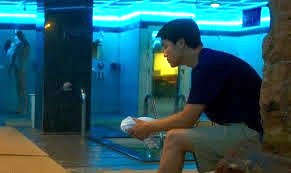
      On his way back, in a moment of compulsion, however, he detours to the pool they have talked about, breaking in through a cut in the metal fence. Peering through the glass windows he sees that there are now four boys, one photographing the other three, shirtless, as they seem to be involved in what appears as almost a ceremonial dance, each following the other along the side of the pool.


      Now inside, he sits on a plastic pool chair with a small wooden flute they have clearly handed him as one of their members as they sing a quite sexy song, the lyrics beginning:


                    From my little window

                    I see big things

                    and life looks good from here


                    Now everyone’s in rush

                    to buy a few more things

                    before closing time


                    haste, they say, is from the devil

                    and I am the little bunny

                    who is constantly late….


     Sitting, a bit awkwardly, in his chair, stripped to T-shirt and boxer shorts, he watches almost transfixed, observing their half-naked bodies and gyrating hips as they move around the pool in his direction. As the lyrics now involve the song-narrator’s desire to play the flute “and smile at them like a jerk,” he’s ready to pretend to play on his small flute as the lead singer, now crawling on his hands moves forward intoning, “blow, blow, blow the flute.” As he has been coached by the group, he puts it to his lips, afterwards wishing their friend a good enlistment, smiling as best he can in his confusion.

      The song (“Ya Hilili” by Lithuanian-born Rafi Perski), with its choruses of “ya halili, halili,” is quite homoerotic, particularly given its references to a “bunny” and “blowing the flute,” (presumably meaning, “sucking cock,” the singer’s preference to the consumer products the masses are buying). But Meir seems almost completely oblivious to the metaphors, if completely cognizant of the sexual maneuvers of the lead singer.


      Finished, they discuss the “weirdness” of the ending of the clip, and even suggest they give their teacher another part. He is perfectly willing to shoot it again, obviously now invested in their performance.  “I’ll do it better this time,” he states. But they insist it turned out just fine.

    Soon after they appear to be interviewing him on the camera, describing Meir as a family man and a history teacher, but by night “an incorrigible anarchist.” He laughs, somewhat uncomfortably. They attempt to get him to say they were best students, while the others were dumb, pushing him even so far as to admit that we would rather hang out with them.

       But Meir chooses a middle path, ultimately saying he would “hang out” with himself, a diligent student, an obedient being who would “go to school, serve in the army, work.” After some discomfortingly quiet moments, they ask him one last question—about his hair. They admit they couldn’t resist. But one of them quickly takes out some hair jell, runs to Meir, puts his hands to the man’s head and transforms his hair into a punk-rocker look. They offer him a marijuana joint, and he hesitatingly takes of short toke. The interviewer asks, “Won’t your wife be mad if you come back stoned?”

      A moment later they are all joyfully playing in the pool, while Meir looks off, seeing a reflection of himself in the glass of the pool walls, perhaps contemplating how all his life he has played it far too safe, been far too correct and conventional in his decisions, missing out on the joys these boys seem to have in each other’s company.


      He too takes off his shirt and joins them, the boys at first wrestling with one another, but gradually involving him as one rises from the depths on his shoulders while another appears on the shoulders of another boy, representing an eerie few moments of bonding, both generationally and sexually.

      A few seconds later, however, they calling out to him, “Meir, come out!” The police have arrived, and when Meir comes up for air, they all have abandoned him. Hearing the police siren in the background and speakers announcing the break-in, he hides half-naked behind a tree now outside of the pool enclosure. He steals a bicycle and hurries on down the road to home and society once again—but obviously rejuvenated and, perhaps, even transformed by his night with the boys.


      The film reminds me of Clu Gulager’s wonderful 1969 short film A Day with the Boys, also involving a dangerous encounter with an older man and young boys, although in Gulager’s film the boys are in junior high or even grade school and the danger is much more serious since it ends in the older man’s death, whose very willingness to consort with the boys hints at possible pedophilia. It also reminds me of a comment my writer friend Sam Eisenstein once made regarding the film, On Golden Pond of 1981: “Doesn’t everyone know that all an old man needs to bring him to life again is a day alone with a young boy?”


Los Angeles, May 9, 2023

Reprinted from World Cinema Review (May 2023).

Index R-Z

Angelo Raaijmakers I, Adonis / 2021 Peeter Rabane Firebird / 2021   Tyler Rabinowitz Catalina / 2022 Tyler Rabinowitz See You Soon / 20...