Saturday, November 18, 2023

Alice Guy (Blaché) | Au bal de Flore (At the Floral Ball) / 1900 || Le depart d’Arlequin et de Pierrette (Le Fredaines de Pierrette) (Pierrette’s Escapades) / 1900

dancing women: two films by alice guy

by Douglas Messerli


Alice Guy (Blaché) (director) Au bal de Flore (At the Floral Ball) / 1900

Alice Guy (Blaché) (director) Le depart d’Arlequin et de Pierrette (Le Fredaines de Pierrette) (Pierrette’s Escapades) / 1900


These two short film clips from 1900 are possibly related, as one commentator, popegrutch writing for the fascinating Century Film Project, suggests they may represent an all-female dance troupe in Paris that was accepted at the time for its somewhat transgressive balletic actions.
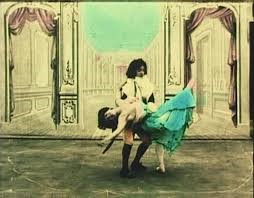

     In At the Floral Ball the scene gets particularly “steamy” as the two women dance, one in a low-cut dress and the other in 18th century male clothing (the duo described in the credits as Miss Lally and Miss Julyett of the Olympia). In this hand-tinted, 2-minute clip, the woman in a long light-blue gown leaps forward into the arms of the second woman in reddish-brown tights, later moving around her several times, spinning and dipping in a manner that does not represent true balletic positions. At several points, the woman in the blue gown reveals a great deal of her naked leg and thigh.

    The male-female kisses the other’s hand, the woman in the blue dress retiring to a chair to fan herself as if overheated by her lover’s attentions, he also fanning her with her/his coattails. The male figure moves toward her, sitting on the spindle of the chair as she/he kisses her hand once more, following her/his smooches up her arm to her elbow and just beyond before the screen goes black.


     The second 2-minute clip, Pierrette’s Escapades, is more narrative-oriented as it plays out a pattern of the Harlequin tradition. Again the short is hand-tinted, the central dancer dressed in a pink gown, as she moves to her dresser to briefly apply her powder just as a clown in white, also apparently a female, enters, attempting to steal a kiss from her. The lady resists—although momentarily toying with her/him as she kisses the air in return—before finally sending the clown on her/his way. 

      She returns to her bedroom preparations, miming the actions until suddenly a new clown, another female, in green tights with a yellow bicorne hat appears by her side, moving with her into a full dance—consisting of several pirouettes, spins, and short skips—before the colorful Pierrot awards her a final kiss on the lips.

      Although Pierrot is generally a sad clown as was the clip’s figure in white, this “Pierrette,” the female version of the traditional figure, is clearly joyful, celebrating his love with his Columbine.

       Perhaps the audiences of the days recognized these all-female performances as far less shocking than if they had been performed by a mixed gender cast. Certainly, it might have been shocking to have the woman in At the Floral Ball reveal her full naked leg and thigh to a male partner in this Edwardian-era piece.  


Los Angeles, December 6, 2020

Reprinted from My Queer Cinema blog and World Cinema Review (December 2020).

Clément Maurice | Le Duel d’Hamlet / 1900

hamlet’s duel

by Douglas Messerli


Clément Maurice (director, scene based on Shakespeare’s Hamlet) Le Duel d’Hamlet / 1900


I might not even have included a discussion of Sarah Bernhardt’s 1.23-minute dueling episode playing Hamlet to Pierre Magnier’s Laertes were it not for the fact that it is probably the very first cross-dressing role ever to be filmed.


     The film, which was shown on October 1, 1900, may have come after Alice Guy Blaché’s cinematic representations of female dancers performing with cross-dressing female partners, but Bernhardt had already performed the entire Hamlet in drag on stage the year before, with major performances in both Paris and London, so that her brief enactment of Hamlet’s death in Act V predated the dancers—although they may have also danced as crossdressers onstage previously as well. It truly doesn’t matter since neither has much to do with LGBTQ issues except for the blurring of gender.

       More importantly, Bernhardt’s cinema debut is interesting in how it relates to Asta Nielsen’s far more significant appearance as Hamlet in Svend Gade and Heinz Schall’s film of 1921. If director Clément Maurice’s Le Duel d’Hamlet is centered upon a female playing a male role in a man’s costume, Gade and Schall’s Hamlet is centered upon a transgender figure, a woman who is not only “dressed” as a male but has lived as one throughout her/his entire life until college days at Wittenberg University, when Hamlet is called home because of the father’s death and the uncle’s upcoming marriage to his mother. Nielsen’s performance is one of the first major works, along with Mauritz Stiller’s Vingarne (The Wings) (1916), Richard Oswald Anders als die Andern (Different from the Others) (1919), and Bernard Natan Le Ménage moderne du Madame Butterfly (1920), to actually focus directly on LGBTQ images and issues.

        In relationship, Bernhardt’s very brief performance is simply a footnote. But it is an interesting nod to queerness, nonetheless. And evidently her Hamlet, performed in its entirety on stage, was quite different from the most popular male performers of the day, although little of that is in evidence in this piece, which amounts to nothing more than a “clip” shown at The Exposition Universelle with a synchronized wax cylinder recording providing sound, the cylinder now lost.

      An actress of the day, Elizabeth Robbins provided a written summary of Bernhardt’s stage performance, when the great actress was 55 years old, that might provide us with some illumination about Bernhardt’s complete performance:  


 “Madame Bernhardt’s assumption of masculinity is so cleverly carried out that one loses sight of Hamlet in one’s admiration for the tour de force of the actress… She gives us…a spirited boy; doing it with an impetuosity, a youthfulness, almost childish.” In the scene in which Hamlet advises the theater troop how to perform, she behaves as “a precocious young gentleman, who…thoroughly enjoys laying down the law to plodding professionals.” And in the play scene, “with something a little reminiscent of an urchin swarming over an orchard wall, [Hamlet] crawls up to the throne, till his eyes, not sombre and horror-stricken, but keen and glittering, are on a level with the King’s. When he has surprised the guilty terror there, this Hamlet actually bursts out into peal on peal of laughter. His clever trick has succeeded, his Schadenfreude overflows.”


     Certainly, this was not the typical melancholy Dane on the edge insanity as most males of the day performed the pondering hero.


Los Angeles, July 5, 2021

Reprinted from World Cinema Review (July 2021).

James Bamforth | Ladies' Skirts Nailed to a Fence / 1899

keeping posted

by Douglas Messerli


James Bamforth (director) Ladies’ Skirts Nailed to a Fence / 1899

In Bamforth’s one-minute statement of male chauvinism two cross-dressing males, costumed as proper housewives appear to be gossiping. Evidently the cards accompanying the film suggest that they are engaged in a discussion about women’s suffrage, although we cannot tell whether they stand against or for it. That very much matters since as they talk two men come up behind the fence by which they are standing and nail a hem of each of their dresses to the fence before running off like naughty pranksters.


     If these women are sharing their displeasure with the suffragettes we can say that it serves them right, since they shall surely remain tied to their husbands just as they now stand attached to the fence, only with great difficulty freeing themselves from their predicament, and in the process in this instance revealing their true gender.


     If these women have been arguing for the possibility of women voting, however, the attack on them by the males reveals the ugly patriarchal world in which they live that only reiterates their forced attachment to the male species and the patriarchal punishment for even discussing the possibilities of their escape.

      One might wonder, of course, why males were playing the role of the females. Were they unable to find any females willing to participate in such an attack on their own gender, whether it be seen as prank or punishment? Or were their husbands and the director Bamforth of such a conservative bent that they would not even permit women to be represented in the new medium?


      Accordingly, this film seems more to have to do with issues of women studies and feminism than LGBTQ representation, even if we know the issues are highly interconnected. But I don’t think we can chalk this short experiment in filmmaking as evidence of male desire to perform in drag, unless we go back to the belief that women should not ever be allowed on stage or in cinema, forcing men to play out female roles that merely reveal their own inabilities to comprehend the opposite sex or their latent desires to live out their lives as that sex.

       If so, there may be more here than we might first have suspected.


Los Angeles, May 21, 2022

Reprinted from World Cinema Review (May 2022).


Georges Méliès | Le méprise / 1896-1901 || L’amant supris 1896-1901 [flipbooks]

two méliès kinographs

by Douglas Messerli


Léon Beaulieu (publisher, based on film images by Georges Méliès) Le méprise / 1896-1901 Flipbook #17

Léon Beaulieu (publisher, based on film images by Georges Méliès) L’amant supris 1896-1901 / Flipbook #23


In the late 1890s until the early part of the 20th century French publisher Léon Beaulieu produced a series of kinographs (“moving pictures”) also called Daumenkino (“thumb cinemas”) based mostly on the images of Georges Méliès which might be described as short, short films which reproduced the French director’s originals as flipbooks while further popularizing his art.


    The San Francisco Silent Film Festival has preserved, edited, and added music to a great number of these mini-films, a couple of those I’ve seen which flirt with gay and LGBTQ issues.

     The first of these, Le méprise, begins with what appears to be a woman facing the display window of a street shop with a door announcing M. Tetard Modes. It must be raining because the woman stands with a large open umbrella obscuring the back of her head.

     Suddenly a man dressed in a white straw hat, a dark coat, and white pants braves the elements as he walks behind her, nearer the camera. Noticing the seemingly attractive female form, he suddenly turns into a masher, planting his hand flat upon her fanny.

      The shocked figure abruptly turns toward him revealing the astounded face of a local French parish priest who haughtily turns and walks away, most offended, but in his strut perhaps portraying just a little pleasure in the mistake.


*


     In L’amant supris two lovers meet in a bedroom, undressing and almost dancing in the delight of expectation, she heading him toward the bathroom for a quick freshening up before their lovemaking.

     Suddenly from out of nowhere a man leaps into the room quickly speeding over to the man and shooing him off into the bathroom as he follows.

     We cannot be certain for what purpose he has usurped the woman’s intentions. Perhaps he is simply a jealous lover attempting to break up the affair in progress. Yet since the title suggests the second man is himself the “surprise lover,” it appears that he has stolen the man away for his own pleasures.

     Once again this is based on a Méliès short film.

     I could not find either of these titles listed in a fairly complete catalogue of Méliès’ films, but since the images were attributed to him, they perhaps were films that were lost before they might even have been catalogued. They surely would have had to be made before 1901, because in that year Bealieu died.


Los Angeles, April 12, 2021

Reprinted from My Queer Cinema blog and World Cinema Review (April 2021).

William Kennedy Dickson | The Dickson Experimental Sound Film / 1894 or 1895

dancing princes 

by Douglas Messerli


William Kennedy Dickson (director) The Dickson Experimental Sound Film / 1894 or 1895


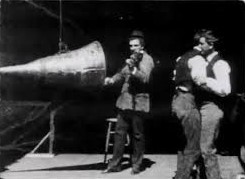
The first US sound-film by William Dickson, with music by Robert Planquette, filmed at Thomas A. Edison studios “Black Maria” in 1894 or 1895, was also one of the earliest representations of possible gay interactions recorded on film.


      Certainly, that is what Victor Russo in his The Celluloid Closet argued, describing the 17-second film as actually being titled The Gay Brothers. Russo’s suggestion of the short’s title is highly unlikely since “gay” generally was not a word applied to homosexuals at that time. Moreover, it was extremely common during that period—far less sexually determinate than our own times—for men, particularly at sea (Planquette’s 1877 composition was titled “Song of the Cabin Boy”) or in the all-male military to regularly dance together in what were described as “stag dances,” a course in which was taught during that period at West Point.

      Yet, one cannot but be intrigued by the Kinetophone film, restored from a rediscovered cylinder at the Edison Laboratories, by the handsome, well-dressed gentlemen in this work dancing to Planquette’s barcarolle. 

      Even if these men were not at all romantically-involved Edison employees chosen at random from their all-male environment, this was not a casual situation. With the director himself playing the violin, the dancing males are well-dressed and coifed, and they do indeed look, as Russo suggests, somewhat alike. They might as well be brothers.


    And they certainly do know how to dance, holding one another quite closely while they smile in apparent pleasure, and at a least in one moment, leaning into each other’s crotches. Clearly, they are not shy of the terpsichorean pleasures they are attempting to present to a larger audience. They truly seem to be enjoying the event.

    Again, this may simply be a matter of how images of gay men, lesbians, and bisexuals changed over the decades following the late nineteenth century. What was seen as simply a “gay” (in the alternative meaning of that word) delight was soon turned into something darker and dangerous in film, literature, and the public consciousness.

     It is still fascinating, nonetheless, that the very first cinematic captures of sound image should feature two men, when Dickson and others might have easily reached out for a local woman to come join in the dance.

     This is not a film that one needs to read “into” or “under.” It represents, quite obviously two men dancing, with no narrative implications of romance. Yet, it is an astonishingly significant 17 minutes, as important, I suggest, as Leslie Fiedler argues for Huckleberry Finn, as Jim’s call to Huck to come back to the raft: “Come Back to the Raft Ag’in, Huck Honey!”

      Women are shown dancing together throughout our film heritage, particularly when men were away at war, and even in other situations. But men, even if they participated daily in such events, were not generally captured on film. Like Thomas Eakins’ homoerotic photographic clips and paintings of the same period, these two men, in Dickson’s very short cylinder-film, tell us something that the general public soon after might not quite want to accept. 

      These dancing princes record their enjoyment that it would take decades to regain.


Los Angeles, January 12, 2020

Reprinted from World Cinema Review (January 2020).

Eadweard Muybridge | "various male athletes" / 1887 || Andrew Toovey | Dutch Dykes (with Eadweard Muybridge moving video) / 2002

muybridge male nudes

by Douglas Messerli


Eadweard Muybridge (cinematographer) “various male athletes” / 1887

Andrew Toovey (composer and editor) Dutch Dykes (with Eadweard Muybridge moving video) / 2002


In his 1887 collection notebooks, photo albums, and films about 300 male nudes appear, most of these, like his images of women, animals, and nature concerned with locomotion and muscular movement.

     None of these are truly erotic, although some of the male figures are rather handsome and virile and may be perceived by some viewers as homoerotic images, particularly the ones that involve the motion of the male penis.

      I certainly don’t perceive them that way, although among the wrestlers, walkers, sprinters, jumpers, pole vaulters, discus throwers, and others such as the muscular, bald-headed man who climbs and descends stairs who appears to have a rather erect penis; one commentator comments that that model’s name was Bill Bailey. And there is male-to-male skin contact as one handsome young man puts his hands to the back of another as he leaps over him.


     But generally these short “moving pictures” cannot truly be categorized as early LGBTQ movies, but are nonetheless important simply because they represent some of the first portraits of the male nude in motion.

      Most of these figures are represented in books and in series of photographic images. But the best collation of the films I have seen, which repeat certain images, slow down others, and present fames in backwards motion, at moments, is gathered in British composer Andrew Toovey’s 6 minute short from 2002, Dutch Dykes (with Eadweard Muybridge moving video) named for his orchestral composition that accompanies the images. By presenting the images in this manner, we can more fully perceive just what the cinematographer was attempting to discern, how the body in motion truly looks. And yes, at moments this collation does slightly eroticize the short clips, allowing us, moreover, more carefully to pursue their faces and other body parts.

      If nothing else, the orchestral accompaniment provides the images a sense of comic intensity as we hear in the mostly brass and percussion stutters of sound the more awkward stoppings and clumsy motions of the rest of us who cannot match the graceful gestures of the sportsmen depicted.


Los Angeles, April 27, 2021

Reprinted from My Queer Cinema blog and World Cinema Review (April 2021).


Eadweard Muybridge | The Kiss / 1887

kisses and poses

by Douglas Messerli


Eadweard Muybridge (cinematographer) The Kiss / 1887


Interested in all bodies in motion, human and animal, photographer, and early cinema pioneer Eadweard Muybridge might certainly have portrayed two men embracing or kissing had it not been a subject so controversial at the time that it would have been characterized as pornography.


   Amazingly, perhaps the first human kiss we have recorded on film, accordingly, was between two nude women, models Muybridge hired to reenact an everyday event. Men might only be shown engaged in sports such as fencing, boxing, wrestling etc. or, in one case, even posing together in frames that might remind us of the beefcake photos by Bob Mizer, Bruce of Los Angeles, Douglas of Detroit, Lon of London and Walter Kundzicz of the 1950s and early 1960s.         

     If for Muybridge there was no sexual narrative behind this short compilation of images—let alone lesbian or homosexual implications— yet it is nonetheless fascinating that a same-sex kiss is recorded in his 1887 clip that would later be countlessly repeated throughout the centuries since he first captured it.


   This is also of particular interest, I suggest, in regard to Andy Warhol’s film Kiss of 1963 which, despite its definitely heterosexual, homosexual, lesbian, and transexual participants is seemingly just as sexless—his “models” where also “for hire” even if they were unpaid—yet far more erotic than Muybridge’s females. In the end, it forces to ask just what a kiss signifies, recognizing that it very much depends upon how it is proffered and received.


Los Angeles, December 6, 2020

Reprinted from My Queer Cinema and World Cinema Review (December 2020).


Index R-Z

Angelo Raaijmakers I, Adonis / 2021 Peeter Rabane Firebird / 2021   Tyler Rabinowitz Catalina / 2022 Tyler Rabinowitz See You Soon / 20...