Monday, March 18, 2024

William Desmond Taylor | The Soul of Youth / 1920

reformation: the soul of youth and the death of its director

by Douglas Messerli


Julia Crawford Ivers (screenplay, based on her book), William Desmond Taylor (director) The Soul of Youth / 1920


Given the series of sermons William Desmond Taylor’s film preaches about the ill-treatment of homeless and orphaned young boys in a society that was not very enlightened in how to care for them, it wouldn’t surprise me if most people missed evidence of any behavior in this film that related to LGBTQ relationships. Like Charles Dickens, Taylor and the screenwriter and writer of the original book by Julia Crawford Ivers upon which the The Soul of Youth was based argue through example for the goodness and innocence of young children, particularly neglected boys sent to an orphanage.


     The orphanage in this film, although outward more beneficent than Oliver Twist’s workhouse, is still filled with incompetent caretakers, one matron Miss Joye described in Taylor’s highly detailed and floridly written intertitles as “one of those sad persons who could not possibly manage anything, much less a boy.” She and the head mistress as well as the lone male helper and others are not even capable of perceiving what might be going on around them, blaming nearly everything that goes wrong on one young man, Ed Simpson (Lewis Sargent), in part because he is tasked with so many jobs that involve caring for the otherwise unsuperintended boys. As a child put in charge of keeping the kitchen the coal bin filled, of deep-frying donuts, bathing younger boys, and numerous other jobs he is constantly punished for the wild behavior of those he’s charged with overseeing. And labeled the worst behaving boy in the institution, he is denied food and often even sleep. Given so many responsibilities, moreover, it is no wonder the other kids attempt to take advantage of him, since he stands for the only male adult in their lives, while he himself is shown absolutely no love or even appreciation.


       Instead of attempting to argue and defending his behavior, he has learned to keep silent and accept the constant abuse of the women who run his institution. It is only when a stray dog wonders into the compound, whom he adopts and calls, after himself, “Simp,” that he learns what love means, an emotion that wells up from inside him without having been taught or demonstrated.

       The hypocrisy of the society that allows such institutions to exist is made evident by the decision of wealth Mrs. Hodge (Sylvia Aston), after her husband has tossed out her beloved pet cat, to adopt a beautiful blonde-haired tot from the orphanage. All the boys are paraded before her, except Ed, of course, who is forced to run errands at the very moment when he is bathing a small black child, Rufus, who as he keeps attempting to explain every time they demand something else from him, is waiting in a bathtub with the water still running. When he finally forces his way back to the tub to save the child, he is blamed for the incident of course. And Mrs. Hodge obviously cannot find any young boy they trotted out to her to fit her image of a proper son.

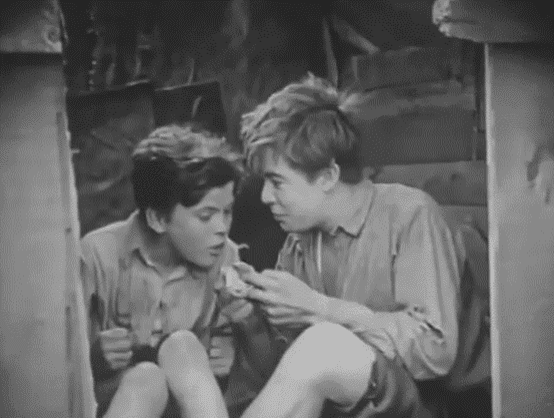
       But it is their discovery of his dog and the decision to send the mut away that finally determines the boy to escape from his house of bondage. He takes to the street, immediately arousing the wrath of a local cop for stealing bananas to satisfy his hunger. It is only his meeting up with the younger but far more savvy newspaper boy, Mike (Ernest Butterworth), who offers him a momentary hideout—playing a role similar to Oliver Twist’s Artful Dodger—that shows him how to survive such a public life.                 Mike not only offers him advice but brings him home to his little lean-shack that opens with large piece of canvas like a back street tent, just large enough for Mike, Ed, and Simp to eat and sleep within when they are not working the streets.


       At Mike’s suggestion Ed takes up the “shoe-shining” business, offering men temporarily waiting in autos for their dates or, in one case, a simple repair job, a quick “shine.” Together with the pennies Mike makes from selling papers, the two of them make up a household of true equality where both work to provide the little food they can purchase or steal, protect one another, and plot to outwit the ever foreboding cops.

        In the earliest scenes of this movie he have been provided with the facts of Ed’s infancy, shown how he was born to a poor, dying woman (Barbara Gurney) forced to sell her baby simply to survive. The buyer is the mistress of corrupt local politician Pete Moran (Claude Payton), who she is certain that if she can pass off a newborn as Pete’s baby that he will dismiss her once he tires of her feminine charms.
        But Pete, seeing through her schemes, first orders the baby be taken away and then ditches his mistress, she vowing to get revenge.


        Again, much as in Dickens’ tales, Taylor’s film finds solace in coincidence. Now running for city mayor Pete faces stiff competition from the upright and socially concerned young Mr. Hamilton (Clyde Fillmore), a man with two daughters, a young girl Vera (Lila Lee) and an older daughter Ruth (Elizabeth James) who just happens to be in love with Dick Armstrong, son a wealthy patron of Pete Moran.

        Ed and Mike have already run into some minor trouble regarding the Hamilton family, when seeing the chubby little Hamilton dog munching on a bowl of dog food, Ed steals away its bowl to feed his own pooch. But hearing Vera cry upon the discovery of the missing bowl, he returns it only to be highly reprimanded by Mrs. Hamilton (Grace Morse) who, despite her husband’s open-mindedness, is herself, as Taylor’s informative intertitles tell us, “one of those women whose viewpoint is no wider than her own front door.”


       Despite discovering a small coin purse with six dollars inside—which represents a veritable fortune to Ed and Mike—the two boys soon again find themselves near starving, Mike determining with Ed’s help to steal from the Hamilton kitchen wherein, while standing upon their porch and looking inside, Ed had glimpsed a whole cabinet of jams and jellies. But in the midst of the robbery, Mrs. Hamilton, alone in bed at the time, hears the robbers and calls the police which sends the boys on a run with the cops close behind. When they discover themselves trapped, Ed turns himself in to permit Mike to escape. And he is soon brought to justice before a local court.


       Unlike Dickens’ works, however, in which surely such a judge would make matters only worse, the film’s hero is Judge Ben Lindsey, who plays himself who in real life founded the US Juvenile Court in 1901 committed to the belief that children commit mistakes, not crimes. According to Jesse Hawthorne Ficks, writing on this film for the San Francisco Silent Film Festival:


“Lindsey explained in interviews that he had been ‘just a judge, judging cases according to the law,’ until a moment in early 1901, when, upon delivering an adult’s sentence to a young boy in his courtroom, he heard a heart-rending shriek from the boy’s mother. It was then that he decided to change the criminal court for child offenders. He clarified how children needed careful rehabilitation as opposed to the institutional cruelties of 19th Century reformatories.

     Lindsey’s first foray into the movies was a three-reeler entitled Saved by the Juvenile Court (1913). Dozens of letters were sent to the film’s distributors the Columbine Film Company from child-betterment organizations inspired by the Judge’s social activism. This prompted Lindsey to announce an interest in directing feature films on the child labor dilemma. The Soul of Youth, however, proved to be the pinnacle of his movie career, and it was William Desmond Taylor who knew how to best reveal the compassion that resided in the Judge’s gentle eyes because Taylor himself had been brought before the Judge ten years prior. In 1910, Taylor was beaten by police and arrested after being mistaken for a homeless delinquent. Judge Ben Lindsey acquitted the soon-to-be director the next day. The judge appeared in one more film, Judge Ben Lindsey in Juvenile Court, which featured his voice via the Photokinema sound-on-disc system.”


     In this film we see Lindsey mildly freeing several children from jail time while garnering promises from them for better behavior. But without a father and mother to whom he might return the boy for better guidance the judge is about to send Ed to a youth rehabilitation center—a place we might imagine even worse than the orphanage from which he had escaped. But Hamilton’s daughter Vera takes a liking to the boy and demands her father help him by offering him a foster home. The plaintiff, Mrs. Hamilton, cannot believe that her husband might dare to take in such an incorrigible youth, but when he makes the offer she has little choice but to begrudgingly agree to it.

      So Ed ends up with a supportive father figure in the very home he and Mike had attempted to burgle. Mike, however, seems to get lost in everybody’s good intentions; and what about Simp, his beloved dog?


     Meanwhile, with regard to Hamilton’s mayoral run, he has received a letter from Peter Moran’s old mistress that she has the proof that he defrauded a company years before, with her name listed on the document. Hamilton is sure to win if he can only buy the document from her. But who can he send as a go-between? Hamilton’s elder daughter Ruth argues for her would-be financé to be the link since no one would possibly imagine that the son of Moran’s major patron would be involved in undermining him.

      Hamilton reluctantly agrees. But having himself heard of his former mistress’ plans, the savvy Pete suspects that young Armstrong will be carrying the letters. As the young man returns home, Moran and his goons meet him at the station, cutting away the pocket in which he has hidden the documents. When Dick goes to deliver it to Hamilton, he discovers it missing, the elder furious with his failure.

     Ruth cries, realizing that she now will never be able to marry the man she loves, and once more being unable to bear a woman’s tears, Ed plots to resolve the situation.

    Having been in the Hamilton home only a couple of days, he rejoins his street buddy Mike to attempt to break into Moran’s home and steal back the documents. But this time he feels it necessary to call the judge and warn him that, although he promised never to steal again, he must do it to protect those he loves.


    With an open heart, Ed with Mike’s help, climbs up and breaks into Moran’s apartment, successfully stealing the papers. But at the very moment of his escape the villain, who might have been his father, returns to the room, and, as Ed jumps to the ground shoots and wounds the boy. With Mike’s help, the boy literally holding his friend up as he struggles to the Armstrong house, Ed collapses on the Armstrong doorway, Mike running to report to Dick that they’ve got the papers, but Ed needs his help.

    Carrying Ed inside and depositing him on the couch, Dick listens to Ed’s advice to take the documents immediately to Mr. Hamilton and save his relationship with Ruth.

       In the meantime, Mike, who has been gently stroking his wounded friend’s forehead, puts his arms around his neck and pulls him in close as he demands that in return for what Ed has done for him, he has to help his friend by calling the doctor.


     The thoughtless young Armstrong finally does so, and runs off to the Hamilton house with the news. The doctor has evidently saved the boy’s life, and now even Mrs. Hamilton is so proud of Ed’s actions that she declares that she will become his mother, particularly when Mrs. Hodges suddenly appears on her doorstep, proclaiming she will be willing to adopt the young hero despite the fact he looks nothing like the boy she wanted.

      Hamilton, who forces Moran to go on the run by threatening to reveal his fraudulent past, has now won as Mayor for which the city will certainly be better off. Vera, who likes the look of Simp, demands they adopt the other dog as well, and Ed has finally found not only a father but a mother. But the film, alas, seems to have forgotten about Mike, who presumably returns to selling papers and living in his makeshift tent.

       In 1920 there was absolutely no way that a film could suggest that these two boys might have shared anything but the adolescent love of friends. But as a former boy scout, you can’t convince me that two pubescent boys, well-schooled in the lessons of the street, sharing a lean-to for weeks or even months did not explore one another’s bodies. If nothing else, these boys certainly functioned as a loving couple. And, if Ed learned how to love through caring for a dog, Mike, the movie proffers, has learned how to love by looking after his best friend, a love openly displayed in his final scenes with him.

       In his book Behind the Screen: How Gay and Lesbians Shaped Hollywood 1910-1969, William J. Mann, in fact, recounts how bi-sexual director William Desmond Taylor enlisted his young male lover George James Hopkins’ help “in livening up a mawkish tale of a do-gooder judge who reforms boys.” Mann continues into territory that even I had not perceived in the script:


“The script implied the boys had whored themselves, so Hopkins convinced Taylor to depict a scene in a whorehouse. In the days before the Hays Code existed to prohibit such a thing, Taylor agreed. For good measure, they also threw in a scene where the sixteen-year-old star…is sold into sexual slavery.

     Just to make sure they got their details correct, Hopkins wrote that he and Taylor visited an actual male brothel in Los Angeles. Later, after Taylor’s death, there would be reports in The New York Times of the director’s visits to an all-male ‘love cult’ in Chinatown, where ‘the men would be in silk kimonos, smoke the essence of the poppy flower and so commence their ritual, old as Sodom…. The members of the cult were held together by a bond, unthinkable, unbelievable, and that each had sworn an oath of undying affection for the others.’”


      Even I can not imagine what scene Mann might be referring to; perhaps it was cut. But it is clear that the director and his lover Hopkins certainly recognized the sexual implications of what their young boys were up to.

       The movie may pretend to be about reforming the laws regarding young boys, but the boys clearly learned by reforming themselves, in the sense of that word’s meaning “to form something all over again,” in this case a queer relationship between two individuals who have no other models but the one they themselves created.

     Unfortunately, given the demands of social propriety the film could not resist replacing their personally credited definition of relationships with the far more normative ones of a father, mother, and in the forthcoming marriage between Ruth and Dick, heteronormativity. But surely the loving Ed will not forget Mike. And one can imagine a later adventure where Mike is brought also into the Hamilton household. But of course, that’s not possible on the popular screen which demands its own sort of fairy tales.

      It’s even more fascinating when one recalls that just prior to this film, 16-year-old Lewis Sargent had played Huckleberry Finn in Taylor’s film version, a movie in which the young boy in Twain’s original at least, forged another queer male relationship with Jim.


   Only two years later Taylor’s own life would become a scandalous mystery. On February 2, 1922, the director was found dead in his Los Angeles bungalow at the Alvarado Court Apartments in Westlake. The body, lying flat on its back, with hands beside it, appeared to be calm with no expression of terror, and the police quickly came to the conclusion that he had died of a stomach hemorrhage. But as they went to move the body, they found to their surprise, a small pool of blood on the floor under it, a bullet hole in the lower part of his back.

     The last person to see him, actress Mabel Normand, was questioned as to why she had visited the house the evening before, explaining she’d come to collect her personal letters written to him.


        Some neighbors claimed to have seen a dark figure leave the house, but nothing further turned up as evidence—except for a large selection of pornographic photos depicting Taylor engaged in sex with several notable actresses, and a closet containing a collection of lingerie, each of the items dated and initialed. Of particular interest was a silk nighty embroidered with the letters M. M. M.


       The newspapers and nearly everyone in Hollywood had their own theories of who the murderer might have been. Some suggested it might have been the recently fired valet and cook, Edward Sands. He had prior convictions for several attempts of desertion from the U. S. military and for embezzlement and forgery. He also had had several aliases, and spoke with an outlandish cockney accent. He had previously forged Taylor’s name on checks the year before while Taylor was vacationing in Europe. Sands had also wrecked the director’s car and burgled Taylor’s bungalow, leaving footprints on the director’s bed. Following the murder, he was never heard from again.

      Henry Peavey, Taylor’s current valet, was the one who found Taylor’s body. He, so newspapers trumpeted wore flashy golf costumes, although he did not play the game. And only three days before the murder he had been arrested for “social vagrancy,” charged for being “lewd and dissolute,” which today might be read as attempting to pick up a gay man in public. Peavey died in 1931 in a San Francisco asylum where he had been hospitalized for syphilis-related dementia.


       Comedic actor Mabel Normand, who according to Robert Giroux—who along with others such a director King Vidor became so fascinated with the case that he did sleuthing of his own, the famous publisher writing a 1990 book on the murder—was deeply loved by Taylor. A locket bearing her photograph was found on Taylor’s body. Apparently Normand had first approached him to help cure her of her dependency upon cocaine. Her repeated relapses had terribly upset the director, and according to Giroux, Taylor met with federal prosecutors shortly before his death offering to testify against Normand's cocaine suppliers. Giroux expresses a belief that these suppliers learned of the meeting and hired a contract killer to assassinate the director. According to Giroux, Normand suspected the reasons for her lover's murder, but did not know the identity of the triggerman

     On the night of the murder, Normand claimed to have left Taylor's bungalow at 7:45 pm in a happy mood, carrying a book he had lent her. She and Taylor blew kisses to each other as her limousine drove her away. Normand was the last person known to have seen Taylor alive, and the Los Angeles Police Department subjected her to a grueling interrogation, eventually ruling her out as a suspect. Normand's career had already been faltering, and her reputation was tarnished by revelations of her addiction, which was seen as a moral failing. According to George Hopkins, who sat next to her at Taylor's funeral, Normand wept inconsolably throughout the ceremony.

     Faith Cole MacLean, the wife of actor Douglas MacLean and neighbor of Taylor's, claimed to have seen Taylor's killer. The couple was startled by a loud noise at 8 pm. MacLean opened her front door and saw someone emerging from the door of Taylor's home who she said was dressed "like my idea of a motion picture burglar." She recalled the person paused for a moment before turning and walking back through the door, as if having forgotten something, then re-emerged seconds later and flashed a smile at her before running off and disappearing between the buildings. MacLean thought that the loud noise she had heard was a car back-fire, not a gunshot. She also told police interviewers this person looked "funny" like a movie actor in white-faced makeup, speculating that it may have been a woman disguised as a man due to the person's height and build.


      The M. M. M. of the embroidered night coat, Mary Miles Minter was a former child star and teen screen idol whose career had been guided by Taylor. Minter, who had grown up without a father, was only three years older than the daughter Taylor had abandoned in New York. Love letters from Minter were found in Taylor's bungalow. Based upon these, the reporters alleged that a sexual relationship between the 49-year-old Taylor and 19-year-old Minter had started when she was 17. Both Giroux and Vidor, however, disputed this, citing Minter's own statements that her love for Taylor was unrequited. Taylor had often declined to see Minter and had described himself as too old for her.

     Facsimiles of Minter's passionate letters to Taylor were printed in newspapers, forever shattering her screen image as a modest and wholesome young girl. She was vilified in the press. Minter made four more films for Paramount Pictures, and when the studio failed to renew her contract, she received offers from many other producers. Never comfortable as an actress, Minter declined them all.


      Mary Miles Minter's mother, Charlotte Shelby, like many a stage mother was described as manipulative and consumed by greed over her daughter's career. Minter and her mother were bitterly divided by financial disputes and lawsuits for a time, but they later reconciled. Shelby's initial statements to police about the murder are still characterized as evasive and "obviously filled with lies" about both her daughter's relationship with Taylor and "other matters." Perhaps the most compelling bit of circumstantial evidence was that Shelby allegedly owned a rare .38 caliber pistol and some unusual bullets which were very similar to the kind which had killed Taylor. After this information became public, she reportedly threw the pistol into a Louisiana bayou.

      Shelby knew the Los Angeles district attorney socially and spent years outside the United States in an effort to avoid both official inquiries by his successor and the press coverage related to the murder. In 1938, her other daughter, actress Margaret Shelby, suffering from both clinical depression and alcoholism, openly accused her mother of the murder. Shelby was widely suspected of the crime and was a favorite suspect of many writers. For example, Adela Rogers St. Johns speculated that Shelby was torn by feelings of maternal protection for her daughter and her own attraction to Taylor.

       Film actress Margaret Gibson had worked with Taylor when he first came to Hollywood. In 1917, she was indicted, tried, and acquitted on charges equivalent to prostitution, along with allegations of opium dealing, after which she changed her professional name to Patricia Palmer. In 1923, Gibson was arrested and jailed on extortion charges, later dropped. At age 27, she was in Los Angeles at the time of Taylor's murder. No record of her name was ever mentioned in connection with the investigation. Soon after the murder, Gibson began working in a number of films produced by Famous Players-Lasky, Taylor's studio at the time of his death. Shortly before she died in 1964, she confessed to murdering Taylor. [Sources: Robert Giroux, A Deed Of Death: The Story of the Unsolved Murder of Hollywood Director William Desmond Taylor, Jesse Hawthorne Ficks, writing on The Soul of Youth for San Francisco Silent Film Festival, and Wikipedia, along with various news recountings of the murder.]

      Along with the Fatty Arbuckle scandal, Taylor’s death was perhaps the central Hollywood event that brought everyone to believe that the motion picture studios had become a true Sodom.


Los Angeles, April 25, 2022

Reprinted from World Cinema Review (April 2022).

Sunday, March 17, 2024

Bertrand Blier | Les Valseuses (Going Places) / 1974

the couple

by Douglas Messerli


Bertrand Blier and Philippe Dumarçay (screenplay, based on the novel by Blier), Bertrand Blier (director) Les Valseuses (Going Places) / 1974


Upon its original release in 1974, Bertrand Blier’s Les Valseuses (Going Places), based on Blier’s own novel, was perhaps one of the most controversial films of its day. Vulgar, sexually explicit, and featuring rape, physical abuse, and suicide, among other things it must have seemed in 1974 as crude and ballsy as its French meaning, “the testicles.”   


     Vincent Canby of The New York Times was more perceptive that he often was, describing its two central characters as being “pursued, doomed like that mythical bird Tennessee Williams sometimes writes about, the one that must spend its entire life flying, since evolution has denied it landing gear.” But like so many other US reviewers of the day, he also found it to be “a movie whose good performances and technical expertise can never disguise the vacuity of its assumed nihilism, which bears about as much relation to the real thing as fashion photography does to the work of Cartier-Bresson.” He concluded: “I must say that though I thought parts of it funny, and Miss Moreau riveting, the net effect was one of irritation and gloom. It's not very invigorating to see so much talent squandered on such foolish mixed-up romanticism.”

       By its re-release in 1990, Kevin Thomas of the Los Angeles Times proclaimed that none of Blier’s later “notable and distinctive” films “have packed the punch of his debut film…. The road/buddy movie was scarcely new 16 year ago, but Blier’s strategies in the telling of his sexual odyssey remain fresh, outrageous and inspired.”

    Although even in 1990 a critic as august as Roger Ebert still didn’t get it, declaring “Going Places is a film of truly cynical decadence. It’s also, not incidentally, the most misogynistic movie I can remember; its hatred of women is palpable and embarrassing.”

    Seeing it the other day, I was wowed by its originality, its fresh sense of camp and imitation, and its utter cinematic charm.


   What Canby and later Ebert didn’t comprehend is that that the film’s two appealing and even charming central figures, Jean-Claude and Pierrot, played wonderfully by Gérard Depardieu and Patrick Dewaere, are a non-realist Beckettian duo the likes of Mercier and Camier (and before that Gustave Flaubert’s Bouvard and Péchuchet), clowns who cannot exist without one another, and who, although always seeking sex with females are more in love with one another than they might possibly be able to even imagine with the opposite sex. And no married couple spends as much time together as do these two men.


    In fact, at one point in Blier’s film when they have escaped to a beach city out of season with no female in sight (nor anyone else for that matter), they readily have sex with one another. To describe them as gay is beside the point, and such figures would surely rankle at such a description since their stock role in movies demands they seek out the opposite sex. Yet they can only exist as a pair, doing everything together, including enjoying sex with females who they simply see as machines for their pleasure; they haven’t a clue how to really love. These are, after all, puppets, cute rag dolls who troll the countryside for pleasure.

    But pleasure for such figures is more difficult to find than a good man—or woman, since that’s what they imagine they are seeking. Besides, whatever they do, they are punished. Described as petty criminals, their first crime was simply stealing from a five-and-dime store, much like the characters in Truman Capote’s Breakfast at Tiffany’s. But since even such petty crimes turn them automatically into criminals, they obviously feel they might as well go whole hog, forever after actually robbing their way through the film, first an older woman on her way home who turns out to have hardly any money in her purse; then a beauty parlor where a woman they have also stolen, Marie-Ange (Miou-Miou) works; and finally from a wretched couple with a beautiful young daughter, Jacqueline (Isabelle Huppert in one of her earliest roles), who actually suggests the heist as she runs off with them.


     They also begin by borrowing a Citroën DS for a joyride. But when they attempt to return it, the owner points a gun at them and threatens to turn them into the police. As Pierrot attempts to run, the owner of the car shoots him in the balls, Jean-Claude overpowering the shooter stealing the gun, car, and the man’s date, Marie-Ange, who is just as happy to go with them than she is with the man, her boss, who treats her perhaps even worse than our two clowns will, even though they leave her in the care of a mechanic who rapes her and later slap her about on several occasions, at one point tie her up and leave her after they rob the beauty parlor, and later toss her a couple of times into a watery canal. She too is simply a doll, a Punch and Judy-like character who sustains the slings and arrows, or in this case, blows and slugs in which the threesome engage.

       Meanwhile, to find care for Pierrot, Jean-Claude threatens a doctor and his wife, forcing the doctor by gunpoint to provide fix up Pierrot. Once the bandages are in place, they steal the doctor’s money and run. Fortunately, Pierrot’s wound is only superficial, but he fears for the worst when he cannot get an erection. But soon he’s back in action.   

       The robbery of other cars (and even bicycles) follows, mostly just to exchange vehicles so they won’t be identified, but often they have no other way to get from place to place— although a wonderful train ride ends in Pierrot sucking from one tit of a nursing mother, while Jean-Claude titillates the other with his finger in scandalous scene that probably wouldn’t be permitted except in a porno film today.


     In this topsy-turvy world, however, the women almost all seem to take great pleasure in the company of these extraordinary misogynists. The woman on the train (Brigitte Fossey), about to meet up with her nerdy husband, is most certainly sent into a sexual spin by their adulation of her breasts. And despite their treatment of Marie-Ange, she is only too ready to join them, as they live on their money from beauty parlor heist, in some of the few moments they have of true rest and relaxation in the country, dining on good bread, meat, and wine.


        At another point, believing that perhaps a woman just released from the prison may be the most desperate for sex, they pick up Jean Pirolle (played by the wonderful Jeanne Moreau), who indeed is perfectly happy to join the couple in bed—although in the case, after sex she steals away to shoot kill herself with their gun. Her reasons seem inexplicable, but they perhaps relate to the fact of the reason she has been imprisoned (which I will discuss momentarily), not because of having had sex with them.

         And, as I’ve already suggested, the young Jacqueline is only too ready to escape with our boys in the car stolen from her parents, and even enjoys her first sexual experience with them in tandem.

        In short, Blier’s clowns are stock figures programmed for behavior not only like Beckett’s Mercier and Camier, but like the all those pairs and singles who we’ve already experienced in numerous films before Going Places, Jim Stark and Plato Crawford in Nicholas Ray’s Rebel without a Cause (1955), the young rebel Antoine Doinel and his friend Patrick Auffay in François Truffaut’s The 400 Blows (1959), Michel Poiccard in Jean-Luc Godard’s Breathless (1960), Franz and Arthur in Godard’s Band of Outsiders (1964), Ferdinand Griffon (aka Pierrot) in Godard’s Pierrot le Fou (1965), and, particularly, Jules and Jim who meet up with a young Catherine (Jeanne Moreau) in Truffaut’s 1962 film, to which work is almost a satiric testament.

      If you recall, in that last named film, Catherine, caught between her love for Jules and Jim, runs her car off a broken bridge, killing herself and Jim, while leaving Jules to bury them. But let us pretend she survived in the magical land of motion pictures, being sent off to jail for her crime. 10 years later she is freed as the older Jeanne we witness in this film. She has not had a miscarriage as Jules reports she had in Jules and Jim, but has had a young son, Jacques (Jacques Chailleux), who has also been serving time in prison for criminal activity.

       Certainly, Jeanne (or perhaps the real actor behind her, Jeanne Moreau) does not want yet again to go through the process of splitting up such a perfectly matched pair as the Laurel and Hardy-like couple of this film, Jean-Claude and Pierrot, and destroys herself to prevent it.

       But the fools can’t resist destroying the moment of joy they are now encountering in their country hideaway, and, finding out about the existence of Jacques, they go to the prison to pick up him and take him back to their little commune where, as they tell him, they share everything, including the pleasures of Marie-Ange—although, as they explain to him, while she’s completely open to sex, she’s also rather sexless with no reaction whatsoever, never reaching, apparently, a climax.

        All that changes when the virginal young man approaches her and cums early two times before the third time he succeeds, also presenting her with her first orgasm. From now on, she becomes not just a willing sex-object but a sex-crazed woman, desperate to have sex almost constantly including in the back seat with both of them, one after the other, while the empty-handed one drives on.

          In the meantime, Jacques argues it’s time for another heist, and taking the two fools along with him visits a house in which he says an elderly man is holding a great deal of money. Actually, it’s the home of the prison warden whom he intends to murder; he succeeds, involving our two fools, sending them once again on the run. Newspaper headlines post their pictures. They attempt to rid themselves of Marie-Ange, since they have developed feelings for her and don’t want her involved in case they are caught. But she refuses, and, as I have mentioned above, they collect Jacqueline as well.  


        But finally, they put Jacqueline by the side of the highway to hitchhike back to civilization, and by the end of the film the two are once again alone as a couple, “going places,” they suggest. But we know, alas, they have nowhere to go. Rebels without a cause, they are nothing but a type, a team who repeat themselves over and over, stealing cars, fucking women, constantly on the run. If only they were given some money to simply rest for a while, eat, drink, take in the sun, they might figure out that it is one another whom they truly love.


Los Angeles, March 17, 2024

Reprinted from My Queer Cinema (March 2004).

Éric Rohmer | La Collectionneuse (The Collector) / 1967

someone to preen to

by Douglas Messerli


Patrick Bauchau, Haydée Politoff, Daniel Pommereulle, and Éric Rohmer (screenplay), Éric Rohmer (director) La Collectionneuse (The Collector) / 1967


Éric Rohmer’s La Collectionneuse, the 4th of his “Six Moral Tales” (it was the 3rd of the series made, however) is perhaps one of the most revealing concerning Rohmer’s major concerns in these works and aspects of his own life.


      Although the two males of this tale, Adrien (Patrick Bauchau) and Daniel (Daniel Pommereulle) might like to think of themselves as the moral centers of their world, particularly when compared to their accidental house-mate, Haydée (Haydée Politoff)—an attractive but apparently empty-headed young girl who each night brings home another young man to have sex—in the mansion they have borrowed from their friend Rodolphe primarily to evade working and to live out the summer in conditions of intellectual non-existence.

      True, these two friends consider themselves as total intellects—the beautiful Adrien wants to begin an Asian art gallery and the fair-haired Daniel is described by Adrien as a conceptual artist—they are both truly somewhat empty-headed drifters, whose major abilities seem to be in entertaining or even preening themselves for those around them more than accomplishing anything. Indeed, Rohmer evidently selected these two unknown “actors” primarily because they lived the dandyish lives of his own characters. After hours of conversation with the three major actors, Rohmer credited them as co-authors.


      If Haydée is, in fact, a “sexual slut” as they later describe her to her face, or, as they and the film’s title describes her, a female “collector” of men, Adrien himself, as a would-be art dealer, is himself a collector of meaningless objects (particularly since he seems to have little knowledge of history or art except what he has been told), just as Daniel is a collector of art ideas which he never truly realizes except in small maquettes, in one of which the walls of a spherical form are protected with razor blades, a metaphor that surely applies to his and Adrien’s own lives as they spin into space.

       They need Haydée to demonstrate their prowess more than she, who will sleep with nearly anyone who looks good, needs them. Yet she allows them to basically imprison her in the mansion, refusing to help take her to her various rendezvous or to allow her young men to enter their shared domain.

      Together, they mock her and attempt to psychologically torture her, Adrien by pretending to be disinterested in her physicality and Daniel by taking advantage of it, making love to her before turning rather violently against her and ultimately leaving the would be “paradise.”

       The self-enchanted Adrien, constantly fidgeting with his hair and presenting himself in various forms of half-nakedness, is perhaps the worst, simply because he is so self-centered that he sees himself as the focus of the young girl’s attentions as well, imagining that she has some elaborate plan to seduce him. In the end, it is he who attempts to seduce her, without much success.


       Having refused any of her previous advances, when Adrien makes his move she rejects him—which he believes is merely another move to reel him in. The delusion of these macho-fools should truly be the subject of the movie, but since Haydée, herself, is so mindless and purposely self-destructive, it is hard to side with the misunderstood female as well.

       Fixing her up with his possible backer of the gallery, Sam (Seymour Hetzberg), Adrien is even a bit disappointed when she reports that she only shared a boat ride and a pleasant dinner. In short, he has played pimp to the young woman, a role for which she joyfully punishes him by destroying his priceless Chinese vase, and probably, by that act, nixing any hopes that Sam may continue to support Adrien’s future gallery.

       Finally admitting Haydée’s sexual prowess, Adrien attempts to drive off with her into a sort of romantic sunset; yet she soon encounters friends traveling in the opposite direction, and just as quickly abandons Adrien to travel back the way she has come.

      The slightly chastised Adrien flies off to London where his girlfriend, Mijanou (Mijanou Bardot, Brigitte’s sister) appearing only in the film’s first prologues, has gone, catching the first plane to join her. But we can only suppose, given what we’ve seen of his views of women, that he probably will also fail at that relationship as well.

      We might deduce, accordingly, that the true moral of this story is simply that Adrien should not have left the woman who was best for him in the first place, a story, as are most of the “Six Moral Tales,” about comeuppance. However, as Maura Edmond, in her 2017 review of the work in Senses of Cinema reminds us, Rohmer was himself a kind of dual person, hiding under the identity of a highly religious family man, Maurice Henri Joseph Schérer, who worked as a classic’s teacher, while actually spending his life (unknown even to his mother) as the famed filmmaker, who hung out with just such Paris starlets and self-enchanted young men.

      In a sense, accordingly, the “morality,” if there truly is any, of this tale turns inward, into a kind of self-observation that uses the director’s “real” lost figures as symbols. In short, there is a kind of self-revelatory dishonesty, that Adrien reflects, in this, one of Rohmer’s best films.


Los Angeles, August 3, 2018

Reprinted from World Cinema Review (August 2018).

Spike Lee | She's Gotta Have It / 1986

seeking independence

by Douglas Messerli


Spike Lee (writer and director) She’s Gotta Have It / 1986


In Spike Lee’s first feature film, shot on the near impossibly small budge of 175,000, is a charming film about a black woman’s self-empowerment in a world in which the men have always had the upper hand with it comes to multi-sexual relationships.


    Despite that powerful theme, however, Lee’s film does not preach to us, but simply allows the woman, in this case the remarkably intelligent and beautiful Nola Darling (Tracy Camilla Johns) to tell her own story and present the trio (or would-be quartet, which includes Opal Gilstrap [Raye Dowell]) of sexual encounters she has with three men, who all desire her, and one lesbian friend, who would love to get her into bed. Opal, a lesbian, however as no major role in this film, but the character was extensively expanded in the 2017 Netflix series of the film, in which Opal appeared generally as a positive, pan-sexual and polyamorous figure.

      Each one of them would truly like to possess Nola and make her their own love object, but the smart designer, artist keeps them all at arms’ length by making her apartment a kind of turnstile in which the men and woman observe each other coming and going at all times.

     Anyone, it appears, is welcome—as long as you have some special personality trait that Nola enjoys.

     Jamie Oversteet (Tommy Redmond Hicks) is an equally intelligent gentle lover who is perhaps best suited to Nola’s own personality, but even he is kept at a distance.

     The least suitable is Greer Childs (John Canada Terrell), a successful, if self-centered model who has become fairly wealthy. He takes Nola into a world of fine dining and other areas of culture which she clearly enjoys.


      Mars Blackmon (Spike Lee) is a kind of idiot motor mouth, but he’s funny and makes Nola laugh in way only she can.

      That’s the story, folks, and the details hardly matter. Yet, unlike any white-directed films of the time, when blacks were nearly always portrayed as drug addicts or criminals of various sorts, these citizens of the Fort Greene, Brooklyn area, are all healthy, normal beings with their own desires and achievements—a truly refreshing change in the portrayal of the black community. Even the doctor (S. Epatha Merkerson) who Nola visits when she is told that she has nymphomaniac tendences, pronounces Nola’s sex life as normal and healthy.

      What the lovers of this story resent is that she has not given all her love to one of them. Even though Nola tries to bring peace to her entourage, by inviting them to her place for Thanksgiving dinner, they fight, destroying any good that might have come out of the celebration.

     As Nola makes clear in direct statements before the camera, that is what her life is: a kind of celebration of womanhood, of a woman who does not want to be tied down to one man.

      Even after she dismisses Mars and Greer (the latter of who insists that for Nola the three of them acted together as a kind of machine of 3 penises and 6 arms), choosing Jamie to be her companion, the relationship does not last long.


      For she refuses to be tied down to one man. The “she’s gotta to have it” of the title is not as much about sex as it is about the independence Nola continually seeks. Yes, she loves sex, but it is the friendships with her lovers that she most cherishes, the special things she discovers in each of them. And, in that sense, particularly in 1986 when this movie was first released, that was a radical act. For any woman to declare that she wanted sex without any of the strings attached was seldom permitted.

      And that is why Lee’s rather modest film is so very fulfilling. It is the woman in control here, not the men who surround and would fold her into their singular lives.

        In that sense Nola is special, but in Lee’s telling she is also an everywoman who seeks to define her own role in society in which she lives. Nola, I would suspect, also knows that women have always been some of the strongest forces in black communities, often defining themselves as a moral compass to their men. Whether this is a myth or not, it does appear again and again in the most objective of literary and cinematic works about blacks.

     You can call her a freak, a nymphomaniac, whatever…. But she is still a force to be reckoned with.


Los Angeles, June 13, 2020

Reprinted from World Cinema Review (June 2020).


Index R-Z

Angelo Raaijmakers I, Adonis / 2021 Peeter Rabane Firebird / 2021   Tyler Rabinowitz Catalina / 2022 Tyler Rabinowitz See You Soon / 20...