Friday, May 24, 2024

Teinosuke Kinugasa | Jigokumon (Gate of Hell) / 1953, USA 1954

the “other” inside

by Douglas Messerli


Teinosuke Kinugasa and Masaichi Nagata (screenplay, based on the play “Kesa’s Husband” by Kan Kikuchi), Teinosuke Kinugasa (director) Jigokumon (Gate of Hell) / 1953, USA 1954


With the introduction of color film by Eastman Kodak that allowed a single strip film camera to carry three dye emulsions, producing a high level color, Japanese director Teinosuke Kingugasa created the first commercially produced color film in Japan in 1953. For a country that had lagged far behind US color films, it was a startling feat, displaying some of the deepest and richest colors in all of cinema, particularly in the Japanese medieval tale’s lavish costumes and sets, allowing the director to blend the colorful flourishes with rich woven textures. The film won the Cannes’ Palme d’Or and the Best Foreign Language Film at the 1955 Academy Awards, as well as the Academy Award for the Best Costume Design.


    But, as Stephen Prince writes in the liner-essay to Criterion’s DVD restoration of Gate of Hell, “although Eastman Kodak’s new film stock (5248) offered revolutionary cost savings…unlike those of three-strip Technicolor, its colors did not prove to be long lasting.” And within a few years Kingugasa’s great film had nearly disappeared.

     Fortunately the studio Daiei had made separation masters in black-and-white that record all the color information, and in 2011 was restored to its original beauty, the edition that Criterion has published.

     The story, for all of its spectacle, is startlingly simple. During the Heiji Rebellion of 1160, when the castle is attacked, warlords helped the emperor and the empress escape, in part by employing one of the empresses’ ladies in waiting, Lady Kesa (Machiko Kyō) to ride away from the Imperial Palace in her carriage. The ruse succeeded when the invaders, chasing after the carriage in hopes of capturing the empress, were rebuffed by the emperor’s supporters; in the midst of the battle the warrior Morito bravely pulls the carriage out of harm’s way, steering it to his brother’s house nearby, allowing Lady Kesa, who in the fear of the moment has passed out, to survive.

      As Morito (Kazuo Hasegawa) attempts to awaken the startled Kesa, he is possessed by her beauty, but is distracted by the return of his brother and others, whom he quickly discovers has gone over to the side of the rebels. Defending his position and continuing to protect Lady Kesa, he rebuffs his brother’s behavior. And when the rebellion has ended, the emperor(s)* restored to their rightful place, his brother is killed as a traitor. Visiting his brother’s memorial, sometime later, Morito once again encounters Lady Kesa and her aunt who have stopped also by the Gate of Hell, and two share a brief conversation.

     When Gen Kiyomori (Koreya Senda) awards his loyal warriors' gifts of their own choosing, Morito asks that the General intercede on his behalf for a marriage between himself and Lady Kesa, only to discover that Lady Kesa is already married to the palace guard, Wataru Watanabe, a gentle and loving man. So possessed has he become, however, that he stubbornly refuses to accept any other award, and pursues the beautiful Kesa, against all advice, throughout the rest of the film, battling with Wataru in several ways, through a horserace, threats, and, finally, threatening Kesa and her aunt themselves, determining to kill Wataru in his sleep and claim his prize.   
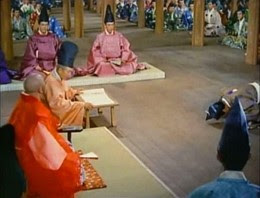


    Terrorized by the now near-mad Morito, Kesa promises she will help with the murder of her husband, but cleverly manipulates him into her bedroom, while she moves into his. As Morito creeps in to kill her husband, he stabs Kesa to death instead, and, discovering, his horrible crime, confesses everything to Wataru, challenging the guard to end the warrior’s life. The wise and now suffering Wataru refuses—insisting that such an act can do nothing to restore his lover’s life. And the guilt-stricken and suddenly saner Morito abandons his sacred status, cutting off his chonmage (his queue of hair) to become a wondering monk. 

     Although this story is beautifully enacted by the central actors and stunningly visually presented, it is its hyper-intensive colors and patterns, like the scrolls that tell this early story, that make Kinugasa’s work so memorable. So intensely saturated are the palace scenes that they create almost a sense of fantasy and disbelief. Although we want to define this attention to light, texture, and detail as a kind realism, we can only recognize it as being closer to a sort dream-state where things are never quite what they seem.


     And indeed, that psychological tension between what things outwardly seem to be and inwardly actually are is behind several of Kinugasa’s themes. From the very beginning we perceive that people are not always who they seem to be: Lady Kesa is not the empress fleeing the palace, Morito’s brother is no longer a loyal supporter of the throne. Although clearly loyal and brave, Morito is at heart a potential murderer and a selfish destroyer of marital bliss.

      But even here, in the seemingly deep love between Wataru and Lady Kesa, we can only wonder if things are precisely as they appear. Why has Kesa not herself told Morito of her marriage when he first kissed her at his brother’s house or when he verbally accosted her and her aunt at the Gate of Hell. Although the aunt seems friendly and kind, she is also, apparently, a kind gossipy old woman, spending far too much time telling Morito about her niece, even when Kesa herself attempts to demure and escape.

      After the horserace between Morito and Wataru, the later an experienced winner of the annual even, Wataru is accused by his fellow guards as having purposely lost. Did he, perhaps, inwardly doubt his wife’s version of events, resulting in his failure to whip on his horse to winning? Certainly, Wataru might have sought more explanation for his wife’s involvement with Morito in the first place.

     Although General Kiyommori attempts to dissuade Morito from his interest in Kesa, he still manipulates a meeting in the palace between the two. Even though Kesa is wary of events, why does she still chance the night-time walk to her aunt’s house? Even the truly noble and gentle Wataru cannot explain why his angelic Kesa had not come to him to tell him of Morito’s threats. Did she so fear his inability to deter Morito, just as he had lost the horse race, that she was willing to sacrifice herself?

     These questions and many others are (fortunately) never answered by Kinugasa’s film, for the very tensions between the inside and the outside of the selves in this culture are what create the most significant moments of this profound film. In such a beautiful world as the one the director has created before our eyes, it is hard to see the darker recesses of the individuals with whom he presents us. And we can only guess of the “other” inside each of these historical figures.


*Historians tell us that during this period in Japan there were two emperors, one, hermetically separated, who made all decisions, the other living as a more available figurehead.


Los Angeles, September 10, 2013

Reprinted from World Cinema Review (September 2013).


Michael Haneke | La Pianiste (The Piano Teacher) / 2001, USA 2002

dreaming of what they don’t have

by Douglas Messerli


Michael Haneke (screenplay, based on a novel by Elfriede Jelinek), Michael Haneke (director) La Pianiste (The Piano Teacher) / 2001, USA 2002


When Michael Haneke’s powerful film The Piano Teacher first opened in 2002 in the US, numerous American critics described the work as “depraved,” “unwatchable,” “deeply disturbing,” even while saluting the director’s masterful approach and the wonderful acting of the film’s star, Isabelle Huppert (the film was awarded the top awards for directing and its two major actors at Cannes). But even the generally perceptive reviewer Roger Ebert could not quite put his finger on what was behind Huppert’s character, Erika Kohut’s bizarre sexual behavior.


      Looking back on this film nearly 11 years to the date of its Los Angeles premiere—and having witnessed now four other of Haneke’s brilliant films—this work seems far less shocking and ambiguous as it must have appeared to its first US audiences. One might even describe this picture, filmed in Freud’s home city of Vienna, as a textbook study of Freudian sexual frustration and perversion.  

      Having devoted her entire life to a musical career as a piano concert performer, Erika has had little experience, it is clear from the beginning of this work, with the opposite sex. She lives with a domineering woman (Annie Girardot), not so very different from the kind of stage mother portrayed in the American musical, Gypsy, a somewhat unrefined woman who, even though her daughter is now in her 40s, continues to control her life and rules over her career and teaching responsibilities; when the girl does not return home on time, she enters her closet to destroy any new dresses the daughter may have purchased. The mother even warns this insecure woman not to let her students become better interpreters of music than she is. The husband of this monstrous mother has unsurprisingly gone mad. Erika painfully is forced to share her mother’s bed.

     We soon discover that Erika’s only experience with sex has been through late-night visits to a Vienna porn theater, where, after being ogled by the male denizens, she locks herself in a cabinet to watch violent porn tapes. At one point she takes the blade of a razor to her vagina, bleeding into the bathtub. Upon another occasion, she stealthfully visits a drive-in theater on foot to observe the young couples engaging in automobile sex. With such a violent view of sexuality is hardly surprising that she steers clear of the male world, describing them as pigs, while simultaneously having all the sexual urges of a woman of her age.

     If her life is devoted to music, particularly to the mournful love songs of Schubert and Schumann—one song, ”In the Village” from the Winterreise cycle, repeated throughout the film, begins with dogs barking and people “dreaming of what they don’t have,” as it’s translated in the film, typifying the “love, death, transformation” themes of his famed lieder written during the time when Schubert began experiencing the symptoms of syphilis—Erika clearly gets little joy from the music she so elegantly performs. As a teacher at the Vienna Conservatory of Music, she tyrannizes her students just as her mother does her, demanding they suffer in order to become great musicians.

     She is particularly mean to a rather plain looking girl, Anna Schober* (Anna Sigalevitch), whose entire existence has been given over to piano-playing; her mother telling Erika that the girl practices eight hours a day. Even her lessons, as she expresses it, are a bore.


     At a recital in which Erika plays in a wealthy Vienna apartment,** the musician meets a handsome if slightly haughty young man, Walter Klemmer (Benoît Magimel) the nephew of the apartment’s owner. During a buffet discussion he speaks somewhat intelligently about her performance, but she remains wary. He is evidently studying engineering at the university, but a piano performance by him after the buffet reveals he has true musical talent as well, and despite Erika’s dismissal of him, Huppert conveys a deeper and darker attraction. Soon after, Walter applies to study piano under Erika. At the audition he clearly wows the other faculty members, while Erika votes against him. When he is permitted to enter the conservatory and shows up to his first lesson, he reveals his passion for her, that he is attracted to the older woman like—in a rather ill-chosen metaphor—like a “nut to a bolt.”  His forthright approach clearly takes her aback, while, quite obviously, she nonetheless reveals her hidden desires. Their conversation represents the tensions between them:


“Erika Kohut: Schubert's dynamics range from scream to whisper not loud to soft. Anarchy hardly seems your forte. Why not stick to Clementi? Schubert was quite ugly. Did you know? With your looks, nothing can ever hurt you.

Walter Klemmer: Why destroy what could bring us together?

Erika Kohut: Mannerism is no...

Walter Klemmer: [interrupting her] Why can't I look at you? Because if I do, I won't resist the temptation to kiss you on the neck. May I kiss you on the neck?

[she walks away]”


     Soon after, at a rehearsal of the conservatory’s Jubilee performance, the young Anna Schober arrives late, having had diarrhea through her fear of Erika’s tyranny. The teacher calms her student, only to watch Walter, helping to set up the next set, speaking to Anna and even eliciting from her a small laugh. Watching Walter serving as page-turner to Anna, Erika exits the auditorium, obviously jealous of even the clumsy friendship Walter has offered his fellow student. Suddenly, Erik breaks a wineglass, spilling the broken pieces into Anna’s coat pocket. The rehearsal closes, with the inevitable: Anna, thrusting her hands into the pocket, is severely cut, unable to perform at the Jubilee event—or perhaps ever again. While Erika has been jealous, we also comprehend that she may have unintentionally saved the young girl from an empty life like her own, a world in which she has given over all to her musical avocation.    

     When Walter observes her escaping the scene, he follows her to a bathroom where Erika has tried to hide herself away. Leaping over the stall to bring her out, Erika exits, falling into a passionate embrace with Walter, but refusing to allow him to touch her. She, in complete control, performs fellatio without allowing him to ejaculate, forcing him to keep his erect penis in place while facing him. While he pleads with her, she terrorizes the student with threats that she will never let him touch her again, before finally jacking him off, demanding that any further contact will be through her own methods, obscure communications and letters.


      So begins a series of manipulative actions in which she demands Walter, in her own apartment with the bedroom barricaded against her mother, to tie her up, gag her, and force her into sexual acts of her own depraved imagination—much like the scenes she has witnessed on her porn tapes. Reading her written requirements, the young Walter is disgusted with her S & M demands. He proclaims he loves her, but wants no involvement with such degradations, emphatically dismissing her vision of sexual life:


“Erika Kohut: Do you like me calling you darling?

Walter Klemmer: It's absolutely marvelous.

Erika Kohut: You must be patient. I'll give you all the names, we'll play all the games you want.

Walter Klemmer: You know you really stink? Sorry, you stink so much, no one will ever come close to you. You'd be better leave town until you don't stink so bad. Rinse your mouth more often, not just when my cock makes you puke.”


When Erika continues to make her demands, Walter leaves her, but utterly frustrated and mentally “snapping,” returns to her home, locking the mother into her room while he beats and rapes Erika, proving to her, obviously, that men are “pigs,” along with her realization that the fantasy world she sought, played out in reality, like everything else in her life, is without any pleasure.


     Walter leaves her permanently. As she and her mother attend the Conservatory event, where she will now accompany the Schubert song in her student Anna’s place, she witnesses Walter arriving with others, before secretly exciting the hall, pulling a long kitchen-knife from her bag and plunging it into her breast. It may be only a symbolic death, instead of the real death German myth so often requires of its lovers (I am listening even at the moment of writing this to a New York Metropolitan performance of Wagner’s Die Walküre), but even if she survives, we recognize it is the beginning of her total undoing. She has, if nothing else, symbolically committed suicide, as if replying to Schubert’s next phrase in his song: “What is this foolish desire?”


*Schober was the name, incidentally, of Schubert’s landlord, at whose house he originally performed the Winterreise.

** In the scenes in which Huppert plays the piano, the actress, who studied piano for 12 years, actually performs the music.


Los Angeles, April 13, 2013

Reprinted from International Cinema Review (April 2013).

James Whale | Show Boat / 1936

fish gotta swim

by Douglas Messerli


Billie Burke (story, based on the novel by Edna Ferber and the musical by Oscar Hammerstein II and Jerome Kern, with additional dialogue by Zoë Akins, and additional lyrics by P.G. Wodehouse), James Whale (director) Show Boat / 1936


Until yesterday, when I tuned in early in the morning to the Turner Classic Movie television cable, I had only seen George Sidney’s 1951 remake of Oscar Hammerstein’s and Jerome Kern’s classic Show Boat. While I have enjoyed the enthusiastic dancing of Marge and Gower Champion, the singing of Kathryn Grayson, Howard Keel, and William Warfield, and comic acting of Agnes Moorehead and Joe E. Bown, I had never known how far superior the 1936 version was.


     The earlier version was generally performed more in the style of a romantic operetta—the kind of musical productions, in fact, that Kern had primarily composed before this ground-breaking musical. James Whale’s film also unabashedly uses racial stereotypes in his numerous tableaux of “happy dark folk,” and, at moments, he has no idea what to do with the camera during romantic duets, such as “Make Believe,” sung by warbling tenor Allan Jones (the tenor, you may remember, of A Night at the Opera) and a very young Irene Dunne. At moments stage actress Helen Westley (as Parthy Hawks) wavers between a bourgeois scold and a secretly bemused foil for the hammy acting of Charles Winninger’s Cap’n Andy. And Helen Morgan (as the mixed-raced Julie LaVerne) sings at the edge of bathos. Finally, there’s the painful imitation of a “darky” cakewalk (as critic Daniel Eagan describes it) by Irene Dunne, who later appears suddenly in blackface. Equally embarrassing are the friezes of back-breaking black labor Whale conjures up to support the lyrics of Paul Robeson’s “Ol’ Man River.” And the movie ends in one of the most sentimental love-hugs of all time, as a now elderly Magnolia kisses and makes up with her long-gone, gambling husband, Gaylord Ravenal.


      But then there is Robeson’s incredible voice and his unforgettable performance of “Ol’ Man River” and a new song written by Kern and Hammerstein, “Ah Stills Suits Me,” sung with veteran comic actress Queenie Smith. And while in the 1951 version, miscegenation and black culture are mentioned, black actors are nearly invisible. Here, at least, Whale employs whole choruses and populates the small towns along the Mississippi with black citizens. Robeson, argues Egan, clearly knew that the cakewalk and blackface performances were a statement against prejudice rather than manifestations of it.

     The character of Ravenal, moreover, is less a bad-boy matinee idol than a possibly dangerous force, who, Parthy discovers has already killed a man. The scene in which, having left his wife, Ravenal visits his daughter in the vaulted halls of her convent school is particularly moving, and helps to redeem his rascality.


    Although she somewhat overacts, Helen Morgan can still take her audience to the brink of tears in her beautiful renditions of “Can’t Help Lovin’ Dat Man” and “Bill.” We truly do feel the fatal inevitability of her love when she declaims “Fish gotta swim, birds gotta fly.” Whale cleverly pans away from the singer during the latter song, emphasizing the wonder of her voice through the absolute thrall of listening bartenders, dancers, and others. As in Frankenstein before it, Whale again proves his mastery of tableaux. 

     The plot of this version remains much truer to Edna Ferber’s original for good effect, allowing much more of the action to remain on the boat of the title and the shimmering river upon which it sits, before the film goes careening down the road of a theater bio of Magnolia and her daughter, Kim. One of the very best scenes, quite brilliantly dramatized, is the storm Whale whips on the night of Kim’s birth.


    Earlier, Winninger’s one-man performance of a corny melodrama of the day is priceless. And for all of its old-time theatrics, Whale’s Show Boat seems grittier and more honest than Sidney’s spiffed up, lollipop-colored musicale. At moments, in fact, you really do feel you might actually be there, on the constantly moving Show Boat of the antebellum South.

      Alas, the expenses of the film racked up by the director put Carl Laemmle, Jr. out of business, fired from the studio, Universal, which his father had founded. The film, however, was later added to The National Film Registry.   


Los Angeles, December 21, 2013

Reprinted from World Cinema Review (December 2013).  

Thursday, May 23, 2024

John Madden | The Best Exotic Marigold Hotel / 2011, USA 2012

everything will be all right

by Douglas Messerli


Ol Parker (screenplay, based on a novel by Deborah Moggach), John Madden (director) The Best Exotic Marigold Hotel / 2011, USA 2012


Madden's feel-good film, The Best Exotic Marigold Hotel, is an affable work in which a group of aging adults suddenly are forced to come to terms with where they are in their lives. After years of a docile life as a housewife, Evelyn Greenslade's (Judi Dench) husband has died, and, much to her surprise, finds there is not enough money for their debts. Selling their home, she is forced to awaken from her kind of "sleeping beauty" life and determine her own future. 

     Douglas Ainslie (Bill Nighly) and his wife Jean (Penelope Wilton) also find themselves in the unfortunate position of not having enough savings after investing in their daughter's failing internet company. Muriel Donnelly (Maggie Smith), we discover later, has simply been let go after years of service as house-keeper for a wealthy couple; she also needs, and cannot afford, a hip replacement. Norman Cousins (Ronald Pickup) is an aging would-be lover, studying the Karma Sutra and Madge Hardcastle (Celia Imrie) is a well-off woman on the search for a man. Graham Dashwood (Tim Wilkinson), a high court judge, suddenly resigns, deciding to retire. This unlikely group inexplicably find themselves in Jaipur, northern India, attracted by a brochure for a retirement hotel that looks little, in person, like the pictures represented in the folder.


     The plot is fairly predictable. Each member of the group must come to terms with something that he or she has not been facing or has hidden from others. Evelyn, forced to find employment, must learn to become self-dependent and face the fact that she has, once more, fallen in love, this time with the equally self-dependent but martially unhappy Douglas. His wife must come to terms with her own sour personality and her inability to face any change. Muriel must reflect upon her own bigotry and narrowness of vision. Norman must deal with his aging body, and Madge with the fact that she may find no one to love. Graham, soon reveals that he is gay, and has returned to India for the first time since his youth, when he was in love with an Indian man whose life was shamed when the two were found together.

      Writer Ol Parker (basing his script on Deborah Moggach's novel) adds to this potpourri the young Indian manager of the hotel, Sonny Kapur (Dev Patel), a charming and well-meaning entrepreneur who unfortunately is incapable of hotel management and, more to the point, a failure in life, refusing to even admit his love for the beautiful Indian girl Sunaina (Tena Desae).


     Each of these characters is destined, in the chaotic, colorful, and almost claustrophobic atmosphere of the city, to rub up against precisely that which they are refusing to face. And one by one, although some more slowly than the others, each of them come to terms with their radically new lives. Perhaps only the unpleasant Jean, who is also the only one who returns home, refuses the challenge of the often frightening but just as often exhilarating world into which they have suddenly discovered themselves. But then she does come to recognize that she is a veteran complainer, unhappy with everything in life.

     These various psychological and physical encounters are perhaps enough for anyone to describe this film as highly enjoyable. Yet it is just the clichés and even stereotypes of their confrontations that weaken the work overall. Evelyn, perhaps the most passive of these figures for most of her life, finds that she is remarkably resilient, able not only to cope but to prevail over the most complex of situations, including her new job and her budding love. She is, in short, just the kind of independent, open-minded woman that Judi Dench loves to play. So too is Muriel the close-minded, sharp-tongued figure who Maggie Smith has spent a career portraying. Of course, she gradually comes round to liking the subcontinent and its people that she so strongly dismissed. But it is difficult, despite her aptitude for organizing things, to imagine, at film's end, that she has become this decaying hotel's manager, sustaining the likeable Sonny by allowing him to radiate his faith in future life. As he beamingly proffers early in the film: "Everything will be all right in the end...if it's not all right then it's not the end."

      Obviously Graham will reconnoiter with his former lover, now married, with whom he spends a pleasant day. But the fact that the plot requires that he suddenly die—while he has told everyone that he gay, he has not told anyone that he has a heart condition—strikes me as a kind retribution for his young abandonment of love. And traditionally, of course, the sinner (the sexual deviant, often gay) must pay with his or her life.


     With Evelyn and Muriel's help Sonny stands up to his dominant mother and announces his love to everyone. Norman gets his woman and, for a least for a few seconds—when Sunaina, thinking Sonny is waiting in the bed, crawls in with her—Madge gets her heart fluttering again.

     If you can't go home, so it appears, at least you can start your life over. Too bad these stage types seldom exist in "real" life and that everyday living remains as confusing as a Jaipur street scene.


Los Angeles, June 18, 2012

Reprinted from World Cinema Review (June 2012). 

Index R-Z

Angelo Raaijmakers I, Adonis / 2021 Peeter Rabane Firebird / 2021   Tyler Rabinowitz Catalina / 2022 Tyler Rabinowitz See You Soon / 20...