Wednesday, December 4, 2024

Nitzan Giladi | In Bed / 2022

bow down

by Douglas Messerli


Nitzan Giladi (screenwriter and director) כאילו אין מחר (In Bed) / 2022


I have long mentioned my appreciation of contemporary Israeli LGBTQ film. But this time I almost turned away in horror of Giladi’s 2022 film with tatted, drugged, cellphone addicted, and not very friendly boys and a girl with disgust. Although one might say in its vision of the ugly side of the gay world, this film returns to the embracement of gay reality found in the significant filmmaker Amos Guttman’s movies, there something here that rubs me wrong.

       The situation is rather fascinating, based somewhat on fact. A gunman, evidently part of the LGBTQ community itself, suddenly is shooting people dead in a Gay Pride Parade. This kind of horror not only could, but does happen, just as the gay beatings outside of gay clubs and bars continues even today.


      The horror of it all sends the two major figures of the film, Guy (Israel Ogalbo) and his bestie girlfriend Joy (Moran Rosenblatt) back into the shelter of Guy’s apartment, only to discover several shell-shocked individuals gathered on the stairsteps, one of whom, shivering and stuttering in utter horror, Dan (Dean Miroshnikov) they invite into the apartment with them, offering him coffee, the time to recover, and money before he disappears to return in a now quite dangerous world since the shooter or shooters have not been apprehended.

       In the meantime, we become wisened-up to who our heroes really are. Guy seems to work as a tattoo artist, which explains his endless markings across his body, and Joy is a drug dealer, who at least has determined herself to cut off her desire for Tina, (Crystal Methamphetamine), a terribly additive drug that almost put her in the insane society and surely would have led to her death. That doesn’t mean that this wacky couple doesn’t continue with other “chemsex” drugs, from Xanex to a drip on the tongue from time to time of a drug that keeps them in a high and, later, nearly kills Guy.


      And that’s when the film becomes nearly unbearable to watch as, knowing the dangers that lie lurking in the world outside of the bed into which they retreat, they gradually lose control of themselves, their deep friendship, and finally any rational behavior, particularly when Guy begins to search on Grindr for the face-covered villain of the film, which may or may not be the Dan which they have attempted to save.

      A bath, an attempt of heterosexual sex pretending a Dolce & Gabbana-like nirvana follows, before one of the endless fights of the film occurs, sending Joy back into the joyless night, while Dan, a Russian expatriate shows up to fuck seemingly endlessly Guy to his mindless delight and regret.

      Gradually, as the drugs increase, and as for the first time Guy is introduced to Tina, things grow out of control as in many a heterosexual erotic thriller. Guy almost dies, but Dan appears to save him, while both begin to suspect the other of betrayal.


       Almost desperate, Guy tries to contact Joy again, asking for her help (he appears unable to imagine calling for the police), while Dan suddenly insists he’s not gay, that he has a heterosexual partner, and hints that his friends might be among those who pose on Grindr just to pick up gay guys to beat them up. He now is seeking refuge as well in gay sex.

       Finally, he admits that he too is now a suspect, having been involved with a whole group who may or may not have been involved with the Gay Pride Day killings. But by then it is too late, Guy, already hooked on the new drug, fucked intensely at least 4 times by my count (the incredibility of the sexual tenacity is never explained, but if possible, I guess even I would become delirious), can no longer think straight or even crooked.

       Joy shows up to protect the man with whom she would like to have a baby, but is pushed away by the now supposed protector of the drugged-out Guy. When she attempts to intercede, Dan kills her, whether intentionally or accidentally is almost beside the point. Even Guy witnesses, butt-naked, his dragging off of her body.

       By this time, I have to say anyone with a shred a decency has lost all interest in these truly despicable characters. Even if, as the director Giladi insists“I wanted to explore a topic that is rarely openly spoken about in the gay community, or shown at all in film: chem sex. The ecstatic highs and intensely deep lows of drugs in gay party culture. I have seen this around me; I have seen it influence people I love, and it has affected me…I wanted to show this side of our culture in a truthful way. Not in the sense of being realistic or documentary-like, but portraying, in an honest and visceral way, the feeling of being high, reaching for fantasy, the distortion of reality, and loss of control”—we have to wonder “why?” Is anyone in this film redeemable, loveable, someone to whom we should pay attention.


      Guy survives, walking stark-naked down the street, ineffectually asking for help, and begging, uncomprehendingly, for the police to pay attention. Far too late, far too meaninglessly, far too insignificantly to turn film into the masterpiece many claimed for it. We might even feel sorry for the 28-year-old Guy, but he has been a mindless idiot from start.


Los Angeles, December 4, 2024

Reprinted from My Queer Cinema blog (December 2024).

Tuesday, December 3, 2024

George Sidney | Kiss Me, Kate / 1953 [dance only]

tommy rall, bob fosse, ann miller, carol haney, jeanne coyne, and bobby van

by Douglas Messerli


Dorothy Kingsley (screenplay, based on the book by Sam and Bella Spewack), Cole Porter (music and lyrics), George Sidney (director) Kiss Me, Kate / 1953


I have always felt that the film version of Kiss Me, Kate was a sort of mixed bag. The introduction of Cole Porter into the film as he tries out a couple numbers in Fred Grahm’s living room, and the abandonment of the great show opener, “Another Op’nin’ of Another Show,” framed the work like too many other film musicals, and missed the opportunity to display the open theatricality of the original. But then, there is something contradictory in the original as well, where the on-stage personalities of the leads (in this case Katherine Grayson and Howard Keel) seem in their operatic style of singing and action in opposition to the other figures. Porter’s songs for them, as well, songs like “Wunderbar” and “So in Love” appear to be worlds away from the sprightlier numbers such as “Why Can’t You Behave” and “From This Moment On.”


     Accordingly, the musical and film both seem almost divided in two, with a Shakespeare-coated operetta at one end, and a jazzy series of dances choreographed by Hermes Pan and Bob Fosse at the other. Although most of the songs are wonderful, the story and its structure, seems almost to break the piece in two.

     But the dances are all so good that I might have chosen four great dance moments from this  film instead of the two I’ve selected, the other two being Miller’s tap performance of “Too Darn Hot” and Miller’s and the chorus’ rendition of “Tom, Dick, and Harry.”

     However, it is hard to match the dancing wonder of Ann Miller’s and Tommy Rall’s “Why Can’t You Behave?” in which she lovingly chastises him for his reckless behavior, while all the while he jokingly mocks her. The rooftop location of this scene, which literally flirts with “a loss of gravity,” is perfect, for the character clearly has no sense of gravitas. Indeed, when Miller reaches the roof she cannot, at first, locate her lover until he slides in from above down a pole which he has evidently previously shimmied up. It is the first of his gravity defying feats, as, the moment she finishes singing, he skips away, her tapping along, as he, spins like an ice skater, before somersaulting and cartwheeling off. A short rhumba between the two in which she plays out her frustrations in mock punches, butt kicks, and feet stomping, only sets him into a more irresponsible state as Rall dizzily dances at the very edge of the roof, imitating a near deathly fall before he leaps back to safety, catapulting himself up again and again (presumably with the help of a hidden trampoline) spreading his legs, and returning to the floor on his knees. Given Rall’s amazing acrobatic leaps one might almost be able to believe that he is propelling himself with his own leg power, instead of a piece of stretched fabric to help him spring back, except that had he truly fallen back to earth from the heights he reaches, he would surely have broken his knees. As it is, he makes a final leap onto another small construction before closing the piece in a balletic spin that seems for a few seconds it may never cease.


     If the first dance belongs to Rall, the second, “From this Moment On” belongs to Fosse, who choreographed part of it. The dance is a celebratory one after the news of Kate’s marriage, which means her younger sister Bianca can now pick between one of her three suitors. Together with two other women (danced by Carol Haney and Jeanne Coyle) the male dancers don’t seem to care as much about the pairings of women, as they do in the joy of the occasion. Using the roman arches repeated throughout the set, the couples dance out separately or together several times, moving in lateral parallel patterns before shifting from front to back. After several of these arrivals and exits, however, Carol Haney dances out as the song changes rhythm from a zippy, upbeat song of new beginnings to a jazz-infused rhythm that works perfectly for Fosse’s moves.

   After a few seconds of Haney moving across the stage, Fosse suddenly leaps out through the arch seemingly from the sky instead of the floor. As he catches up with the surprised Haney, he leaps to the small ledge of a post, allowing his face and arms to go limp in what would become a signature Fosse pose. Haney crawls toward him in a prone position before they join up again alternating between leaps and sweeps upon their knees as they move forward to close the piece.

   Pan is a great choreographer, but by allowing Fosse to direct his first dance in film, he truly makes the piece fresh, and we absolutely do believe something has changed in all the characters’ lives.


Los Angeles, April 12, 2011

Reprinted from World Cinema Review (April 2011).

Stanley Donen and Gene Kelly | Singing in the Rain / 1952 [dance only]


donald o'connor and gene kelly

by Douglas Messerli


Betty Comden and Adolph Green (writers), Nacio Herb Brown (music), Arthur Freed (lyrics), Stanley Donen and Gene Kelly (directors) Singing in the Rain / 1952


I have to admit that, perhaps because of the fact I saw so many “Francis and the Mule” movies in the early 1950s, I had never given Donald O'Connor, the actor in these silly caprices, a thought until as a college student I saw a tape of Singing in the Rain. His burlesque-like humor still, from time to time, makes me cringe, but what a remarkable dancer he was, particularly in comic numbers such as "Make Em Laugh!"  Based on Cole Porter's "Be a Clown!" Nacio Herb Brown's and Arthur Freed's joyful anthem to humor is perfect for the rubber-faced O'Connor, who uses everything in the room as a prop. With his bright blue eyes, hat on head, O'Connor dances across couches, chairs, walls and, after fighting a battle with a headless dummy that might remind some viewers of the Surrealist artist Hans Bellmer's dolls, O'Connor spins in a circle upon the floor like a Samuel Beckett figure, unable to stand. His final series of backward leaps off walls painted to look like vast perspectives and his last dive into a thin veneer of wood truly does bring smiles to all faces, both out of wonder for his rhythmic energy and his ability just to survive.


     Little need be said of one the greatest of all film dances, "Singing in the Rain," by the matchless Gene Kelly. With a broad smile upon his face, Kelly doddles down the street in a rain storm before embracing a light post from which he hangs in midair, spinning his umbrella like a top, and, in a blue, rain-soaked suit and red shoes, splashing his way through the puddles as a joyful child might. The lively tap number quite literally plays out its lyrics in his body movements, revealing physically that despite the natural elements and all they symbolize, everything can be conquered through the inner joy of love.


Los Angeles, February 27, 2011

Reprinted from World Cinema Review (February 2011).


Eileen Tracey | A Particular Friend / 2023

the denial of the natural

 by Douglas Messerli


Eileen Tracey (screenwriter and director) A Particular Friend / 2023 [15 minutes]


Yet another revelation of the abuses of the Roman Catholic Church, A Particular Friend takes place at a Northern Ireland conversion-therapy center, presumably where homosexual-sinning young priests are sent to get cured.


    The figures involved are Father Brady (Liam Burke), Father Brendan (Stuart Dunne), Father Gibson (Desmond Eastwood), Father Matthew (Brian Milligan), and Father Cillian (Chris Robinson) have evidently all had a “particular friend” in their lives, suggesting a homosexual relationship which, according to the tenants of this small and very isolated strict retreat, have taken their minds away from Christ and their duties as priests.


     Yet, the images and sexual alliances of the past, no matter how much the priests prostrate themselves in the grass for forgiveness, continue to haunt their heads. And some go evidently even further in their continued transgressions, especially when Father Matthew discovers two of the priests together in a bedroom sitting in discussion on a priest’s bed. Instead of overlooking the transgression, he reports it, sending the younger man into a spin of guilt and further isolation.

      And finally, it ends with the complete abandonment of the faith by a priest nightly visited in his mind or in reality by his “particular friend.”


      The closeted world of the priesthood is again revealed, as it was in the film I recently reviewed, The Devil’s Playground (1975), as a society which creates repression, self-hate, and torment.

      Belief should not require the absence of the body. And righteousness, in my view, is not achieved by abandoning the body’s natural needs. Where in these men’s lives is the love celebrated as the most important aspect of human life by Christ? One might have thought through the ages of endless literary works, operas, and musical compositions, that we have learned love is not merely a spiritual thing. Yet the Vatican cannot seem to come to terms with this reality.


Los Angeles, December 3, 2024

Reprinted from My Queer Cinema (December 2024).

Otto Preminger | Advise & Consent

expendable heroes

by Douglas Messerli


Wendell Mayes (screenplay, based on the novel by Allen Drury), Otto Preminger (director) Advise & Consent / 1962


I can’t recall when I first saw the Otto Preminger-directed political drama Advise & Consent, but it must have been after I had come out as a gay man because I remember being shocked by its depiction of the character Brig Anderson (a handsome Don Murray), a young senator from Utah who is asked to chair the committee for the support of Robert A. Leffingwell (Henry Fonda) whom the President (Franchot Tone) has nominated for the position of Secretary of State.


     In fact, I believe I was shocked for a second time, the first time being when, having been accused of being a member of a Communist cell in his youth, Leffingwell denies it, perjuring himself. When Fonda lies on screen, to who else can you turn to believe? True to form, the Fonda character admits to the President that he has lied and asks him to withdraw his nomination. But knowing an honest and capable man when he sees him, the dying President refuses to do so, creating the rather flimsy device of this movie’s plot.

      Anderson, we are shown, is a good family man, happily married, so it appears, to Ellen (Inga Swenson) and so honest that when he gets wind of Leffingwell’s perjury, he demands that the President pick another candidate.

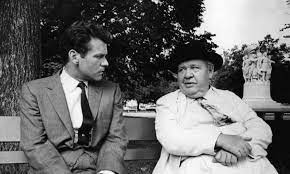
      Behind the scenes of this political melodrama are two men of power, the affable Senate Majority Leader Robert Munson of Michigan (Walter Pidgeon)—who, with his deep baritone voice has played so very many reassuring and stalwart survivors on screen—and the sly, somewhat comical villain of the piece, Senator Seabright Cooley (Charles Laughton), who opposes Leffingwell’s nomination and will do anything he can to prevent it.


      Seeing this played out again, as I did the other day, I couldn’t but be reminded of the partisan politics of today’s Senatorial body. But, at least, the five decades earlier fictional event suggested that most Senators (the cast also includes Will Greer, Paul Ford, Peter Lawford, George Grizzard, and Betty White) were men and women of good-will, while even the villains back in those days had more fun. In fact, if anything, Preminger’s vision of US politics takes itself a bit too seriously, as did the original Allen Drury novel, published in 1959. My high school friend, David Ray, however, tells me he was very moved by the original book when he read it that year.

      Yet, for me, both times I saw the film version, my stomach turned when Anderson and his wife began getting threatening phone calls that hinted at “Brig’s” behavior as a young military man when he was stationed in Hawaii.


       Instead of sitting down with his loving wife to discuss what that behavior might have entailed—a homosexual affair, as a lonely young soldier, with a man named Ray Shaff (John Granger)—the macho-like adult argues to himself and his wife that he can handle this matter, rushing off to a gay bar (strange that he still knows which one and where) to encounter Ray, who admits he has sold the information about their relationship to Cooley and others.

      That on-film depiction of a gay bar may have been one of the first in US movies.


     Growing up in the 1950s, one could not help but know how McCarthy and “the Red Scare” destroyed the lives of so many who had even flirted with the tenants of American Communism. I knew what even having read Marx might destroy men and women’s careers. I hated that always, terrified that political figures might be able to control what you read and believed.

       I also knew being publicly outed as a gay man would, in 1962, might destroy a man’s career. My father, after my asking a rather question about gay behavior described in Life magazine that very same year—"why wouldn’t men or women who liked one another want to kiss?”—roared back at me with a hatred I’d never before believed him capable of.

       But when the handsome hero, perfect husband and father, visits that gay bar (Frank Sinatra singing over the sound system) and then returns to Washington, D.C. to kill himself in his Senate office, I felt like I had been punched in the gut. I was horrified. I was scared and confused. For I suddenly realized that both the original author and Preminger were not really interested in the gay character they had represented except to show a kind of example of what happens to those of us who are interested in relationships with their own sex.

       I have always suspected, with absolutely no evidence, that my young handsome Air Force-flying father might have been approached by another man when stationed in Naples during World War II; or perhaps he just observed others on his team having homosexual relationships, that might explain his suddenly irrational response. And now, in this film, it all came home to me. Those who might have explored different political views and notions of sexuality, were expendable, not even redeemable.


      Even if Drury’s and Preminger’s hearts were in the right place, wanting to show us the evils of such narrow views as Cooley’s (Laughton, a man who it is rumored he liked young boys was suffering from cancer at the time he made this film, and died soon after), I couldn’t get over the fact that the loving, caring Utah Mormon was being punished, after all these years, for his love and new-found faith in a traditional family. Perhaps I was also just a little angry also of his having so completely abandoned his early sexuality.

     I have also to admit, I’ve never quite liked Preminger’s films, most filled with big liberal ideas—racial, sexual, political (most of whose values I share). Yet, he generally botches them, sentimentalizes them, and gets lost in his subplots, even in Laura’s murder.

     In Advise & Consent three good men—Leffingwell, Anderson, and the President—go down in sacrifice to the society in which they live. Maybe that’s reality; perhaps that’s what happens every day in the real world. But I don’t want that world; I want an alternative fiction.


Los Angeles, February 7, 2020

Reprinted from World Cinema Review (February 2020).

Arthur Dreifuss | The Quare Fellow / 1962

straightening up the quare

by Douglas Messerli


Arthur Dreifuss and Jacqueline Sundstrom (screenplay, based on the play by Brendan Behan), Arthur Dreifuss (director) The Quare Fellow / 1962


I have been wanting to see the film version of Brendan Behan’s first play, The Quare Fellow, for many years now, and finally ordered it through my subscription through Netflix.  In part, I wanted to catch a glimpse, at least, of a play by a writer of the 1950s at a time of my extensive theater readings of Ionesco, Pinter, and Albee, since Behan was not among those I read. I suppose to my young 14-16-year-old mind, a drunken Irishman, no matter how good a writer, was simply not of interest to me. How little did I know!

       Accordingly, I was delighted to finally have the opportunity to make amends. Unfortunately, the film version, directed by the grade-B Hollywood German-born director, Arthur Dreifuss, never quite gave me the opportunity to experience Behan’s dark, gallows-humor work.


      The first act, which in the play was mostly outside of the prison, was quickly moved within so that prisoners could release their tensions through song and complaint as the new “screw” (prison overseer) arrives. Patrick McGoohan as the well-meaning rustic new prison guard Crimmin is quite excellent in his innocent eagerness to learn and in expressing his in-born sensitivity, despite his seeming ignorance of the brutal world in which he has just entered.

      Fortunately, he has Regan (Walker Macken) as a seasoned guide to help him find his way. Although Crimmin believes firmly in the criminal system, Regan, who has served in the prison for many years, has a much more skeptical view of the entire system, particularly since there are now two “quare fellows” (queer men, men outside of the normal prison population) who are about to be executed, and Regan has seen far too many executions in his service.

      In the play, Behan uses this first act, removed basically from the inner workings of prison life to help break down Crimmin’s naivete through the dark humor that characterizes much of his writing. By quickly jumping into the prison itself (realistic as it is: it was filmed in the real County Wicklow prison), we lose the objectivity that Crimmin must later come to, and the real horror of a system (much like that in US prisons today) which still consider it permissible to kill certain prisoners, including one of the “quare fellows,” named as the silver-caned murderer, who, it appears, is actually a “gay” Wildean kind of man (not made evident in this film production), whose actual crime we never discover; one must recall, however, being gay was still a punishable offence in these days. It hardly seems to matter, since his punishment is stayed; yet, despite that fact he soon after he hangs himself, the fact of which perhaps says more than even his terrible punishment.

       The other “quare fellow,” whose crime in the original play was also very vaguely presented, in this production we discover, has murdered his brother. And this is where the well-intentioned film really begins to unravel, moving to a kind of social documentation against capital punishment.


     In its determined attempt to decry that terrible reality, Dreifuss’ and Jacqueline Sundstrom’s script, widely swinging away from Behan’s far subtler dramatization, introduces the other “quare fellow’s” wife (Sylvia Syms), who resides in the same boarding house as Crimmin, and gradually convinces him that her affair with her husband’s brother is behind the fraternal murder committed by her husband, who refused to mention the affair during proceedings in an attempt to protect her from being described as a “whore.” In short, what was a story of male intrigue and governmental suspicion is turned in this director’s vision to a kind of melodrama about heterosexual jealousy and revenge, giving the comic and far darker elements of Behan’s play an almost melodramatic flair, in which she and Crimmin attempt to save the day—without success. The drama of this film is entirely centered upon the events concerning the possibilities of saving her murderous husband, which we already know, given the dismissals and snobbery of the authorities will never happen.

      There are some excellent moments in this film: particularly when two seasoned criminals drink down the rubbing alcohol that Crimmins is trying to administer to their knees. And the interchanges between Syms (as Kathleen) and Crimmins almost incriminates him in having a secret boarding-house affair, which, of course, transforms the innocent rube from the West coast into a kind of willing participant in witness tampering.

      Generally, the acting, particularly by McGoohan and Macken is credible, and some of the moodily expressionistic cinematic images are quite arresting. But this is clearly not the Irish masterpiece of dark prison humor and suffering that the playwright intended it to be.

       Although the movie received, in its day, general acclaim, Dreifuss went back to grade B Hollywood films such as Life Begins at 17 (1958) and Juke Box Rhythm (1959). Too bad that the great Joan Littlewood, the original director (who died in 2002) wasn’t allowed to transfer this film onto screen.


Los Angeles, September 29, 2018

Reprinted from World Cinema Review (September 2018).

Index R-Z

Angelo Raaijmakers I, Adonis / 2021 Peeter Rabane Firebird / 2021   Tyler Rabinowitz Catalina / 2022 Tyler Rabinowitz See You Soon / 20...