Thursday, June 12, 2025

Willard Carroll | Playing by Heart / 1998

an alternate world

by Douglas Messerli


Willard Carroll (screenwriter and director) Playing by Heart / 1998


Director Willard Carroll’s Playing by Heart might easily be described as the alternate universe of Todd Solondz’ Happiness. Instead of the inability to demonstrate a morally responsible love and experiencing a life of despair, of loneliness and failure, Carroll’s version of Chekov’s Three Sisters is a romantic fantasy of love’s possibilities and the utter success of nearly everyone in the film to achieve an almost fairy-tale-like relationship.


     If at first the story of the sisters appears to be dour, by the time the movie is finished, all have struggled through the thicket of despair and confusion to discover their desires. There is Gracie (Madeleine Stowe) married to Hugh (Dennis Quaid), whose marriage inexplicably has lost it’s meaning for her, mostly because she is convinced that Hugh has utterly no imagination; but it appears to be Gracie who has lost the ability to cry—the emotion she evokes when she is truly happy—and she has taken on a lover, Roger (Anthony Edwards), a liberal-minded minister (we are never told of what denomination) who ultimately discovers that he is still in love with his wife and children.        

     If her character is rather boorish, (she is given to repeating British phrases such as “daggered”), Quaid (whom I have almost always enjoyed as an actor) gives the performance of a life, having signed up for an improvisational acting class, where he is asked to seek out in real life people and perform before them a dramatic monologue. We watch him become a husband who, in a hurry to get home to his family, runs a red light, and crashes into his wife’s car with children aboard, killing them all. Next up he successfully moves a lonely woman with his tale of being a TV executive whose low ratings gets him fired. But the best of all is played out in a gay bar with the wonderful comedian Alec Mapa as Lana, a drag figure who begins their conversation with the lines: I’m Lana…28 years old, and that’s in real years, not Heather Locklear years. I’m also a drag queen.” Hugh responds, “Well I guess I could figure that out,” Mapa responding, “Well, I just didn’t want there to be any misunderstanding. This ain’t no disco, and I don’t want no Crying Game confusion…,” a reference to Neil Jordon’s film of 1992, which I discuss elsewhere in these pages.


      Hugh goes on to tell an old story with a “newish twist” about how he, a married man, has fallen in love with Sam, his wife’s younger brother. And after what appears to be a long story—we only get bits and pieces—Lana, a character who is well-schooled in fantasy, responds: “Can I tell you something…I’ve had a great time with you darlin’, right entertaining it was. But sweetie, who the fuck to you think you’re kiddin’? …Lana may be three sheets to the proverbial wind, but I don’t believe a word out of your pretty straight-assed mouth.”


           The second sister, Meredith (Gillian Anderson), a theatre director, has been burned several times in the past regarding men, and is highly leery of developing new relationships. She has been particularly devastated by discovering the boy next door who she married, Mark (Jay Mohr), was gay, even though they have remained friends. Yet against her desires and a great many walls she quickly raises to keep him away, she quickly falls in love with the somewhat explicably insistent architect Trent (a likeable Jon Stewart) who convinces her to invite him to dinner, and when that falls apart, invites her to his own fabulous home for Chinese carry-in. Finally, after returning to her place to care for her huge dog Barley, they find themselves in bed and in love.  


     In one of the most moving of the many scenarios Carroll takes us through is about Meredith’s former husband, Mark, now dying of AIDS, whose lover died previously, apparently living in New York City. He is visited by his loving mother Mildred (a role beautifully performed by one of the best and underrated actors in Hollywood, Ellen Burstyn). Together they reveal a great many secrets that neither knew about one another, the first being obviously something Mildred has had to come to terms with before her travels from California to see her son, that he is gay and been in a marriage-like relationship with another man. She, in turn, reveals that she never loved her husband, the marriage forced upon her like so many of her age, by expectations and motherly encouragement. The husband, ironically, was an undertaker. Together they forge a new relationship neither son nor mother might have imagined in the past before Mark dies in the last third of the film.     

     The third sister, Joan (Angelina Jolie), the youngest, is a regular club-attendee of the Mayan Theatre in downtown Los Angeles. In great public display, she is breaking up with her current boyfriend, as they argue over the pay phone upon who gets what of the pieces of their past life. It is at the Mayan that she also meets pretty boy Keenan (Ryan Phillippe), who becomes clearly fascinated by her endless takes on the world around her, but resists even dating, finally showing up to a movie where she has told him she’d be attending. But even after that evening together, he still keeps his distance, she finally coming to recognize that there seems to be no possible way to break down the barriers he has built against all friends, until he finally admits that his previous lover has had sex with others who shared needles, thus leaving him with one final gift, AIDS.


     Even if they can’t have sex (the first drug that stopped HIV, AZT was developed in the 1980s, but tests took longer and, the drug was not readily available until the 1990s, also causing severe side-effects such as severe intestinal problems, damage to the immune system, nausea, vomiting and headaches; by 1998 other medicines were being developed, but this film seems to have been unaware of those life-saving drugs, and makes no mention of even using prophylactics as protection.

     In her relentless love of Keenan, however, Joan finally gets her man to hug and hold, if nothing else.


    The director tells all of these stories in short scenarios, broken up into small segments—a method director Robert Altman has previously explored, although far more experimentally. The publicists for Playing by Heart even refused critics of the day be allowed to piece these scenarios together in their reviews, as I just have, let alone reveal the final scenes wherein they almost all come together to celebrate the 40th wedding anniversary, a remarriage ceremony, between the sisters’ parents Hannah (Gena Rowlands), who performs as TV chef, and Paul (Sean Connery), the latter of whom has also just been diagnosed with an inoperable brain tumor. Yet, they too express distress, in this case over a long ago love affair (sans sex) between Paul and one of Hannah’s assistants. Paul keeps a picture of her, in fact, to remind him that he too could be loved again, but also that his true love is still Hannah.

     By the time of the final celebration, nearly all seem to have found new love and possibilities in their relationships, even Gracie discovering via young Keenan’s admiration of a web game Hugh has created, just how clever her husband is. And in that statement, we now discover his daily employment.


    As these characters all take to the dance floor, the jazz trumpeter who has told Joan that talking about love was like dancing about architecture, is proven wrong. In fact, this talkative movie, much like the later director Richard Linklater in his “Before” series of films, proves you can indeed talk about love.  

     If these figures are meant to represent “real figures,” however, we quickly perceive most of them as romantic stick figures, but the mostly excellent acting, the clever dialogue, the beautiful landscapes created by noted cinematographer Vilmos Zsigmond, and the music by John Barry, all help us settle into this work as we might a good soap opera or a slick Hollywood rom-com.

    Indeed, these very qualities led Roger Ebert, who so loved Solondz’ Happiness, to declare thumbs down to this film.

    Ebert took issue with the picture-book quality of this film, even the articulate dialogue, and easy pleasing choices the director argues for as the characters attempt to rectify their lives’ failures. Ebert wrote:


“It’s easy to like the movie because we like the actors in it, and because the movie makes it easy on us and has charming moments. But it feels too much like an exercise. It’s yuppie lite–affluent, articulate people who, except for those who are ill, have problems that are almost pleasant. It has been observed that a lot of recent movies about death have gone all soft and gooey at the center. Here’s a movie about life that does the same thing.”


     The critics from Variety and The New York Times basically argued similar points of view.

     It is certainly true that some figures, particularly Gracie and Hugh—except for Hugh’s (Quaid’s) signature pieces—seem flat and uninteresting; there comes a moment when I wanted Hugh to simply get up and leave a wife who sought out the arms of the bland minister Roger, who also officiates over Hannah and Paul’s restatement of their wedding vows.

     And, although they are both fairly interesting, it takes a lot of energy to imagine why Trent continues to woo the sour faced Meredith. He’s handsome, and apparently rich; but what but an angry face does she truly offer him?

     The rest of the cast, however, is so good that even if the story Carroll is telling is wrapped up as if it were a cellophane-covered box of chocolate truffles, I’ll eat and enjoy. And perceiving this work as an alternate to Solondz’ movie—yes, a far superior and challenging film—is, I believe, a fascinating way to perceive Carroll’s work, something that Ebert and others never seemingly even imagined probing.

     I have to admit, I have owned and watched Carroll’s work for years, and every time the truffles call out to me: eat until you’ve satisfied your appetite, which I joyfully do.


Los Angeles, June 11, 2025

Reprinted from My Queer Cinema blog (June 2025).


Wednesday, June 11, 2025

Mauro Bigonzetti (choreographer) | Caravaggio / 2025

revealing caravaggio’s gay sexuality

by Douglas Messerli


Mauro Bigonzetti (choreographer), Roberto Bolle and Timofej Andrijashenko (dancers), Caravaggio / 2025 [5.30 minutes]


Art critics and biographers has long tip-toed through the years concerning the Italian artist Caravaggio’s sexuality. Some such as Andrew Graham-Dixon even argued that any such claim that Caravaggio was homosexual was based on “circumstantial evidence and much rumour,” and that he certainly did also have sexual relations with females and prostitutes.


     Washington Post art critic Philip Kennicott has taken issue with what he regarded as Graham-Dixon's minimizing of Caravaggio's homosexuality:


      “There was a fussiness to the tone whenever a scholar or curator was forced to grapple with transgressive sexuality, and you can still find it even in relatively recent histories, including Andrew Graham-Dixon's 2010 biography of Caravaggio, which acknowledges only that ‘he likely slept with men.’” The journalist notes the artist's fluid sexual desires but gives some of Caravaggio's most explicitly homoerotic paintings tortured readings to keep them safely in the category of mere ‘ambiguity.’


     Today it is generally recognized that the mercurial artist who created through his dramatic use of chiaroscuro what came to be described as tenebrism, influencing such major artists such as Peter Paul Rubens, Jusepe de Ribera, Gian Lorenzo Bernini, and Rembrandt, was gay. He is now generally acknowledged to have been a gay or bi-sexual man who had open relationships with other males, and often was involved with what today would be called street gangs and murder. Some proclaim he was mad by the time of his death, perhaps of syphilis, but more likely sepsis he acquired through a wound.

      Certainly, this ballet number centers upon his male sexuality, occasionally referring to some of the paintings in a room made up to look like the Caravaggio room in the Palazzo Barberini.

        The dance features lifts, thrusts, hand-locks, and positions in which one dancer wraps his body around the other, in one case in this ballet the other removing his supporting hands as if the two had become one body.


       This is a ballet full of homoerotic moves symbolizing both the love of the two men and their sexual commitment. There is no question here about the artist’s sexuality.


Los Angeles, June 11, 2025  

Reprinted from My Queer Cinema blog (June 2025).


Tuesday, June 10, 2025

Cullen Arbaugh and Bradley Hildebrandt | Bram (Bräm) / 2025

the psycho

by Douglas Messerli


Cullen Arbaugh and Bradley Hildebrandt (screenwriters and directors) Bram/Bräm / 2025 [21 minutes]


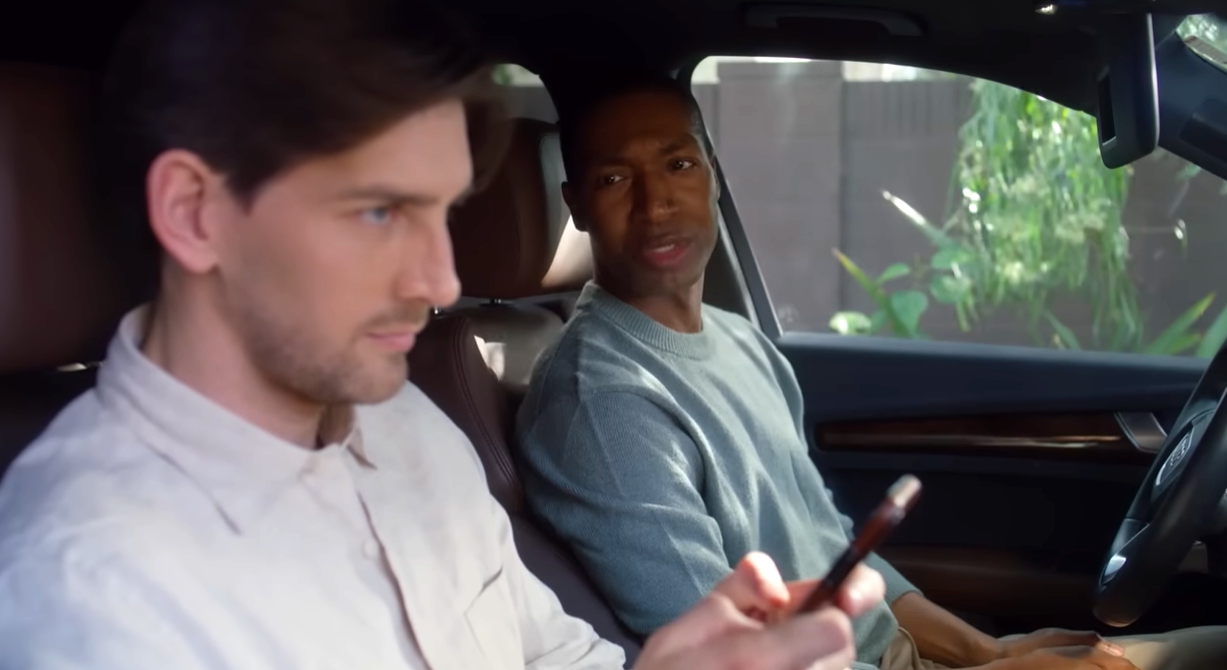
Dalton (Ryan Maltz) has recently separated from his wife of five years and given up the custody of his two children, and his mother Fiona (Lucinda Holshue) decides, after a complete silence of three years, to pay a visit.


    There is certainly evidence that Fiona is a bit unstrung, calling her psychologist Dr. Armstrong-Steen regularly, and praising herself for only having one drink on the plane trip to Minneapolis, but even a totally calm and collected being might be a little taken aback by the man Dalton has taken to be his boyfriend, Bram (Bradley Hildebrandt).

     He met Bram, it appears, when working as a corrections officer in the local prison, Bram being not a fellow worker, but a prisoner who, we soon discover, accidently killed his parents through his meth lab in the basement, which, while he went out for cigarettes, exploded, killing all within.   Bram, moreover, is not a particularly handsome man, but an effeminate, if seemingly gentle being who slinks about somewhat like a petulant cat about to pounce at any moment.

    Bram begins their relationship by correcting the way his name is pronounced, Bräm (with the umlaut), not the flat Americanized Bram as Fiona keeps repeating, and proceeds to make Dalton’s mother a stiff drink of mixed liquors.


     The two, Bram and Dalton sit together, kissing one another for long periods of time as if Fiona were absent. Fiona is also disturbed that Bram has redecorated nearly every wall with gay flags, drawings, and other gay insignias and pictures.

     One of the joys of the film is attempting to determine whose reality to believe, the foreboding world that Fiona seems to recognize in Bram, a danger that seems all too real and present; or the fact that Bram is a lovely person, the right man for her son, but that Fiona is close to a nervous breakdown.

     She certainly appears that way as she hears through the airduct the sexual encounter between her son and Bram, one of whom intensely fucks the other—with Crisco, which suggests perhaps a far deeper fuck than the usual insertion of just the penis.


     By film’s end, Fiona proves the true unstrung patient, her doctor Armstrong-Steen suggesting a higher dosage of what the mother already believes is giving her hallucinations, while the two young gay men, as strange a combination as they appear to be, are simply attempting to provide her with a comfortable visit.     If there is a psycho is this moral fable it is the heterosexual mother, not the oddly matched gay couple, who seem happily in love.

     This still remains a quite strange work, however, with some very creepy possibilities. At times we half expect Bram to pounce, strangling her from years of resentment of others of her kind, homophobes who desperately attempt to affect love and acceptance.


Los Angeles, June 10, 2025

Reprinted from My Queer Cinema blog (June 2025).

Liz Uys | FBoy / 2023

is sexual monogamy truly necessary?

by Douglas Messerli


Connor D’Angelo (screenplay), Liz Uys (director) FBoy / 2023 [15 minutes]


In the student movie from Chapman University, Liz Uys takes on a familiar subject in the gay community. How do young man who came out long after their high school heterosexual peers, find the time to properly explore their full sexuality before attempting, like their straight

counterparts, to seek out full time relationships?


    Or should they even be expected to repeat all the behavior patterns of heterosexuals? There are, after all, one might argue, actual social and perhaps even behavioral patterns engrained in the lives of gay men, that argue for a difference. Although it has now become popular for gay men to repeat the patterns of heterosexual life—marriage, children, pets, and even suburban living—do we need repeat what has also been shown in many a culture of having failed spectacularly? Is sexual monogamy truly necessary?

     I can hardly be a spokesman, having been married and fairly faithful to the same man for 55 years. But I can report that when our relationship began, having just had a full year in New York City to explore all my sexual desires, I was perhaps not at all ready to settle down and enter the imitation of the straight world gay marriage denotes. I too wanted more, more time to explore the many dark and joyful worlds of LGBTQ life. But fully accepting the world of the man I loved probably saved me, during those dreadful days of the 1980s and 1990s, from acquiring AIDS.

     In fact, both my husband and I, easily accepted in the straight world as professionals in the literary and art worlds, lost nearly all our ties with the gay world—one of the reasons you find me at 78 exploring the gay experience through film.


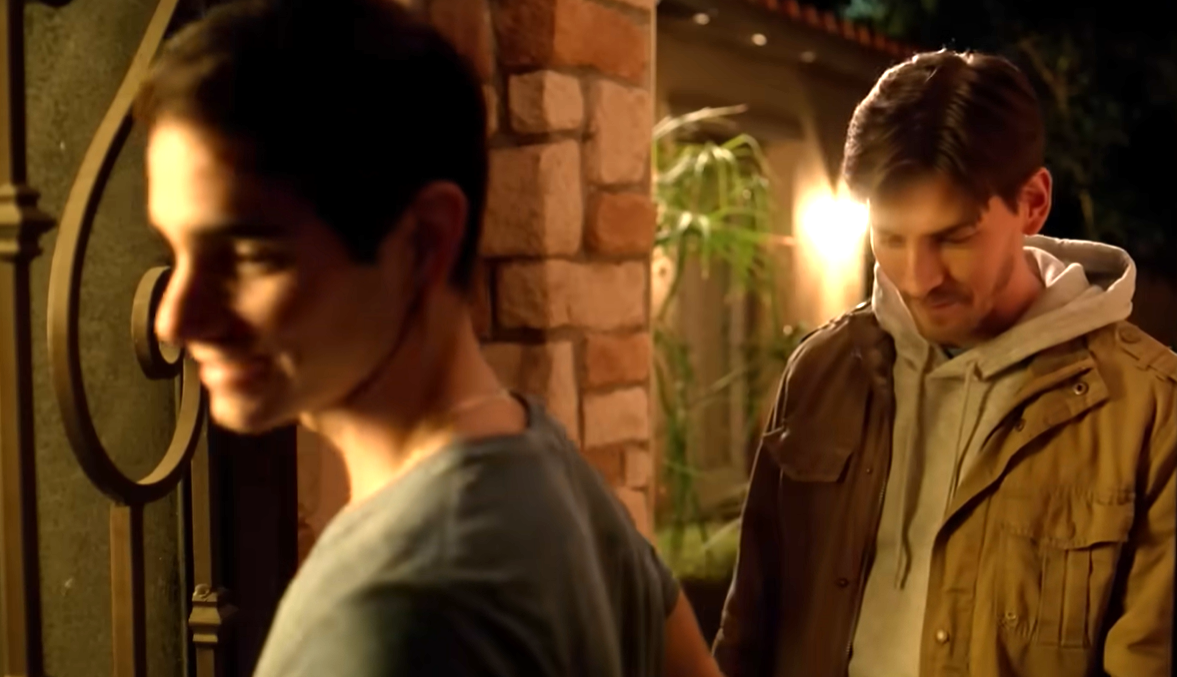
     In this short take, Finn (Zach Kelch) is that person who still is not quite ready to give up his full sexual exploration, while his boyfriend Lucas (Andre Heimos) is dead-set on the idea of marriage, children, and pumpkin patch visits. This irreparable difference between them—still represented as a lack of maturity regarding Finn’s position in this movie by Liz Uys—results in a breakup between the two at Finn’s home, where his accepting parents and slightly crazy podcaster sister Charli (Siena Solinda) want more information about the couple’s daily activities, not less.

    Lucas, seemingly comprehending his friend’s need to explore, moves on to his search for the heterosexual ideal, while we don’t quite know where it will lead Finn, who at least symbolically suggests a somewhat more coherent lifestyle by revisiting, no sex involved, a previous one-night fling.


     Although it is clear where author D’Angelo and director Uys hearts are on this issue, they nonetheless present Finn as a sympathetic character trying to come to terms with the gay values of today, while feeling the pull of those of the time before gay marriage served as such a beacon of societal acceptance.


Los Angeles, June 10, 2025

Reprinted from My Queer Cinema bog (June 2025).


Monday, June 9, 2025

Sam Liddell | Orange Cheesecake / 2025

no resolution

by Douglas Messerli


Sam Liddell (screenwriter and director) Orange Cheesecake / 2025 [15 minutes]


After years of silence from his father, the gay college boy Joe (Harry Jenkins) is invited back home to have dinner with his estranged father, George (Adrian Yearsley). It has been his father’s girlfriend’s idea, who George orders about like the cruel misogynist he basically is, to invite Joe and thought it might help mend whatever problems to the had between one another.

   Even though Joe has brought an orange cheesecake, made by him in memories of the ones he and his father made during his childhood, nearly everything goes wrong. Phoebe serves up a wonderful-looking dinner of salmon, but either his father has forgotten or never cared to pay attention to the fact that Joe is and has always been allergic to all seafood. Phoebe offers to get him a sandwich, but George refuses to let her prepare it, and the boy goes hungry.

      The father’s real problem is that he remains a violent homophobe, unable, as it puts it, to accept his son’s “life style.” Evidently, Joe has failed to inform him or he refuses to believe that one’s queer sexuality is not a choice, but is simply part of who one is.

      In any event, George cannot accept any part of his son. And when Phoebe begins to try to link him up with a girl during dessert, Joe finally explains that he is with someone he loves, except she is a he.    


     His father grows even more furious in his son’s attempts to explain the problem to the more open-minded Phoebe (although she too seems to have rather stereotypical concepts about gay man, associating them immediate with drag), George demanding that his son stop the conversation which he describes as attention-seeking. But this time, Joe stands his ground pointing out to his father that it is he who is eaten by hatred, he one who cannot come to terms with reality, explaining that for much of his childhood he hated himself, and yet was loved by the family; but the moment he discovered his identity and begin realizing and coming to terms with himself, his family, particularly his father, turned on him.

     He leaves the “false” get-together, calling his friend back in the university to have a pizza ready for him, while waiting for the bus, eating a piece of his delicious orange cheesecake with delight.

      British director Liddell’s short film is certainly not original; we have gone over this territory of the unforgiving parent in almost endless queer films. Yet this short from 2025 reveals that despite all the growing openness and awareness that has been made in the general community, young gay men must often face years of rejection from those they most need and once loved. It is the disappointed homophobes at home, however, who unknowing suffer most, unable to wrap their minds around the notion of simple sexual difference.


Los Angeles, June 9, 2025

Reprinted from My Queer Cinema blog (June 2025).


Index R-Z

Angelo Raaijmakers I, Adonis / 2021 Peeter Rabane Firebird / 2021   Tyler Rabinowitz Catalina / 2022 Tyler Rabinowitz See You Soon / 20...