Wednesday, May 22, 2024

Orson Welles | The Stranger / 1946

time dooms its keepers

by Douglas Messerli


Anthony Veiller, Decla Dunning, John Huston and Orson Welles (the latter two uncredited), Orson Welles (director) The Stranger / 1946


The other day I was delighted to discover that Netflix is now streaming Orson Welles’ 1946 film, The Stranger, a film I had never before seen. I quickly sat down to watch it.

     Although this film is often dismissed since Welles, anxious to be able to direct a new film after 4 years of silence, made a sort of devil’s pact with the producer, Sam Spiegel and the studio, promising to produce it on schedule and allowing for the numerous deep cuts that his overseers demanded. The ruminations and philosophical conundrums of his previous films he promised to resist. And, indeed this film was a true money-maker, one of the very few of Welles’ checkered career.


     Since this movie is set in a small Connecticut town where evil has been installed in the form of a seemingly well-respected teacher in the town’s all-boys’ school, the work is sometimes compared with Hitchcock’s Shadow of a Doubt. However, in Welles’ original there was a long sequence is South America which I would have loved to have glimpsed to help contextualize those parallels.

     Moreover, despite the film’s homey qualities, enhanced by the beautiful Loretta Young, playing Mary Longstreet—daughter of Supreme Court Justice Adam Longstreet—who is about to marry the hidden Nazi in their midst, Franz Kindler (played by Welles himself), Welles’ film is a far darker noir than Hitchcock’s wonderful work. Hitchcock’s creepy Uncle Charlie, after all, has murdered only a few elderly women for their money, while Kindler has evidently been responsible for the death of thousands or even millions of Jews and during the course of the film kills the first of the strangers to arrive in the town of Harper, a former colleague, Konrad Meinike (Konstantin Shayne) who has purposely been allowed to escape from prison so that he might possibly lead authorities to Kindler (now living under the name of Charles Rankin). We never quite learn why the highly nervous Meinike, now a born-again Christian, wants even to meet with his former associate—perhaps simply to try to convert him—but the visit, during which he leaves his suitcase at the local drugstore which seems to be the heart and soul of of the town, quickly results in Kindler-Rankin strangling him, presumably because he realizes the reason behind Meinike’s miraculous “escape” and is terrified that some of his students, racing through the woods on a “paper chase,” have spotted the suspicious looking outsider.


     The second, and more predominant stranger come to town is the US Wartimes Commissioner, Mr. Wilson (Edward G. Robinson), who has followed Meinike to that small village but, since his target has attempted to kill him as he enters Rankin’s school, has no clue to what the former Nazi, now teacher, looks like or knows anything about his current identity. All he knows is that the ex-Nazi has an extraordinary interest in clocks, which, obviously, echoes the lecture of Welles’ villain in The Third Man about the Swiss gift to the world of “cuckoo clocks.” Welles wanted Robinson’s role to be played by his long-time friend, Agnes Moorhead; it might have been a brilliant coup to have a feminist sleuth, but it was not to be.


      Despite all the limitations with which the producer and editor presented him—Welles described editor Ernest J. Nims as “the great supercutter, who believed that nothing should be in a movie that did not advance the story. And since most of the good stuff in my movies doesn't advance the story at all, you can imagine what a nemesis he was to me."—the director got the upper hand by inserting long discussions between Wilson and the local, laid-back druggist, Potter (the ex-burlesque actor Billy House) while the two play checkers as they attempt to check out one another, Wilson and Potter struggling to eke out as much information from the other as they might.

      Wilson loses the first round but later, paying the 25-cent fee, receives more information than he reveals, discovering the local church in the town square contains a large Habrecht-style clock mechanism, which Rankin is attempting to repair as part of his hobby.


      But even when Wilson realizes he has found his man, he needs the testament of Rankin’s new wife, Mary—or at least her recognition that she is living with a man who opposes all of the values which her family has believed in. Another cut scene revealed the long patriotic military history of the Longstreet’s through a tour through the local cemetery.

       Yet Welles, always the clever dodger, tells this part of the story through a bizarre combination of the wonderfully evocative score by composer Bronisław Kaper, with images right out of Fritz Lang’s M (menacing shadows overlaying the images of the town’s innocents), through the murder of Mary’s dear dog, Red, and the help of her wised-up brother, Noah (Richard Long), who, along with a sawed-off staircase (straight out of Shadow of a Doubt) incriminates and finally destroys—in a scene that might have come straight out of Charles Dickens’ Oliver Twist—Rankin/Kindler, allowing our villain to suffer the justice that the Nuremberg Trials could not provide.

       This isn’t Citizen Kane or (without the last scene) the brilliant The Magnificent Ambersons, but it comes close, at moments, to revealing the great director’s genius. And I’ll watch it any day over so many other less challenging movies of its genre—whether it be noir or Nazi conspiracy tales.


Los Angeles, March 28, 2019

Reprinted from World Cinema Review (March 2019).     

Mikio Naruse | 銀座化粧 Ginza Keshō (Ginza Cosmetics) / 1951

small joys

by Douglas Messerli


Matsuo Kishi (screenplay, based on Tomoichirô Inoue’s novel), Mikio Naruse (director) 銀座粧 (Ginza Keshō) (Ginza Cosmetics) / 1951


Mikio Naruse is one of my very favorite of Japanese directors, although I love a great deal of Japanese cinema. Naruse, however, is particularly sensitive in his portrayals of women at a time in post-World War II Japanese culture where, with a destroyed and failed male population, women had very few choices regarding how to survive.


     Ginza Cosmetics—a very strange title given the fact that we witness a cosmetic shop only for a few moments—shows us, as do so many other Naruse films, the few choices left to Japanese women of the day. Either one married and lived unhappily with the mostly elderly business men who had survived the war, or one sought out these same men in various roles of prostitution—some women, like the heroine of the film, Yukiko Tsujo (Kinuyo Tanaka) serving simply as pleasurable hostesses, while others more directly engaged in sex. The hours were late, and the pay insubstantial, but it was a way, without any resources, one might survive. 

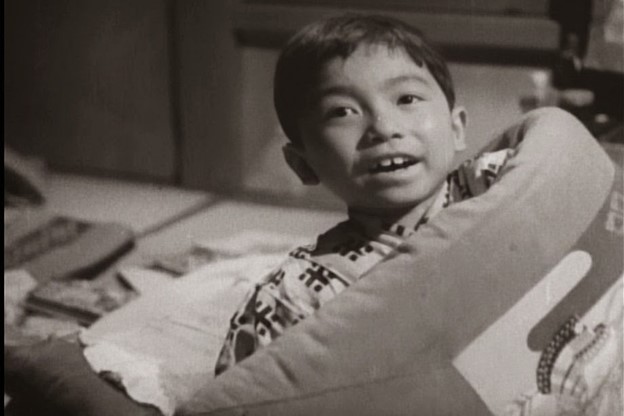
    Like many another of Naruse’s characters (his best film, When a Woman Ascends the Stairs portrays the same situation), Yukiko is a widow with a child—the marvelous young boy, Haruo (Yoshihiro Nishikubo)—she, a woman who is growing a bit too old to attract the men to her table; “Once you hit 40, you can’t really do it,” Yukiko says. Of course, she still has suitors, such as the buck-toothed business man with a mole astride his nose, who attempts to force her into sex at a nearby warehouse; but Yukiko knows that she is in her last years as a Ginza hostess at Bel-Ami, despite her endless application of cosmetics, particularly since even the bar is having financial problems which she works to resolve.

      The only man she meets throughout this episodic tale who might be worth her interest is a far younger country boy, loved by Yukiko’s friend, Shizue Sayama (Ranko Hanai). The shy, intellectual kid, (Yuji Hori), does not at all like Tokyo, but is the first functional male Yukiko has met in years, and it’s clear she might have dreams of marrying him, or, at least, of discovering more about the world of stars which he explains to her. But at the very most tender moment of that developing relationship, her son goes missing, and she must entrust the stranger’s tour to her younger sister, who quickly falls in love with the stranger, who in turn, promises to invite Kyōko to his country home.

      As critic R. Emmet Sweeney has noted, when Yukiko hears the news, “Barely a flutter passes over Tanaka’s face at the passing of this brief flirtation. It speaks to the million tiny heartbreaks that Yukiko must have suffered through the years that this latest one barely registers.” And Yukiko is soon back at work, knowing that Haruo will be obediently waiting for her back at home.

     In short, little changes throughout the film in Yukiko’s basically unhappy life; but she remains a survivor in the most profound sense, a self-aware believer, despite the cynical world in which she is forced to live. The only man to whom she is grateful, Fujimura (Masao Mishima)—once a wealthy businessman who helped her pay for Haruo’s birth—is now a poor “sad sack,” who cannot even afford a new pair of shoes.


     Yet, despite this film’s bleak outlook, it is utterly filled with possible joy. Yukiko’s landlady gives music lessons in traditional Japanese songs, and throughout the excellently scored work by Seiichi Suzuki, music plays a major role, even when badly performed by a drunken student of the traditional music. The musical score gives this work a sense of beauty far beyond what Yukiko might find in her personal contacts. 

     And then there is her charming son, who wants to become a scientist and loves fishing boats! Despite their different schedules and Haruo’s wandering habits, he is a joy to everyone in the neighborhood, as each of the many women living in Yukiko’s house call out to him when he returns, however briefly, home. Everyone in the entire neighborhood seems to love him, and who wouldn’t, given his youthful enthusiasms?


      For all her disappointments in life, Yukiko, perhaps, has more joys than many of us do. She certainly knows who she is, and what her future will be. But she is a tough survivor, who also asks for music even when it is terribly performed. She asks for love, even if it is seldom given. She asks for respect, even when spurned from the society in which she lives. Naruse presents us with a totally modern woman whose character might be a model for women even today. Although she might be demanded to perform sex, she is not at all the demurring Geisha of the American stereotype, but is, rather, a strong figure determined to raise up a child into a new world never available to her.


Los Angeles, March 5, 2018

Reprinted from World Cinema Review (March 2018).


Agnès Varda and JR | Visages, Villages (Faces Places) / 2017

let us now praise not-so-famous women and men

by Douglas Messerli


Agnès Varda (screenwriter), Agnès Varda and JR (directors) Visages, Villages (Faces Places) / 2017


Agnès Varda’s last work, made with photographic artist JR, is an odd documentary, even given her rather eccentric (and I mean that in the best possible way) career. Faces Places (Visages, Villages) follows the pair, this time Varda offering ideas and camera angles more than directorial content, as JR and his photography truck travel throughout rural France snapping shots of individuals, factory workers, farmers, and others, and then blowing them up to large black-and-white posters, which JR and his crew then paste to the sides of buildings, factories, and barns. One of the most touching of sequences is when she and JR photograph the hard-working wives of three local dockworkers, posting them across stacks of cargo containers, the men totally enjoying the fact their wives have finally become visible to their workers, but with a slightly misogynist slant that suggests that these women are still being “contained.” “This will give a totally new perspective” says one of the husbands. But one of the wives is bit frightened for sitting on a high container just beneath the head of her photograph.


     It’s such a simple premise that my review might stop here. The joy in the film comes primarily from the lovely, if brief, interchanges between the then 89-year-old director, in her double dyed hairdo seemingly always joyous and curious about everything she encounters, which links this film a bit with her previous The Gleaners. But if in that earlier film Varda sought people who picked up food and products which others had left behind, here, the Almost all of them seem absolutely delighted to be photographed, and even more awed by the monumentalism of their faces, proudly pointing out their images in the group portraits, and delighted to become rather famous in the towns and country neighborhoods in which JR’s and Varda’s larger-than-life portraits have now been placed.

      In a sense these unknown folk, who work at simple and back-breaking jobs or simply have outlived others not so fortunate, have suddenly become the heroic figures they might always have wished to have be. Instead of the monuments to the great—so pervasive in French life, particularly in the major cities—these hard workers finally receive their own, if temporary, due.


      We are never told just how permanent JR’s outsized portraits are, and how quickly in the rain, heat, and winds, these testimonies to their very existence will last. Surely for enough time for them to claim some sense of temporary fame. 

      But that may not really matter, because JR’s camera as well as Varda’s several cinematographers, Romain Le Bonniec, Claire Duguet, Nicolas Guicheteau, Valentin Vignet, and Raphaël Minnesota, have also captured their faces on a film which they may never see. But we, the audience, recognize this as a kind double tribute accordingly, one at the local level and the other on the international (this film was shown at the Cannes, the Toronto, and other film festivals, winning several awards along the way). And their rugged faces and their open demeanor reveals them, if only briefly as actors far better than those in most of cinema.


       Like Bresson, Varda, in this film, uses people untrained to act, but they act so very unassumingly that each of them should win an award, which perhaps they unwitting did when the film was chosen for France’s highest prize for a documentary at the  César Awards in 2018.

       Along the way the director expresses her joie de vivre, even laughing at herself and the impossible project she and JR have undertaken. At one point she poignantly recalls visiting famed French write Natalie Sarraute near where they snap another photo.

       Near the end, JR determines to take pictures of Varda’s eye, now nearly blind, and her small feet, blowing them up and pasting them the sides of railroad oil cars. The railroad-head approves, telling Varda that she will now be taken to places she has never before been. It’s a touching conclusion to this highly populist film.


      At another moment the film goes back in time to show JR rushing Varda, seated on a wheelchair, through the Louvre Museum in a kind of unspoken contest with Godard’s quick run-through that institution in one of his films. It is a lovely comic moment, as Varda calls out her favorite paintings as the photographer rushes her by them one by one. 

    Varda, in turn, has a surprise for JR. She has made an appointment with Jean-Luc Godard, presumably for her final picture-shoot of the great director. But when they arrive, Godard is not there, presumably having bolted.

      One of my friends suggested that this passage of the film was immensely sad. But Varda, herself, proclaims that Godard is a solitary philosopher, which cinema needs in order to survive. Yet, underlying her defense of him, we also perceive that it was Varda, herself, who had the best instincts. Celebrities are not, perhaps, the greatest subjects for film. The ordinary people, running wild in the streets, gathering up things that the society-at-large no longer wants, and workers living in near-solitary in small rural communities are far more interesting in the end. These people are truly appreciative the art she creates about them and their lives.


Los Angeles, May 3, 2019

Reprinted from World Cinema Review (May 2019).

Tuesday, May 21, 2024

Harrison J. Bache | The Favor / 2011

straight flirt

by Douglas Messerli


Harrison J. Bahe (screenwriter and director) The Favor / 2011 [6 minutes]


This first edition of what might have been an entire series of short sketches on Saturday Night Live (Bahe has made only two films to date), is a clear example of a phenomenon which probably occurs far more often than we know, but is seldom portrayed in LGBTQ cinema. A young supposedly straight boy, played hilariously by Bogdan Korishey, knowing his friend (Michael Henry) is gay and desires to have sex with him, flirts incessantly with his bestie only to get what he ultimately wants—or perhaps in this first version of the comical syndrome, just to toy with him, to keep him in his place.

     Bog calls up his Michael, almost panting out the provocative words in a pleading tone while sucking on a small red lollipop:


     “Hi Michael. Michael I need you for something. Something very, very special Do you think you can help?”

     “When do you need this?” asks his unsuspecting friend

     “Right when you get here. Please Michael. Please hurry.”

     Jumping into the shower, dressing as hurriedly as he can, combing his hair, Michael readies himself for the sexual encounter he’s obviously been waiting for, racing as fast as is legally possible to reach Bog’s house. As he rings the bell, the boy, now fully dressed stands ready at the door.


     “I need you to do something for me,” he continues in the same sexually evocative voice, then dropping it entirely. “I need you to take me to Walgreens.”

      As you might suspect, Michael is crest-fallen, disappointed beyond belief. “You want me to drive you to Walgreens?”

      “Yes, is that all right?”

      What can you do when a friends need help, even if it isn’t the kind of help he had in mind?

Michael apologizes and drives him the drugstore, finally asking him what it is that he needs to buy.

       “Condoms for you and me,” Bogdan answers.


       Michael’s face lights up again with hope and desire, and in the very next frame the boys are laying naked on a bed together, with Bog claiming it’s best sex he’s ever had.

       Strangely, Michael looks away, sad and disgusted, clearly unhappy. “I didn’t like it,” he comments.

      “Are you serious? That was like the best sex we ever had.”

      “Not my favorite.”

      “What are you gay?”

      The sex they have just had together has been with a female prostitute. And yes, Michael is gay, despite the pretense they continue enact.

       Bogdan grabs Michael’s billfold and plays Chandelier, thanking her for the pleasure.

       The boys lay quietly together for a few seconds, Michael turned away from his friend.

       Michael finally speaks out: “Are we going to have sex or not?”

       “I’m not gay!”

       “Oh. (Pause.) Me neither.”  


Los Angeles, May 21, 2024

Reprinted from My Queer Cinema blog (May 2024)          


Cameron Thrower | Accidentally Gay / 2001

case dismissed

by Douglas Messerli


Bick Brown and Cameron Thrower (screenplay), Cameron Thrower (director) Accidentally Gay / 2001 [8 minutes]


Two male roommates (Brandon Massey and Martin Balama), who’ve been out to the bar the night before wake up in bed together. At first, as the well-honed adage goes: “They can’t remember a thing,” but gradually they do begin to recall having been very drunk, watching a film together (Nick Cassavetes’ The Notebook) and, yes, having sex. “Martin’s” ass hurts.


    “Let’s just forget we’re gay,” “Brandon” insists. But thoughts keep returning. Both the pleasure and the pain keep coming back in brief flashes. What’s even worse is that suddenly there’s a knock on their door.  “Brandon” cautions “Martin”: “don’t act gay or stay anything that they might think you were blowing me last night,” to which the offended roommate answers, “What the fuck? Who was face-fucking who last night, bitch?” “You see what I mean,” shouts Brandon: “That sounds gay!”

      It turns out to really be some version of a “gay cop,” their next-door gay neighbor, who’s not only gifted with gaydar, but has heard it all, so he claims, through the paper-thin walls.

      Being good straight boys at heart, they deny everything, although he quickly responds—particularly given their memory of Cosmos, Mojitos, and a movie with Ryan Gosling before their claim of pulling off the girls’ panties—“Boy that closet’s getting crowded.”


      He leaves with them imagining that they convinced him, even if they haven’t yet been able to convince themselves.

      If Thrower and Brown had left it there, with both the boys and their audience in doubt, the short film might have become far come interesting, permitting a whole host of other issues to be explored.

      Alas, the film sticks a pin into its little balloon of comic hysteria as a woman suddenly appears from the kitchen, ready to serve up breakfast. That’s not to say, of course, that “Brandon” didn’t still play “Brokeback Mountain” to “Martin’s” ass, but now they can easily explain it all as part of a heterosexual threesome, any gay activity occurring, as the title suggests, only by accident.

      I am sure straight boys actually do this from time to time, one of boys exploring his male friend’s body while the other is engaged with a female’s vagina, explaining it away as being the only receptacle available in which to put his horny instrument. The only problem is that he can’t put the incident to rest the next day when, as “Martin” complains, it still hurts in the ass.

     Although, all film sources list the date of this film as 2001, some suspicion arises about that date, particularly since the Cassavetes film it mentions (and shows outtakes from), The Notebook, wasn’t released until 2004. Some filming of the work had been done as early as 2001 however and perhaps the director had connections with the original director Martin Campbell.


Los Angeles, May 21, 2024

Reprinted from My Queer Cinema blog (May 2024).

Index R-Z

Angelo Raaijmakers I, Adonis / 2021 Peeter Rabane Firebird / 2021   Tyler Rabinowitz Catalina / 2022 Tyler Rabinowitz See You Soon / 20...