Sunday, April 6, 2025

Andrew Ahn | Spa Night / 2016

LOCKED UP IN FAMILY LOVE

by Douglas Messerli


Andrew Ahn (screenwriter and director) Spa Night / 2016 

Andrew Ahn’s dark coming out film begins with a family crisis: the small Los Angeles Koreatown restaurant they run, with only a few customers, is taken away from the mother, teenage son, and father, who have worked there together for several years, because of Jin’s (the father) inability to pay the rent. With little money left, the mother Soyoung (Haerry Kim) is forced to work as a waitress in a more successful restaurant owned by a church friend, while the father and son attempt to find day jobs, without much success. Although Jin applies for other jobs, his age and bad health work against him.


      What is even worse for the family is that, without money, they find the American Dream they had planned for their son, is almost out of reach. David (Joe Seo), moreover, is a middling student and does not have the SAT scores to get into the favored educational facility for such families, University of Southern California. The family can hardly even pay for the tutoring necessary to increase his scores so that he might get a fellowship for his necessary education. And when he does begin his lessons, he makes little improvement in his test scores. For David is, as one might say, extremely distracted, beginning to realize—living within a community where such a thing is unthinkable and even more importantly, unspeakable—that he is gay.


     There is no place, clearly, for him to turn to help make the difficult transition. His parents link him up with a slightly older USC student who has also known him from church—that successful restaurant owner’s son—encouraging David to spend a day on campus in that hopes that he will become more interested in the prospect. But his campus visit only confuses the young David even more, as his former “friend” apparently dorms with a young man who spends most of his nights at his boyfriends and the tutoring elder student spends most of his nights drinking and partying with girls.

     They all, including David, get so drunk that the males determine to visit one of the many local spas that dot the Koreatown landscape—places, as David remembers them, of close father-son bonding, as we see early on, when the two gently rub each other’s backs in a kind of cleansing process after their sweat in the spa.
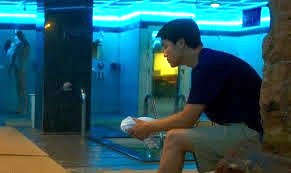


       While visiting with the others, David has spotted a “help wanted sign,” and so goes to work, unbeknownst to his family, to bring in a little extra income. But as he gathers towels, mops down floors and, after work, joins others in the over-heated rooms and showers, he perceives another series of activities also at work in the spas, a world of secretive gay love. For the most part, he observes these erotic couplings—as if almost out of the corners of his eyes—with simple desire. And much of the film, accordingly, seems more voyeuristic than revelatory. But gradually, he too, joins in with more direct stares, an occasional touch of an older man, and dares to go even a further—while still engaging in nothing too obvious or salacious.

      He is, after all, aware of an occasional arrest when a gay man mistakenly encounters a heterosexual customer, and he has been told by the spa owner to report any “unusual goings-on.”

       The tension of this film is that every member of this family is a loving being, caring and meaning well for each other. Yet in that embrace of family love, everyone is also delimiting and gradually choking one another. Soyoung is exhausted from her long hours and hurt, surely, by her former friend’s orders that she dress better. Without a job, Jin, like his father before him, turns to alcohol and increasingly falls into a drunken stupor each night. David, locked up in his parent’s dream for him and his own whirl of inexpressible sexual feelings, is represented again and again in this often-slow-moving film, as almost torturing himself, exercising beyond endurance in endless sit-ups and long street-runs. Like the deep rubs between father and son in the spa, he can be seen in many sequences as clearly trying to rub out his own existence.

       When Jin returns late one night drunk and fights with Soyoung, she angrily reacts, forcing the now-completely defeated man to admit his failure in life. He leaves the house, with Soyoung gently asking that her son follow him to make sure he doesn’t attempt to drive.

      After a long prowl in the late-night Koreatown streets, David, following in his father’s staggering footsteps, finally takes him to the well-known spa, this time paying for their entry, where he puts his father into a chair to let him sleep off his drunkenness. David, meanwhile, undresses and enters the spa, this time encountering a handsome young man with whom he finally consummates, in no uncertain terms, his desires. Yet as the couple finishes their lovemaking, the spa owner enters to observe what has just happened, and David realizes the consequences. Collecting his now more sober father, he drops his locker keys off at the desk, attempting to apologize for his actions—which the spa-owner meets him with a stony silence.


        As David goes for yet another long run through the vibrant Koreatown streets, the screen goes black.

        In short, this painfully moving first film offers absolutely no solutions to the problems its characters face. It simply shows the situation, the near impossibility of coming to terms with such issues within a society that refuses to speak of the problems here reiterated. All we can hope, as the director has said in a newspaper interview in the Los Angeles Times, is that this film can serve as an opening of that now-closed conversation. If nothing else, this movie reveals that all cultural and social communities share the same problems and fears, even if some would rather pretend they not exist.


Los Angeles, September 4, 2016

Reprinted from World Cinema Review (September 2016).


Moshe Rosenthal | שבתון Shabaton (Leave of Absence) / 2016

a night with the boys

by Douglas Messerli


Moshe Rosenthal (screenplay and director) שבתון Shabaton (Leave of Absence) / 2016 [19 minutes]


Moshe Rosenthal’s 2016 short Leave of Absence is not explicitly an LGBTQ movie, but in its tone and implications clearly represents—through the encounter between an older man, Meir, and three teenage boys (Michal Bernstein, Chen Hefetz, and Ben Heine) who are determined to spend their evening frolicking in a pool together and filming their own fraternal-coded songs and antics, no girls invited—a symbolic male gathering with strong homoerotic overtones.


     Their invitation for the former teacher (Uri Klauzner) to join them is proffered at the perfect moment for the older man. Having recently taken a leave of absence from his teaching job, and after one of his two daughter’s had just attempted to lighten the shade of his hair—with disastrous results, turning him into a peroxided blond—he has just escaped from his dominantly female society into the night, on his way to get a darker shade of hair dye when he encounters the boys.

     Meir’s sense of displacement from his absence of his weekly teaching responsibilities, the suggestion by his daughters that need do something about his graying hair, and the simple realities of his uneventful daily life all remind him that he’s aging and without a sense of purpose he previously felt. Meeting up with the boys, some of his better students as they brag, determined to involve him almost as a mascot in their male rituals, is somehow exciting, certainly something out of the ordinary and apart from the female-oriented world which he now daily inhabits.


     At first, understandably he refuses, but they begin by insisting they take a picture with him, suggesting he will be missed by the one of the three students who hasn’t yet graduated. Already their actions seem to involve physical expression, one of the students asking “Sir, could you carry me piggyback,” as he literally heaves himself up upon his teacher’s back to have his photo snapped.

      It does not take long for them to suggest he be included in the video they’re planning for one of the trio who’s just enlisted for his military duty. When he demurs, they even jokingly offer him beer and drugs. But he trudges on to get his “Just For Men” hair coloring.

      On his way back, in a moment of compulsion, however, he detours to the pool they have talked about, breaking in through a cut in the metal fence. Peering through the glass windows he sees that there are now four boys, one photographing the other three, shirtless, as they seem to be involved in what appears as almost a ceremonial dance, each following the other along the side of the pool.


      Now inside, he sits on a plastic pool chair with a small wooden flute they have clearly handed him as one of their members as they sing a quite sexy song, the lyrics beginning:


                    From my little window

                    I see big things

                    and life looks good from here


                    Now everyone’s in rush

                    to buy a few more things

                    before closing time


                    haste, they say, is from the devil

                    and I am the little bunny

                    who is constantly late….


     Sitting, a bit awkwardly, in his chair, stripped to T-shirt and boxer shorts, he watches almost transfixed, observing their half-naked bodies and gyrating hips as they move around the pool in his direction. As the lyrics now involve the song-narrator’s desire to play the flute “and smile at them like a jerk,” he’s ready to pretend to play on his small flute as the lead singer, now crawling on his hands moves forward intoning, “blow, blow, blow the flute.” As he has been coached by the group, he puts it to his lips, afterwards wishing their friend a good enlistment, smiling as best he can in his confusion.

      The song (“Ya Hilili” by Lithuanian-born Rafi Perski), with its choruses of “ya halili, halili,” is quite homoerotic, particularly given its references to a “bunny” and “blowing the flute,” (presumably meaning, “sucking cock,” the singer’s preference to the consumer products the masses are buying). But Meir seems almost completely oblivious to the metaphors, if completely cognizant of the sexual maneuvers of the lead singer.


      Finished, they discuss the “weirdness” of the ending of the clip, and even suggest they give their teacher another part. He is perfectly willing to shoot it again, obviously now invested in their performance.  “I’ll do it better this time,” he states. But they insist it turned out just fine.

    Soon after they appear to be interviewing him on the camera, describing Meir as a family man and a history teacher, but by night “an incorrigible anarchist.” He laughs, somewhat uncomfortably. They attempt to get him to say they were best students, while the others were dumb, pushing him even so far as to admit that we would rather hang out with them.

       But Meir chooses a middle path, ultimately saying he would “hang out” with himself, a diligent student, an obedient being who would “go to school, serve in the army, work.” After some discomfortingly quiet moments, they ask him one last question—about his hair. They admit they couldn’t resist. But one of them quickly takes out some hair jell, runs to Meir, puts his hands to the man’s head and transforms his hair into a punk-rocker look. They offer him a marijuana joint, and he hesitatingly takes of short toke. The interviewer asks, “Won’t your wife be mad if you come back stoned?”

      A moment later they are all joyfully playing in the pool, while Meir looks off, seeing a reflection of himself in the glass of the pool walls, perhaps contemplating how all his life he has played it far too safe, been far too correct and conventional in his decisions, missing out on the joys these boys seem to have in each other’s company.


      He too takes off his shirt and joins them, the boys at first wrestling with one another, but gradually involving him as one rises from the depths on his shoulders while another appears on the shoulders of another boy, representing an eerie few moments of bonding, both generationally and sexually.

      A few seconds later, however, they calling out to him, “Meir, come out!” The police have arrived, and when Meir comes up for air, they all have abandoned him. Hearing the police siren in the background and speakers announcing the break-in, he hides half-naked behind a tree now outside of the pool enclosure. He steals a bicycle and hurries on down the road to home and society once again—but obviously rejuvenated and, perhaps, even transformed by his night with the boys.


      The film reminds me of Clu Gulager’s wonderful 1969 short film A Day with the Boys, also involving a dangerous encounter with an older man and young boys, although in Gulager’s film the boys are in junior high or even grade school and the danger is much more serious since it ends in the older man’s death, whose very willingness to consort with the boys hints at possible pedophilia. It also reminds me of a comment my writer friend Sam Eisenstein once made regarding the film, On Golden Pond of 1981: “Doesn’t everyone know that all an old man needs to bring him to life again is a day alone with a young boy?”


Los Angeles, May 9, 2023

Reprinted from World Cinema Review (May 2023).

Friday, April 4, 2025

Kenneth Macpherson | Borderline / 1930

the white gaze

by Douglas Messerli


Kenneth Macpherson (screenwriter and director) Borderline / 1930


In Kenneth Macpherson’s 1930 film feature, his only full-length cinematic work, Pete Marond (Paul Robeson) arrives in a small provincial Swiss village, much like Territet where the director, his wife Annie Winifred Ellerman (better known as Bryher), and her and his female lover Hilda Doolittle (the poet H. D.) along with H D.’s young daughter Perdita* had taken up residence and established a new film and publishing venture, The Pool Group, supported primarily by Bryher who was the daughter of a wealthy British shipper.


     In the film, a similar ménage à trois had already been played out between the character Thorne (the grandson of President Chester A. Arthur, Gavin Arthur who, like Macpherson, was bisexual, later becoming increasingly gay-oriented),** his lover Astrid (H. D.), and Pete’s wife Adah (played by Robeson’s real wife, Eslanda), who had been having an affair with Thorne.

     Add to the film’s remarkable story-line concerning what was still illegal under the miscegenation laws  active in 1930 throughout most of the US, the plot’s introduction of a Weimar-like bar-hotel run by Bryher (simply called the Manageress) and her lesbian barmaid (Charlotte Arthur, then married to Gavin), that featured a gay piano player (novelist, poet, and film critic—he contributed extensively to Macpherson’s film magazine Close Up—and editor of Life and Letters, Robert Herring) and one recognizes this long-obscure feature as having all the earmarks of a succès de scandale.

     Yet, the critics of the day, and many I am sure of today, knew little of the casts’ histories, literary or sexual, while being utterly puzzled by the director’s use of the expressionist tropes of German filmmaker W. G. Pabst—which Macpherson employed in his long histrionic-like gestures of psychological angst through Thorne and Astrid—or the radical cuts and montage influenced by Russian director Sergei Eisenstein, that he employed throughout the work. Surely they could comprehend even less about the various racially and sexually-charged reactions of his characters to one another. In fact, for many years the film was thought to be lost, and when copies were finally discovered, because of their rarity, few film scholars were able to see them. Only recently has the film become a work standardly taught in film courses.


     I am sure for many viewers even today that if the lesbian relationship of the manger and barmaid is apparent, that others miss the pianist’s sexual admiration of the black Adonis Pete who Astrid has summoned to this isolated hotel in order to restore relations between Pete and his wife in order to free herself of the jealousy she suffered over Thorne and Adah’s affair. The pianist, apparently, has not only already struck up a friendship with Pete but features a photo of the man taped to his instrument (all puns intended).

      Moreover, today’s viewers will find the locals’ racial hostility, particularly that expressed by the town busybody named The Old Lady (Blanche Lewin), intolerable. Even the obviously welcoming hoteliers are caught up in the white gaze of the black man, consisting simultaneously of desire, awe, fear, and disgust.

      British critic Ellie Jones, writing of the film in 2016, best captures one of the film’s most captivating scenes when, realizing that Adah has left him, Thorne picks up a knife and, uninvited, rushes to Pete’s hotel room with perhaps revenge on his mind. Jones writes:


“As the film reaches its climax, we see Pete and Adah together in Pete’s bedroom above Bryher’s café. Thorne, jaded by Adah’s rejection, storms through the café and charges upstairs. Sensing trouble, Bryher and the pianist follow him, quick to protect Pete and Adah from the intruder. The resulting stand-off is truly sensational: it marks an exhilarating moment in cinematic history. As Thorne bursts in on Pete and Adah, he is unwittingly caught in a constellation of multidirectional gazes. Stood separately within the confines of the bedroom, Pete, Adah, Bryher and the queer pianist jointly stare at him. For about forty seconds, a straight white male is subject to the devastating looks and smirks of queer and non-white men and women. Beads of sweat gather on his brow and slip down his face, melting away the stability of his own identity.

     In this brief interim, Pete and Adah are not strangers in the village. Neither is Bryher, queen of her own queer counterpublic in which the potentiality of a cross-cultural, alternative community is hinted at and made credible. In the café, Thorne is the stranger. Undone by the simultaneous disdain and desire for the black body, whiteness—the most elusive of social categories—is suddenly stripped bare. Instead of being the default position, white masculinity is uncovered as a specific and neurotic mode of being, paranoid to the point of pathological.”


     We can only recognize in this intense moment of a black man caught up in the white gaze that Pete must recognize it is the result of a myriad of differences in perception. For the pianist it is primarily what I already suggested, a sexual fixation for the man he can possess only in a photograph; for the manager and barmaid Pete it represents their attempt to create an alternative community to the normative white world that surrounds them and threatens their own identities as well; for Thorne it is more complex, involving issues of rage, patriarchal control of the female and, yes, clearly the sexual desire that he cannot admit even to himself let alone to others. If his rage demands action, his sexual desires push him into passivity, and the tension of the advancing and retreating motions themselves are the cause of his stasis in space and the perspiration that pours from his every cell. Robeson’s character, perceiving the push and pull of those who face him can only laugh at the ridiculousness of it all.

     Twice the manager attempts to pull Thorne out of the room, only to have him return. Only when she pushes him down the stairs does in awaken from the fever that has overtaken his body, forcing him to literally cool off, in the following scene, in nature.

      He returns to his home and Astrid an utterly broken man whom she now further taunts for his lack of masculinity, taking up the knife he might have used on Pete to threaten him by slashing at his arms and face. She certainly knows that by doing so she is endangering her own life; after all she has just finished reading the cards which foretell her own death. But in her anger that he still mourns his loss of Adah, she cannot resist. To protect any of the male macho he has left, Thorne can only destroy her, obviously regretting it the moment he has committed the act.


       A bit like a mad Lady MacBeth he spends an inordinate amount of time ordering and cleaning up any sign of the assault before he goes to the police to report the violent result of his act.

       After a trial, Thorne is acquitted, while the innocent Pete is told by the mayor that he must now leave the town, adding to his sorrow for the fact that his wife has already left. As the stranger in a world in which he can only be seen as an outsider, a dangerous thing in a society, like the Swiss in general, who value racial and genealogical histories that tie the individual to the communal whole. As James Baldwin, who in 1953 found himself in just such a Swiss provincial community, wrote in his essay “Stranger in the Village,” after recognizing that no matter how long he might remain there he would always be an outsider: “They move with an authority which I shall never have; and they regard me, quite rightly, not only as a stranger in their village but as a suspect latecomer, bearing no credentials, to everything they have—however unconsciously—inherited.”

        The hotel manager, attempting to comfort Pete, expresses something like that sentiment in her simple statement and admission that they have both lost their battles to alter the status quo: “What makes it worse is they think they’re doing the right thing. We’re like that,” shifting from the other (“they”) to the self (“we”) in recognition that she can no longer dare to separate herself from those who create borders to the alternative world of inclusion she and her friends have attempted to construct. As Jones interprets the closing scenes: “The films ends, the café closes and with it our hopes of a queer utopia.”

      The lines of the borders separating human beings have been reconstructed as Pete awaits the train that will take him away to other societies equally segregated into absurd divisions of “them” and “us.”


*Strange to say, I once slept in Perdita’s narrow bed. Barbara Guest often stayed in Perdita’s New York Chelsea apartment when Perdita was traveling. And twice on my visits to Manhattan, I stayed in that apartment, once with Barbara and once alone.

**Later in his life Arthur was intimately involved with British poet and gay rights advocate Edward Carpenter and with Neal Cassady, the model for the character of Dean Moriarty in Jack Kerouac’s On the Road. Arthur was also close friends to Allen Ginsberg and Alan Watts, and was himself involved with early gay right liberation activities.


Los Angeles, October 15, 2020

Reprinted from World Cinema Review and My Queer Cinema blog (October 2020).

Tuesday, April 1, 2025

Jean-Paul Civeyrac | La vie selon Luc (Life According to Luc) / 1991

without rational explanations

by Douglas Messerli


Jean-Paul Civeyrac and Pierre Guillaume (screenwriters), Jean-Paul Civeyrac (director) La vie selon Luc (Life According to Luc) / 1991


Something happened to LGBTQ cinema in the last few years of the 1980s that coalesced into a much more racially and culturally diverse and far darker vision in the early 1990s that came to be described as the New Queer Cinema. A great deal of the shift, quite obviously, had to do with the recognition of how AIDS was killing gay people as early as the mid- and late-1980s movies such as Buddies, No Sad Songs, and An Early Frost of 1985, Parting Glances (1986), and Longtime Companion (1989), all films that established the AIDS genre which would continue as a major cinematic concern throughout the following decade beginning with the grand theatrical summaria, Tony Kushner’s Angels in America  of 1991-1993 (not filmed until 2003).


      But alongside those dark chronicles of the times—and juxtaposed to what we might describe as an intermediate mode of the second wave of what I describe as the second B version of “coming out” films (works such as Whitnail & I, Friends Forever, The Two of Us, and What If I’m Gay? of 1987, Clay Farmers, 1988, and Fun Down There, 1989)—were a group of quirky new films revealing a  far more perverted, violent, and awkward representations of LGBTQ relationships. These films might themselves be characterized as the advance guard of the 1990s New Queer Cinema works: Prick Up Your Ears (1987); Apartment Zero, We Think the World of You, (1988); The Comfort of Strangers (1990), Poison, My Own Private Idaho, and The Adjuster (all 1991). Beyond AIDS—drugs, prostitution, violence, sickness, and death had embedded themselves into the LGBTQ lexicon in other ways that heralded a shift in gay filmmaking which permanently matured the queer cinema scene.

    One of these early precursors of the films by Cheryl Dunne, Tom Kalin, Gregg Araki, Marlon T. Riggs, and others who would define the new LGBTQ trends was French director Jean-Paul Civeyrac’s 1991 short La vie selon Luc (Life According to Luc).

     In a work of just 14 minutes Civeyrac crowds so many significant possibilities that the film becomes enigmatic, as if a long novel had been shaved down into a story of just of few pages. We can read all the signs but it is nearly impossible to definitively interpret them.

     Perhaps we should begin with what he do know. A young man Luc (Jean Descanvelle) is a good-looking, surly male prostitute, willing to participate in nearly any sexual act including kissing, sucking, fucking, and being fucked and perhaps, for enough money, other things. He hangs out, evidently, mostly at the urban stadium swimming pool and in a dark dance bar, picking up his customers carefully and participating in sex without any protection, about which the first partner we encounter warns him. Luc apparently doesn’t care. Certainly, he doesn’t have much of a life outside of tricking. He sleeps in what appears to be a temporary room in his sister and her husband’s derelict apartment, next door to a squalling newborn. And even that squatter’s-like room appears to be in question, since the first time in the film when he returns to count his money, his sister (Sabine Friess) reports that Ivan, likely her husband, wants his key back.


      From that same visit we also glean that his mother is in the hospital and that the sister and her husband are about to visit her; he refuses to join them, responding to the invitation with “You must be kidding!” He is resentful that his sister seems to be spying on him and has caught him with his precious money box wherein he carefully lines up the French banknotes with which he gets paid.

       We also gather from a man called Serge (Thomas Badek) who demands he be paid back for a loan, that Luc has evidently borrowed 10,000. We also know from the scene in which his sister caught him counting this money that he has now earned that amount. But we have no idea why he has borrowed the money or even if he has any intention of paying it back, although Serge appears to be a terrifying beast who threatens to kill him if he fails to pay off the debt.

      And there is another wrinkle in the story. It appears that Luc has previously had sex with a customer, Bernard (Alain Payen) who has befriended and possibly fallen in love with the boy. Evidently he has been a regular customer of Luc’s because the prostitute is teased by his peers who

describe Bernard as the boy’s sugar daddy or his “old man.” Clearly, Luc no longer wants anything to do with Bernard, the man nonetheless trying to track him down.

      When he finally meets up with Luc, Bernard tries to tell him he has arranged for a job to permit him to quit his job as a whore, but Luc is still disinterested and attempts to rush away. When Bernard finally pays him, as he would for a sexual encounter, just so that he’ll listen, he finally is able to explain that he has arranged for employment. But Luc argues that it won’t be enough; he can make more in prostitution. What amount do you need, Bernard asks? When Luc names the 10,000 amount, his friend tells him to meet him at the Stadium at 11:00 that night.


      It appears that Bernard is trying to find a way to release Luc from the burden of his sexual activities. But what kind of work might begin at an 11:00 meeting at the Stadium that might pay that kind of money? We can only wonder whether this job involves an even more dangerous activity such as robbery or something worse.

       In any event, Luc has no intention of keeping that appointment and, in fact, when approached again by Serge for payment offers up Bernard as the solution: “You want your money. Bernard’s there. Mess him up and help yourself!”

       After another sexual connection in a room behind the small dance hall, where we gather that the boy is about to be rather brutally fucked, we soon after observe Luc leaving the place, again meeting up with Serge who tells him, “You’ll never recognize your old man now.”

       Luc walks slowly away in a manner which he might imagine represents some sense of sorrow over his betrayal. But frankly, we don’t really know how he feels having so readily sold out the only person who appears to genuinely care about him.

      Luc returns to his room, adds in his new bills, and slowly turns all the banknotes in the proper direction, tapping them carefully together before he closes the tin in which he keeps them and, instead of putting it back into the drawer, hides it under his bed. We now perceive that he must have more in that box than 10,000 and that he will be able to keep it all since Serge has been paid through robbing Bernard of the money he had meant for Luc.


      Luc sits on the bed in the darkening light, finally laying down seemingly pondering the situation. The screen goes black.

      What does he plan to do with the money? We might imagine that he intends to make his escape from the life in which he has imprisoned himself. But we have no evidence that he has made any such decision or that he even wants to escape.

        As for the reason he has borrowed the money in the first place, any answer we might come up with tells us more about ourselves than about Luc. I have concocted a little imaginary plot involving the work’s title, “Life According to Luc,” which resonates for me with the Biblical text of The Gospel According to Luke. The apostle Luke, if you recall, was a physician as well as an artist, which was why the Apostle Luke is the patron saint of doctors and artists. The film’s Luc is certainly no doctor and has no interest in art as far as we can tell. But his mother is ill, in the hospital, and perhaps he has used the borrowed 10,000 to help pay for her medical bills, attempting to repay the loan through prostitution, the only way he might imagine in his poor working-class world to make that kind of money fast.

        But even if that were true, how to reconcile his seeming disdain of his mother and his unnecessary betrayal of Bernard remains an enigma. Luc is not a “good boy at heart” but a desperate man willing to do anything to get what he wants, including selling his own body. And unlike many male prostitutes who often insist that they are not gay and will not engage in kissing, in the few moments in which we observe his sexual activities he seems to enjoy them, quite ready to participate in the passion of the moment. It appears he is not at all suffering from his chosen (or even necessary) profession. Perhaps he has simply been seduced through his own previously innocent involvement in making love to unknown men. But that is 11 possibilities away from any evidence. And we have no logical end or solution to this Luc’s gospel. In a sense we know about as much about this Luc as we do about the gentile, possibly Jewish writer of the Book of Acts and his encounters with Christ, a man who was born possibly in Antioch and lived possibly in Troas near the remains of the ancient Troy.

      About this Luc we know only that he is a male prostitute who has a bit more than 10,000 in banknotes and intends to keep them. Luc is no homosexual hero even if we might imagine him as not being a total villain.  

       As I began this short essay, in this movie something is vastly different from most previous LGBTQ films we have previously seen. Rational explanations for apparently irrational behavior have disappeared.


Los Angeles, April 26, 2021

Reprinted from My Queer Cinema blog and World Cinema Review (April 2021).


Index R-Z

Angelo Raaijmakers I, Adonis / 2021 Peeter Rabane Firebird / 2021   Tyler Rabinowitz Catalina / 2022 Tyler Rabinowitz See You Soon / 20...