Saturday, June 1, 2024

Ohm Phanphiroj | The Deaf Boy's Disease / 2018

the fever

by Douglas Messerli


Bowen Astrop and Ohm Phanphiroj (screenplay), Ohm Phanphiroj (director) The Deaf Boy's Disease / 2018 [14 minutes]


Ant (Arthur Andersen) learns a lot in his summer of coming-of-age. First of all, through an arrangement between a neighboring woman and Ant’s own mother, Early (Beck Nolan) comes to stay at Ant’s house, the two boys gradually growing very close.


   Early is basically deaf and, consequently, has some difficult in speaking. But quite quickly Ant learns that, despite what seems, at times to be a stuttering invert, is basically a normal kid who rumor has it is gay. It doesn’t take Ant long to realize that he himself is attracted to Early, and the two boys, living in a rural community, quickly establish a close relationship with nature and their own selves, designating their friendship with, at least on one occasion, a kiss.

     During that same summer Ant realizes in explaining the fact that his father simply one day left their family, is faced with a memory of his father having sex with another man—the explanation for, which he’s evidently never before come to realize, his father’s exit.


      At the end of the summer, with Early gone, Ant once again encounters his close friend Tremor (Nic Caruccio), who’s been away at camp all summer. When Ant reveals that he’s become friends with Early, Tremor reacts in the manner that apparently the whole community for a long while has, that Early is queer and that even kissing him leads to the disease of homosexuality. He mocks his stutter and represents him as a kind of communal outcast.

      Tremor’s comments both disturb and irritate Ant, who knowing that he and Early have indeed kissed and become good friends, is angry at the prejudices and wives’ tales his friends evidently believe. In bits and pieces, director Ohm Phanphiroj reveals Ant re-living his summer and coming to all the realizations I just recounted, forcing him to challenge his best friend’s beliefs. After all, Early has opened him up to a totally new world of love, and acceptance of his father, and a recognition of how the community outcast can truly be someone you come to love.


      At one moment it almost leads to a fight before the two older friends as they descend back into more serious conversation, Ant wondering whether or not Tremor really believes that homosexuality can be caught by kissing. More sincerely, he wonders whether if he were queer Tremor would still remain his friend.


     As the two boys lie head-to-head in deep discussion of these important issues, Ant rises, turns to his friend and gives him a kiss, which is greeted in turn with Tremor’s own kiss. The presumption that Phanphiroj’s film ends with is that indeed love is something that is truly infectious. Ant can only look to his own family history, Early, himself, and now Tremor to realize perhaps that a kiss is more than a kiss.

    A disease? You won’t be able to convince these boys that it is anything else. But the fever’s sensations put them into a world of near bliss.


Los Angeles, June 1, 2024

Reprinted from My Queer Cinema blog (June 2024).

Yoan Clauzel | Ramené par les vagues (Carried by the Waves) 2022

crossed wires

by Douglas Messerli


Yoan Clauzel (screenwriter and director) Ramené par les vagues (Carried by the Waves) 2022 [11 minutes]


Here we have all the elements of a heterosexual romantic comedy, a moony young man, Loïs (Victor Snegas)—who wakes up at the beach after a drunken night, if we are to believe the flashbacks, of his attempts mostly to sexually hit on a woman other than his girlfriend—and a passing jogger Killian (Valentin Champion), who we are told is aged 20 (as opposed to Loïs’s 22 years), “Falls for him at first sight.”


    That isn’t very evident in the story, when the stranded Loïs begs first for the use of Killian’s cellphone to call his girlfriend, and then asks if the jogger might give him a ride back to civilization, something to which Killian insists he can’t devote his time.

     Yet Killian, on his way back from running, still offers Loïs a ride, which ends in them inexplicably eating at a fast-food joint and eventually returning together to Loïs’s girlfriend’s abode, actually the young man’s own hovel into which he finally lures Killian, admitting he is now desperately in love with the stranger.

     I don’t know, but it appears to me that Yoan Clauzel might have confused genres. This happens regularly in heterosexual films where a sloppy, somewhat cute male seduces a female back to his place, who, after much ado and corrective criticism of her seducer’s behavior—precisely what occurs in this short film—she admits she’s already fallen for him, the two embracing, kissing, and demonstrating that they are eternally in love—none of which, fortunately, Clauzel bothers to repeat. This short film’s gay couple’s relationship is established by a close-to-the-credits scene of Loïs attempting, quite unsuccessfully, to follow Killian on his morning jog.

    Nonetheless, it’s the same rom-com claptrap, which in recent days has snuck its way into queer cinema, as if somehow that’s the way, after all, gay boys also fall in love, waiting around drunken on a beach to find their true white knights.

      Sorry, boys and girls, I don’t think the transformation works. I’ve never even imagined myself as a gay boy, after a night of trying to prove to himself I was totally straight, hanging out on the beach to catch sight of the first passing male jogger. It simply doesn’t register on my gaydar. Some wires have evidently been crossed. And even if, by some far-fetched possibility of cinema magic, a jock like Killian (despite his long hair tied back in a man-bun) were tempted to fall for a cutesy fuck-up like Loïs, I’d immediately, as his best sissy friend, warn him away. The tide pool into which Loïs isn’t deep enough for even a good romantic dog-paddle.

     But then, there are apparently no sissies allowed on the beach of French director Clauzel’s Ramené par les vagues. And why for god’s sake are we told in the IMDb description their precise ages? Do two years really matter? Doesn’t mean a thing in gay years, but might very well establish the perfect sense of male age-dominance in a heterosexual rom-com.


Los Angeles, June 1, 2024

Reprinted from My Queer Cinema blog (June 2024).

Walerian Borowczyk | Docteur Jekyll et les femmes (The Strange Case of Dr. Jekyll and Miss Osbourne), aka Bloodbath of Dr. Jekyll / 1981

the colors of pleasure

by Douglas Messerli


Walerian Borowczyk (screenplay and director, based on “Strange Case of Dr. Jekyll and Mr. Hyde,” by Robert Louis Stevenson) Docteur Jekyll et les femmes (The Strange Case of Dr. Jekyll and Miss Osbourne), aka Bloodbath of Dr. Jekyll / 1981


Since Docteur Jekyll et les femmes was never shown commercially in the United States nor in Britain where it played at only one cinema theater for a week, it is not surprising that this film is basically unknown in the English-speaking world. Polish director Walerian Borowczyk, who began his career as an animator, when he moved to film features focused on films of adultery and illicit love, came quickly be described, particularly in the US, as Margalit Fox quipped, as “a genius who also happened to be a pornographer.”

      Beloved in France and other European countries Borowczyk’s films are still likely to be banned in many US and British theaters, although several of his works have been brought to DVD and there is currently even an English-dubbed version in with Dutch subtitles on YouTube of Docteur Jekyll.


     Frankly, if this work is typical of his films, his images of sexuality are far less transgressive that many an LGBTQ film that has been brought into the “ordinary” cannon (i.e. consisting of works that emphasize artistic content over pure pornography) by directors as various as Peter de Rome, Radley Metzger, Wakefield Poole, or even Pier Paolo Pasolini, whose works incorporate far more full nudity and sexual action.   

   The basic tenant of Borowczyk’s work is that after killing the young female child in his neighborhood, Dr. Jekyll’s other self, Edward Hyde (Gérard Zalcberg) has no need to roam the London streets. Dr. Henry Jekyll (Udo Kier) simply invites his doctor friend Dr. Lanyon (Howard Vernon), his personal friends Mr. Utterson (Jean Mylonas) and Mr. Enfield (Eugene Braun Munk), along with the family minister Reverend Guest (Clément Harari), family friend General Carew (Patrick Magee), his mother, and his mother-in-law to be, along with their families, Carew’s daughter and a young girl who dances to celebrate his engagement to Fanny Osbourne (Marina Pierro) over to his house for a ghoulish celebration.


     By simply jumping into his bathtub with a vial of the important formula sprinkled into the tub water, Jekyll through a pleasurable plashing and a far more visually interesting thrashing, as opposed to swilling down of a mixed chemical drink, turns himself in Hyde time and again so that he can encounter everyone at the party in his own time, delving them out their just desserts.

     It’s absolutely brilliant since it saves poor Jekyll all those trips back and forth to seedy cafés and rooming houses with the police hot on his heels, and gets almost immediately to the heart of the matter of maiming and killing all Jekyll’s hypocritical friends such as Utterson, Carew, and Guest, allowing him, moreover, to brutally fuck all the pretty girls and boys he wants, in this case sometimes doing them in simply because this Edward Hyde is possessed of an enormously enlarged cock.

     People bring gifts, books, from the General, a shaft of poison Amazon tribal arrows, and a painting in the case of his mother-in-law by Vermeer. And the women dress up so very beautifully that we know they’re all ready for whatever the unknown guest might mete out to them.


   It also permits Stevenson’s story to reveal the supporting characters’ hypocrisies more readily, as we observe both the general and Reverend flirting with Fanny, their mothers as boring matriarchs demonstrating a commitment to the arts through money and in Jekyll’s own case by pretending to be an accomplished pianist when she can hardly hit the right notes.

     Just as in their private conversations in Stevenson’s tale, this film shows the conservatism and small-mindedness of his dinner guests in a grand dinner party first introduced in the 1920 version and repeated thereafter. Jekyll is a good sport about Lanyon’s and Reverend Guest’s grand pronunciamientos about the doctor’s experiments concerning the good and evil elements within each of us, but Hyde has no such reservations about destroying them for their limited abilities to comprehend the “transcendental” or just for the smug beings they truly are. Each time Hyde appears, in fact, he begins like a small schoolboy by tossing over sacred books and paintings, scrawling upon them, or even burning them, as if he were still trapped as a student in Jean Vigo’s Zéro de conduit of 1933.

     He has no time for such cultural accretions. Hyde is pure pleasure whether he be stomping someone he doesn’t like to death like the young seemingly innocent child of the very first scene, or breaking Jekyll’s mother legs after having demanded she play the piano until her fingers are almost bleeding, acts obviously motivated by Jekyll’s years of unbearable patience, a patience with which Hyde isn’t blessed, being in fact a totally damned being.


     The evening “fun” gets underway with Hyde attacking one of the guest’s teenage daughters who has just performed a dance dressed in what is supposed to look like a ballerina’s tutu, but appears to be more like undergarments and panties. She excites all the men, but Hyde gets to break her hymen so powerfully that the young sleeping virgin expires in the sexual act. 

   Thus begins an evening wherein the men suddenly all grow hysterical in the demand of their patrimonial control, ordering the women to the bedrooms, Dr. Lanyon secretly providing them with morphine to help them sleep through their ordeals. The General gets out his gun and begins shooting at everyone who suddenly appears out of the corners of his eyes, accidently shooting and killing Mrs. Osbourne’s coachman, to which Jekyll, suddenly returned to their midst, is sent out to see what he can do for him. The man, Jekyll later reports, suffered interminably for 20 minutes before he died.


      With Hyde now back, he takes on the General’s buxom daughter, who seems quite delighted in the fact that she is about to be raped, bending over to reveal her bare bottom as she leans forward hugging a sewing machine, symbol of what might have been her future. Hyde has already tied up her father so that he must witness, as a voyeur, the act, revealing to us for the first time just how endowed this monster is.

       Unfortunately for both Hyde and Miss Carew, they are interrupted. But even after being “saved,” the daughter is frightened about untying and loosening the ropes around her father, terrified of the inevitable “punishment.” He assures her that he will not punish her, but he lies, slapping, striking, and spanking her in what his clearly the old man’s Sadist pleasures.

      It is clear by this time that like Gore Vidal’s 1955 Jekyll, the good, kind doctor actually enjoys himself as Mr. Hyde, and as in that TV version, he demands that Lanyon provide him, for the very last time, with the antidote through which he is transformed back to Jekyll, in part, just to force this closeted figure to realize what is on the other side. More than any beating or sexual abuse, Lanyon falls in a faint and perhaps into a mental breakdown simply by realizing the truth.


      Meanwhile, lest you think this Hyde is simply a womanizer, he attacks the blond, curly-headed young merchant boy who has joined the party, sodomizing him, again his tool causing the cute kid to bleed in his abdomen, although he evidently survives.

      Having refused to drink the morphine potion provided by Dr. Lanyon, Fanny finally makes her way back to Jekyll’s private room and watches him, while hiding, thrash through his transformative bath, wide-eyed with wonder.


      But when she meets up with Hyde, who has already done in his mother and, despite, the ready arms of Carew’s daughter, has shot them both with poisoned arrows, he seems to be unable to recognize Jekyll’s fiancée, thrusting an arrow into her arm as well.

      Drinking Lanyon’s solution, he returns to being Jekyll, horrified of having hurt his beloved Fanny, although apparently regretting none of Hyde’s other acts. But it is here, as critic Glenn Kenny observes, that the work “turns genuinely subversive.”

     “Shot throughout with diffused light that gives the whole thing a feverish, half-remembered quality, the movie builds inexorably to a (to lift a phrase from Ed Wood) nightmare of ecstasy, a truly Sadean paroxysm. The film indulges a subversive impulse that’s genuinely in the realm of the capital-S Surreal. I was reminded of Luis Buñuel and Salvador Dali’s 1930 mini-feature L’age d’Or, whose focus was on a couple in the most extreme stages of mutual “amour fou”—the viewer first sees them trying to have sex in a mud puddle—who are constantly separated and thwarted by societal pressures. ‘What joy to have murdered our children’ goes a rapturous voice-over in a garden scene just as the couple is about to be reunited in eye-rolling erotic squalor. Borowczyk’s film is like the Buñuel and Dali vision suddenly awarded a “happy” ending. Fanny does not physically transform in Jekyll’s chemical bath, but as the Rolling Stones put it, the change has come. But rather than operate under the oppressive weight of Hyde’s appendage, Fanny becomes an equal partner. Bounding a carriage to who-knows-where at the end, the now fully-compatible couple draw each other’s blood.”   


     What I have not yet expressed about Borowczyk’s work of cinema is the spellbinding beauty of the whole. Much of the time we feel, given the dark shadows that pervade this Victorian world, that, as in Duchamp’s Étant Donnés, we are viewing Hyde’s and Jekyll’s acts through a peephole in which as “through a glass darkly” we are witnessing these heinous but yet so-delicious “crimes against society and nature”—as we have forewarned by the dinner guests. But when we do glimpse the rooms, the baths, the nude bodies, the burning books and slashed Vermeer, even the gore of the vampirish blood, the colors of the images are so rich and sensuous that they can hardly be resisted, reminding one of the cinematic worlds of Gregory Markopoulos, Werner Schroeter, or Luchino Visconti, three gay artists who entice us into their frames through their blues, reds, greens, purples, and yellows. We patiently wait for the dark to be briefly lifted so that we, like Hyde, might take our pleasures as voyeurs to the destruction of Jekyll’s universe.

      I suspect that had Robert Louis Stevenson seen this film, he would have been astounded and outraged. Yet I feel that it comes closer to his original story than any of the other cinematic tellings I have witnessed.


Los Angeles, August 5, 2022

Reprinted from World Cinema Review (August 2022).

Roy Ward Baker | Dr. Jekyll and Sister Hyde / 1971

entering a strange land without a destination

by Douglas Messerli


Brian Clemens (screenplay, based on the story by Robert Louis Stevenson), Roy Ward Baker (director) Dr. Jekyll and Sister Hyde / 1971


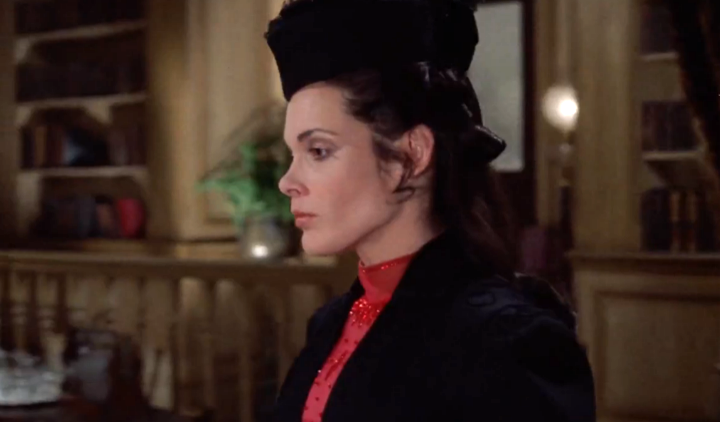
Roy Ward Baker’s Hammer Production of yet another transformation of the Dr. Jekyll and Mr. Hyde myth, this titled Dr. Jekyll and Sister Hyde (1971), is a holy mess of a movie that retains issues that are truly at the heart of Stevenson’s tale, but also takes it into completely new territory.


      Here, as one might suspect from the film’s title, the dedicated Doctor (Ralph Bates) shares his split personality this time around with a full bodied and voluptuous woman (Martine Beswick) named Mrs. Edwina Hyde, who is far stronger and more sexually interested than the timid experimenter whom his upstairs neighbor, Howard Spencer (Lewis Fiander), suggests may be “impervious to women.”

      Actually, the good Doctor—and he is a “good” man compared to all the womanizers around him such as Spencer, the doctor’s friend Professor Robertson (Gerald Sim), and the local sailors and low life males of the Whitechapel area in which Jekyll resides—is very much interested in women, but simply for “other” reasons. Having done away with all the added plot contrivances appended to Stevenson’s tale through the years, writer Brian Clemens focuses on Jekyll and Hyde him and her-selves as Jekyll seeks out an elixir that might make him live longer so that he can find a potion that might prevent all infectious diseases from Cholera, Smallpox, Typhoid, Malaria, to, had it been around in those days, Covid. Robertson suggests he will need more than a single lifetime to solve the riddle of so many diseases, and Jekyll, taking him quite seriously, seeks first, accordingly, a potion that might help him live longer than the usual man. Don’t women live longer?

      Clemens has jerry-rigged a plot in which Jekyll becomes convinced that female hormones are the answer, but accordingly he must eviscerate the bodies of woman to protract the needed material.

      For a period of time, he is able to find, through a local coroner, bodies of young girls who have recently died. But running out of fresh bodies, he is forced to turn to William Burke (Ivor Dead) and William Hare (Tony Calvin), invoking the names and stories of the famous Irish duo who did away with numerous ill and not so indisposed individuals in order to sell their bodies to medical institutions. Indeed, the tendency of this film to take on and assimilate other stories is one of its biggest flaws. For it soon also establishes Jekyll as the real Jack the Ripper. But for the moment we’ll overlook that.

      In any event, after even the flow of whores and other “road” kill that Burke and Hare provide runs out upon their being found out and captured—Burke hung by the mobs and Hare blinded in a vat of lye—Jekyll is forced, after pondering his moral scruples, to stalk prostitutes himself, kill them, and cut out the specific gland that produces the needed hormones. Hence the designation of “Ripper.”

      In so doing, however, we discover this time around that it is not Hyde—at least not yet—but Jekyll himself who is the true monster, in this case showing himself to be a horrific misogynist out to murder nearly anyone of the opposite sex. One could hardly describe this Jekyll as being “impervious” to women since he is utterly obsessed with them, seeking out their deaths in order to create his elixir for eternal life.

     But then Ms. Hyde appears and everything changes. As Robertson has advised his young friend:  

“Put a woman in your life, and one day you’ll wake up a changed man.” Indeed, Jekyll has done just that, waking up as a woman he later describes as his sister, Edwina. Talk about “coming out!”

     So does this ambitious film begin to tackle the far more profound theme of gender transformation, a subject which it first takes on rather rambunctiously without knowing precisely where it might end.


    When Jekyll first sees himself in the mirror he is amazed by the lovely woman he sees before him. The scene is actually quite well conceived as Jekyll, discovering his own female breasts, at first tentatively, but then seriously explores them, carefully and yet deliberately coming to realize they are part of his/her own anatomy, the realization which begins as slight amazement, shifting to astonishment, and finally joy. Moving her hand soon to her hair, then to her face, as if fearful that it is all just an illusion, she hints at feelings which soon turn to what we might describe as relief and liberation.

    All too soon, Jekyll’s hairy hand appears to be stroking her shoulder, and she realizes just as suddenly that the transformation has been only a temporary one, and she shall soon be back in a male body. And in that moment we glimpse a sense of the issues of transsexuality, dysphoria, and hormone replacement therapy all in one fell swoop.

       It takes no time at all before Edwina Hyde realizes that she is the stronger of the two, daring to take on the sissy-like Jekyll by secretly ordering up dresses—all in red—and before long taking over the necessary murders and dissections, particularly since it has become dangerous for Jekyll, who is more likely to be identified, to undertake them.


       But that, alas, is also the rub. Edwina loves the violence and is quite obviously motivated by the purloined hormones to which she owes her survival. But the writer and director also have the audacity to also make her into an “evil” woman, like almost all of those represented in this film. The only innocents are Howard Spenser’s virginal sister Susan (Susan Brodrick) and her mother, who with Howard live above Jekyll’s laboratory. One might simply chalk Edwina’s character up, accordingly, to the film’s general demonstration of all things misogynistic.

       Yet we cannot but realize that in her evilness Edwina is also powerful, and her character, set against all the simpering, drunken, and harassed women and the womanizing and weak-willed men of this film, she becomes almost a beacon, strangely enough, of feminist values.

        And the film suddenly becomes great fun as Edwina sets her sexual sights on Howard at the very moment that now terrified Jekyll finds himself vaguely interested in Susan, he agreeing, in his most spontaneous moment of the film, to join her at a concert.

        Howard, meanwhile, absolutely lusts after the woman of whom he has caught a glimpse of feeling breasts in a mirror, and the two soon get together for what might almost have been a porno scene were it not interrupted by the arrival of Susan. As the two women meet one another for the first time, Edwina immediately wonders aloud in her internal struggle between her and Jekyll—a brother and sister within a single body (which further calls up the myth of the siblings of the House of Usher)—who will win the love the real brother and sister, Howard and Susan, neither of whom of course can imagine what she might truly mean by “winning.”

       The film delights in the fact that its audience knows that Howard and his sister are equally sexually aroused by the very same being. As Robertson earlier on, inspecting the murdered bodies, notes: “It’s a queer business sergeant. Very queer.” In fact, he is soon done away with by Edwina for his growing knowledge of the truth.

        Baker and Clemens seem to absolutely delight in the sexual confusions they have created through their character’s indeterminate gender.


      At one point when Jekyll unexpectedly comes into contact outside his door with his neighbor, Howard, they exchange the following conversation:


howard: How is your sister.

jekyll: Fine. Fine. ....I am in excellent health.

howard: Oh no, you misunderstand me.

jekyll: (Reaching out to touch his neighbor’s face, and purring the word) Howard.


     Ultimately, Edwina almost does get her wish, or perhaps we should say, Jekyll is almost able to complete his gender transformation as he, dressing for the concert with Susan, reaches into his closet to pull out an overcoat but instead grabs Edwina’s red dress. Naturally, he fails to show up for his date.

     Yet the conventions of the day (this film was, one must remember, made in 1971) and even more importantly the established traditions of Jekyll and Hyde stories, encourage the film’s creators to reestablish the good Doctor’s credentials as a male of moral credence as he struggles to pull away the knife from Edwina’s hand at the very moment she is about to stab her female foe, Susan, in the back. Like so many other Jekylls, this one scurries back to his laboratory to finish scribbling down his diary entries so that everyone will know that “he done them wrong.”

      If we imagine that he, like other Jekyll’s, might swallow a vial of poison, we are wrong, however, as the Edwina in him just wants to live! He goes scrambling like a squirrel up the side of a building, crossing over on a ledge as thin as Edwina’s dainty feet, and jumps across the street to slide down the slope of a mansard roof, hanging for life on the rain gutter, only as he once more transmogrifies into Edwina and losing strength, falls to her death.

     Baker’s film dared to enter a strange land without knowing the destination that might have made his work transcendent.


Los Angeles, December 21, 2021

Reprinted from World Cinema Review (December 2021).


Titles Index A-N

https://myqueercinema.blogspot.com/2023/12/former-index-to-world-cinema-review.html Films discussed (listed alphabetically by director) [F...