Tuesday, November 26, 2024

Matthew Diamond and Stephen Wadsworth | Rodelinda / 2011 [HD-live broadcast]

the conscience of a king

by Douglas Messerli


George Frideric Handel (composer), Nicola Francesco Haym (libretto, based on a libretto by Antonio Salvi), Stephen Wadsworth (stage director), Matthew Diamond (film director) Rodelinda 2011 [Metropolitan Opera  HD-live production]


    On the surface Rodelinda seems a somewhat confusing story about a King, Bertarido (Andreas Scholl) who has just been defeated, and presumably killed, by Grimoaldo (Joseph Kaiser). The former queen, Rodelinda (Renée Fleming) and her son Flavio have been immediately arrested and put into chains, sequestered away—at least in the Met production—in what seems like an abandoned bedroom somewhere in the bowels of the castle.


     Before Grimoaldo's usurpation of the throne he had been offered the hand of Bertarido's sister, Eduige (Stephanie Blythe), which would have made him the heir apparent to the throne, but she has several times denied him, and now that he has illegally taken over, he lusts for Bertarido's widow, Rodelinda. When he approaches her with his desires, however, she is outraged and insists upon her devotion to her former husband and the protection of his child.

     Meanwhile Grimoaldo's advisor Garibaldo (Shenyang) prods his master on to more evil deeds, insisting that only the forceful, even the brutal are fit to rule. He has his own plans, moreover, to take the throne for himself, by marrying Eduige and becoming the rightful ruler.

      Only the court advisor Unulfo (Iestyn Davies) knows that Bertarido is still alive, pretending death in order to evaluate the situation and retrieve Rodelinda and his son from harm's way.

      Through her lovely arias we know that Rodelinda is loyal to her husband, denying the approaches of Grimoaldo. But when Bertarido shows up, to be hidden away in a nearby horse barn by his friend Unulfo, he overhears yet another encounter between Rodelinda and Grimoaldo in which she first insists of her love for her dead husband, but then suddenly seems to change heart, accepting Grimoaldo's proposal for marriage. What the two men hiding in the barn have not seen is that Garibaldo has threatened to kill her son if she does not give in, the knife put to the son's neck.
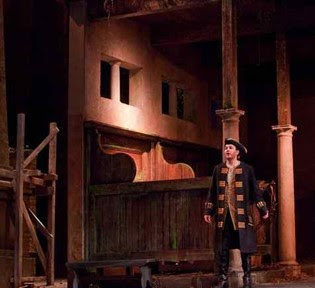

     Suddenly Bertarido's world collapses around him as he believes that his wife has not been able to remain faithful. Unulfo attempts to cheer him with an aria that relays the underlying theme of Handel's work: what seems unbearable today will look different in the future. Performed as it is between the two countertenors there is a slightly homoerotic suggestion in the plea that Bertarido should try to forget his wife's faithlessness.

     Unulfo suggests that Bertarido tell his wife that he is still living, an idea which, at first, Bertarido rejects, but then perceives that it will help to torture her for her deeds. It soon becomes apparent, however, that Rodelinda has no intentions of becoming Grimoaldo's wife, insisting that if she is to marry him that he must personally kill her young son, that she cannot be a mother to the boy would have been king and wife of the throne's usurper both. The ploy works, as Grimoaldo backs down, and Rodelinda is freed, temporarily at least, from any vows.

     Meanwhile, Eudige discovers that her brother is still alive, meeting him upon a pathway in the night, reassuring Bertarido of his wife's constancy. Unulfo brings Rodelinda to him, and the two are lovingly united, joyful to be in each other's company again. At that very moment, however, they are discovered by Grimoaldo, who orders Bertarido's arrestment and death.

     In collaboration, Eduige and Unulfo plan Bertarido's rescue, she secretly passing him a sword, Unulfo determined to lead him through a secret garden passage to his son, Rondelinda, and escape. However, when he comes to guide Bertarido to safety, in the dark room where he lies Bertarido mistakes the intruder as one of Grimoaldo's henchmen come to kill him, and he stabs Unulfo, who, although badly wounded, still pulls Bertarido to safety.


     Grimoaldo, meanwhile is in deep torment. All that he has sought has slipped his fingers. His first love Eudige has rejected him and Rodelinda has declared him a monster. Power has not fulfilled him, and he is tormented by conscience and his dark deeds. Finding him in such despair, Garibaldo is disgusted with his lack of will and determines to put a sword through his heart. At that very moment Bertarido and his family are passing, and the former king leaps into action, killing Garibaldo and, in so doing, saving Grimoaldo's life.

     Recognizing his position, Grimoaldo is only too happy to give up the throne to its rightful king. Turning again to Eudige she finally accepts his apologies, and the happy survivors sing in celebration of the future.

     Just recounting this breathless plot nearly exhausts me. One by one each of the major performers sing marvelous arias revealing their feelings and situations. This production was particularly blessed with the glorious soprano of Renée Fleming who premiered Rodelinda at the Met in 2004. Both countertenors were splendid, while Stephanie Blythe performed with her usual high artistry. The surprise of the opera, to me, was the tenor voice of Joseph Kaiser, who as the opera proceeded changed in both costume and voice from a seemingly pompous and puffed-up murderer to a handsome man of sorrow and conscience. It was a remarkably revealing performance both in its musical expression and acting abilities.

     In all this was a marvelous opera. If only the director, Stephen Wadsworth—who the singers all highly praised—had not felt it necessary to keep everything in motion by bringing in and out ancillary individuals during each aria, and arming his singers with flowerpots, books, even toys which at some point were often flung or crashed into the set. We understand that Handel's arias are structured with a beginning theme that elaborated on and repeated several times before returning us again to the original theme to be repeated once more, but that does not mean that we need be continually distracted. If the singers are good enough actors—as all of these were—to revitalize and slightly revise each repeated phrase, the music enwraps us into a kind of trance that works against this production's realist interruptions.

     Although the set was quite lovely, and the concept of moving horizontality through different sets across the gigantic Met stage worked well in several scenes, it appeared that the designers and director feared that the audience might fall asleep without the constant interruptions of everyday life. Although he is a powerful storyteller and a masterful dramatist, Handel is not Verdi.

      Nonetheless, with such great singers I would love to see the Met look into yet more Handel and other Baroque operas. Rodelinda was a joy.


Los Angeles, December 9, 2011

Reprinted from Green Integer Blog (December 2011).

Monday, November 25, 2024

Jason Bradbury | We Once Were Tide / 2011

postponed escape

by Douglas Messerli


Matthew Kyne Baskott (screenplay), Jason Bradbury (director) We Once Were Tide / 2011 [18 minutes]


This is truly one of the most beautifully poetic films of 2011, which I saw several years ago but only now come to review. I don’t quite know what made me delay in writing about it. Usually such delays involve problems with the film, dilemmas or confusions of the movie which I need to work out before returning to it. But this film was quite brilliantly straight forward in its representation.


      Anthony (Alexander Scott), living a truly lonely life on the British Isle of Wight at the southern end of England, is more than a little depressed since he mother now clearly has Alzheimer’s disease and cannot even recognize him anymore. His one solace is his friend Kyle (Tristan Bernays) who helps  evidently as his mother’s caregiver, but is also his gay lover. Together the two escape for a few moments to engage in kisses. But even that results in a problem, since in their absence his mother Annabelle (Mandy Aldridge) has wandered off to the ocean’s edge, ready to enter it at the very moment he finds her.


      Anthony himself is ready to leave, having packed his suitcase for a quick escape. But he realizes that he cannot yet leave his mother in Kyle’s capable care, a man who seems to be able to offer her more delight than her clearly despondent son is able to.

      The boys have sex, but even upon awakening he realizes his mother is missing, Kyle having whisked her away in a wheelchair to take her to a view of the ocean she so loves and in some vague sense wishes to return to, hence the film’s title. For the first time in a long while, when Kyle turns her chair toward her approaching son, she recognizes him as Anthony instead of the man who presumably was her husband, Harrold.


       Kyle has been given a Polaroid snap camera by his mother—which if you recall spit out pictures immediately after taking them, which had to be waved in the air to dry before being witnessed. And he has taken several photos of Anthony and his mother, before he leaves for the day, also slipping a piece of important news through Anthony's mail box: he has been accepted to photography school in England.

       Upon reading the letter, Anthony is left even more alone and isolated than before. He watches Kyle disappear via bicycle, leaving him in a world of utter isolation, as tears form in his eyes. Yet there is also a recognition through the photos left behind that this is his lover’s destination.

       British director Jason Bradbury’s work is a melancholy film that does not end well—perhaps why I put off writing about it—but still is a beautiful testimony to devotion and love. Despite his pain, it is clear Anthony cannot resist his lover Kyle’s movement into a new life, even if it is one he cannot yet enter.


Los Angeles, November 25, 2024

Reprinted from My Queer Cinema (November 2024).

Sunday, November 24, 2024

Michèle Flury | Waking Up in Vegas / 2023

new possibilities

by Douglas Messerli


Michèle Flury (screenwriter and director) Waking Up in Vegas / 2023 [15 minutes]


As in so very many loving gay films there is a point in puberty where two boys, having grown up and played together quite innocently, but who are also secretly in love, begin to part ways.

     Yael (Finnigan Inan), a young Turkish boy in Swiss German Michèle Flury’s film is suddenly increasingly in admiration of his physically fit brother Silas (Ayan Eranil) and is gradually pulling away for his longtime friend, Swiss-born Aaron (Fritz Rudolph), who is now increasingly demonstrating gay tendencies, including painting his nails. Working on his own body to imitate his brother, Yael moves away from his friend, particularly when in an imaginary soccer game Aaron kisses him on the forehead upon winning the goal as “Messi,” the legendary Argentine soccer hero.


     And there are other signs of separation. On a trip to their local swimming hole, Yael now refuses to strip off his clothes as Aaron has. Aaron’s comment that he thinks his friend is beautiful equally upsets him.

      His brother’s notion of virility haunts the young teenager as he struggles through what is clearly a separation between his childhood love of Aaron and his own growing adult expectations. “Why do you paint your nails?” he asks his friend, who answers in a completely guileless way, “Because I like it.” But suddenly for Yael it has become a different issue: “You don’t think it’s gay?"


     But Aaron is also beginning to challenge him. In a game of “either or,” he asks a quite ground-breaking question, “Sex with your sister or a man?” a question Yael finds simply disgusting. But it is indeed the deepest question these two adolescents can ask. How deep is your love for the other sex? If it embraces even incest then, Aaron perceives, there is no hope for him any longer in his best friend’s heart.

      But Yael, in turn, imitates his sister’s sexual orgasm with a boyfriend, while grabbing hold of Aaron, which also frightens the not yet-quite sexually aware boy. The tensions between them grow as each explores just how intense their own love is for one another.


     Yet Yael is willing to explore what it’s like to kiss, since his sister first explored it with her girlfriend, by kissing Aaron. The boys kiss, but as Yael complains his friend always overdoes it, being clearly ready to engage subconsciously in just such a boyhood kissing session. Aaron, in fact, is angry about what he himself describes his friend’s macho behavior in imitation of his brother.

     The boys separate in anger. Yet Yael, back home, obviously feels as he later puts it, “bored,” and bicycles back to Aaron’s house, breaking in through his bedroom window. Tentatively and somewhat fearfully he asks if Aaron if he will paint his nails.

      When Aaron does, it admits he likes it, and there seems to be a break-through as the boys curl up in bed together.

       This, as the sexist leader of Casablanca, Captain Louis Renault announces in Michael Curtiz’s Casablanca, might be the beginning of “beautiful friendship,” something other than Yael’s brother Silas has ever imagined.

       At the very least, Yael has been willing to explore a world he imagines outside of this brother’s heterosexual posing on Instagram and move into a private world apart from macho heteronormative behavior for at least one night. If we can’t totally comprehend what Vegas means in this film, we can imagine that it might represent a flamboyant possibility not currently available in either of the boy’s organized Swiss lives.

      Director Flury, educated as a psychologist, has been working on films that explore other possibilities of sexuality.


Los Angeles, November 24, 2024

Reprinted from My Queer Cinema blog (November 2024).


Euros Lyn | Heartstopper (Season 2) / 2023

paris is for lovers

by Douglas Messerli


Alice Oseman (screenwriter), Euros Lyn (director) Heartstopper (Season 2) / 2023 [TV series]


The second season of the now fabled TV series starring Kit Connor and Joe Locke consisted of eight more episodes, in order titled “Out,” “Family,” “Promise,” “Challenge,” “Heat,” “Truth/Dare,” Sorry,” and “Perfect.”

      It begins where the season left off with Nick (Connor) and Charlie’s (Locke) growing love being challenged, in this case by Nick the ruby player’s difficulty in coming out, despite the fact that he has done so to Charlie’s closet friends and his own mother (Olivia Colman). As with any such gay relationship, difficulties immediately arise. In this case Charlie has been letting his studies go, and when he tells his parents about his new relationship they are anything but sympathetic given the fact that he has not turned in a major history paper and his grades are slipping. They ban him from seeing Nick in their own house, particularly with the clause of no “sleepovers.”


      Nick, meanwhile, has been pulled out of his classroom position next to Charlie to study for his General Certificate of Secondary Education (GCSE) exam, and the boys encounter each other less than previously in their classroom situations.

      Both Elle (Yasmin Finney) and Tao (William Gao) continue to be attracted to one another, but also face problems, in part because of Tao’s resistance in expressing his feelings and Elle’s consideration of attending Lambert Art School—a distance evidently from the communities in which her friends now live—and her involvement there with other lesbian couples.

      Throughout this series of episodes, we also get a glimpse of some of the problems arising between the Higgs School lesbian friends of Elle, Tara Jones (Corinna Brown) and Darcy Olsson (Kizzy Edgell). In Tara’s case it is still a problem, in part, that she is coming to terms with being “out,” but also for now being concerned about Darcy’s inability, despite her seemingly open acceptance of herself and her identity, to be able to actually say the word “love.” Tara has also never yet met her lover’s mother.


      As the series proceeds, we also discover that Darcy’s mother is perhaps the least open-minded of all the fairly liberal parents in this series, and Darcy has not even been able to tell her quite vicious mother about her sexuality, representing an extreme contradiction of her behavior at school.

      Meanwhile, Isaac Henderson (Tobie Donovan) begins to receive attention from the Truham School’s other gay boy, James McEwan (Bradley Riches), which he first accepts but with whom has difficulty when it comes to true intimacy, as he gradually discovers that he is asexual.

       Other barriers arise when Nick’s brother David (Jack Barton) returns home. He’s definitely homophobic, and when he discovers his younger brother has a boyfriend, he’s more than a little vindictive. Nick is also quite disturbed about his former girlfriend Imogen dating Ben Hope (Sebastian Croft), knowing that eventually she will suffer the truth of Ben’s confused sexuality.

        If so far, this sounds like the makings of a grand soap opera, so it is. But writer Alice Oseman has several solutions up her sleeve, sending most of her characters off to a school trip to Paris accompanied by the wonderful school Art teacher, Mr Ajayi (Fisayo Akinade) and the far stricter disciplinarian Mr. Farouk (Nima Taleghani).


        Of course, in the city of romance everyone falls in love. Charlie and Nick get to spend some lovely time together, despite having the share their beds with Isaac and Tao. Tao and Elle finally come together as a couple, Darcy and Tara become closer, and even Isaac appears to become friends with James. In a truly unnecessary plot hookup, even Ajayi and Farouk hook up for a hot sexual night. Who’d of guessed that Farouk was a somewhat closeted queer?

       But there are still problems. In Paris Charlie and others begin to perceive that Nick is quite fluent in French, only to discover that his father, who has long ago left the family (Thibault de Montlembert) is French and lives in Paris, but can hardly be bothered by his own son’s telephone calls in an attempt to set up a meeting. He eventually plans a lunch, when Nick plans to come out to his father, but again the father is distracted and leaves his son and Charlie, before Nick is able to say anything.

      Charlie, meanwhile, is still suffering the previous year’s bullying, finally having to deal with his own anorexia, as in faints in the Louvre, and later admitting to Nick that he cut himself during the earlier period in his life.

       Back at home, Nick invites Charlie and his family to dinner at his mother’s house when his father Stéphane shows up for a rare visit. At the dinner, suffering the taunts of his brother David, he finally speaks out, revealing his brother’s homophobia and his father’s inability to care about his own son, and in the process opening coming out to his entire family.

       But Charlie’s family are impressed by his clear devotion to their son. And now even Charlie, when Ben, his former lover, attempts to a confession of his wrong behavior, speaks out against the selfishness of his behavior, recognizing that even now he is merely seeking self-validation.

      And although Tao and Elle are now very much in love, she admits that she has been accepted to Lambert.


       At the school prom, Darcy does not show up after having a show-down with her unloving mother. The “group” leave the prom to join Darcy and find themselves all back in their comfort zones and each other’s intense love.  

       Yes, Heartstopper, is a kind of teen romance soap opera, but as one observer suggested, almost every time it seems about to fall into sentimentalism, the writer and director move it off into a new situation, a problematic dilemma which leads the series into new dimensions. One might might wish, however, for a few less stock youth and gay situations.


Los Angeles, November 24, 2024

Reprinted from My Queer Cinema blog (November 2024).

Saturday, November 23, 2024

Gary Halvorson and Willy Decker | La Traviata / 2012 [HD-live broadcast]

 count down

by Douglas Messerli


Giuseppe Verdi (music), Francesco Maria Piave (libretto, after the play La dame aux camellias, by Alexandre Dumas fils) Willy Decker (stage director), Gary Halvorson (film director) / 2012 [Metropolitan Opera HD-live broadcast]


In this Willy Decker / Wolfgang Gussman production of Verdi’s standard, there is no consumptive coughing, no overdressed man and women attending the red-plumaged Violetta. Bringing the story into a more contemporary period, the director and designer have established from the outset—through the presence of a gigantic, surrealist-like clock, that the consumptive courtesan’s time is short. The entire set, in fact, appears as a giant waiting room with a long, curving cement-like embankment and an elliptical mezzanine where the choruses, a bit like observing doctors, can look down upon the theater of operation, Violetta’s “apartment,” wherein she plays out the short life she has yet to live.

     In some respects, this expressionistic set overstates everything, and certainly does not allow any dramatic tension about the inevitability of the plot. But it does free up the characters to symbolically enact a ritual which, after all, is not about story in the first place, but centered on the intense musical relationships of the three major characters: Violetta (Natalie Dessay), Alfredo (Matthew Polenzani), and his father Giorgio (Dimitri Hvorostovsky).


     Dessay, a trained actress, begins the opera as a performer about to go on stage, the way many have described Judy Garland offstage just before her entry, her small frame suddenly rising into a figure slightly larger than life. Violetta, having recovered from a recent consumptive attack, is weak, not at all sure she might be able to attend the party she is throwing that night. But bit by bit she pulls together, transforming herself into the party girl in short red dress her guests—men and women all dressed in black and white suits—have come to expect. This “bacchanal,” however, is closer to a mined performance of Baz Luhrmann’s Moulin Rouge than it is to Verdi’s original salon party. The champagne they drink is from empty glasses, the camellia obviously a silk flower. Dessay has not only to sing of “Sempre libera degg’io,” but, raised and lowered, on a red couch, must balance herself and dance upon the prop. She is, in short, less a consumptive woman confined to a couch than a jumping, singing acrobat. And any joys she may have in her party-life seem those that come from a successful theatrical performance than a lust for life. If Dessay was contrite, during the intermission, for having missed one of her high notes, it was easy for her appreciative audience to forgive her given her otherwise beautiful singing during her energetic apologia to the “good life.”


     It is little wonder that we find her, in the second act, having capitulated, escaping with Alfredo to the country. In the flower laden landscape of Alfredo’s world, Violetta becomes almost young again, wrapped in a flower-laden housecoat, playing hide-and-seek among the flower-covered couches. Indeed, she becomes one with the couches, becomes herself something and someone other than her former self. In this production it is immediately apparent why Violetta has given up her Parisian life; even the dreadful clock, ticking down the hours left to her, is half-covered in the same pattern, and the elliptical has become a kind of garden. The snake creeps into this paradisiacal world with her servant’s revelation that Violetta is selling her Paris belongings to support her country life. Alfred is determined to rectify the situation, rushing off to Paris, allowing the more horrific Satan, Alfredo’s bourgeois father Giorgio, time to destroy her momentary joy in life.

    For Giorgio, Violetta is, at first, nothing more than a selfish courtesan out to steal his son’s money and affections. Gradually, however, when that vision proves difficult to sustain, he employs the usual tricks of men who cannot escape the petty limitations of a societally controlled life: his beautiful daughter will lose her fiancé if Alberto does not return home. Crueler yet, Giorgio tells Violetta of her own destiny, her loss of beauty and betrayal, perhaps, by Alfredo himself. As Violetta notes, the punishment for her libertine lifestyle comes not from God but from man. Even Giorgio, however, finally comes to recognize Violetta’s sacrifice, singing in a beautiful aria (Hvorostovsky at the top of his form) of her love and generosity.


     So pure is Violetta’s love that she agrees, most reluctantly, to give up Alfredo and return to Paris, knowing now that her fate will be an early death. Accepting an invitation to her friend Flora’s costume ball, she pretends to take up once more with her former protector Baron Bouphol.

     While in Verdi’s original, the costume ball was replete with gypsies and bullfighters, the new Met version has mixed these with costumed performers from the partygoers, along with a male dressed as Violetta in mockery of her return to their world. If the whole scene is a kind of confusing mish-mash at times, it still makes more sense than the presence of these “types” at the grand ball, and their taunting tales only reiterate what we know, Violetta’s life as a grand courtesan is over. The clock itself is now transformed into a gambling table where Alfredo, who in revenge has rushed back to Paris, wins, tossing his winnings at and stuffing them into Violetta’s orifices in what is clearly a kind of capitalist rape. Even Giorgio, having followed his son to the party, is shocked by Alfredo’s behavior, but then propriety is at the heart of his torturous demands.

     The party-goers, now carnival celebrants, reenter this cold waiting room once again, this time with another women, clad in red dress, strapped to the clock. Violetta is no longer the life of the party; she has almost been drained of life.

     Sick and suffering, with just a few hours to live, she awaits the return of Alfredo who, having survived his duel with the Baron, has discovered the truth of Violetta’s abandonment and has written of her determination to see her once again. As in any grand opera, the lovers reunite to imagine the possibility of life as they once lived it, a reunification that the audience has known is impossible from the start. For a second, just before her death, the courtesan is relieved of all pain and age, until she faints away, both Alfredo and Giorgio left to face their own failures of faith in her love.

     Some of the subtlety of this opera may have been lost in the symbolic posturings of Decker’s and Gussman’s vision, but the overall dramatic impact, particularly in Dessay’s powerful performance, remains, and La Traviata seldom wavers in its musical splendor as this grand courtesan had in her past.


Los Angeles, March 15, 2012

Reprinted from Green Integer Blog (April 2012).


Mat Plendl | Revenge of the Wicked Witch / 1993

the wicked witch of the west gets a gig in las vegas

by Douglas Messerli


Mat Plendl (screenwriter and performer) Revenge of the Wicked Witch / 1993


Despite The Wizard of Oz’s truly iconic position as a gay classic, I have always felt a bit uncomfortable describing it as a LGBTQ pic. Yes, there is the cowardly “dandy-lion,” a girl who feels quite unhappy with her current identity, and an entire world of fairy pixies she dreams up as an alternative to her rural Kansas life. The witches of her real world represent strictures of authority which she would like to escape but has no way of doing so despite the love of her practical Auntie Em and uncle. In visiting the wonderful and colorful world of Oz, Dorothy has clearly entered a queer world of possibility. In the process she rediscovers her ability to think, her heart, and her courage, all the things a young possible lesbian girl might need to come to terms with herself. But…this is a world that is coded even beyond what one might describe as a 1939 coded film. It’s a truly wonderful fantasy that isn’t truly about sex—which I’d argue is at the heart of all LGBTQ films. But The Wizard of Oz is a coming-out story for anyone who feels compelled to be like everyone else in his or her community, straight or gay equally, which is why it is so totally appealing.


      But then there’s this wonderful 1993 deconstruction of the film by Mat Plendl, which deliciously and quite queerly explores the wickedness, several years before the far blander Broadway musical by Stephen Schwartz Wicked (2003), in a manner closer to the later gay comic entertainer Randy Rainbow.

      Plendl has reclaimed the original story, like a fractured fairy-tale, as an evil Grimm-like story in which the witch is no longer villain but a secret hero, desperate for the ruby slippers in order to prove herself to her family who have obviously disowned her for her wicked ways. She is the true lesbian hero to which the sweet Dorothy might only aspire to, witches long being associated in literary and cinematic presentations of lesbian behavior (read my essays on Bell, Book, and Candle of 1958 or Ulrike Ottinger’s Laocoön & Sons from 1975, and there are others).


      Through his wonderful performance addressed to plastic flamingos, a representation of the famed Flamingo Hotel in Las Vegas, this dissatisfied bitchy witch wants the ruby slippers simply to get the powers from which she, the outsider, has so long been refused. (“The shoes sure are pretty. Pretty enough to kill for? I bet you’re just about do go tippy-toe down the yellow-brick road to break ‘em in.”)

       But since the story doesn’t really permit it, she sourly settles on forgiveness and a new act in Vegas where Plendl pelts out several witchlike songs, including Lorenz Hart’s and Richard Rodger’s “Bewitched, Bothered, and Bewildered,” Johnny Mercer and Harold Arlen’s “That Old Black Magic,” and Carolyn Leigh and Moose Charlap’s “I’m Flying.”

      Plendl’s movie displays a true camp spirit that, in a sense, redeems the somewhat saccharine tale of Dorothy in dusty Kansas, to end by suggesting to Auntie Em “There’s no place like Vegas.”

     This version of The Wizard truly confirms its queerness and over-the-top excess.


Los Angeles, November 23, 2024

Reprinted from My Queer Cinema blog (November 2024).


Index O-Z

Dave O'Brien Straight Boys / 2005 Nick Oceano El primo ( The Cousin ) / 2008  Ken Ochiai Phoenix / 2006 Carlos Ocho Relación Abierta ...