Tuesday, February 11, 2025

Bob Mizer | 42nd Street Hood / 1957

 copping the hood

by Douglas Messerli


Bob Mizer (scenarist and director) 42nd Street Hood / 1957


    From my viewpoint, there is little visual artistry—even in his early complex “epic” works such as his Aztec Sacrifice and Boy Slaves for Sale, the mini-spectaculars of the 1950s—and even less “acting” talent displayed by his early silent posers in their straps. The narrative was minimal, usually involving an encounter with two popular gay “types,” a greaser and a cop, college boys and Tijuana bandit, fraternity boys and their pledges, cowboys and Indians (now more appropriately described as Native Americans), sailor boys and Marine Corps recruiters, yard workers and their employers, etc. The plots consisted of the two “types” meeting up, unwillingly or willingly stripping one another, and fighting or wrestling for dominance, sometimes moving off together into the sunset. The standard hierarchal figure of the day would usually “win” over the rebels. The actions are carried out in a near symbolic, what I shall describe, as “American porn-Kabuki” manner. Although violence is the central mode of behavior, it is never truly expressed but simply indicated by gestures and bodily leaps and maneuvers. The guns and knives used to prod the “other(s)” in action might as well have been sticks, and some cases actually were.


    Consequently, it would be utterly meaningless and unworthy of the vast effort to attempt to write about all or even many of his films. I have, accordingly, chosen a few examples, mostly works well known at the time, that represent his standard tropes.

     The one considered here, the first of the selected works which will ultimately include films previous to this one and after, is his 1957, 10-minute short, 42nd Street Hood.

      In this work Doug Scott as a greaser “hood” stands near an alley on 42nd Street, grabbing any cute boy that passes by to rough up and rob. After we watch him rob one such victim we see a policemen (Rick Spencer) dressed entirely in leather walking up to him to demand his identification. A pat-down ends in the discovery of four billfolds, which obviously requires a thorough strip-down.


      The hood is slow getting his boots off so the cop pulls them off tripping the boy up and sending him to the sidewalk. But soon he’s got him stripped down to his posing strap (it’s odd that none of these boys seems to have ever every imagined wearing a jockstrap).

       But the minute the cop turns his attention to the boy’s jeans, the hood grabs his gun and points it at the cop, demanding that he now strip as well, a request to which the cop, seemingly casually and almost joyfully, obliges. But once more, impatience wins out as the hood grabs the pants off the cop, sending him also to ground.

       Before long the two are wrestling or, as we might better describe it, choreographing movements which reveal their muscles and butts, almost always ending up with one lifting the other high into the air as if in a sexual act, before returning to the ground to maneuver their bodies into positions for which the camera might want to get a close up.


    Eventually good (the cop) ends up winning out over evil (the hood), and at film’s end, the two walk off apparently to the police station, still undressed. We have only to imagine what might happen at the station and within the jail.


Los Angeles, July 17, 2021

Reprinted from My Queer Cinema blog (July 2021).


Bob Mizer | Otte Boersma / c. 1956-1971

body beautiful

by Douglas Messerli


Bob Mizer (director) Otte Boersma / c. 1956-1971


The largest number of Bob Mizer films consist of single models posing, usually beginning frontally, standing or sitting, turning to their side, demonstrating their asses either in full recline, bending or standing, and returning again to the front where they attempt to engage in some athletic activity, jumping, skipping, lifting weights, etc. These are only as interesting as one finds the model to be attractive or appealing in in his personality. And most of the many hundreds of bruisers that Mizer put to film are simply boring to watch in action, although the effort here, apparently, was to gather as many possible types that somewhere along the way there were enough men that caught the eye of his viewers that they came coming back to order more and more tapes and pursue the pages of his magazines.


     My favorite example of such pointless physique presentations—utterly necessary if Mizer wanted to maintain that his interest in the male form was purely athletically inspired—was of a young blond named Otte Boersma, of who I could find no specific information despite the fact that one can readily find both a clip and whole reel of his session online.


      Boersma as a truly winning, youthful smile, and seems to be simply enjoying the fact that the camera is whisking over his body. Unlike so many others, one can truly see the full outline of his penis through the posing strap, and he seems to even encourage that fact by lamely making a few jumps which turn into a short effort of jumping jacks.

     Otherwise Boersma simply stands smiling, turning to the side, and eventually laying down to do a few sit-ups so that the camera can catch a full view of his ass.


     Near the end he stands again leaning against the column backdrop before simply sitting down on the cement to show off his pretty face, his slightly sweaty chest, and his winning smile, almost waving away the camera at last as if to say, so now I deserve a rest. No grimaces or muscle posturing here, just a cute boy showing his near naked body off.

     The film (B079) is undated, but apparently was shot somewhere between 1956-1971.


Los Angeles, October 19, 2021

Reprinted from My Queer Cinema blog (October 2021).

Erik Gernand | Tech Support / 2009

the sound of your voice

by Douglas Messerli


Erik Gernand and Jenny Hagel (screenplay), Erik Gernand (director) Tech Support / 2009 [10 minutes]


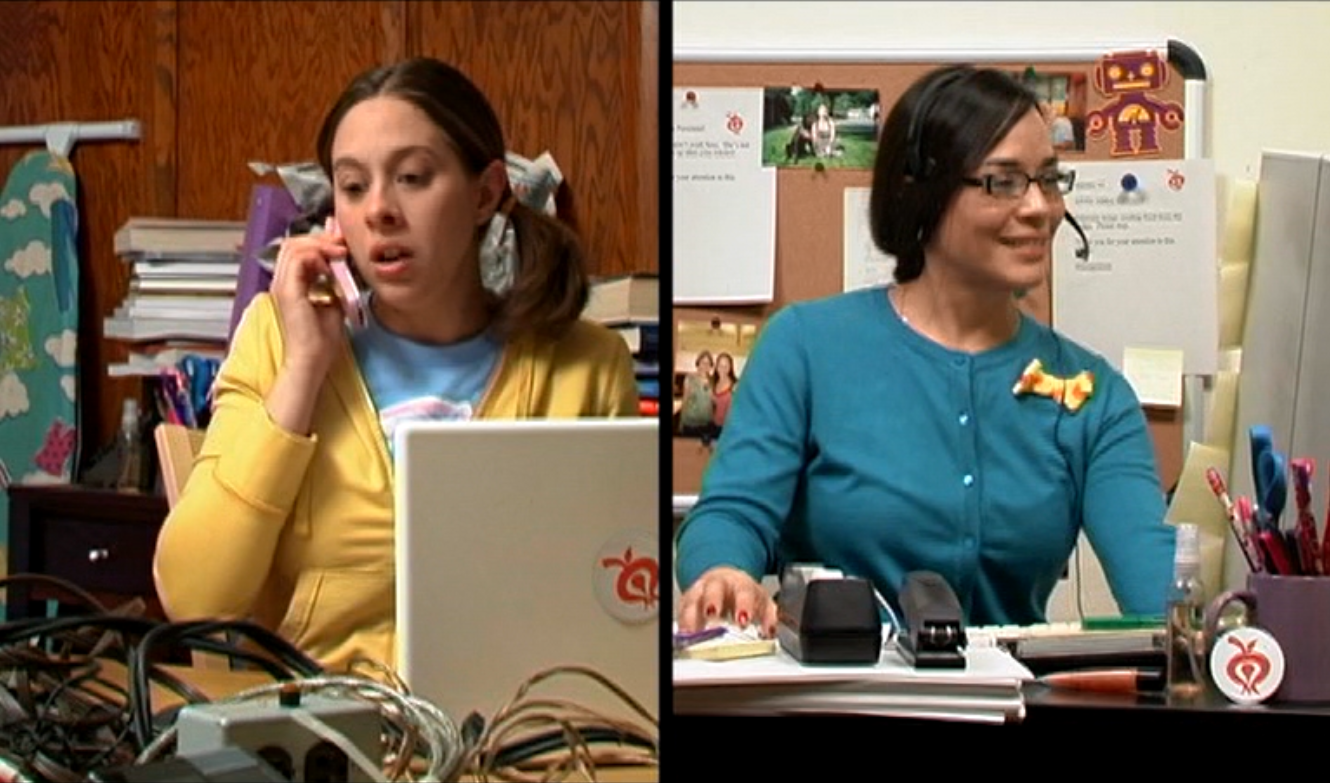
A young woman is having a serious problem with her computer and is more than a little frustrated with the fact that she can’t transfer her files from her own older laptop to the new one she has just purchased.

    After a great deal of telephonic-computer interchange with demands that she press various numbers, she finally reaches a real person, a tech support woman who, after all the niceties that go along with the pretense of being a truly helpful human being, she insists that our central figure (Jenny Hagel) is “putting it in the wrong hole,” which, by coincidence, is what her girlfriend, who has just dumped her, declared.


     The tech support person (Niki Lindgren) suggests what I have done in frustration many a time, that the customer log onto their website whereupon she can help control the devices and lead her customer to complete satisfaction.

      The conversation spills over to her own unhappiness, the fact that she’s moved into a new world where she doesn’t even know the neighbors, and can’t even now connect her new computer up the world that might possibly put her in contact with the rest of the world.

       Out international tech support individual obviously has similar feelings. And since the transfer of her files might take 2-4 hours the two strangers wait it out together.

      The two drink tea, blueberry spice, and share articles that they’ve mutually read. They remember high school and college experiences together, exchange recipes, and read out what appear to be sexual texts—although the tech support seems to be reading from her technical net guide (“to clear a paper jam, open the rear door”).


      With side-by-side images, US director Erik Gernand puts the two closely in touch as they discover a true kinship through the internet, where these days so many lonely same-sex couples encounter others. They engage in bad musical performances and even stapler versions of Morse code. They even drink together, out of matching glasses.

       As the customer reports, “This has been the most amazing 2-4 hours of my life,” the tech support responding, “Me too.”

       Finally our heroine is ready to say, despite her hesitations, “I love you,” but the connection is suddenly cut.


       Our heroine attempts to call back to other Pomegranate tech supporters without any success. But she finally meets up with her love in her next-door apartment dweller.

       If this little simply-filmed satire is not truly profound, it is nonetheless a comedic treat.


Los Angeles, February 11, 2025

Reprinted from My Queer Cinema blog (February 2025).

Douglas Sirk | Written on the Wind / 1956

the good and the bad

by Douglas Messerli


George Zuckerman (screenplay, based on a novel by Robert Wilder), Douglas Sirk (director) Written on the Wind / 1956


The melodramas of Douglas Sirk are nearly always overwrought statements of human behavior with dramatically lit, color images to match. But none of his films is quite as theatrically conceived as his 1956 film Written on the Wind, which begins with Kyle Hadley (Robert Stack), speeding to his mansion in an Allard J2X before angrily opening the front door, with a whirlwind of leaves sweeping into the house as he himself storms up the stairs to shoot either his wife, Lucy Moore Hadley (Laureen Bacall) or his best friend and her hinted at lover, Mitch Wayne (Rock Hudson), whom Kyle believes is the father of the child with which his wife is now pregnant.


     A rather cheesy song, written by Sammy Cahn and Victor Young, and sung by The Four Aces follows as the calendar pages spin backward, presumably themselves wind-driven as well, to take us into the past when Mitch first met secretary-designer Lucy and was “be-smitten” with her on first sight. If that word sounds horribly archaic, it is nonetheless appropriate for “gee-gosh” attitude with which Hudson plays his role.

      Instead of immediately rushing off with her, which any hot-blooded male such as Humphrey Bogart might do, Hudson carries her off, like a cat bringing home its prey, to his “true” love, the playboy alcoholic Kyle, who speeds away with the flummoxed good girl in a taxi. A quick plane ride raises her spirits enough that she almost immediately determines to spend the rest of her life saving this ne’er-do-well, a role the good-natured, hard-working Mitch has evidently attempted to play for most of his life. The question: is he mad that Lucy has taken Kyle away from him or that Kyle has stolen off with Lucy?


    Once we meet Kyle’s even more self-destructive sister, Marylee (Dorothy Malone)—an alcoholic also and nymphomaniac to boot—we realize, if he can simply allow himself to see beyond the forests of highly serious dramatic postures, that we’re now in for some good fun in this quite evident mid-century acting out of good and evil.

      In this case the evil folk actually win. Stack as the tortured rich boy, son of oil tycoon Jasper Hadley (Robert Keith)—who clearly would have preferred Mitch as his son—does a rather excellent job of acting, and his evil sister, jealously in love with the impassive Mitch who does his best to ignore her, won an Oscar for her supporting role.

       Hudson and Bacall, the good folks, mostly attempt to ooze their goodness into Hadley’s ugly world (stuffed with oil derricks and scruffy patches of land in-between) without much success. Hudson beats up Marylee’s down-home would-be boyfriends, stands face-forward with his impressive male torso, and smiles his most toothy grin. Bacall shows off her legs and deep-throated purrings; but neither does much good. The evil ones get all the fun, and all the alcohol, and all the lies they desire. An old grumpy doctor is even capable of convincing Kyle that he is impotent, just as Kyle’s father has convinced his son of the boy’s utter incompetence. This is pure Freudian stuff.

      I’ve always loved, and have commented elsewhere, how screenwriters—in this case, George Zuckerman based on a book by Robert Wilder—often subtly, and sometimes not so subtly, work in the sexual realities of their actors, particularly in the case of Cary Grant and Rock Hudson. Zukerman provides us some absolute zingers which I am sure flew right over the heads of most of the theater-goers of the day. At one point, when old man Hadley suggests the ruggedly handsome Mitch should get married, Hudson’s character replies: “No….I have enough trouble finding oil.” He later begs Marylee: “Please don’t waste your life waiting for me.”

      What he seeks from his women is clearly “decency,” as when, entering the suite into which Kyle has ensconced his new love, Mitch calls out, again and again, “Lucy, are you decent?” He quickly discovers that she is so decent that she has escaped the place.


       When the circle turns (and the merry-go-round theme is established early in this film), and we, near the end of the movie, come back to the opening scene, it is Mitch who is nursing the suffering Lucy, and it is Marylee who shoots her brother dead. Particularly after the trial redeeming Mitch from killing his dear friend, the good couple, Mitch and Lucy, are now given an open field to express what should be their love. Yet Sirk, like a silent Buddha, gives us no clue of what might happen in the future. And we can guess that Mitch may indeed speed off to Iran, which he has been threatening to do throughout the film, to discover some Arabic lover, or, at the very least, some lost male—just as Marylee has proclaimed her youthful afternoons with him as “wonderful lost afternoons”—to whom he might express his affection. Lucy is far too sexy for him. And she, having had a miscarriage, is now perhaps far too smart to start all over again, despite the circular structure of the plot.

      In Sirk’s melodrama, both the leads remain utter innocents. As Marylee cattily proclaims to Lucy early in the film, “I’ll loan some time of my towels since you seem to still be wet behind the ears.” Neither Lucy or Mitch seemingly have a clue of how to get under the sheets without the evil ones’ attempts to bed them. Lucy will perhaps always be seeking another man to “save”—after all, as she herself recognizes, she is so very capable—and Mitch is seeking something similar, a man who needs him as a partner for life.

      If there was ever a gay drama in a woolf’s skin, Sirk’s Written on the Wind is it. No wonder Fassbinder loved this film so dearly.


Los Angeles, April 5, 2019

Reprinted from World Cinema Review (April 2019).

Eden Poag | Boys Beware / 2021

barbie’s fault

by Douglas Messerli


Eden Poag (screenwriter and director) Boys Beware / 2021 [5 minutes]


Eden Poag’s version of Boys Beware is also an appropriation film, using images of the 1950s over which the original’s narrator once again drones.


     But Poag’s work is probably the weakest of them all, taking obviously pots shots at gender definition, even suggesting that the reason why young men may turn into gay men is all Barbie’s fault. Tell that to Greta Gerwig!

      The first third of the film displays numerous Barbie dolls and period women attempting in various ways, through dress, dance classes, and in other ways to emulate their favorite childhood figure.

       The first two boys we encounter are seemingly naïve, particularly one who believes he has found true love, while the second, more cynical roommate makes fun of his confusion of love and sex or perhaps even dating. Even though he seems to have his own girl, at one point he commands the other to get into bed, although they are separate beds.  


     But as we watch the younger boy finally put on his pajamas, we get a strong sense, that the other, more experienced boy, might not mind if the younger crawled into his own bed instead of the other bed, a space only a short distance from his.

     Another found episode concerns what appear to be a boy and his female prom date. She has evidently told him that her real interest is in girls, now attempting to explain to him why she prefers girls by asking him what he likes about them, interrupting herself in the middle of the question to ask if he’s straight.

     Throughout the date they appear not to be able to stop talking about her sexual preferences, she hinting that he has an almost inordinate obsession about her love of the same sex.


      The last found film is about a young man seeing a psychiatrist because of his unhappiness over being gay, hoping for some sort of cure or, at least, some way to make it all better. The psychiatrist compliments him for his fortitude, his desire to overcome his “illness,” but obviously offers no help except vaguely expressed statements such as the fact that his patient will have to decide what he wants to do about the “now,” as opposed the “past.”

    Throughout their conversation, images of Barbie keep appearing, as if their existence had something to do with his disinterest in the female sex.

       Frankly, it is difficult to even guess at Poag’s logic for gathering the clips he has chosen, all of which seem share only the dissatisfaction of these young men and women with their own lives, except perhaps for the young boy who we know will soon be disabused of his analysis that he finally found the “right” girl.


Los Angeles, January 2, 2024

Reprinted from My Queer Cinema blog (January 2024).


Trevor Scholtens | Boys Beware 2 / 2019

the driver as homophobe

by Douglas Messerli


Trevor Scholtens (screenwriter and director) Boys Beware 2 / 2019 [4.25 minutes]


At this point no title connected with anything about Boys Beware as number 2 seems meaningful, since we have had dozens of such rewrites, satires, and re-interpretations, as is apparent from the previous entries. But young directors clearly may not know the entire history of what has almost become a franchise, so we should perhaps simply forgive US director Trevor Scholtens for his presumption of being the only second version of the title. His short film, fortunately, is an interesting revisit of the original.


      In this film, the young boys are in college, removing them from the teenage context of the original, and allowing us to see the film a bit more objectively. A college boy Johnny is walking to his house after a long, stressful day at school. Tiring, he sits on the side of road to rest. Soon a man in a car stops by and offers him a ride. The man looks and Johnny, always ready to make a new friend, jumps into the auto.

       Like Jimmy in the original version, Johnny finds the man enjoyable to talk to and a good listener, and is delighted, according, when the man suggests that, since he drives that way every day, he’d be glad to pick him up the next day well.

       The following day, in fact, the two meet up again, Johnny delighted for the ride. This time the driver complains of an annoying co-worker: “He was being a real fag today.” Taken aback, Johnny asks the man not to use that slur, the driver curious about his reaction. Johnny explains that hate speech is not okay. The driver is still curious why the boy is so offended, Johnny replying that he is gay.

       At this point the driver suddenly stops the car and demands the boy get out, which Johnny does, walking the rest of the way home.

      The narrator now references the earlier Boys Beware film: “Johnny had thought he’d made a new friend. But what he didn’t know is that the man was sick. The sickness was not visible like smallpox, but no less dangerous. A sickness of the mind. You see, the man was a homophobe, somebody who has an extreme an irrational hatred toward members of the LGBTQ community.”

       Johnny turned out okay, we’re told. But we’re reminded that not all homophobes are passive. Some resort to violence—the narrator now bring in real-life examples—"which is the case of Aaron McKinney and Russell Henderson. They tortured and murdered Matthew Shepard on October 6, 1998 after offering him a ride home.”

        A final title reads: “According to the National Coalition of Anti-Violence Programs 52 hate related homicides of LGBTQ people were reported in 2017.”

        In 2022 there were a reported 1,944 incidents of hate violence due to sexual orientation, a rise from the previous year. One wonders if, in fact, there may be more young gay men being attacked, abused, and killed by homophobes than young boys being molested by gay men. The statistics are difficult to determine since, as we know, such molestation is difficult to separate out by sexual orientation, the molestation sometimes also committed by homophobes whose fear for their own sexuality which often results in hate and violence and, of course, by pedophiles who make no gender distinction and cannot form relationships with other adults. As with rape, child molestation often has more to do with power and control than it does with sexual desire.

       Scholtens’ film does not fully probe these issues, unfortunately, and the narrative voice, probably that of the director, represents such amateur acting that it quickly disengages the viewer in the director’s important subject.


Los Angeles, December 30, 2023

Reprinted from World Cinema Review (December 2023). 


Deven Green | Beware Homosexuals / 2015

reading the codes

by Douglas Messerli


Deven Green (screenwriter and director) Beware Homosexuals / 2015 [6.30 minutes]


Canadian comedian Deven Green created a fascinating parody of Boys Beware in 2015. In this work, Green does not focus on the would-be molester as much as she does on the boy, performing a ridiculously queer reading of his body language so that we see not just the original Ralph, but the boy Jimmy as the dangerous homosexuals, with all their actions representing a coded gay language.


      Green changes the central figure’s name to Officer Dick, while the boy becomes Scout. Dick begins the story as an undercover cop looking for homosexuals, but he gradually is converted by the boy into a homosexual through his association with their “hot, sweaty athletics.”

      Since Green supplies a running commentary of the coding, it would be nearly impossible in a short essay to comment on the entire film of 6 ½ minutes, so I will simply try to convey a sense of Green’s parodistic work. Here, for example, is the text to the initial hitchhiking and pick-up scene:


“This is officer Dick he is going undercover in broad daylight to find homosxuals.  From a distance they blend in but up close there are finger codes to attract other homosxuals in a row.  Hand pocketing is code for fondles.

      This is Scout, he will know he is gay if his thumb enlarges. Yes it has paid off – he has just won a car.


    Their ilk break many laws: side sitting and over smiling. Officer Dick, undercover homosxual reciprocates with hand in air code meaning 'we be parking.'

     The affirmative back touch is an agreement of future meetings. Dick playing the role of a homosxual driver insists the thumber clean his particulars before moving forward.

      Scout has now scrubbed his business section and his thoughts are on tossing.  Dick, the driver is pleased that protocols are being followed yet reappears as the passenger to indicate that he is flexible in either position.  Scout enters and sits where another man's posterior has been. Very homosxual.”


      On the famed fishing episode of the original, when the narrator reveals that the boy can’t remember when he had so much fun, Devon’s commentary turns every moment into a salacious statement:


“Danger! Rods and poles. Pulling up pants, showing 'the form' before both pants are removed. The man sack is fiddled with as Scout fully realizes his basket.  Homosxuals judge each other’s mouth size by testing the limits with food.  Dick sees a perfect match and shows Scout his sizable member in pictures. Dick and his mustache await an affirmative response.

      Waiting...affirmative...yes. The two are locked in a symbiotic relationship anxious to try each other’s 'pout.' Regardless, a North East wind always tightens a trouser.


     And the final scene, as they move on into the hotel room is read by Green as a silly queer scholar as:


“After all the mating and courting rituals it is time to put out—in a motel room with half hour rates.  Whoopussy…Dick’s undercover was blown when Scout found Dick’s shield.

      Scout was given a stern warning and now must live with his parents in their economy basement.”


     The later episodes are nearly as clever, particularly the scenes where the young boys gather near a men’s room on the beach.


“Public restrooms are a nesting ground for training and drills and undercover Dick has a handful of semen to prove it. Which will Dick chase down to make his own deposit? Well, homosxuals always curve… to the left.

     Dicks now needs it multiple times a day – like VITamins – so he made a rabbit proof fence to snare his little bunnies. The bunny poses with a come hither look before being sand blasted. Dick appeared to have a heavy load so Buck enlisted friends for satisfaction and completion.”


      Instead of running away to join his friends when he sees the man following him as in the original version, this boy, according to Green’s reading, runs off the bring back his other friends to share in a threesome.


     Green finishes her comic piece by reminding us that “Homosxuals are a crafty breed found in every parking lot across the Americas. Beware – there may be one right behind you at this very moment.”

      By reinterpreting the entire piece as a gay saga, Green defangs the ugly message of the 1955 and later versions of this short film.


Los Angeles, January 1, 2024

Reprinted from My Queer Cinema blog (January 2024)

Index R-Z

Angelo Raaijmakers I, Adonis / 2021 Peeter Rabane Firebird / 2021   Tyler Rabinowitz Catalina / 2022 Tyler Rabinowitz See You Soon / 20...