Sunday, March 31, 2024

Gregory J. Markopoulos | Sorrows / 1969

house of sweet sorrows

by Douglas Messerli


Gregory J. Markopoulos (director) Sorrows / 1969


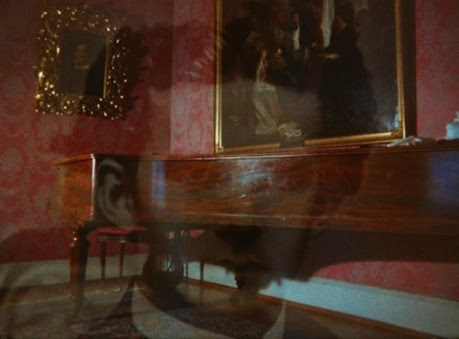
Sorrows, US expatriate director Gregory J. Markopoulos’ 1969 film, shares his earlier films’—Bliss (1966) and Gammelion (1968)—fascination with significant structures and the lives of those who lived in or constructed them.

     In the case of Sorrows, the mansion, Villa Tribschen, filmed from the outside and inside, viewed from a cold, frigid landscape, and within with the warmth of furniture, sculpture, art, and windows which provided natural light from all four sides of the house on each level, was built by King Ludwig of Bavaria—most often described as the “mad” king—for the composer Richard Wagner.

     If Luchino Visconti’s great film is to believed, Ludwig’s madness consisted mostly of loving music, particularly the operas of Wagner, architecture, and attractive boys, as well as believing he could offer his citizens culture instead of politics. All very dangerous, apparently, and very expensive, particularly given the costs of the wars his advisors preferred to support. And clearly it is just Ludwig’s loves that has attracted the director to this house, along with the sorrows that both Ludwig and Wagner were made to suffer for their pursuit of the arts.


     The first half of this film, the entire scored to a motif from Beethoven’s Eroica symphony (Symphony No. 3 in E flat major), moves rhythmically back and forth with frames depicting the surrounding fields of snow, barren trees, gray skies, and the outer shell of the house in Lucerne. Alternating with these momentary images are patterned patches or blots of color or black and white without the structures to which they were originally attached, representing, in those moments, something like George Seraut’s paintings in reverse, instead of the blotches of color building up figures and architectonic patterns, the pattern’s figures giving way to the residual colors, blacks, and grays.

       When Markopoulos’ camera moves indoors, the images become more central, the colors richer in depth are overlaid with white sculptural images, the scored music sheets of the “Siegfried Idyll,” and a painted portrait of Cosima, Franz Listz’s daughter, the former wife of the noted Wagner conductor Hans von Bülow, and later Wagner’s wife. The house, accordingly, was filled literally itself layered with sorrowful (and sometimes joyful) music and affairs of the heart, which Markopoulos visually portrays by turning his images themselves into pulsing in time with the musical composition. As Art Forum writer Rebekah Rutkoff observes, “the overlapping dissolves build in clusters with increasing layers and blinking force around the lengths of vertical windows.” The director himself describes how the film was “scored” to the music which accompanies it: “Each phrase is composed of certain frames that are similar to the harmonic units found in musical composition.”

      The result is a bit like the pulsing hearts—Wagner’s, Cosima’s, von Bülow’s, and, of course, Ludwig’s from his nearby castles of Hohenschwangau and Neuschwanstein. Love and death, just as in Wagner’s great operas, are the themes of this inside/outside tribute to the house Ludwig built to his symbolic and spiritual “father,” transforming himself, in the process, into a kind of illegitimate Siegfried, a disguised son of the gods and Wagner himself, the name also, incidentally, of Wagner’s real son.


Los Angeles, July 28, 2021

Reprinted from My Queer Cinema blog and World Cinema Review (July 28, 2021).


Federico Fellini | Fellini Satyricon (Satyricon) / 1969, USA 1970

memento mori

by Douglas Messerli


Bernardino Zapponi and Brunello Rondi (screenplay, loosely based on the work by Petronius), Federico Fellini (director) Fellini Satyricon (Satyricon) / 1969, USA 1970


Loosely-based on the Menippean satire by the Roman writer Petronius, Fellini Satyricon seems to be the movie the great Italian director always wanted to make, or let us just say that all his films previous to this one seem to be summed up in what Fellini himself described as a “science fiction of the past.” When one recalls the open sexuality of nearly all of Fellini’s works, the vague science fiction theme in 8 ½ (whose final scene takes place near a huge space-rocket launching pad), and the extreme and bizarre beings of many of his films, particularly Juliet of the Spirits (which like Satyricon features a hermaphrodite), one might see this beautiful fantasia as a summation of the director’s career.


    Fellini’s films seldom present a straight-forward story, relying as they do on travelogue (Nights of Cabiria, La Dolce Vita, and 8 ½) and picaresque (Nights of Cabiria and Juliet of the Spirits), but in his 1969 film—given the fragmentary and pedantic qualities of the original (at the heart of Petronius’ form are a series of pedants)—Fellini jettisoned plot entirely, taking the viewer through a series of unconnected encounters with two central characters, Encolpio and Ascilto, and various other figures, including both mens’ beloved Gitone.


     Throughout Fellini’s film-making, woman have always been portrayed as innocent waifs, glamorous temptresses, or as misshapen hags, and if one reads these images as psychological we can suppose that, at heart, the director was quite misanthropic. But in Satyricon, in which Fellini seems to have moved to the borderline between dream and imagination, allowing nearly all of personal archetypes to come into being, the director, strangely, has created a male-centered world, where nearly all women are ugly monsters and heterosexual love is represented as perverse or debilitating. The figures at the center of the story, on the other hand, are beautiful homosexuals (Martin Potter and Hiram Keller) or bisexual boys (such as Max Born). 


     The major storytellers of this work (the satire’s pedants), Eumolpo (Salvo Randone), Trimalcione (Mario Romagnoli), and Lichas (Alain Cuny) divide their sexual time between their wives and young men or boys: Trimalcione turning to two boys the moment his wife begins to dance, Lichas actually going so far as marry Encolpio, and Eumolpo rewarding the spirit of poetry to Encolpio. Women such as Scintilla and Enotea are terrifying monsters. Even the beautiful female African slave left behind in the emperor’s villa is allowed sex with Encolpio only by joining in a threesome that includes Ascilto. As Parker Tyler summarized the film when it first appeared: “It is the most profoundly homosexual movie in all of history.”    

     Saytricon is also a film about art, not only in its own overstated artistry—few movies have been so brilliantly framed, the costumes so shimmeringly beautiful, and actors’ faces so lovely or grotesque—but in its presentation of and references to theater, mime, poetry, and spectacle. The scene with Eumolpo begins in an ancient art museum, and the film ends abruptly with a presentation of frescoes of the characters we have just observed in action.

      At the heart of Fellini’s Satyricon, however, is neither love nor art, but death. For all its bawdy couplings, stolen kisses, and hidden embraces, the film is as Giovanni Grazzanti described it:


It is evident that Fellini, finding in these ancient personages the projection of his own human and artistic doubts, is led to wonder if the universal and eternal condition of man is actually summed up in the frenzied realization of the transience of life which passes like a shadow. These ancient Romans who spend their days in revelry, ravaged by debauchery, are really an unhappy race searching desperately to exorcise their fear of death.”


     And in its highly fragmented passages, in its purposeful disjunction of speech and image (Fellini deliberately dubbed the dialogue to make it appear the actor’s voices and lips were out of sync) and in its Brechtian theatrical distancing, Fellini has created a grand momento mori. To emphasize this, the film ends in mid-sentence as the destination of Encolpio’s newest voyage looms up in the vision of an island. Even if he has found a new safe haven, however, he is now alone, without his beloved Gitone or his long-time companion, forced to live a life, quite obviously, that has turned to stone the frescoes represent.


Los Angeles, January 18, 2014

Reprinted from World Cinema Review (January 2014).


Giuseppe Patroni Griffi | Metti, una sera a cena (Love Circle) / 1969

china is china: conversations at dinner

by Douglas Messerli


Dario Argento and Carlo Carunchio (screenplay, based on the play by Giuseppe Patroni Griffi), Giuseppe Patroni Griffi (director) Metti, una sera a cena (Love Circle) / 1969


After seeing and reviewing theater director and filmmaker Giuseppe Patroni Griffi’s Il Mare (1962) I was anxious to view his 1969 film Metti, una sera a cena (which literally means, “Let’s say, an evening for dinner”), mundanely retitled Love Circle in English; but I was so involved in finishing the 1887-1929 volume of My Queer Cinema that I simply couldn’t immediately get to it. Finally, yesterday I was able to view the film and was delighted by what I saw.

     There has been very little English-language commentary on the work—more about Ennio Morricone’s wonderful musical score than the film itself—and what has been written complains, as US viewers who haven’t yet learned how to read more complex European films often do, that the work seems didactic and narratively confusing.


  Since the play, originally written by Patroni Griffi and turned into a screenplay by Dario Argento and Carlo Carunchio, is not simply a torrid, outré romance as most viewers probably saw it, but is loosely based on Plato’s Symposium, and Argento rightfully determined to break up any linear sense of narrative in order to provide a more lively interchange and rhythm regarding the various viewpoints of eros that the film outlines, it should surprise no one that the film’s characters present their stated ideas and feelings about love in a rather random, out of sequence, manner. This is no domestic sex comedy.

     Indeed, as a traditional love story this tale would be basically pointless and certainly uninteresting, one of thousands of films that gets all excited about a wife having an affair with another man and the husband simultaneously having an affair with another woman. Americans were constantly being shocked and amazed, particularly in the 1960s, by the French and Italian’s incidental demonstration of such “naughty” affairs. In this case, however, it is their mutual friend who truly changes the traditional pattern of such farces, but even his more untraditional behavior is not truly what matters.

      The husband, Michele (Jean-Louis Trintignant) is a film writer who is obviously extremely popular beginning the film with a celebratory gathering of admirers and the press, some of whom argue that his writing is simply shallow in its popularity. Indeed the whole encounter might remind one of Federico Fellini’s director in 8 ½, except that nothing really is made of it as his close friend Max (Tony Musante) suddenly appears and helps him escape from the happenings.

       The two are obviously best friends who feel comfortable with one another to talk about nearly anything. And the subject that Michele seizes upon is his next film script for which he’s consideringly a story about marital affairs going on under the very nose of the central character, he proposing, as example, that Max is having an affair with Nina, Michele’s wife—in fact, we soon discover that is precisely the case, either Michaele being absolutely blind or simply purposely playing dumb to see if he can wheedle a confession out of Max.        


     But before we can even begin to establish those realities, we observe his wife Nina (Florinda Bolkan) visit the underground lair of a beautiful young “rebel”—although obviously a bourgeois dropout, since he clearly relies of the cash payments of his sexual partners—Ric (Lino Capolicchio). Nina has sex with the beauty, wrapped since he appears to have no available blankets and she is cold, in a Nazi flag which he has among his few recent found treasures.

       Nina simply returns home, and that evening she and Michele dine as they do most nights with their close friends, Max and the wealthy unmarried Giovanna (Annie Girardot). Their conversation, evidently representative of most evenings together, is a rather droll and sometimes witty discussion of sex, including their own real and possible relationships. Gradually between

what is said and what is happening under the table—events that are occasionally repeated throughout the film so that we might perceive them in different contexts—we begin to comprehend that Max has long been a sexual partner to Nina, even before she married Michele, and that Giovanna and Michele occasionally make love when the other two are off to the theater (Max is an actor) or when other appropriate “excuses” are made such as illness or personal problems. Michaele doesn’t seem to mind much nor, clearly, Giovanna although she feels it shameful that her friend is so obvious about her “other affections,” to which she has admitted all to Giovanna. Indeed, what we are really observing is what we might today describe as a polyamorous series of relationships that are apparently important in order for their love and friendship for each other to survive.


     What’s more, we soon discover, is that Max is bisexual, and has previously had a long affair with Ric, introducing him to Nina so that they might together share him and bring a bit more excitement into their sexual play. Of course, the fact that Nina is now highly attracted to Ric and he to her, brings up the former relationship the boy had with Max, competitive barbs being thrown out from time to time, much like the talk at dinner with Michele, Max, Nina, and Giovanni, each pointing up their particular weaknesses and viewpoints on what they define as love.

     To make it even a bit more sexually complex we eventually learn that when Nina determined to marry Michele years before, since she was already in a relationship with Max, it was not simply her marring him but they marrying Michaele, making it clear that perhaps the most passionate relationship of all in this “circle” is the love that is totally unspoken and sexually unexpressed between Max and Michaele.


      We might say that this quartet of lovers are perfectly happy in their various open secrets, willing to allow each of the others to move in and out of the more traditional relationships they have as husband and wife, friends, and confidants—perfectly happy that is until Max introduces Ric into his and Nina’s sexual acts

   For unlike the sophisticated world which they inhabit, a world which Ric has abandoned, he represents himself as a barbarian at heart—or at least a would-be barbarian. And when he finally finds himself totally in love with Nina he wants her as a lover all to himself, without any of the polite polyamorous permissions of the noblisse oblige. His demands suddenly shake this seemingly unshakeable community at its roots.


   Threatening suicide if he cannot be loved only by Nina, the boy suddenly makes everyone, particularly Max and Nina aware that love has limits which can be challenged. In one scene later in the film, indeed, Ric demands to comprehend the hierarchy of Nina’s affections by asking one by one who she would throw off a high tower, him or Michele, Michele or Max, herself or Michele, etc.

      Although Max, who still sees the Ric he first hired for sexual pleasure as a boy whose declaration of suicide he imagines as merely a meaningless threat to get attention, Nina who has never before had one man truly demanding her alone without others involved, perceives the danger. She runs to Ric’s side at the very moment he attempts to hang himself, pulling him down from his noose in order to save him.


   Played out at the very moment that Max is performing in Luigi Pirandello’s Six Characters in Search of an Author which—with its own issues of sexuality, of the interchangeability of characters and actors, of reality and theatricality, along with the fact that the young boy of the play kills himself with a gun in the last act—reflects also on what is happening in the film to its characters, bringing up further questions of what each character truly feels, imagines they feel, or is supposed to feel for one another, particularly when Nina decides to leave Michaele and live with Ric, depriving the trio of  the center of their emotional endurance.

     Basically laconic through the work, Michaele now seems to come alive as a kind commentator on Eros suggesting that demanding faithfulness has nothing to do with love, that love is perseverance rather than a temporary emotion, reminding those familiar with Plato somewhat of Agathon to Max’s Aristophanes.

      Ultimately, Ric’s fears and jealousies prove too much not only for Nina but for Ric himself, who brings her back to Michele explaining he is simply unable to deal with such a powerful force of love.

      Michaele gracefully accepts his wife back only if Ric himself brings her to their table, joining their round table as a regular guest.    

    He does so, perhaps like the late-arriving Socrates speaking for an ideal love the others do not truly comprehend or desire. Yet, it appears to me, that Michele has the best line; responding to a comment that they have now restored the table, he insists that no, it is not a table, but is a “raft.” And indeed, they do seek the brief time they have with one another almost out of a sense of survival, Max suggesting that soon one day, without warning, China may suddenly send out three nuclear bombs at the very same moment, one to Europe, one to the US, and the other to Russia, ending the civilized world.


    Patroni Graffi’s world, accordingly, is ultimately not so very different from Andrei Tarkovsky’s world as expressed in The Sacrifice of two decades later, when each of them have to weigh their little raft of love and family against the destruction of their world. And we have to wonder, at what price have they asked the man to dinner who constantly demands moral choices, their own Socrates. One suspects that they may eventually turn on him, demanding he sacrifice his own life to their more dubious pleasures.

      No one fully gets what they desire in this work, and in fact neither they nor we truly discover what it is in love that they each truly want. Each of these figures play many roles in Plato’s configuration of banquet guests of Phaedrus, Pausanias, Eryximachus, Aristophanes, Agathon and Socrates, and Alcibiades, and we would never be able to perceive them as fully representing any of these ancients’ viewpoints. But the very fact that they continuously struggle together to define their feelings about one another makes them more serious lovers than those we might find in any of the normative heterosexual monogamous relationships which make up the majority of contemporary cinematic liaisons of love. And perhaps they are far richer for it.

     Finally, it would be fascinating to compare this 1969 movie with Nik Sheehan’s 1996 documentary-like Symposium: The Ladder of Love.


Los Angeles, July 31, 2022

Reprinted from World Cinema Review (July 2022).
 

Jean-Pierre Melville | L’armée des ombres (Army of Shadows) / 1969

black out

by Douglas Messerli


Jean-Pierre Melville (screenwriter, based on a novel by Joseph Kessel, and director) L’armée des ombres (Army of Shadows) / 1969


Jean-Pierre Melville’s intense drama of the French Resistance during the early years of World War II begins with the arrestment of Philippe Gerbier (Lina Ventura)—leader of a network of Resistance workers in Marseille—a scene filled with ironies that extend to the entire film after. Gerbier is seen by the Vichy government as possibility a De Gaullist, but they, clearly, are unaware of his position, so they put him in a relatively empty camp built originally for German prisoners. Three of the prisoners with whom he must share quarters are ridiculous fools, men arrested for various infractions that have little to do with commitment to the French cause. The other two men are Communists, one a former teacher who is dying and the other a young electrician who is devoted to his dying friend and apparently his male lover. When the friend dies, the young electrician, in charge of the camp’s power plant, confesses to Gerbier his plan to escape. The two are about to accomplish that escape, but Gerbier is again taken into custody for an inquiry in Paris by the Nazi superiors. While waiting for the meeting, he and another man make their escape, and Gerbier returns to his fellow workers.


     The next scene reveals the sad series of events that seems to dominate the underground activities. Three of Gerbier’s men, Félix Lepercq (Paul Crauchet), Guuillaume Vermersch, a rotund being known as Le Bison (Christian Barbier), and Claude Ullmann, known as La Masque (Claude Mann), have picked up another of their agents, Paul Dounat, and have been ordered to execute him for having betrayed Gerbier. Having never killed before, the three are flummoxed when they perceive, given that strangers have recently moved next door to the apartment they have rented, that they cannot use their guns to shoot Dounat; they have no silencers. Seeking a knife, they find no such tool in the apartment, and they are forced to strangle the young man, tears flowing down his eyes as they themselves suffer in horrified silence for their actions. 

     With Lepercq’s recruitment of an old, risk-loving former pilot friend, Jean-François Jardie (Jean-Pierre Cassel) and his assignment to deliver up a transmitter to a housewife in the underground, Mathilde (Simone Signoret), we now have met almost all of the secret Resistance workers—except the very head of the organization, who turns out to be Jardie’s philosopher brother, who lives in what appears to be a removed life in a Paris mansion. Even the younger Jardie has no idea of his brother’s role.


     In short, nobody in this film is who he appears to be, not even, at moments, to their own knowledge of themselves. Driven by a cause larger than themselves, they must act as pawns in a larger game, jumping from planes without any lessons in parachuting, helping their own kind to escape from impossible situations when they are arrested, and killing members of their own network when it appears they might be likely to provide information. Some of their undertakings, moreover, work at odds with the others of their group.

     When Lepercq is arrested and tortured in a Gestapo prison, the younger Jardie pretends to resign and, sending an incriminating letter about himself to the authorities, allows himself be also be arrested and placed in a cell with Lepercq. Meanwhile Mathilde and others have concocted a complex plot to save Lepercq, but they arrive too late, as he too sick to survive travel, little knowing that now Jardie, who also has been tortured, will soon be in the same position.


     When Gerbier is again arrested, Mathilde and others plot a remarkable escape, based on their knowledge that as he and others are about to be shot, the SS officer’s play a sadistic game of forcing them to run like scarred rabbits. Gerbier, who at first refuses to play along, is almost shot, but when he finally does run, is miraculously saved.

      Yet soon after Mathilde herself is arrested, and, since the Nazi’s have taken in her daughter, she is no longer to be trusted; Gerbier has no choice but to order Mathilde to be killed.

       By film’s end, we realize that within another year of the occupation, all of these figures have died or committed suicide.

       Despite their heroic actions, accordingly, they have little effect. The Maquis, by film’s end, seem to have become more successful than the complex machinations of these underground warriors.

     Although Melville filmed in color, the hues of his scenes are so dark that we often perceive the images as being in black and white. After each sequence, moreover, the camera goes black for what appear to be longer and longer periods, as if to suggest that the characters and the viewer are moving down a dark tunnel where any possible vision of reality becomes increasingly unreliable.

     At one moment, while visiting Britain in order to request materials and funds, Gerbier is caught on the street during a black out and, momentarily, seems unable to know where to turn. Through a small crack of light, coming from a nearby window, he perceives there is action within, and he enters to find that, despite the dangerous and deadened world outside, the room is filled with young soldiers, sailors, and uniformed women dancing as if nothing were wrong with the world. But it is, we quickly perceive, a kind of joyless dance, a dance of death.

     Bravery, cunning, love, and violence in Army of Shadows all seem meaningless, since no action, no matter how committed to purpose (or how existentialist) the actor might be, can save anyone’s life. Even if one might survive the horrible world in which they are trapped and tortured, the survivors are hunted down and destroyed by their kind.

     The bleak view represented in this film was apparently unperceived upon its original showing, when French critics took it to task for glorifying Charles de Gaulle, a highly unpopular position given the ravages of the Algerian War. And the film was not released in the U.S. for nearly 40 years. Thank heaven for the restoration and re-release in 2006, as well as its DVD appearance in the Criterion collection.


Los Angeles, March 23, 2015

Reprinted from World Cinema Review (March 2015).

François Truffaut | L’Amour en fuite (Love on the Run) / 1979

pasting together the torn picture of the past

by Douglas Messerli


François Truffaut, Jean Aurel, Suzanne Schiffman, and Marie-France Pisier (screenplay), François Truffaut (director) L’Amour en fuite (Love on the Run) / 1979


François Truffaut’s 1979 film, the last of his Antoine Doinel cycle, is literally a pastiche; but instead of borrowing from or imitating other filmmakers, he steals pieces from the films of his own past, including not only the Doinel works (The Four Hundred Blows, Antoine and Colette, Stolen Kisses and Bed and Board), but from Day for Night, along with references to others of his films.


     This recycling of his previous films, which is made quite clear within the narrative of the new adventures in the life of his man-child, might also be compared to the metaphor that is at the heart of this new film, Love on the Run. The hero (Jean-Pierre Léaud) discovers his new lover, Sabine Barnerias (Dorothée), after observing, in a restaurant telephone booth, a man arguing with his lover over the phone and angrily tearing up a photograph he leaves behind. Entering the booth, Antoine picks up the pieces and later pastes them back together, eventually falling in love with the unknown subject of the photo. After weeks of searching, he tracks her down working in a record store, and after a few visits, the two strike up a relationship which, by the time Love on the Run begins, has, like all of Antoine’s previous relationships with women (his former wife, Christine [Claude Jade], her assistant Liliane [Dani] and his childhood unrequited love, Colette [Marie-France Pisier]), falls apart. 


     Complications—the signing of his divorce decree from Christine, his promise to take his son Alphonse to the train, and an accidental sighting of Colette—all appear to intrude upon his new relationship, condemning it to failure; but the viewer also recognizes, even if he has not seen the other Doinel films, that they are simply diversions that the failed hero uses to delay and even scuttle his commitment. The fact that Antoine, moreover, cannot bring himself to allow these consequential and inconsequential events to intersect—except through art—makes it quite clear to all of his would-be lovers that he compartmentalizing his life, using them for his various childish needs—for a mother, nurse, confessor, and lover—that impedes any wholeness in his life.

     The autobiographical elements of film that point to the director’s own past are obvious, and Truffaut’s growing discomfort with that is made apparent in Antoine’s own discussion of his fiction, in which—although he uses events and individuals in his own life, twists events, combines characters, and obfuscates in numerous ways—still reveals his inabilities to create something original. What’s more, into the pastiche of his own art, Trauffaut slips subtle cinematic references (such as the similarities on the train with Hitchcock’s North by Northwest), along with numerous red-herrings of plot developments that are left dangling in mid-air (what is the secret manuscript that Antoine’s co-worker asks him to lock away in the safe? Why does Christine attempt to visit Sabine in her apartment? Why does Colette, who has herself lost a child, become determined to defend a child-murderer, and what does it have to do with Antoine’s story?) which make for an often turgid tale that confuses more than it ultimately reveals.  It is little wonder that the director himself agreed with critics who found Love on the Run contrived and narcissistic.


     Léaud, who knew this was to be his last reincarnation as Antoine Doinel, later admitted to a great sadness while filming the piece. Certainly, this work lacks the freshness so noted in many Truffaut’s best works.

     Nonetheless, there is something to be said by laying all these obvious “pieces” of life and art out on the cutting board in order to attempt to release the eternal child from the past that haunts him with the knowledge that if they can be pasted back together in a slightly different order, the future can possibly be redeemed. We may never truly believe that the loveable but psychologically damaged Antoine can ever truly stop running, that he can commit to a real relationship by interconnecting the various aspects of his life. At least, by film’s end, there does appear to be some hope.


     The sudden appearance of one of his mother’s former lovers, Lucien (Julien Bertheau) who describes the “monstrously” anarchistic mother as a “little bird” and takes her traumatized son to see her burial plot in Montmartre cemetery, Colette’s analysis of his behavior and her generosity of seeking him out to return to him his beloved photograph of Sabine, and even Christine’s obvious love for the man she has divorced, all help Antoine to return to Sabine, revealing to her his devotion and, at least, a promise for a new future. It is as if Truffaut, himself, in pasting together all these autobiographical-like images of his art (in the editing of the film, with which he commented, he was pleased) has been able finally, in laying aside the Doinel character, to move forward with a commitment to a new work evidenced in The Last Metro, The Green Room, and Confidentially Yours. His sudden death prevented him, perhaps, from fully realizing the symbolic redemption of Love on the Run.

Los Angeles, April 25, 2015

Reprinted from World Cinema Review (April 2015).

Titles Index A-N

https://myqueercinema.blogspot.com/2023/12/former-index-to-world-cinema-review.html Films discussed (listed alphabetically by director) [F...