Friday, June 20, 2025

Kade Alexie | Pit Stop / 2024

talking

by Douglas Messerli


Kade Alexie (screenwriter and director) Pit Stop / 2024 [10 minutes]


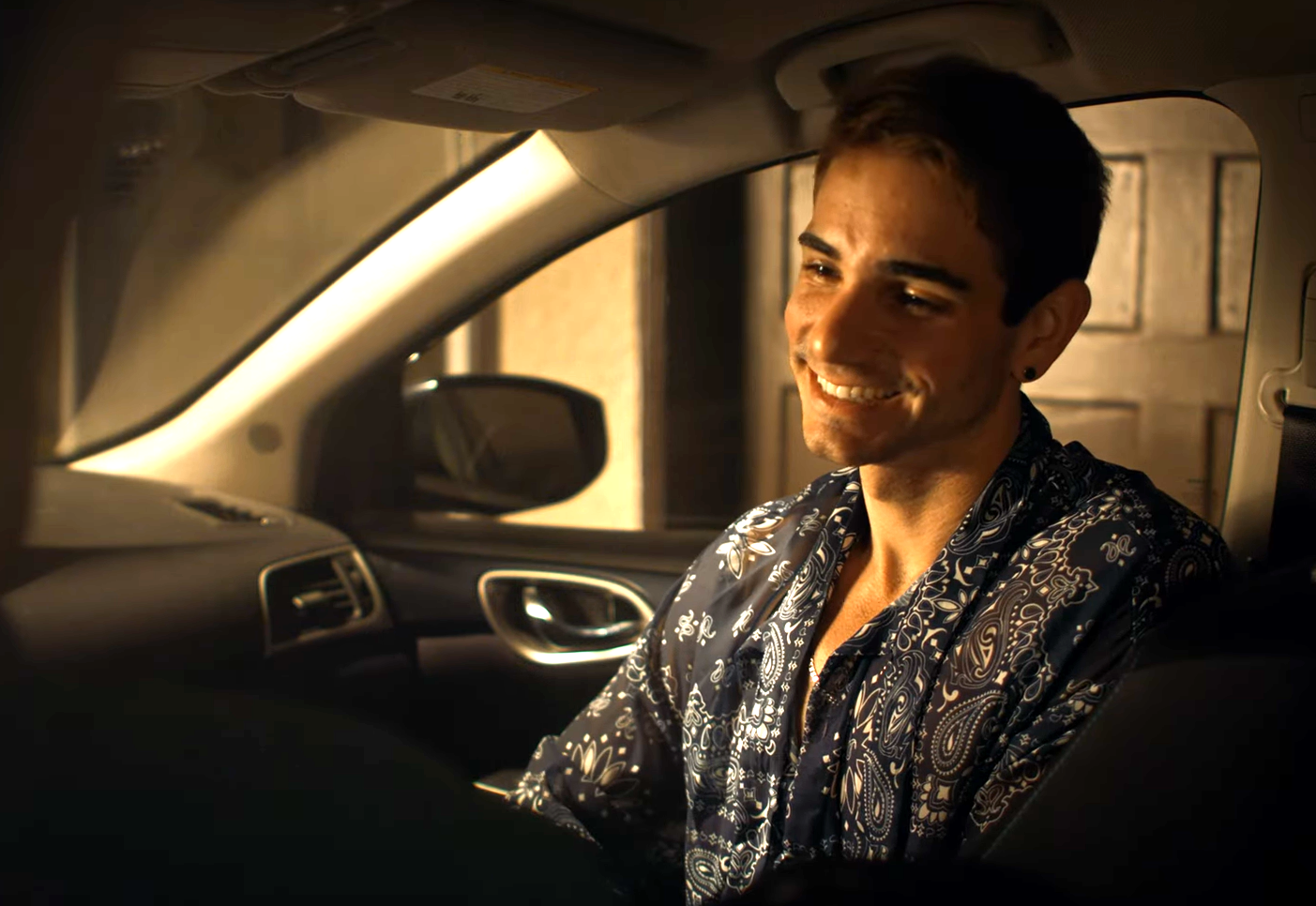
Two men meet up in a car, in what one calls a “pit stop,” after a Grindr connection. The first man,

a Latino named Lalo (Jason Caceres) immediately goes for the cock, while the black man, Justin (Kade Alexie) admits he’s not hard yet.


     So instead, the two sit back and talk a bit, getting to know one another—a rare thing on Grindr dates. Lalo discovers that Justin works at a restaurant to support himself, but is struggling to become a comedian. Lalo, in turn, is a would-be actor who “sometimes” goes to auditions, except that there aren’t many roles for Latino men, just as a slightly overweight black man finds few venues.

     They also discuss relationships, Lalo just wanting a man to support him so that he can cook and keep the house clean, his favorite activities in life. He’s even thought about joining a monastery, where he could just pray and make beer—but then, he admits, he would have to give up sex; not a good choice for him. 


  Lalo finally admits, when asked how his search for a husband going, he reveals an engagement ring. His lover, however, is not truly interested in sex, allowing Lalo to meet up with others for sexual activities.

     Justin admits that he’s just been on a date where the man he met far too serious religion and simply boring.

     They continue to talk, Lalo seeing life as a constant action of suffering, Justin as something that allows one to evolve every day, making him ultimately a better person. He too wants a relationship, but Lalo argues that he himself is not the one for Justin.

      Justin argues that Lalo deserves better than the man he is planning to marry.


      After, they spontaneously kiss, both fully enjoying the experience; but it’s time for Lalo to go in, and he doesn’t see the same person twice, he announces. Justin convinces him, nonetheless, to take his number, even if he later deletes it.

      Before he’s even driven off, however, Lalo has texted him on how he too enjoyed his company.  Except for Justin being unable to support Lalo’s home-bound life, they seem to be the perfect couple, and director Alexie leaves us with that vague possibility, even if it is without any likelihood.

      Nonetheless, both have experienced something about what a relationship is truly like, with the ability to discuss freely and openly about one’s feelings and ideas.

      This has been for both an enlightening “pit stop,” allowing both men to see new possibilities in their love lives.


Los Angeles, June 20, 2025

Reprinted from My Queer Cinema blog (June 2025). 

Abdulbasit S. Hadji Abdullah | Under the Crescent Moon / 2022

a sword that cuts through the ties of love

by Douglas Messerli


Abdulbasit S. Hadji Abdullah (screenwriter and director) Under the Crescent Moon / 2022 [15 minutes]


The short film by Pilipino writer and director Abdulbasit S. Hadji Abdullah is yet another example of the age-old split between the spiritual and the physical played out in cultures that have not yet been able to recognize LGBT behavior as a form of normative love.


     Abby (John Gerad Majen), from a conservative Muslim family, is a high school student highly attracted to and close to revealing his love for his best friend, Jerryl (Francis Ramil Fernandez). Jerryl speeds Abby to his morning prayers and school on his motorcycle, the two sharing meals and the little free time Abby possesses, the couple flirting with one another, and even holding hands, but evidently have carried it no further. Yet we easily perceive that they are clearly in love and almost at the verge of openly expressing what they latter describe as “this thing” between them.

     But with his religion intervening, Abby finally makes a decision to break-off with Jerryl, believing their growing relationship to be an affront to Allah. It is a tearful breakup for both boys, particularly for Abby, who finally explains to Jerryl his decision, Jerryl trying to argue that they’ve done nothing wrong, that they’re just friends.


     Abby, however, fully sees the implications of their relationship, asking outright, “Are we just friends?” and bringing both boys to the open recognition of their true “friendship.” Yet, of course, it is just for that reason, steeped as he is in religious dogma, that Abby must go it alone, leaving both to deep loneliness in their small Philippines town, and which will surely lead Abby to unhappy life with probably an arranged marriage of which he and his wife will remain forever resentful.

     Yet Abdullah does move in that direction and does not preach or even fully question Abby’s harsh decision. Thousands of such relationships have been broken up not just by societal and family pressures, but religious beliefs of various faiths as well. And there are very few, except for liberal-minded protestant groups that have fully embraced the LGBTQ+ community, and even that seems at times to be gradually eroding.

      Even though most religious groups tout “love” as among their major tenants, gay love does register in their minds as a legitimate form of love’s expression. Why is quite inexplicable since these religions came into being in a time when there was no such thing as something called “homosexuality,” and men, particularly Muslim men, often kept company with both young men and women. One need only recall the ending of Paul Bowles’ fiction The Sheltering Sky; or recall the popularity of the dancing boys of Afghanistan (the subject of the short film When You Hear the Bells from 2015).  Over the centuries, limitations have increasingly been put upon gay sexuality, particularly that involving men.


Los Angeles, June 20, 2025

Reprinted from My Queer Cinema blog (June 2025).

Christian Candelaria | Why Do Birds Suddenly Disappear? / 2019

fear

by Douglas Messerli


Christian Candelaria (director) Why Do Birds Suddenly Disappear? / 2019 [7 minutes]


In this short horror film from The Philippines, director Christian Candelaria brings together two young men (Matthew Gador and Teddi Avelino) for quick car sex.


     One seems inexperienced and clearly a bit frightened about the entire activity. Even if he has previously had sexual experience, you can tell that he prefers the gentle “old fashioned” methods of meeting up with someone and taking him back to his house, even if for someone his age that is impossible.

      The other is clearly experienced in on-line sex, and dares to park near a street-light in a place the other feels is not at all appropriate. He even makes the other promise that their sex will be “just for pleasure” and that there will be no emotions attached, clearly a student of what he later describes as the KKK school—sex in which the other is “liked, banged, dumped.”


     In the back seat, however, they seem to both enjoy quite sensual sex, and afterwards, while taking a smoke the experienced boy seems to be trying to get to know his new conquest. They exchange their real names and the second, more experienced boy, even admits regret for following the KKK method of sex. Yet he still wants no commitment, in part because he fears for his later sexual desires others and rejection from anyone he truly loves.

      The fearful boy wonders how long they will be hanging around the place, but the other reassures him that there is no hurry, suggesting that he has some beer in the truck, and asks him to retrieve it.

      To his horror, the fearful boy encounters mason jar after mason jar of what appear to be pickled penises. Like the boy, the audience must immediately jump to conclusions: the other boy is a serial killer who collects his sexual partner’s penises as reward for his sexual prowess.

      When the now perceived killer approaches, our young innocent attacks, eventually picking up a rock and hitting the apparent assailant again and again, blood everywhere.


      The KKK’s boy’s phone rings, and in a daze, the now killer picks it up only to hear a worried mother say, “Where have you been? I’ve been trying to contact you for hours. Why haven’t you been answering my calls? Where are the mason jars?  Direk is pissed off already! He wants to see the props.”

      Suddenly the boy and audience together comprehend his terrible mistake, the horror of his reaction, and the reality he will have to face for the rest of his life. The innocent boy’s fear has overtaken his reason, as it has the viewer’s logic as well.

      Although one may well wonder what kind of stage play or movie—except for this one—might have several jars filled with what look like penises as a prop. In this short film we once more see the hysteria that emanates from fear.


Los Angeles, June 20, 2025

Reprinted from My Queer Cinema blog (June 2025).

Thursday, June 19, 2025

Hayden Soares | I'm Not Gay / 2024

going on grindr to prove you’re not gay

by Douglas Messerli


Hayden Soares (screenwriter and director) I’m Not Gay / 2024 [8 minutes]


This Indian film, made, so its creators brag, on a Samsung they found lying on the streets, is somewhat amusing if not totally coherent.

    It centers around the central character (Hayden Soares), who claims he’s not gay, although is two gay friends (Aakarsh Bansal and Malcom D’Souza) insist he has all the characteristics of a gay man.

    He also claims to not be homophobic, so his friends dare him to go on Grindr, where he immediately gets 138 people interested, including one from his own school, who since he knows him, he is terrified that people will really think he’s really gay. Whatever was he thinking to go on Grindr in order to prove he was not gay? Perhaps he was truly interested if he might attract the same sex.


    He spends most of the remaining time of this 8-minute film asking friends if he seems gay, a close girlfriend hedging by saying “Well, you’re not very masculine.”

     But before the end, he doesn’t seem to care, realizing that being gay has nothing to do with being masculine or feminine.

      Here, however, the movie putters out, and we never discover what becomes of our nervous friend.


Los Angeles, June 19, 2025

Reprinted from My Queer Cinema blog (June 2025).


Terri McCoy, Morris Abraham, and Rosie Perez | Gays in the Military / 1992

an experienced platoon

by Douglas Messerli


Greg Fields, Pam Veasey, Jim Carrey, Damon Wayans, Keenen Ivory Wayans, and others (writers), Terri McCoy, Morris Abraham, and Rosie Perez (directors) Gays in the Military / 1992 [In Loving Color, Season 4, Episode 10]


This hilarious episode begins as the sergeant (David Alan Grier) enters the quarters of the all-gay platoon, the soldiers busily fussing around their highly decorated beds.


     The sergeant begins with the standard military spiel, “For the next six weeks I’m going to be your worst nightmare. If I say spit-shine my helmet, you will spit-shine my helmet; if I say jump, you will say how high; when I say stand up straight, I mean stand up straight.”

     But, of course, this has little effect on some of the men who like their sex tough. When one on the soldiers in the unit—the three major figures played by the wonderful trio of Jim Carrey, Marlon Wayans, and Jamie Foxx—says he’s standing as straight as he can, the sergeant comes back “Well we’ll show how wise you are when you’re chained up in some Iraqi prison getting pumped by some dude in a black leather mask; do you have any idea how that feels soldier?”

     Soldier Carrey interrupts: “I do sir. I must have had that experience at least fifty times, sir.”

     “Where soldier, Danang?”


     “No sir, San Francisco, sir…I served drinks in a bar called The Swallows.”

    When he asks the soldier where he’s from and he replies “Texas,” the sergeant replying, “The only thing from Texas are steers and sissies.”

      “That’s correct, sir, and I ain’t no steer neither sir.”

      So it goes, the sergeant attempting to intimidate his soldiers who highly appreciate and even get excited by his “butch and commanding” manner.

      When in reaction, he suggests, “Maybe you grunts would like to spend a week in the hole,” they all volunteer, jumping into the air in anticipation.

       Another sergeant arrives to announce that President Clinton has now allowed gays into the military and that he is now formally be in charge of Crisco company.

      “Oh great, gays in the life-time military man. That is just what I need, a platoon of Gomer Pyles.”*      

     He is ready to resign but the platoon members stop him by entertaining him first with touting their cleanliness and the fact that they are the first unit to have their barracks featured in Home and Garden.

        “They don’t want to be disciplined by anyone else,” as one puts it, “We like the way you discipline.” They also perform a gay version of a military march which quickly transforms into the closing song from Chorus Line, “One,” the men wearing white hats and dancing in unison.


        Finally, the sergeant is convinced to stay, and his carried off by Carrey in the same way that Richard Gere carries off Debra Winger in the 1982 film, An Officer and a Gentleman.

         In a year in which most Hollywood movies were still circling around the idea of gay movies, while other independent and European movies such as Neil Jordon’s The Crying Game, Rosa von Praunheim’s I Am My Own Woman, and the New Queer Cinema’s Tom Kalin’s Swoon and Gregg Araki’s The Living End were fully embracing LGBT issues, the comedy series In Living Color took its satire to new levels, while embracing the issue of gays in the military through outrageous stereotypes, it did it with a kind of tender and even joyous acceptance. Gays were clearly here, we thought, to stay.


*The man who played Gomer Pyle, Jim Nabors, was alleged to have been one of Rock Hudson’s regular lovers. Later in his life, he married Stan Cadwallader.


Los Angeles, June 19, 2025

Reprinted from My Queer Cinema blog (June 2025).

Wednesday, June 18, 2025

Joshua Longhurst | Oasis / 2016

shame

by Douglas Messerli


Tim Spencer (screenplay), Joshua Longhurst (director) Oasis / 2016 [8 minutes]


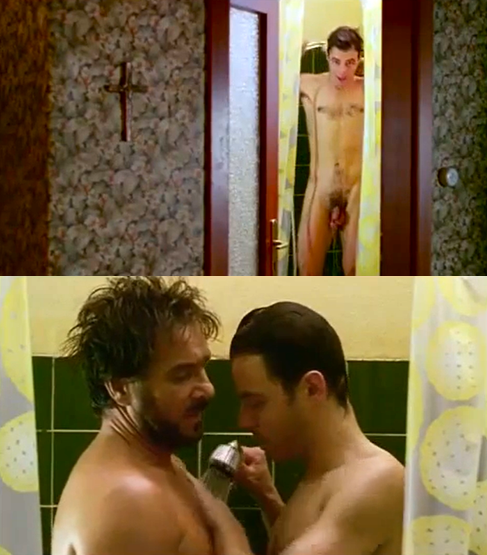
There certainly is not much to this 8-minute Australian film, but I can say that the cinematographer by Michael Filocamo is quite excellent. The story, such as it is, is simply about a moment in time.    Evidently, Dale (Alex Packard), a closeted gay boy staying at a trailer park, has already encountered a handsome and friendly Englishman, Jake (Chris Dingwall).


      The shy boy bolts from a bathroom tall to take a shower in private, still fully clothed.

      Soon after, having parked his wet shirt in his duffel bag, he notices the entry of Jake. It’s almost as if he can’t resist sneaking a photo of the British beauty fully naked. But when Jake finishes and begins shaving, Dale has second thoughts, and admits his “crime,” choosing to keep his fragile relationship with the polite man rather than the memento to which he might have jacked off a hundred times.


     Jake does not approve of his behavior, and Dale, after admitting that Jake is the nicest man in the caravan park, runs off in shame. Yet the next morning he awakens to find his duffel bag on his trailer porch, obviously returned by the dashing Englishman, who has seemingly recognized the difficult decision the young man has made in remaining honest with him.

     Surely, it doesn’t offer anything up to his hormones, but demonstrates the depth of his sensibility. When he meets the right person, we are nearly certain that he will seek out a full relationship rather than seeking night-to-night stands. Although I might have been just such a young man, who waited so long to come out that when I did I went wild with sexual exploration, doing precisely what I suggest Dale will not. Although in the end, I did seek out a relationship that has lasted now some 55 years, so maybe I’m right after all.


Los Angeles, June 18, 2025

Reprinted from My Queer Cinema blog (June 2025).

Hermine Huntgeburth | Das Trio (The Trio) / 1998

straight out of farce

by Douglas Messerli


Horst Johann Sczerba, Volker Einrauch, and Hermine Huntgeburth (screenplay), Hermine Huntgeburth (director) Das Trio (The Trio) / 1998


Derek Elley of Variety writes of German director Hermine Huntgeburth’s The Trio that the director “allows the comedy to come naturally from the characters and situations instead of trying to squeeze the story into a camp comedy format. Performances are natural rather than overplayed, and ellipses in the narrative keep things moving without dwelling on the moral implications of the characters’ actions. Once the new trio’s chemistry is established, pic moves easily to a warm conclusion.”


     But, in fact, at least from my point of view, the film stabs, stamps, spits, and noisily spins its way through space, doing everything but behaving naturally or underplayed as its three major figures attempt to deceive and betray each other in order to fulfill their desires. “Greed” might be another title to this comic work, as first Zobel (Götz George), his gay lover Karl (Christian Redl), and Zobel’s daughter from an earlier heterosexual liaison, Lizzi (Jeanete Hain) descend upon train stations, shopping centers, and any other large gathering spaces to pickpocket its denizens. This trio not only is clever in how quickly they rid themselves of their hot goods, but have trained to how to escape the clutches of the robbed or the police if nabbed, Lizzi being a particularly clever escapee.

      Karl, who occasionally entertains his bed-mate Zobel in the trailer in which they live with private drag shows, is clearly tired of their antics, at one point continuing to read a magazine and Lizzi attempts to escape capture, receiving an abusive put-down by his lover.

     But when he puts on the glasses of a blind man determined to bump into a man on the street in order to relieve him of his billfold, the man is not at all ready to forgive his “accident,” but begins to beat him for his apparent clumsiness, breaking his glasses as Karl is forced to go on the run.


    Terrified for the consequences—even more abuse from Zobel—and feeling completely inept he is almost ready to leap to his death from a walkway on the highway below until Lizzi and Zobel call out. They temporarily retrieve him, but soon after he walks dizzily into the line of a car, and is seriously hit and badly injured. The rest of the film he rests in a hospital before his death late in the film.


     Zobel and Lizzi, accordingly, must seek out a new third man, Lizzi choosing a local mechanic named Rudolf (Felix Eitner) whom she observes stealing a car radio. After a few tests, a great deal of abuse, and tossing the boy’s green, apparently harmless, snake out of the car window, Zobel agrees, Rudolf appearing more capable than Karl, if a bit ambitious; he almost gets caught after attempting to pick-pocket a man in a shopping center Lizzi has warned him against. But he cleverly keeps the wallet beneath his shoe, resulting in a small windfall for the trio.

     Compared to real thieves, this trio’s activities, sometimes themselves snaring true white-collar criminals, is truly petty, most of their money going to maintain their meagre survival—their greatest vice being horse-race gambling. And in this sense their actions play out a bit like characters out of Guys and Dolls, instead of us recognizing them as true criminals.

      But when it comes to sex, all three, Zobel, Lizzi, and even the bi-sexual Rudolf go all out to get what they want, Lizzi almost raping Rudolf in a camp-ground locker room, and Zobel actually engaging in sex with Rudolf soon after—despite his rule No. 1: “There shall be no exchange in the trio of bodily liquids.”


      And it is finally Lizzi’s discovery that her father has also had sex with the man she finds to be so desperately hot that breaks up, at least temporarily, the team. Furious, Lizzi leaves, Zobel sending Rudolf to fetch her or be killed.

       We don’t quite know how long it takes, but eventually he returns, having wed her. In the midst of the previous mayhem, we watch a scene that might have been located at the ending of the film, with Rudolf, now in Karl’s old tux, performing in a carney as the ringmaster of an amateur wrestling concession. He returns to the trailer and to a wife who looks now a bit like the cliché of “trailer trash,” along with a daughter and son.

       But Huntgeburth does not end the film there, but uses it to either to serve as a warning or show us the results of a series of mean and heedless events. Taking us on the trajectory of this ending, the director first shows the trio now working on a train, stealing mostly from sleeping coach car travelers before themselves changing coaches and planting the cash in other traveler’s coats and garments which they later reclaim

       In one horrible scene, however, Rudolf steals the purse of the train’s conductor. He is caught by the police and identified by the conductor; yet when searched nothing is found. They search the nearby Zobel only to find that Rudolf has planted the purse in his pocket. It is off to prison, a rather long stretch for papa, while Rudolf and Lizzi beget their daughter and son.


  The film ends, however, somewhat amiably, not at all as the nightmare we have already witnessed, with Zobel’s granddaughter opening up an old ladies’ purse and stealing its contents before serving it up to her grandfather. As the four walk down the board walk of a seaside town, with Rudolf and Lizzi locked arm and arm, their daughter by their side, Zobel’s cops of deep feel of Rudolf’s ass, to which the son-in-law seems not at all perturbed. Obviously, there still may be further betrayals in store. But no, I’d repeat to that Variety critic that it wasn’t at all natural or comically underplayed. The trio are straight out of farce.


Los Angeles, June 18, 2025

Reprinted from My Queer Cinema blog (June 2025)
Index R-Z

Angelo Raaijmakers I, Adonis / 2021 Peeter Rabane Firebird / 2021   Tyler Rabinowitz Catalina / 2022 Tyler Rabinowitz See You Soon / 20...