Saturday, September 21, 2024

Fred Niblo (and, uncredited, Charles Brabin, Christy Cabanne, J. J. Cohn, and Rex Ingram) | Ben-Hur: A Tale of Christ / 1925 || William Wyler | Ben-Hur / 1959

believing

by Douglas Messerli


June Mathis (screenplay, with a scenario by Carey Wilson and titles by Katherine Hilliker and H. H. Caldwell, based on the novel by Lew Wallace) Fred Niblo and, uncredited, Charles Brabin, Christy Cabanne, J. J. Cohn and Rex Ingram (directors) Ben-Hur: A Tale of Christ / 1925

Karl Turnberg (screenplay with Gore Vidal, Maxwell Anderson, S. N. Behrman, and Christopher Fry, based on the novel by Lew Wallace), William Wyler (director) Ben-Hur / 1959


Fred Niblo’s 1925 version of Ben-Hur: A Tale of the Christ and William Wyler’s remake of the epic drama, I would argue, are gay only if you want them to be. And even then you have to make do in the first version with a moment or two of the lovely smile of the pretty gay actor Roman Novarro and the square-jawed friendly gestures of Francis X Bushman chatting about the good old days they played as children together and in the Wyler version be satisfied with the “almost” lustful eyeing of the beautiful Stephen Boyd’s Messala and the enthusiastic grins of the handsome Charlton Heston’s Judah to believe that they are harboring a deep homosexual love for one another that both feel is being denied and dismissed, leading to the bitter spat which propels the rest of the movie.

      What’s more you have to basically trust Gore Vidal who served as one of the many dialogue writers for the 1959 film—far from the most reliable historian of things gay—and my beloved mentor Vito Russo’s recounting of the situation to contextualize what you’re seeing in the 1959 version of the screen. In his book Russo quotes Vidal in a somewhat different and shorter version from what Vidal recounts on screen in the film documentary version of The Celluloid Closet:


“I proposed the notion that the two had been adolescent lovers and now Messala has returned from Rome wanting to revive the love affair but Ben-Hur does not. He has read Leviticus and knows an abomination when he sees one. I told Wyler, “This is what’s going on underneath the scene—they seem to be talking politics, but Messala is really ready to rekindle a love affair,” and Wyler was startled. [In the filmed interview Vidal suggests that Wyler reminded him that the film’s subtitle was “A Tale of the Christ.”] We discussed the matter, and then he sighed, “Well. Anything is better than what we’ve got in the way of motivation, but don’t tell Chuck,” [in the recorded version adding, “because he’ll fall apart.”] I did tell Stephen Boyd, who was fascinated. He agreed to play the frustrated lover. Study his face in the reaction shots in that scene, and you will see that he plays it like a man starving [in the film version on Russo’s book, adding that Heston plays the role like Francis X. Bushman.]”


    It’s such a lovely Hollywood legend, and it truly helps to make the film far more interesting, that one is tempted to totally believe it. Except that Wyler apparently remembers no such conversation and had most tossed out Vidal’s script this time, replacing it with the more archaic rendering of Christopher Fry. Heston, predictably, is offended by the very notion. But Morgan Hudgens, publicity director for the film, however, wrote to Vidal in late May 1958 about the crucial scene, and implied there was a homosexual context:  “...the big cornpone [the crew's nickname for Heston] really threw himself into your ‘first meeting' scene yesterday. You should have seen those boys embrace!" And embrace they do, with Boyd looking very much like he’s ready to eat up his old friend.


     Novarro and Bushman on the other hand look at first to be at daggers from the very first moment of their reunion, but part of that may be explained by the fact that Judah greets him openly in public before his fellow Roman friends, embarrassing him perhaps not only because Ben-Hur is a Jew, but as all closeted Romans he might not want to let the others know that he has such a pretty boyfriend. After all, the Romans very well knew what young men might do with one another as boys in bed. It’s a bit like the bully trying to hide is secret past, and, perhaps, may help to explain the cause of his current brutalness.

      The two do open up a bit in Niblo’s film when they move off from others and later meet up at Judah’s home, but even then the love they feel between them as little opportunity to reveal itself before they begin talking politics, where after Messala even warns Judah of speaking like a traitor, the scene ends with the arrests Ben-Hur and his family for attempting to kill the new Roman governor Valerius Gratus, when a tile from their roof falls on the Roman parade.

      In writing this piece I had to watch both films in order to make sure that there wasn’t anything

else that others had missed in the first version and I might have forgotten about in the later. But I had seen 1959 version as a young man with my family at The World theater in Cedar Rapids, Iowa and had since watched with growing disinterest and finally distaste about 5 times since. So I did not at all look forward to the nearly 2 ½ viewing time of the 1925 version. I kept reminding myself as I put off the viewings that both movies had been added into The National Film Registry for being "culturally, historically, or aesthetically significant". And several friends and critics had reminded me over my months of postponement that Niblo’s film, the better of the two, was most certainly worth seeing.


     I am happy to report they were quite correct. The 1925 Ben Hur is remarkable in its cinematography, and is truly moving as a film if you skip over almost any and all of the scenes involving the spiritual and the life of Christ. Even the opening scenes with the masses swelling in and out Jerusalem are quite impressive, and the Christmas card retelling the Star of Bethlehem, the rush by the local Shepherds to see the Christ child and the visitation of the Wise Men to the Cave of David where the child lies are rather beautiful, filmed as they are in early two-color Technicolor.

      After the infamous reencounter between Judah and Messala, Ben Hur’s arrest, and his trek through the desert where he briefly meets Christ as a young working with his father Joseph, the silent movie becomes quite remarkable. But even here, in this early scene, Niblo shows himself a master, by refusing to visualize the boy Christ, revealing him only as he works on a piece of wood with a saw and through the hand the scoops water into a gourd that is put to the desperately thirsty Ben-Hur mouth. Looking up to see who has been so kind to ignore the bullying Romans in order to sustain his life, Judah sees no face, as the director focuses his camera once more on the piece of wood and the saw now resuming its motion.


      The scene that follows is one of the most remarkable, outside of the film’s later Chariot Race, in all of silent film history. We are now at sea with the beautiful flotilla of Roman ships. But in the bowels, so an intertitle warns, sits misery as the camera moves below to show us, far more wondrously than Wyler’s later version, shelf after shelf of rowers, the matching hauls filled with layers of most nude men rowing endlessly to the pounding beat. Just such a collation of so man men crowded together, even as unkempt as most of them are, can only invoke an intense homoerotic spell, which strangely and most inexplicably is even heighted by the appearance of a stunning modeled nude body of a man chained up to the wall. What he has done and why he has been treated so differently from the others (we later watch a man who attempts to rise out of his bench being lashed to death and dragged away) is never even spoken about. But it appears in this scene not only as a warning but almost as an enticement to keep leaning forward in the endless progress of strokes. Our sharp-eyed friend Russo noticed it and commented as well.


   It is here, of course, where Ben-Hur is first spotted by the Roman admiral, Quintus Arrius—after the eternity of three years of painful rowing—and admiring his strength and defiance, as well we might presume as recognizing him as the only truly beautiful body existing in this pile of human flesh, which allows him to become unshackled during the impending battle, and which saves both of their lives, finally freeing Ben-Hur from bondage.

      The battle itself in this silent film is absolutely stunning. The detail of the continued ramming of the pirate boats into the Roman fleet, the massive overtaking of the ships themselves, the release of strange weapons such as heated tar and snakes, and indeed the absolute chaos of war is so brilliantly conveyed close up that it almost takes the breath away. If Ben-Hur generally lacks excitement, here is the scene that adventure aficionados have been waiting for.

     There are also close-up scenes of battle in Wyler’s version, but most of it consists of swords and fire rather than the total chaos of killing that is represented in Niblo’s film. Much more time is spent on the heroics of Judah, as he strangles one of the Romans who has been whipping the rowers, steals his keys, and unbuckles the leg irons of the other men, lifting a huge pillar that has fallen with the ramming of the other boat. Heston is always at his best when showing off his grimacing heroic acts. Ben-Hur as hero is the focus of Wyler’s film, while Ben-Hur the survivor is central to Niblo’s movie.

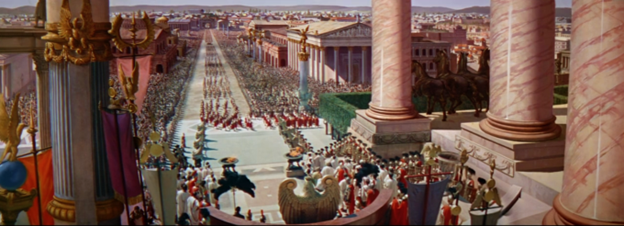
     Best known for his in-depth cinematic scenes, Wyler can hardly be matched once Judah has been made the son of Quintus Arrius and brought home to Rome where becoming a hero for his chariot-racing, a parade in his honor is celebrated throughout the city. Novarro riding through the narrow streets of the city—even if in Niblo’s work it is displayed in Technicolor—although perhaps closer to reality, can never match the grand parade that Wyler whips us through his space of the wide screen that seems to funnel into an endless horizon.


     But once Ben-Hur travels to Antioch, hoping to find more information about the whereabouts of his mother (Claire McDowell) and sister (Tirzah) and where he makes contact once again with Esther (May McAvoy) and her father Simonides (Nigel de Brulier) who has looked after the Hur family’s wealth, the 1925 film again becomes far more interesting as it takes us into the Arab camp of Sheik Ilderim (Mitchell Lewis in Niblo’s work and Hugh Griffith in Wyler’s movie).

      For it is here that when the film turns its attention to the chariot races that things move toward the true center of both works, the unforgettable battle between Messala and Ben-Hur. Both works of cinema present film in a manner that is not only memorable but influential, in Niblo’s case as innovative perhaps as Sergei Eisenstein’s Odessa Steps scene in Battleship Potemkin of the same year.    

     Even as the horses and trumpeters who call the race into being as they move out from a dark corridor to the arena of the race, the director and film editor Lloyd Nosler track with a dolly out into the open space before cutting to a view of the massive crowds and then, craning over with a shot that watches the chariots and their horses move to the starting line, cut again to the various boxes in which the central players sit—create a startlingly innovative montage. Almost immediately the scene is transformed again through another high crane view of the arena from the perspective of the Roman guards and horsemen, before returning us to the final destination of the horsemen and their trumpeting of the beginning the race.


    The race itself, with its constant cuts between wide, sweeping views of the chariots in motion intercut with head-on views of the different riders and side perspectives of the wheels, whips, and horses racing directly into the camera create a rhythm that is constantly shifting in its patterns, at several points even putting us at ground level looking up to see the hooves and wheels race over our very beings much like those who have crashed and await help must perceive the action. The variety of views in the original is amazing, while Wyler’s is far centered on the violent interactions of Messala and Ben-Hur which allow the 1925 picture a broader view of the race than the maddened hate by this time controlling the central characters’ actions. If Niblo’s figures claim it will be a battle to the death, Ben Hur wins, ruining Messala financially without robbing him of life, whereas in the 1959 film Messala must die.


    The fact that after the race Niblo’s Ben-Hur never again encounters his childhood friend or, if you will have it, former lover, is a failure that Wyler’s writers corrected. The final meeting gives both of them the possibility to end their love-hate struggle, Judah attempting to do so by replying, when Messala declares that Judah has defeated his enemy, “I see no enemy.” But in saying that, as the Roman tribune lies dying is to declare there is no longer any relationship between the two, and accordingly, Messala attempts immediately to goad him back into hate which is, without his love, all that he has left of his former friend. Declaring that the “race is not over,” the race clearly serving as a metaphor to Messala of an emotional relationship with Ben-Hur that is an intense as love. To prove it, he freely admits that Ben-Hur’s mother and sister are still living, but now in the Valley of the Lepers, certain that if anything will bring him back into Judah’s world it is that terrible fact.


     As painful as the news is, however, at least Judah now has been granted the possibility that his mother and sister are still alive, along with the potential of seeing them again. Messala grabs the lapel of his shirt as if it might bind them back into some sort of shared existence even in his death; but once the Roman tribune dies, Ben-Hur simply pulls the grasping hand away—with some difficulty I might add—proving that the relationship with Messala is no longer meaningful, and perhaps never was, at least to him. He is dead, and indeed the “race” is now over.

      Both of the movies wind down into what is a far less interesting relationship of that of Ben-Hur with Esther and, particularly in Niblo’s work, a strangely blasphemous spiritual story wherein Christ, as he carries his cross to Golgotha, is asked to bring back a dead child to life (he does so) and, as Esther pulls Miriam and Tirzah into the crowd where Christ will pass, a focus away from the sacred procession upon her prayers to wipe away their leprosy, which apparently the busy Christ accomplishes—all of it reminding one a bit of some Southern Baptist preacher proclaiming that he can cure all the crippled and the sick if only they believe hard enough. So Dorothy returned to Kansas.

      In Wyler’s work Ben-Hur’s mother and sister are cured offstage from the tears and blood of Christ caught up in the storm waters that wind their way to their leper cave. And Judah himself, recognizing the man who offered him water in the desert now offers Christ the same. All equally blasphemous perhaps, but at least more appealing than the begging Esther and a defeated Ben Hur who has brought together legions of men to save their King only to discover the King is about to be crucified.

      Moreover, Wyler’s film, if it had nothing else going for it, had one of the best musical scores, by Hungarian composer Miklós Rózsa, of any epic film ever.

      Russo claims Wyler told Vidal: “The biggest mistake we made was the love story. If we had cut out that girl [Haya Harareet, who played Esther in his version] altogether and concentrated on the two guys, everything would have gone better.”

      That’s a fable I don’t believe. Wyler would never have wanted to steal away a hero’s normative love interest, even if in both movies I noticed that neither Novarro nor Heston ever kiss a woman. Surely any such decision would have thoroughly confused his audience. Although I too might have liked to see both films end with the chariot race, with Ben-Hur rushing back to Rome and a father who adored him, even I perceive why Wyler knew that had he done so he could not possibly have won 11 Academy Awards for his movie, and even I would never have been able to sit through it six times.

      Finally, despite Vidal’s various interesting additions to the lore of this dinosaur of a film, whether or not one wants the love relationship to be centered upon the “two guys or “that girl” and Ben-Hur is a decision that the audience itself must make. There’s no coded message here, it’s all in the eyes of the beholder.


Los Angeles, August 8, 2022

Reprinted from World Cinema Review (August 2022).

Julien Duvivier | Poil de carotte (The Red Head) aka Carrot Top / 1925 || Poil de carotte (The Red Head) aka Carrot Top / 1932

the barn, a beam, a rope

by Douglas Messerli


Julien Duvivier and Jacques Feyder (screenplay, based on the novel by Jules Renard), Julien Duvivier (director) Poil de carotte (The Red Head) aka Carrot Top / 1925    

Julien Duvivier (screenplay, based on the novel by Jules Renard, and director) Poil de carotte (The Red Head) aka Carrot Top / 1932


Based on the autobiographical fiction by Jules Renard, the great French film director Julien Duvivier released two versions of Poil de carotte (in English titled The Red Head and, more appropriately, Carrot Top), a silent film in 1925 and a sound version in 1932. Although, generally speaking, the 1932 sound film is more successful, the silent version in several respects is just as remarkable, particularly for its German Expressionist-influenced images. I discuss both below simultaneously.


    Let me just begin by stating my position that neither of these works is either an explicit or coded LGBTQ movie. The central figure in both works, the titular carrot-top (André Heuzé in the silent film and Robert Lynen in the 1932 film) being only of 12-years of age, is not yet old enough to have even fully dealt with his gender let alone had time to dive into issues of sexuality. In both instances, the young boy is aware enough of gender roles that he can create a fantasy of marriage to Carrot Top’s (real name François Lepic) 5- or 6-year-old female friend Mathilde; but in both the male “groom” is as decked out with more flowers than the symbolic “bride” and in the later sound version he actually wears a floral crown missing from the “bride,” costumes more clearly created by the children themselves than in the earlier version. And throughout both films, the young “redhead” boy is dressed in a kind of tunic that is closer to a dress than a pair of boy’s pants. And in the 1932 film, the boy demonstrates that he as yet no shame of nudity. These and other instances clue us in to the fact that François is still of somewhat indeterminate gender, and has not even begun to contemplate sexual matters.


      In the 1925 film, however, Mathilde’s mother strongly complains against the boy’s marriage fantasies with her child, and one must admit, even if we understand François’ innocence and motives, there is something rather perverse about his childhood fantasy.

     And there is no movie that I’ve seen before this 1925 version of the film that more clearly plays out the archetypal pattern of the marked outsider, portraying a figure of différence that resonates with every queer story ever told. As the youngest child in a family of three siblings, Carrot Top is marked out—in this case by the supposedly red color of his hair, although in the 1932 version his school master remarks that it is blond not red—for mockery, abuse, and outright hatred, particularly by his mother. And this film shares archetypal bonds with numerous such fantasies  such as Cinderella, Snow White, and Beauty and the Beast, wherein the youngest child—in the three fairytales a step daughter, but here a son born after the married couple has come to detest one another—is so maltreated that she or he must escape into the world, in Cinderella’s case, without revealing her name, in Snow White’s situation by shacking up with 7 dwarfed men, in Beauty’s tale by being locked away in the castle of the Beast, and in Carrot Top’s imagination by committing suicide, an all-too-common tragic escape sought out by young queer or “marked” children. In each situation, except for Snow White, the elder far less talented and beautiful siblings are inexplicably preferred to the younger, lovely, and precocious child, who is forced into labor at the whim of the mother. The fathers are either missing, or as in Beauty and the Beast and Poil de carotte intimidated by their wives, or, particularly in the case of Monsieur Lepic (Henry Krauss and Harry Baur), so removed from family life that he has no clue of what is happening in his own house.


      These fantasies all reveal the difficulties of the “other,” the one, as director Richard Oswald described it in his 1919 openly gay film, “different from the others.” All are unloved and unhappy children desperately seeking the love of some unknown being outside of the world in which they currently exist, the very essence of the queer love story. It should come as no surprise that these archetypical tales (along with other tales of exception and difference, even as banal as “Rudolph, the Red Nosed Reindeer” or as complex as The Wizard of Oz) are cited as queer and gay myths and are embraced by LGBTQ individuals such as mathematic genius Alan Turing, who described the Disney version of Snow White and the Seven Dwarfs as being one of his favorite movies.

       Like so many situations in which young boys or girls are labeled by terms that have nothing to do with their own decision, but simply describe mannerisms or physical attributes, the young hero of The Red Head loses his identity as a human being to the general phrase or characteristic, in this case being named “carrot top,” or in other instances a “fag” or a “dyke.” In all cases, their queerness is defined by something over which they have no control. And, more importantly, they seem to be hated for that singular aspect of their being. Although in the 1925 version of Duvivier’s films, we learn near the end of the film that “Carrot Top’s” real name is François, we discover that fact only in the last few frames of the 1932 movie, after the boy has attempted to hang himself and been saved by the father who now, awakened to the situation, insists he will protect and love him in the future. Even Beauty and Snow White seem to be without proper names, although obviously to be described positively for one’s appearance or behavior is far better than being mocked with ugly abstract epithets concerning it.


       Both films begin with brief scenes at the public boarding school where François Lepic spends most the year. Such schools are pretty much a source of misery for all children, heterosexual or budding homosexuals in both history and literature, and this young boy’s experience doesn’t seem much different from the others, particularly when one expresses, as François does, the truth about one’s family life. He writes in his essay, “The family is a group of people living under the same roof who cannot stand each other,” an aphorism that might have found home in Oscar Wilde’s writings.

     The prissy school teacher of the 1925 film, reading the entry over the boy’s shoulder, slaps his hands with a ruler much to the delight of the other boys, whereas in the 1932 movie, the school master at least attempts to talk to the young boy about his strange viewpoints, whereupon he is even surprised to learn that he is called “Carrot Top” at home, a personal description that has not all seemed to have been adopted at François’ school.


    The silent version also carves out a large portion of its longer viewing time to show us what François’ brother Felix (Fabien Haziza) is also doing during his year studying in the city. Felix, we learn, has been regularly attending a local cabaret where he has fallen in love with a disreputable cigar-chomping singer very much in the manner of the young son of Marcel L’Herbier’s The Man of The Sea (1920). Felix attempts to lure her to his provincial home town during his summer stay at home, the subplot spilling into the silent version’s overall story in a way that I, along with most critics, feel does not truly benefit the earlier film and which was removed by Duvivier from the second film. But, as we shall see, it does provide us with a clearer explanation of Felix’s motives and makes him even more unlikeable than in the 1932 version.

       In any event, all three children, Felix, Carrot Top, and their sister Ernestine (Renée Jean and Simone Aubry) are forced to return to the family home which seems to be to none of their pleasures. On the very same day that Monsieur Lepic is off to pick them up at the station, he encounters the new maid, Annette (Lydia Zaréna and Christiane Dor) on her way to his home, having just been hired by Madame Lepic. In both movies the role Annette is crucial in that it is she who becomes closest to François, the only being who shows him love, and as an ally, speaks to the boy’s father about what is going on in his house regarding the mother’s abuse of her son.


       Zaréna in the silent version is given a much larger role, replacing the equally loving grandfather of the 1932 film, and becoming the messenger of the boy’s possible attempt to kill himself to Monsieur Lepic. She is also permitted a far greater amount of physical and emotional expression as she demonstrates to Carrot Top the possibilities of love lying outside of his particular family circle. In both cases, the boy reacts at moments negatively out of jealousy and frustration for his own condition, but in the silent version she is allowed to stroke him on occasion and even bring momentary joys to his face, while in the later movie Dor is allowed less range as the wonderful actor Lynen, given a voice to express his pain, mostly rejects physical expressions of love fearing that the touch of a human hand might just as quickly turn into the thrashings his mother and sometimes even his father regularly inflict upon him. In public his mother often pretends love, stroking his face, while in the very next moment, when once again alone with the boy, those same strokes turn into tools of anger and violence. Dor, who accompanies him to his grandfather’s house, experiences the boy at the moment of his most terrible rage (a term he later uses to describe to his father his long silences) as they return home in a cart, observing en route evidence, again and again, of normal parental-child love, babies being hugged, young boys being carried on their father’s shoulders, parents engaging in games with their beloved children. Growing increasingly furious for what is denied him, Lynen whips the horses with a frenzy as their cart goes careening down the road in danger any moment of crashing into the surrounding meadows and trees. 


     In both films, the hateful mothers are harridans, but in the silent version Charlotte Barbier-Krauss, sporting a full-grown moustache, is by far the more horrific both in appearance and in behavior. Two scenes, in particular, give evidence of the continual abuse she heaps upon the boy who is generally forced to work in heavy labor around the house and barn while Felix and Ernestine lounge about reading and playing the piano. The 1932 film better conveys the boy’s fears as he is forced, after dark, the go out to lock in the hens. For the boy nights are all haunted with the horrors of his day- time encounters with is mother, but the yard between the dining room and the henhouse for some reason, is the gathering place of his worst fears, the images of his horrifying mother rising up from the dead space to encircle him and challenge his very existence.


      The silent film contains an encounter with his mother, however, which does not appear in the later movie, that is perhaps the most perverse. As the boy goes to bed, he suddenly finds the desperate need to visit the toilet, but locked into his room he forced to use his chamber pot which seems to have inexplicably gone missing. He finally has no choice but to defecate in a corner of his room. While he is sleeping, his mother enters, smelling the awful odor before tracking it down with disgust. She quickly leaves the room again and turns up with the missing chamber pot, slipping under his bed, events which Annette witnesses. Carrot Top, predictably, is punished the next morning for his offense.


      Far less dramatic but just as effective is the scene with his mother in both versions of Poil de carotte where Carrot Top is told it is his turn to accompany his father on a hunting trip. Overjoyed, the boy hugs his standoffish father and literally somersaults his way back into change his clothes for the trip. Annette, witnessing it all from the nearby window from where she keeps watch, she observes his mother insisting he go to town for a pitcher of cream. He begs her to let someone else fetch it, but she insists that it is his responsibility. Totally dejected, when his father comes to collect him, the boy has no choice but to say that he’s changed his mind, not daring to admit it was his mother who enforced that decision for fear of further punishment. His father, in turn, describes the boy as a wretched child who can’t make up his mind what he wants. Once again, Annette and the viewer know better, and in the second version she attempts to explain to Mr. Lepic what has happened, without him fully comprehending the significance of her comments.

      Later, when Madame Lepic’s small box of money is robbed, it is, of course, her youngest who is blamed, despite the fact that Felix has stolen it, in the 1925 work, in order to entertain his cabaret girlfriend. And in that silent film, the robberies continue, ultimately ending in a theft of a most substantial amount from the father’s hidden store in a cabinet. But even then, the mother incriminates Carrot Top, without even bothering to wonder what a 12-year-old boy might be able to do with all that money.


     The 1925 version comes to a close with a rather vaguely realized series of events surrounding Lepic’s mayoral candidacy, a local fair, and the father’s discovery of town gossip about both his sons, how the mother abuses the younger and how Felix has been seen in town cavorting with what the local gossips describe as an objectionable girl. It is Annette who finally warns him that she has learned that her son intends to commit suicide.

      All of this is far better handled, if more complexly, in the 1932 remake. In that film, François, having long battled with himself about suicide, is surprised when his father suddenly confronts his mother about yet another task she has assigned to boy to carry out and, even more astoundingly, invites him to lunch with him on the day that it is certain he will be elected mayor. He tells the boy to meet him at the main meeting room after the counting of the votes. Even then, his mother getting wind the invitation, attempts to lock him in his room. But her son escapes through a high window and makes his way into town.

      At the actual counting, Mr. Lepic has also been asked to marry a couple the moment after his election, which he proudly does. The boy is so lost in the crowd and commotion of the successful election and the wedding, that he hasn’t even the possibility of letting his father know of his arrival; and when the wedding party and Lepic’s fellow electors all gather at the café across the street, François is allowed only an instant to see his father, who tells him he’s too busy to deal with him and sends him off.

      Again, put off by his father, the boy begins to leave, but at the door of the café encounters his friendly grandfather, to whom he attempts to convey his sorrows, the old man commiserating while speaking far more fully about his own difficulties at his advanced age, suggesting his grandson simply has to get used to his sorrows. The boy attempts to explain his situation further, but at that very moment an old friend calls to the man, who turns away from Carrot Top, leaving the boy feeling rejected again, this time by the only relative to have shown him any kindness.


      Carrot Top now wanders off to find the proper way to do end his life, stopping by the pond near his grandfather’s house to consider a Mouchette-like drowning (the manner the unhappy young girl chose in Robert Bresson’s great work of cinema). There is again meets up with little Mathilde, whom he tells that he will be unable to marry her because he is now planning to kill himself. In her youthful manner she attempts to dissuade him, but seeing that he’s determined to go through with it, simply suggests that the pond is to dirty and cold a place to die.

      Since she is on her way to see her mother, who has also attended the wedding, he accompanies her back to café before determining to hang himself in the barn. The silent version, indeed, almost creates a litany of the words that come into his mind determining the place and method, repeating la grange…une pouter…une corde…, the barn…a beam…a rope, repeated over and over as if he has finally solved the solution to his suffering.

      In the 1932 film, Mathilde then enters the café, momentarily being greeted by the grandfather upon whose lap she sits for a few moments, reporting François’ intentions to him, before she joins her mother. And it is the grandfather, in what might almost be seen as a kind of rehabilitation for his inattentiveness, who fights his way through the mayoral well-wishers to convey what’s happening with Mr. Lepic.

      Running back to his estate, Lepic searches everywhere for the boy, finding him in the barn, a rope already strung from a beam and the boy’s head in its lasso as he is about to kick away an egg case and drop to his death. In the silent movie, the boy, caught up in his father’s arms, simply removes the rope from around his neck, but in the later version, Carrot Top is still unconvinced his is solution, as Lepic cries out again and again for him to remove the rope as he holds the boy in his arms. Both fall to the floor of the loft in an embrace, perhaps the first full embracement of love this boy has ever received from one of his parents.


     Both films end almost conspiratorially, in the second as the two share a drink near an inn where for the very first time in the film Lepic refers to Carrot Top by his real name. When François tells him of his hatred for his mother, Lepic explains that he too hates her. And that is part of the problem. The boy was simply born to late, after their earlier love, and in revenge for its absence she has taken out her anger of late-born son. With amazing precociousness, François reasserts what parental-child relationships should ideally entail, while his never has. It is a somewhat discomfortingly misogynist scene, father and son sharing their hatred of the wife and mother. And if one might believe that there are any psychological determinants in homosexuality, we certainly might suspect that as the boy grows older, he will surely find it difficult to trust or even fall in love with a woman, particularly when M. Lepic now promises to show him love for the rest of his life, promising to intervene if his mother ever again threatens him. This is already a boy who has become devoted for his life to his father. And I can easily imagine him, at a later date, ending up in Paris, like Georges ‘Jojo’ Castagnier in Duvivier’s Boulevard (1960), because his step-mother despised him, a young boy who does indeed become involved with gay men.

     Apparently, the real Carrot Top, Renard lived a relatively happy married life, devoted to his children. But then as Oscar Wilde long argued, it is always a mistake to conflate life and art.


Los Angeles, April 15, 2023

Reprinted from World Cinema Review (April 2023).


Tom Cairns | Trouble in Tahiti / 2001

up in smoke

by Douglas Messerli


Leonard Bernstein (libretto and music), Tom Cairns (director) Trouble in Tahiti / 2001 [BBC TV broadcast of opera]


I have always been a great admirer of Leonard Bernstein's short opera, Trouble in Tahiti (which premiered at Brandeis University on June 12, 1952) and, accordingly, I was delighted when my companion Howard recently brought home from the library the 2001 DVD cinematic recording, conducted by Paul Daniel and performed by the City of London Sinfonia.

     Using iconographical advertising images of the early 1950s, and moving the opera between each of its seven scenes into the city streets, Cairns presents a fantasy-like vision of suburbia in Bernstein's "pop"-artist like conception of the period.


     But behind the post-war paean to the joys of life, sung mostly by the three-person chorus—


                            Mornin' sun kisses the windows,

                            Kisses the walls

                            Of the little white house;

                            Kisses the door-knob, kisses the roof,

                            Kisses the door-knob and pretty red roof

                            Of the little white house in Scarsdale.


—there is a crueler reality within that suburban household that shares much with the writings of period by J. D. Salinger, Vladimir Nabokov, Allen Ginsberg, and, later, Edward Albee. Dinah and Sam have seemingly everything they might want, he a good job, she a beautiful home with the latest appliances, and a child right out of a Norman Rockwell catalogue, shown in the first scene dressed in cowboy suit watching a cartoon that seems to be teaching the important lesson of American accumulation of goods.


      The couple begins their interchange with full hostility, Sam (Karl Daymond) singing "How could you say that thing that you did in front of the kid!," Dinah (Stephanie Novacek) reacting, "You were the first to go up in smoke." Both are "sick of this life," the humiliations, "the nagging," the impossibility of having a friendly conversation.

      Together they seem oblivious of their son, who slips away at the first sign of the argument. Sam hasn't even time to attend an evening play in which Junior acts; a handball tournament at his gym is of greater importance; and despite her criticism of his values, Dinah too, we later discover, misses the event.

      The couple are both trapped in their own worlds: Sam in a job that keeps money away from some while openly giving it to others through a value system where, he argues, some men "are flabby and some men are thin."

       Dinah torn between sentimental self-analysis (her beautiful aria "A Quiet Place" is little more than a dream of desire instead of a deep subconscious revelation) and total fantasy, wonderfully acted out in a drunken retelling of the plot of the movie "Trouble in Tahiti."  

       Both are adult children who live in a world no more real than the Technicolor advertisements surrounding them. Even as they encounter one another on the street, they lie to escape each other's company. Their promised "talk" turns into another trip to the "Super Silver Screen." Any possibility of real communication vanishes like smoke as they truly "Skid a lit day" (one of the scat phrases sung by the chorus).


      In short, there is no real solution possible in this short satire, and we understand why Bernstein would want to revisit this material in his more substantial late opera, A Quiet Place, wherein Dinah has just died, and Sam's two children, Junior and Dede, return home, along with Dede's husband and Junior's former boyfriend, Francois. These figures are no freer from angst than Sam and Dinah had been, but they do find, by opera's end, at least a temporary release from their own histories, signified most clearly by Junior's tossing the pages of Dinah's diary (in which she has revealed both her hate of the marriage and her love for her family) into the air, after which a short-lived quietude descends upon "the little white house in Scarsdale....Highland Park, Shaker Heights, Michigan Falls, Beverly Hills, Suburbia."

     It is interesting to note that Bernstein's own parents were named Sam and Dinah. And given pushes and pulls of the composer's own marriage, one cannot but recognize the tensions between man and wife in his short opera are a reflection of his own homosexual desires. He was himself, moreover, a man torn between a need for a quiet life in which to compose and simply live, and the reality, as an internationally renowned conductor, of a completely public one.


Los Angeles, December 20, 2009

Reprinted from American Cultural Treasures (January 2010).

Index O-Z

Dave O'Brien Straight Boys / 2005 Nick Oceano El primo ( The Cousin ) / 2008  Ken Ochiai Phoenix / 2006 Carlos Ocho Relación Abierta ...