Thursday, April 11, 2024

John Cromwell | Dead Reckoning / 1947

revenge and confession

by Douglas Messerli


Steve Fisher and Oliver H.P. Garrett (screenplay, based on a story by Gerald Drayson Adams and Sidney Biddell), John Cromwell (director) Dead Reckoning / 1947


In John Cromwell’s 1947 film noir Dead Reckoning Humphrey Bogart plays an ex-paratrooper quite apparently in love with his former military partner. Early in the film both men express their closeness. Almost gushing over his friendship, Bogart suggests his friend give up his love of his mysterious female lover:


“Johnny, why don't you get rid of the grief you got for that blonde, whoever she is? Every mile we go, you sweat worse with the same pain. Didn't I tell you all females are the same with their faces washed?"


     Johnny responds: “I think you're a great guy, too, Rip, if that's what this conversation's about. Even in the U.S.A., this world.”

     The last sentence says it all. Like many young men in the military, friendship often crossed lines. Clearly in the special military world they were more than friends, and even now, back in this world, the USA, they both continue to recognize their deep bonding and love.

     Even a comic series of lines, reiterates their intimacy. Arriving in Philadelphia, a cameraman asks if the two might step out the train taking them to Washington to receive military honors, for a quick camera shot, as the Bogart character asks:


            This is the city of brotherly love?

            That’s what New Yorkers call it. They don’t live here.

            I’m all for love, son.


     Soon after, however, Johnny suddenly vanishes from the train taking them to receive military honors in Washington, D.C. The wave of goodbye “as if it would to be permanent” particularly troubles Bogey’s character, Warren “Rip” Murdock, and having just discovered that his friend has been using an alias, Murdock determines to begin a search for this lost partner, returning to the southern city where Johnny Drake aka John Joseph Preston (William Prince) formerly lived.


      When Rip arrives, a hotel room is already waiting for him, as if Johnny has expected him to follow. A note to Rip awaits at the hotel desk announcing that Johnny will soon call. We have already been told that they “could read each other’s minds,” and that they communicated with each other in a “special code.”

     After two days, when no one calls, Rip makes a visit to the local library to learn more of his friend’s history, discovering that a few days before joining the military, Johnny—a former college professor—had been indicted for murder. How could his beloved Johnny have been a murderer?

       Rip’s search for answers, we can already guess, will lead him through a hall of mirrors which includes Johnny’s former mistress, Coral “Dusty” Chandler (Lizabeth Scott), a club owner with mafia links, Martinelli (Morris Carnovsky), his murdering goon, Krause (Marvin Miller), and an ex-paratrooping priest, to whom Rip spends most of the movie “confessing” as the film’s narrative is gradually revealed.


      Discovering also that Johnny has been murdered, Rip attempts to recover his former friendship with Johnny by getting to know Coral; as he himself puts it:


            I hated every part of her but I couldn't figure her out yet.

            I wanted to see her the way Johnny had. I wanted to hear

            that song of hers with Johnny's ears. Maybe she was alright.

            And maybe Christmas comes in July. But I didn't believe it.


     In fact, it is clear that Rip is not only confused by women, but intimidated by them. In one of the most male chauvinist statements in movie history, he explains that he would rather have women shrunk so that he might put them in his pocket, only to come back to full size when he is ready for their “beauty.”

     Accordingly, while the plot forces him to temporarily fall in love with Coral, Rip remains cool in their relationship, and Coral, being a true manipulator (and the real murderer of her husband) plays it even cooler, the combination of which makes it clear that any relationship between them in a threesome at the center of which is the now dead Johnny.

      This explains, moreover, several critics’ reservations about Lizabeth Scott, who was described as “expressionless,” and as acting awkwardly and deliberately. Bogart also seems grumpier in this film than usual, since the real fireworks exists between him and his now dead friend. And the highly artificial, if often clever, language of the film doesn’t spring the work free from its solemnity.


     Yet if we look beyond the surface story to see the film as Rip’s search through Hades to uncover the source of Johnny’s duress, the film becomes something much more compelling.

    Rip, quite literally, cannot rest in peace until he his reckoned with the past: Johnny’s feelings for Coral, his murdering of her husband, and the truth of Coral’s supposed love for Johnny. This reckoning, moreover, is also a settling of accounts, which can only mean one thing, particularly when he discovers that Coral has been the murderer: her death, even if, in attempting to shoot Rip, she causes it herself.  


      The film ends with a strange coda, Rip standing over Coral’s hospital bed, helping her to die by letting go of life and fall, as he and Johnny had done so many times in their leaps from planes into space. And the last word of film, “Geronimo!” represents a battle cry akin to Electra’s final dance and yelp of revenge.

    Seen through this lens, Dead Reckoning, is a fascinating classical revenge drama, an often misogynistic and homoerotic work in which the hero attempts to redeem his love for his male friend by temporarily becoming him and by avenging his death, to return him—if not into his metaphorical arms—into his head and heart.  At film’s end it is Rip who has won Johnny—all the others who knew him well having died.

       Finally, we can now comprehend Rip’s need for confession. In the year of my birth, 1947, the year this film was released, homosexuality—no matter how sublimated—was a mortal sin. It is almost as if the writers themselves felt they needed forgiveness for the sometimes not so subtle undercurrents of their plot. The only question is, did Bogart and Scot have a clue about the roles they were being asked to perform? Probably. Which explains their strange detachment. Bogart, in one of the cleverest lines of the film, even imagines his male friend being invited to sit on the president’s piano—a position actually awarded by President Truman to his actual true love, Lauren Bacall.


Los Angeles, August 19, 2016

Reprinted from World Cinema Review (August 2016).


Luis Buñuel | Aventuras de Robinson Crusoe (Robinson Crusoe / The Adventures of Robinson Crusoe) / USA 1954, Mexico 1955

voyeur to the cannibal feast

by Douglas Messerli


Luis Alcoriza, Luis Buñuel, Hugo Butler, and Phillip Roll (screenplay, based on the novel by Daniel Defore), Luis Buñuel (director) Aventuras de Robinson Crusoe (Robinson Crusoe / The Adventures of Robinson Crusoe) / USA 1954, Mexico 1955


Luis Buñuel’s Robinson Crusoe is a far more pitiable character than even Defoe’s isolated survivor. Often using a voice-over reciting Defoe’s own language, Daniel O’Herlily—nominated for an Oscar for his portrayal—details his disobedience of his father in leaving home in his determination of traveling to Africa to bring slaves back to Brasilia. A terrible storm scuttles his ship, killing all of his onboard companions, as he miraculously swims to a nearby island.


       His salvation seems God-sent when he discovers that a portion of his ship has lodged itself only a short distance away on an outlying rock, allowing him to retrieve food, tools, wood, guns and, just as importantly, the crews’ cat Sam and dog, Rex.

        Although, in his slave/master culture, Crusoe has not previously needed to know many labor skills, he soon manages to build himself a kind of cave dwelling, fortified by a home-made construction of a wall. By penning up some local island goats, he provides himself with milk and meat. He shoots fowl and wild boars and, after discovering a few grains of wheat growing outside his door (presumably, carried as seeds with him from the boat to his isolated island) he is able to grow a crop and bake bread. Turtle shells provide bowls, and after a few years, he is even able to create his own ceramics.

        Yet it is the lack of human company which tortures this Crusoe, particularly when he becomes sick and lies dreaming in a fever in which he calls up the image of his unforgiving father. Crusoe is even more devastated after the death of his beloved dog. His cat, quite amazingly, seems to have found another of her species on the island, producing kittens, which, along with her, soon grow wild and leave him, predicting, perhaps, what will ultimately have to happen to him if he is to survive.


       In order to maintain his sanity, Crusoe—even in this religious-hating director’s telling—has no  choice but to read, over and over, the one book he has retrieved, the Bible. In his most lonely moment, he reads the Psalm of David (“The Lord is my shepherd; I shall not want.”) to the hills from whence his melodious voice echoes, creating an imaginary friend out of his own voice and God’s word. But, as he himself admits, soon after, dressed in furs and carrying an outrageous umbrella, he would appear as a terrifying figure in any civilized city.

       After years of loneliness, he accidently discovers, one day, that the island is regularly visited by the most uncivilized beings we can imagine, cannibals from a nearby island who use his island to kill and consume their victims. In fear for his life, he is forced to watch the horrible ceremony, later retching when he comes upon their left-over skeletons. Although he imagines and even prepares a bomb for their eventual destruction, he determines not to destroy them—in part, it is hinted, because to destroy them would mean that he has no possibility for human connection.

       The next time they appear, he observes through his trusty telescope that one of the two men they are about to kill, has escaped. As two of the cannibals attempt to chase down the escapee, Crusoe hits one over the head with a rock and shoots the second. When the first comes to, the escaped victim kills the other man himself.

       The events I am describing, of course, for anyone who has not read Defoe’s famed fiction, is Crusoe’s meeting with the man he calls Friday (Jaime Fernández). At first he is terrified that the man, who himself is used to eating human flesh, will attempt to kill him, and Crusoe quickly constructs a huge door which permits him to lock Friday out of his room at nights.


    The relationship between them predictably begins, since Crusoe’s open bigotry has already been established, as that of master and slave; when Friday sneaks into Crusoe’s room one night, the “master” immediately shackles his feet, much to the shock of the loyal servant. But by morning, Crusoe perceives that his Friday has entered the room more from curiosity than any ill intent, and determines to free him. A trust between the two soon arises, and together they create an even stronger settlement, both physically and, Buñuel implies, spiritually. Although there is nothing in Buñuel’s version that openly suggests a sexual relationship between the two, we must presume that once Friday has become a near equal of Crusoe, or perhaps even earlier, the two must certainly satisfy each other’s sexual as well as their psychological and spiritual needs.

      The cannibals soon again intrude, and this time they perceive that there are far too many of them to intervene, retreating to their fortress home. A sudden explosion draws them out to inspect once again, only to discover that Spanish sailors have come ashore, scaring the local natives off. Not so very differently from the cannibals, the newcomers—mutineers we soon discover—have taken two “loyalists” from their ship in order to tie them up and maroon them. Crusoe and Friday secretly cut the ropes which bind the “believers,” and help the two escape.


      Luring the mutineers into their home, the four (Crusoe, Friday, and the freed men) surround them, forcing the other sailors to surrender. Crusoe orders them tied up, and escaping with the two “loyalists” back to the ship, leaves the others behind with his book detailing how he has been able to survive. At least, he admonishes them, they will have each other’s company, which Buñuel hints will perhaps destroy them faster than had they each left to their own devices. Surely they will attempt to war with any returning cannibals.

      Crusoe’s last great gesture is to ask his now equal friend whether—having just witnessed that the so-called “civilized” men are not so very different from Friday’s native companions—he still wants to travel with him to England. Friday commits to the voyage, willing to embrace a new world that, given his race, may be far more brutal than even than the one he has left behind. Obviously, he newfound friendship with Crusoe has provided more faith than the values of his past or those he might imagine to be provided by those to whom he is traveling. And it is now inevitable, even if unstated, that the two shall live the rest of their lives together.

      Jaime Fernández, brother of the famous Mexican actor Emilio Fernández, was working as a film grip when Buñuel spotted him; apparently he did not know a word of English when the director began shooting his Robinson Crusoe simultaneously in both English and Spanish. The younger Fernández evidently learned to speak the language on the set, much in the same way (but surely more quickly) as the character, Friday, learned it from Crusoe. Certainly, his bronzed handsome look made a perfect foil for the virile Irish actor who had previously played in Shakespeare characters in Abbey Theatre productions.


Los Angeles, January 22, 2016

Reprinted from World Cinema Review (January 2016).


Harry Lorraine | The Lads of the Village / 1919

harem scarem*

by Douglas Messerli


Kenelm Foss (screenplay, based on the stage musical), Harry Lorraine (director) The Lads of the Village / 1919


According to commentator Ellen Cheshire, it’s almost a miracle that we still have copies of Harry Lorraine’s 1919 film, The Lads of the Village. The film was based on a popular World War I music hall-like review produced by Joe Peterman that had traveled throughout Britain. Peterman also was the producer of the movie, the only problem being that he did not receive permission from the writers of the original, librettist Clifford Harris, lyricist Valentine, and composer James Tate. Peterman lost the case and was forced to pay damages and destroy copies of his film.

      Today, however, the British Film Institute shows it free from its site and a slightly restored but highly nitrate damaged version appears on You Tube.


      The small village to which the three heroes of World War I return has yet to hear why one of their group, Erb has just been awarded an important metal for bravery in the war, and the story, told by Captain Clements (H. J. Lord) constitutes the substance of the movie.

       The story involves Clement’s own actions as the lover of the local beauty Maud Ellington (Maudie Dunham), who begins by working as a secretary for the head of the International Peace Committee, Sir Karl Dusseldorf (Bernard Dudley) with whom she has apparently had a romantic interlude when she was younger.

       Dusseldorf holds her letters as ransom so that she might remain under his control as he openly flirts with her, reminding her that she once felt differently about him than she now does. She’s ready to return his letters in exchange for hers, but he refuses.

       Meanwhile, he sends her into London to hand-deliver a message of a certain party, Otto Drach, in a Charing Cross café. She hands the letter over but also meets, by accident, Clements in the same café, the two, after a brief lunch and after lunch walk, quickly falling in love.

      Drach, it turns out, is a major figure in the German underground in Britain, and Dusseldorf, we discover, is one of the heads of the German spy network.

       By the time she returns to Hapsberg House, Dusseldorf’s local residence, Maud has determined to resign, Dusseldorf coincidentally about to tell her that her services are no longer needed such he, unbeknownst to the others, intends to join up with the German underground in order to gain access to Clements special orders the officer will soon be delivering to the British forces in Mesopotamia.

       Meanwhile, the two local boys Erb and Bert have joined up with British services and are serving under the command of their local acquaintance Clements. And Maud, also wishing to do her duty, has joined up as a military nurse.


      During their early days in camp, they observe a fellow British soldier Drake (actually Drach who has taken on a new identity) oddly attempting to overhear a conversation of the camp’s military brass. Curious about is behavior, Erb and Bert follow him, overhear a telephone conversation between him and the German underground, and, leaving the confines of their camp, follow him to underground headquarters—finding entry only after hitting him over the head and tying him up—and discover the intent to intervene Clements’ message to the British forces in Turkey.

      Unfortunately, the two are arrested for having illegally left camp, and when they attempt to reveal the story to Clements, he perceives it was a mere story they have cooked up to explain their desertion of duty.

       Soon, all of the small-town group, Erb, Bert, Clements and nurse Maud join one another on a ship headed to Mestopatamia. Drake (Drach) is on the ship as well, spying on Clements and Maud’s shipboard romance, witnessing what he believes in the officer handing over the papers to Maud for safe-keeping.

      Dusseldorf, having imagined Maud to be the way to get to Clements, has encouraged Drake/Drach, accordingly, to hand over the secret message in exchange for her letters, knowing that the revelation of her youthful romance with Dusseldorf will subject her to scandal ending her relationship with Clements.

      She appears to hand them over, and now appears ready to share her past with her lover; but Clements declares he trusts her, and she tosses the letters overboard, being freed of her past. Moreover, it is discovered, Clements still holds the secret message, having never given it to Maud.

       Thinking they have won the day, however, the German contingent on a nearby submarine prepare to fire at the British ship, but the gunner, becoming aware of the sub’s existence, fires first, almost destroying the German boat. At the last moment, however, the submarine levels out, Dusseldorf and the other spies aboard having been saved.

       In the trenches Erb and Bert deepen their friendship, almost hinting at the kind of “buddy” film we will later encounter in William A. Wellman’s Wings (1927) and Louis Milestone’s All Quiet on the Western Front (1930). However, instead of exploring that avenue fully, Lorraine’s film recognizes and even pokes fun at its true genre, the wartime spy movie, punctuating it’s heroes’ actions with intertitular parenthetical commentary—of the kind we later see in postmodern comic hero films such as Batman, Superman, and Spiderman—with explications such as “(the rotters!),” “(the scoundrels!),” etc.

       Once the first-line soldiers are put on the charge, Clements dares to use the smoke the make a rush with his secret message to the front, but when Erb observes he’s been wounded, he himself rushes out, brings back his officer friend and himself hurries off again with the message, reaching the front and helping the British win the day.

       Now in the local city, the Brits, on leave, explore the delights and beauties of the bazaar. Dusseldorf and Drach, however, believing the message has never reached its destination, plan to kidnap both Clements and Maud, taking them to the Caliph for punishment.


     Once more, buddies Erb and Bert meet up, so joyful at rejoining one another that they hug one another and literally join hands with the girls and engage in a “ring-around-the rosy”-like dance. Soon after, they come across Drach, and recognizing him even in his beggars’ garb, force him to reveal their location. They determine to enter the Turkish palace by having Erb dressing up as the Magician who is expected for the evening’s entertainment, accompanied by Bert and the rest of the boys in the unit dressed as the Magician’s personal harem.

       A bit like the imprisoned soldiers in Jean Renoir’s The Grand Illusion (1937), the British grunts can hardly wait to don their female costumes, arriving with Erb at the Caliph’s court where his own harem members lie strewn out upon the floor and bathing in a nearby fountain.


        After a few magic tricks, Erb calls his “women” into action, as they free Clements and Maud and finally arrest and take off Dusseldorf, once more winning the day for the British cause against the mad Huns. 

        Once the story has been told, Clements marries Maud, and Erb, in the last frames, marries his local girlfriend, with Bert, shaking down the apple blossoms from a nearby tree, making it clear that he will remain at his friends’ side forever.

        The Lads of the Village doesn’t even pretend to be anything but it is, a charming fable of World War I heroism denouncing the German enemy. But it briefly approaches some of the concerns and even the depth of the far greater later films exploring World War I. Because of the copyright issue, however, hardly anyone saw this film at the time of its release, and there has been very little critical commentary about it. Indeed, this piece may be the longest analysis of it written to date. For years it was not even acknowledged in BFI records.


*Although the term harum scarum generally denotes the irresponsible or totally reckless behavior of a person or persons, it was used in the 1928 Disney film, Harem Scarem, to mean something relating to a Middle East series of events involving the cartoon figure Oswald the Lucky Rabbit, which seems somewhat appropriate regarding the British film I write about below. The synopsis of the lost Disney works is as follows:  “While crossing the desert on a stunt camel, Oswald is attacked by a large bird. After vanquishing it with the help of the camel, Oswald attaches the bird's detached wings to the camel's sides, resulting in a speedy arrival at Oasis Bar, a Moroccan cafe. While there, a hula-hula charmer fascinates Oswald. Their time together is interrupted, however, by a sheik who arrives to kidnap the girl. Oswald, on his camel, pursues the sheik, and after a wild ride, saves the girl from the sheik's clutches.”


Los Angeles, June 13, 2022

Reprinted from World Cinema Review (June 2022).

F. Richard Jones | Yankee Doodle in Berlin / 1919

beyond the call of duty

by Douglas Messerli


Mack Sennett (screenplay), F. Richard Jones (director) Yankee Doodle in Berlin / 1919


Basically a US propaganda film about the Yankee battles against the Germans in World War I, the Mack Sennett silent film from June 29, 1919, directed by F. Richard Jones, Yankee Doodle in Berlin was Sennett’s most expensive film to date.


      Quite preposterously, given the populist propagandistic intentions of Jones’ work, the plot of this film is devoted almost entirely—when the movie isn’t concerned with representing the silly presumptions of the Prussian army and the German leaders, Crown Prince Freddy, The Kaiser, and Von Hindenberg—to the exploits of the Yankee volunteer Captain Bob White (Bothwell Browne) who is sent into the heart of the German headquarters to spy, dressed primarily as an alluring female singer/dancer who manages to get all three of the major figures, Freddy (Malcolm St. Clair), Von Hindenberg (Bert Roach), and Kaiser Wilhelm, King of Prussia (Ford Sterling), to take her into their arms and in the instance of the latter into his bed.

       Early in his volume The Celluloid Closet Vito Russo argues that it is was inevitable that the numerous early crossdressing films were not actually sexual; the humor and its social significance arose simply from the fact of a male dressing as a female which would eventually become simply part of the stock comic repertoire of many a heterosexual actor that today’s audiences recognize in figures such as Milton Berle, Tyler Perry, or Barry Humphries (Dame Edna). These characters were not meant to be truly sexual beings but existed, Russo argues, in the category of sissies, males who simply did not perform as males should or, in the case of crossdressing, mocked both the ridiculousness of males attempting to become females or satirized those of the female gender itself.

      Consequently, after the early teens of the 20th century, we do not see full movies dedicated to their art. The wonderful crossdressing performances by Charles Chaplin, Roscoe “Fatty” Arbuckle, Buster Keaton, and Stan Laurel are brief representations of the “abnormality” of male behavior simply dedicated to making us laugh.

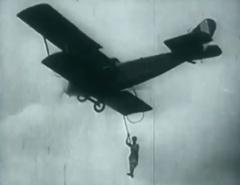
      But in Bothwell Browne’s case or even in the example of his major drag competitor Julian Eltinge, I’d argue that Russo is mistaken, and the performances they give allow for a fuller transformational tradition that resulted in later performances such as Jack Lemmon in Some Like It Hot (1959) in which his character finally became convinced he might actually prefer living as the opposite sex, or Michel Serrault’s Albin in La Cage aux Folles (1978) who simply feels more normal and comfortable in female attire. Although it is made clear that out of costume Bob White is a strapping athletic normative heterosexual man who, in the end, makes a heroic rope climb into an airplane to escape the German forces, throughout most of this odd film he is truly beautiful as a woman, deftly flirting with and sexually engaging with all three of the major German figures—as well as numerous of their underlings. Like many of the critics of his day, I find Browne’s performances as females much more convincing and alluring than Eltinge’s.


      Browne, openly gay, did not like being called a female impersonator. He insisted that “A female impersonator is a man who puts on women’s clothes and prances about. I go much deeper into the role than that. I study women, I am an actor of feminine roles.” And in this, his only film role, Browne makes crossdressing an extraordinarily powerful activity. Unfortunately, the film as already established most of the Prussians whom he seduces as absolutely mindless idiots, and we can imagine the poor Freddy, the heir apparent who has no luck in anything he attempts, as capable of falling in love with the monkey who appears with an Irishman in an unfortunate series of nationalist gibes early in this film. Wilhelm is so brutalized by the vindictive Kaiserini (Eve Thatcher), and Von Hindenburg so visually unlikeable that we can hardly bother ourselves with their sexual interests; but I’d argue that if Douglas Fairbanks, Errol Flynn, or some other handsome heterosexual such as Rudolph Valentino—who performed across from Eltinge in his The Isle of Love (1921), a film analogous to Browne’s—were responding to White’s sexual dealings, the result would not be nearly so insignificant, and his real talent fully represented; surely they too might have willingly landed up together in a deep sexual embrace. And even as it is, White waves his hips into a remarkably supple and sexy dance in the manner of “the seven veils,” (Browne was a former dancer), and winds up in several deep embraces with Wilhelm and eventually is found by the Kaiser’s furious wife lying beside him in bed.

     At some points Freddy appears to peep out between Bob White’s crotch, and at various other times White makes true physical contact with men, not only knocking them out, but falling across and under their bodies.

      Moreover, when he encounters the suffering Belgian potato picker (Marie Prevost) he dresses her up like a man, allowing her suddenly to turn back German intruders and do various other daring maneuvers throughout the film that she previously seemed incapable of.


       Not only does White capture his lovers’ hearts, but he obtains the Kaiser’s general war plan which, through a series of hand signals, he is able to convey to his co-conspirator, portraying a scarecrow in a nearby field, which results with the Allied command forces quickly engaging in huge land battles and air force bombings that help to defeat the Germans.

       If there was ever an example of the power of being ambi-genderous Browne’s White reveals it, turning what is otherwise a cornball comedy vision of German World War I incompetency into a wartime sexual outing that matches Marlene Dietrich’s male drag portrayals in Morocco or stands equal to the dancing, song-miming trio of Priscilla, Queen of the Desert as they capture the Aussie Outback.


Los Angeles, October 9, 2021

Reprinted from World Cinema Review (October 2021).

Titles Index A-N

https://myqueercinema.blogspot.com/2023/12/former-index-to-world-cinema-review.html Films discussed (listed alphabetically by director) [F...