going off track
by Douglas
Messerli
Michael Powell
and Emeric Pressburger (screenwriters and directors) I Know Where I'm Going!
/ 1945
One of the best productions of the duo of Michael
Powell and Eric Pressburger, known together as The Archers, I Know Where I’m Going! can basically be described as a romantic heterosexual comedy-romance;
but there is so much more going on in the background and within the wild swings
of mind of the central figure, Joan Webster (Wendy Hiller) that the work takes
the viewer into a far darker work than most heterosexual comedies dare to tred.
Born with the belief that she always knows
where she is going, Joan, the daughter of a banker, seems almost destined in
her path to marry into wealth and live happily forever. One of her lightest
appearances in the film takes place in a swank restaurant, to where she has
invited her father, whom she keeps addressing as “darling.” She has asked him
to bring the rest of the money in her saving account, an act with which “darling”
(George Carney) disapproves of as well as the chic restaurant to which she has
taken him.
There
also she announces, at age 25, that she is about to marry Robert Bellinger, the
man who runs Consolidated Chemical Industries and “one of the wealthiest men in
England”—and a man, as her “darling” points out is his age. The marriage is to
take place on “his” Isle of Kiloran, located in the Hebrides, an archipelago
off the west coast of the Scottish mainland. She displays an almost awed wonder
of both the man and Kiloran as she describes the natural wonders of Kiloran,
only to admit that she has only ever visited the island in her dreams. And
indeed, since Bellinger never visually appears in this film, one might describe
him also as a man of her dreams, brilliantly visualized by the directors by
high hat, which quickly becomes denigrated to the small-topped engine outlet of
a toy train she seems to be riding to her destination, entering into the
Scottish highlands, also a world of her imagination.

As many critics have pointed out, what began
as a rather charming, spoiled, and determined girl—the stock of many a romantic
comedy—has become a clearly venal and plotting gold-digger figure, a quite
unlikeable character which colors Joan Webster throughout the rest of the film,
who is redeemed only by Hiller’s likeableness and her meeting on upon her
arrival on the island of Mull
with a young and charming Royal Navy officer (Roger Livesay), home on
leave, who immediately tries to convince her to join him at the large house at
the port, since fog has made it impossible for her to proceed to Kiloran that
day. Others move on toward the house, while she stubbornly remains until she
realizes the futility of her wait and finally joins them.

Writing in The Criterion
Contraption, Michael Dessem summarizes our new perceptions of
Joan and Hiller: “Hiller needs all the charm she can muster,
because her character is pretty dreadful, at least at the start. And here's
where we move away from the classic romantic comedy template: the ‘unstoppable
force’ characters are usually on the side of the angels: they're the ones that
are absolutely sure that love will conquer all. It's the other character who's
allowed to have all the wrong goals. Usually those goals are understandable and
innocuous, no matter how misguided….”
At the large port house she meets not
only the young Navy officer Torquil MacNeil, but other local eccentrics as
well. In Rough-cut Williams summarizes the scene: “Joan’s suspended
existence continues when a meteorological hindrance of another kind is
encountered: a gale warning is issued, ‘blowing from every point of the compass
at once’ and chopping up the sea to an untraversable degree. The lengthening of
the delay allows Joan to see more of Mull and its people; eclectic inhabitants
include a falconer who has been training a golden eagle for seven months, and a
childhood friend of Torquil’s who breeds Irish wolfhounds and hunts wild
animals for food to survive austerity conditions. Progressively, the residents’
‘old-fashioned’ collectivist values begin to undermine her closely held
individualism and ambitions. The private gives way to the public: Joan’s
request to travel by car to the town of Tobermory, from which she will contact
Robert, is overridden by Torquil’s insistence that there is no need; they can
take the bus.”
On the way, Torquil and Joan pass by a
small castle, a curse cast upon it for the centuries daring the relatives of
the Laird of Kiloran not to enter, a figure who Torquil finally admits he is.
As the current Laird, Torquil is too poor to live on his island, which is why
he has temporarily rented it to the wealthy Bellinger.
Joan makes a call to Bellinger and is
told by her finance to stay with the Robinson’s, while Torquil rents them two
rooms in the local hotel. But the gale winds continue also the next day, continuing
to frustrate Joan, determined to get to Kiloran and her marriage.
She visits the upperclass Robinson’s who are
boorish and completely disinterested in the local culture, putting down the
locals as brutes. She is forced to join Mrs. Robinson and a luncheon party that
represents the very opposite of the vibrant people she has already met. Joan
asks, “People around here are quite poor, I take it?,” while a local answers “Not
poor. They just don’t have any money.” The major activity of the Robinson’s and
their kind is bridge.
Fortunately, Torquil pulls her away from
what she herself perceives, despite her own upper-class airs, a shallow and
empty world. Once more, the critic Alex Williams nicely summarizes the shift in
Joan’s personality.
“Despite her best efforts, Joan finds
herself attracted to the handsome naval officer, whose intense gaze seems,
disarmingly, to see right through her. Equally, Torquil’s enchantment with her
seemingly unflappable determination fans the embers of a growing physical and
romantic desire, which reaches fever pitch at a cèilidh—an informal yet
traditional gathering for singing, dancing, food, and drink.”
The several days of the gale leave Joan
in a wave of desire and confusion, which completely torture anyone like her who
imagines they can more in a direct route through life. Not only is Joan utterly
confused about her growing attraction to Torquil, but as some critics have
argued is confused now by other sexual feelings.
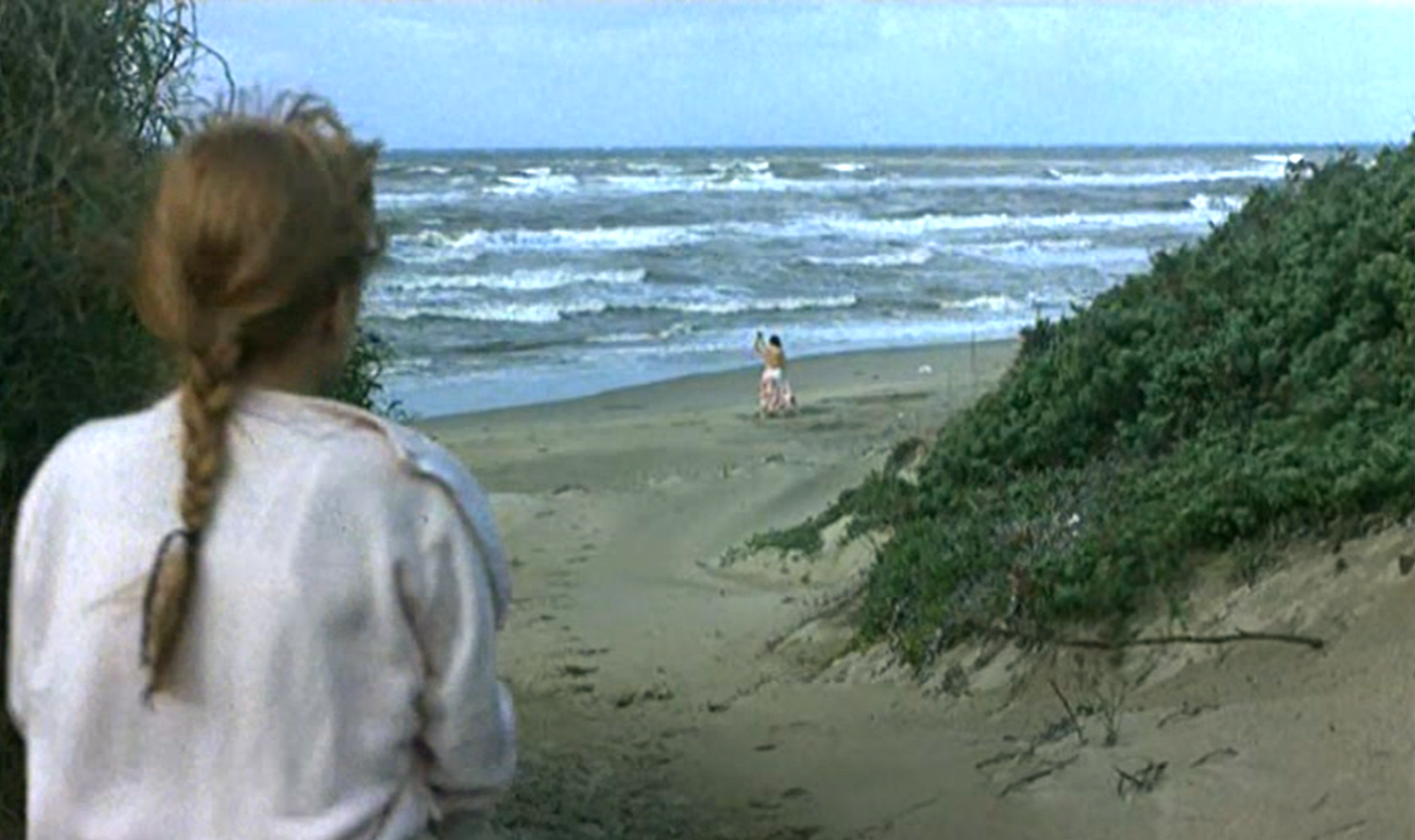
After Joan bribes a young boy Kenny with
20 pounds to take her across during the storm, Torquil attempts to halt the
voyage, without success. But his friend, Catriona (Pamela Brown) finally wises
him up that she is not simply anxious to meet with Bellinger, but is trying to
escape the Navy Officer. Quickly running after, Torquil takes over the perilous
voyage from Kenny.

Once
more, Williams nicely summarizes this chaotic and meaningless voyage: “The
wind, rain, and sea are finally unleashed in their violent and untamable glory
in the climactic whirlpool sequence, which finds Joan selfishly bribing the
young Kenny (Murdo Morrison) to ferry her across the dangerously wild seas to
Kiloran in a desperate bid to escape her attraction to Torquil. Prior to this,
Joan hears of the Corryvreckan whirlpool, the second largest in Europe, which
is infused with mythological associations and lies between her and Kiloran. The
scene—which was constructed by intricately combining footage of the actual
whirlpool, rear projection, exchanges shot in a giant tank at Denham studios,
and miniatures—was directly inspired by the formidable whirlpool at the centre
of Powell’s favourite short story, Edgar Allan Poe’s ‘A Descent into the
Maelström’ (1841). Poe’s portrayal of the whirlpool as a monstrous entity that
swallows humans, trees, boats, whales, and even bears evokes the powerful
emotions arising from a confrontation with the awe and terror of nature. Joan’s
volatile feelings resemble the whirlpool itself; both voids of unknowability
threatening to destroy her whole identity and re-configure her perceived
purpose, should she yield to them.
A
near-death experience with the whirlpool is narrowly averted by Torquil’s
last-minute repair of the boat’s faulty engine, and Joan returns to Mull
rudderless. The embodiment of her carefully designed future, her silken wedding
dress, has been lost to the sea.”
Critic Jo Gabriel, writing in The Last Drive In points
us in a possible other direction.
“One
of the analyses of the picture is that Joan has suppressed desires for women;
though she believes she’s on the right path in her life, she, in fact, has not
been seeking “heterosexual domesticity.” Joan’s plans are altered when she
meets Torquil and Catriona, who is wild in spirit. Torquil refers to her as a
‘queer girl.’ There is a scene where Joan almost dies while getting through the
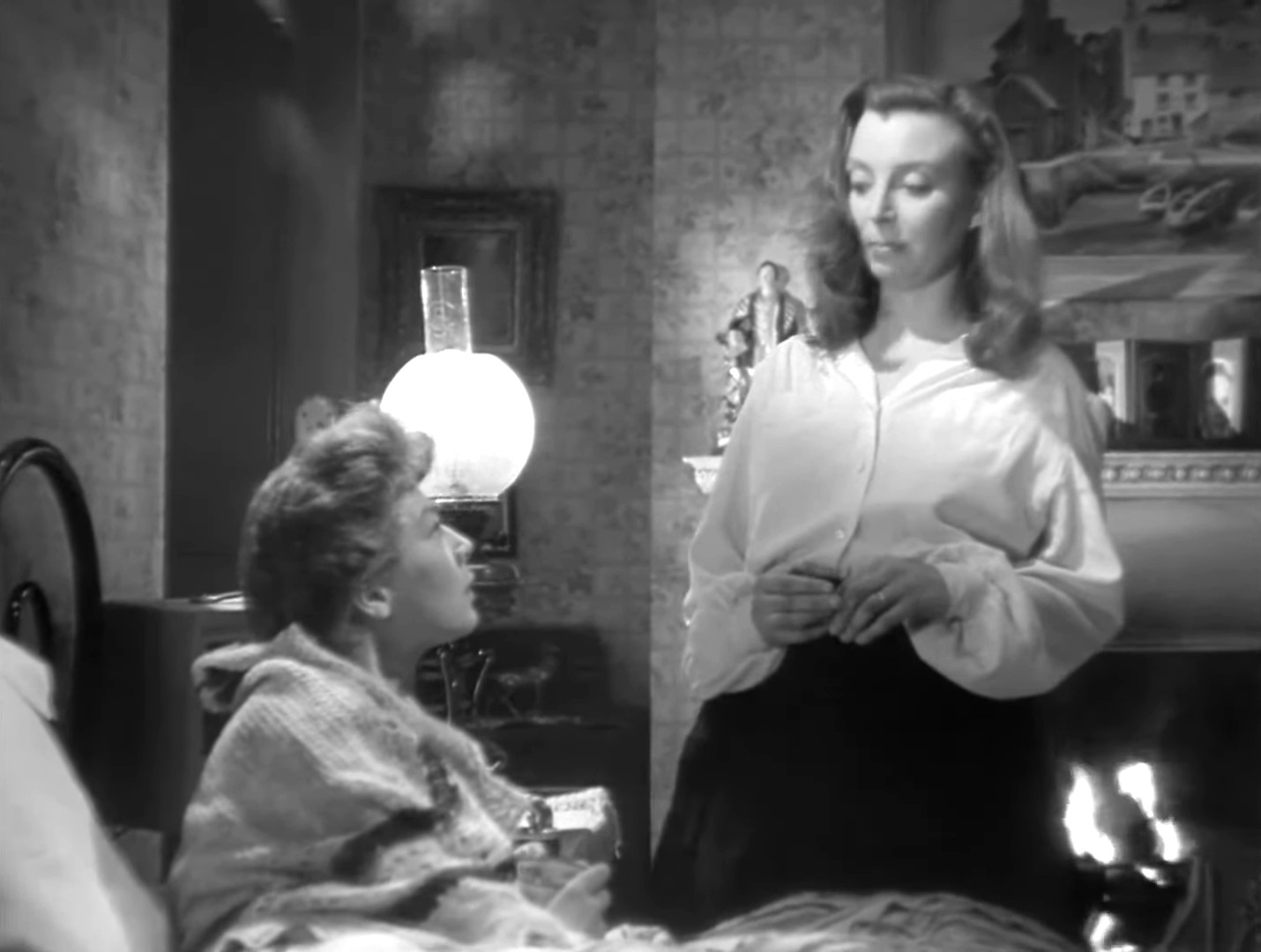
storm, and Catriona takes her to her bedroom. “There’s a fire in my room, and
that’s where you’ll sleep.” “We are left with the impression that the two women
might have slept together. When morning comes, Joan transforms into an energy
of being butch and less tense, as if she has been freed from oppression. It
could be read as the uninhibited Catriona has liberated Joan. Joan falls in
love with Torquil as the film must center on heterosexuality in the end, but
before she goes off with Torquil, she leaves Catriona with this sentiment: ‘Goodbye
Catriona. Thank you for everything.’”
I’m not certain I would take Joan’s multiple
sexual confusions that far, but in this deep work, it is certainly possible.
Of course, this is a heterosexual love
story, and at the end, each lover asks one another for a memory, in Torquil’s
case, the three guest pipers which showed up to the cèilidh. She asks him for a
kiss, and then walks off in the direction of the boat which will take her to
Kiloran and Bellinger. But she soon returns with the three pipers, the two
lovers coming together in a relationship that was previously off the charts.
Los
Angeles, June 6, 2025
Reprinted from My Queer Cinema blog
(June 2025).










.png)