Wednesday, April 10, 2024

Charles Crichton | The Lavender Hill Mob / 1951

golden towers

by Douglas Messerli


T. E. B.Clarke (screenplay), Charles Crichton (director) The Lavender Hill Mob / 1951


The Lavender Hill Mob is one of the best of the British Ealing Studios comedies.

     For over 20 years, Holland (the incomparable Alec Guinness) has overseen the monthly shipments of British gold ingots as they make their way from the foundry to the bank. Meticulously honest—returning even a small scrap of the metal that lands upon his shoe to the melting pot—and overly cautious during the transit of the gold—he calls for a stop every time he sees a car which might be following the truck— Holland might be said to define the word nebbish. Secretly, however, he has great aspirations—to steal an entire shipment of the gold bars—but cannot imagine a way to get the bars out of the country in order to sell them in the underground. 


     That is, until he meets a new neighbor in his Lavender Hill rooming house. Pendlebury (Stanley Holloway) is a would-be artist who works at a day job of designing and crafting tourist trinkets made of lead and copper. On a visit to Pendlebury’s small plant, Holland immediately perceives that the creation of these metal trophies is not so very different from the creation of the gold ingots he oversees. Before long he has confided to his new neighbor his long-planned scheme, who now together plan to steal the truck, melt down the gold bars, and recast them into small models of the Eiffel Tower, which Pendlebury sells at the Tower itself in Paris. In search of further conspirators, the two loudly speak in public of the need of a new lock for Pendlebury’s safe, and wait out the night for a would-be robber. Two, Lackery (Sid James) and Shorty (Alfie Bass) show up and are quickly drawn into the plot.


    The delight of this comedy, however, does not lie so much upon the details of the heist as it does on its hilarious character-types, such as Lackery, Shorty, Pendlebury and the two elderly landlords of The Lavender Hill rooming house, Mrs. Chalk (Marjorie Fielding) and Miss Eversham (Edie Martin).

     The heist itself goes off almost flawlessly, except for the arrestment of Pendlebury, who has “accidentally” walked away with a painting in hand. The truck is easily hijacked by Lackery and Shorty, Holland tied up, blind-folded, and dizzily falling into the river as an alibi. Indeed, he is hailed as a hero instead of a suspect. The ingots are melted down and the “golden towers,” symbol of the wealth the two partners imagine, are cast and sent on to France, with specific instructions that the boxes should not be opened or sold.

     The pair and their conspirators, who have now dubbed themselves The Lavender Hill Mob, celebrate, as Holland and Pendlebury head off to Paris to retrieve their stolen loot. It has a nearly flawless heist—except that a clerk has opened one of the boxes and sold six of the golden Eiffel Towers to a flock of English school girls visiting the Tower itself. In horror, the two middle-aged villains rush after them, racing down the nearly endless circle of stairs in a marvelous dizzying fall that literally puts them (and the camera) into a spin. But it is too late.


      On they rush to the ship which will take back their towers into harm’s way. Forced to buy tickets, clear customs, and suffer a bag check, the two miss the boat. Back in England, however, they visit the school, offering to replace the Eiffel Towers (lead for gold) and award each of the young purchasers a monetary bonus. All agree to the exchange—except one, who stubbornly prefers the one she has. She intends it, we soon discover, as a present to a policeman friend who has already begun to suspect that the robbery might have something to do with Pendlebury and his business. Determined to test the substance of his newly received gift, the policeman might have foiled the entire plot were Holland and Pendlebury not on hand to engage in a “cops and robbers” chase within the police academy itself that ends with them stealing back the trinket and Pendlebury’s arrest.

      Yet Holland escapes with his six “golden towers,” just enough to give him his wonderful year in the utopian world that Brazil here represents. Despite his capture, accordingly, he has—perhaps for the first time in his life—thoroughly enjoyed the experience, becoming of figure of great admiration and largesse. Although prison may be in store for Holland, it can be no worse than the prison of his own making in which lived for the twenty years before he made his miraculous break into the “gay, sprightly, land of mirth and social ease.” Crime has paid, if only temporarily.


Los Angeles, July 8, 2012

Reprinted from World Cinema Review (July2012).

Edward F. Cline | Hearts and Flowers / 1919

the flower girl’s loves

by Douglas Messerli


Mack Sennett (screenwriter), Edward F. Cline (director) Hearts and Flowers / 1919


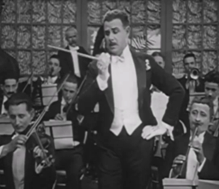
Edward F. Cline’s Hearts and Flowers (1919) is a shaggy-dog tale that in its short 23 minutes takes off in so many different directions that we’re not sure where to focus. But as silent-film historian Lea Stans argues, it certainly does have its charms, although I’m not sure I totally agree with her assessment at the brilliance of its central figures, an orchestra leader (Ford Sterling), the Prune Magnate’s Daughter whom he attempts to romance (Phyllis Haver), an awkward, clumsy, and not-so-attractive flower girl (Louise Fazenda), an indignant nobleman the Prune Magnate’s Daughter is apparently dating (Billy Armstrong), and a tramp without Chaplin’s dapper spirit, the flower girl’s sweetheart (Jack Ackroyd).


     Stans argues:


“This is one of those shorts that’s often dismissed as “disjointed” or “slow in the beginning” or what have you. But really, I think that’s just another case of folks being too quick to dismiss anything that wasn’t made by one of the Big Four, God bless their irreplaceable masterpiece-making souls. Hearts and Flowers isn’t a candidate for the Criterion Collection, true, but like many Sennett products you sense that sincere effort went into it. There’s fun touches like the melodramatic character names given in the opening title card (Ford is “a leader of men”) and the way the audience reacts to the orchestra’s performance. Each main character is given a decent time to develop their characters and perform their “bits of business” for the camera, with the crazier slapstick saved to give the end a burst of energy.

     Ford Sterling is inspired, as he usually is in so many goofy ways. He had long since abandoned his super-duper-broad Dutch character, and playing a debonair society type seems all too easy for him. Louise is also delightful, playing a type of character that she was known for–a naive girl who is “just keen” on a man, even though he has zero interest in her. And Phyllis steals the show with her male impersonation (although Louise does manage to hold her own with a guffaw-worthy reaction to her former sweetheart showing up).”


     Even if all this were true, however, Mack Sennett’s scenario is so stuffed with gags—an Airdale dog singing along with the orchestra, one of the nightclub audience members pea-shooting the ego of self-inflated conductor, the pratfalls of our flower girl heroine, and, for absolutely no reason at  all accept to entertain the horny heterosexual men attending the movie by a bevy of Mack Sennett bathing beauties playing American football on the beach—that we keep forgetting, just as does the orchestra leader, the shallow tale at the center of it all.


      It all starts with the conductor (call him Ford, after the actor who portrays him) attempting to court the Prune Magnate’s Daughter (let’s call her Phyllis), easily pulling her away from the nobleman with whom she’s arrived and dancing with her cheek-to-cheek. The only thing that stands, or in this case sits, in his path is the infatuated flower girl (Louise) who, squatting at the next table, slowly walks her chair over to the loving couple in order to plant a kiss on Ford’s cheek. Even his describing her as having the “grace of a hippopotamus without its charm” doesn’t seem to faze her. And when he arranges for management to throw her out, she skips back for another go-round before leaving.

    Meanwhile, the spurned nobleman, attempting to get even, drops a scrap of paper by Ford’s feet announcing that a true heiress is the flower girl, whose father has left her a fortune. As quickly as he can put on his hat, delivered up to him just for the occasion, he exits the room to find Louise in the lobby where she works, her sweetheart tramp hanging out nearby

   Within seconds he’s kicked the tramp away and swept her off and back into the club where he attempts to dance with her, she capable only of a kind of jig.


   Phyllis, in a fury, goes to her room, stalked, she notices her earlier nobleman boyfriend bearing flowers. She attempts to hide, to enter the room across the hall, but eventually scurries back and retiring behind her dressing screen, reappears as a dapper young man, meeting the nobleman at the door, he utterly confused to see a man exiting Phyllis’ room.

      Phil immediately demonstrates “his” attraction to Louise, toying with her affections so sincerely that she, so the title card tells us, suddenly feels like a vampire who obviously is attractive to all men. Phil even kisses her, delighting her for an instant, until the tramp, she kissing him on the forehead and sending him away, as she turns for yet another kiss from Phil.      

     Ford now maneuvers his wealthy pigeon to the beach with Louise on his arm, hoping perhaps to lure her into the dark chamber of a rock formation, Louise insisting she prefers the beach, where Phyllis and several of her female friends romp in sapphic delight.

      Ford enjoys the eye candy, particularly when Phyllis runs, encouraging him to temporarily abandon Louise, Ford hinting to Phyllis that he is simply working to find a way to fund their future activities.

    Once more Louise’s tramp shows up, she briefly fondling him in the hope of arousing Ford’s jealousy. No luck, she must break up his conversation with Phyllis if he’s going to meet her family as promised.


      The family get-together proves to Ford, as nothing else has, that he has made the wrong choice in agreeing to marry Louise. Her brothers are monstrous bruisers, Pete, Al, and Harry, each one worst that the next, all out to make sure their sister “gets a good deal.” Before the ceremony can even begin they start a brawl over Pete’s pipe, Maw having to step in and slug them all in the face to get them to stop.

      When they find Ford again, he having run off from all the action, the wedding is about to start, Ford horrified by what he is about to undergo until Phyllis and her nobleman, with whom she’s evidently reconciled, break into the ceremony, shoving a newspaper in front of the orchestra leader’s face telling of the joke they’ve played on him.

       Ford goes on the run, the brothers chasing after him through room after room, each time nearly catching him while suggesting more and more dire consequences, at one point using him like a baseball which they bat about from one room to another.

       But fortunately, the tramp shows up once again, and the marriage ceremony starts without any further delays. The brothers briefly protest, demanding that Louise wait until after their father “gets out” (presumably of jail), but finally the little bridegroom has had enough. He takes of his coat, announces that he’s marrying “her,” not the family, and punches out the two of lugs.

       Not much true LGBTQ content here, but the female kisses are a lot of fun for a moment at least.


Los Angeles, February 7, 2022

Reprinted from World Cinema Review (February 2022).  


Andrew Gillingham | Banana / 2017

heartbreak in bananaland

by Douglas Messerli


Hayley Gauvin, Andrew Gillingham, Daniel Jeffery (screenplay), Andrew Gillingham (director) Banana / 2017 [14 minutes]


Charlie (Ryan Jinn) is uncomfortable with on-line dating, particular his new on-line dating service Banana, which he finds to be more about being liked (somewhat like Facebook) than consisting of men who are truly interested in a relationship. Moreover, the man he truly has a crush on is his friend, Zach (Jacob Woike), in whose apartment he spends most of his time sleeping on his couch.


    In the first frames of Canadian director Andrew Gillingham’s short film, in fact, Charlie and Zach seem to be hitting it off really well, as Zach compliments the way Charlie looks, suggests that instead of complaining about Banana that he really seek out a true relationship, and readily agrees to go to the gay bar with him that evening in cute matching costumes of red overalls. It’s to us, if not to Zach, as Charlie looks over at his friends naked torso, that he has a great deal of sexual interest in his friend.

    Checking out his Banana site, Charlie receives a message from a former friend Liam (Adam Allsop), “Hey!”; and almost as he’s speaking, Zach connects up with Liam, asking what he’s doing that evening.

      Zach, we soon perceive is not truly on Charlie’s wave length. As Charlie looks over the landscape from Zach’s balcony, responding “It’s so pretty,” Zach, busy once more on his cellphone, responds “Who?” Liam, meanwhile, messages back, “Nothing, wanna hang out.” So much for Charlie’s plans.

      Dressing up in his cute costume, he discovers Liam in the living room with Zach. Not taking a clue about the intention of his visit, Charlie interrupts by at one point sitting between the two, and finally begins to actively interfere with meet-up, suggesting he call a cab, that Zach put his overalls on, etc. When Liam actually begins to rub Zach’s thighs, Charlie demands to talk to Zach separately, Zach suggesting it’s rather rude, and Charlie reacting with a comeback, “You’re being rude.” Zach suggests Charlie stop drinking, that his face is red, Charlie immediately interrupting the statement as being racist.


     As things escalate, Liam leaves, feeling it’s definitely not the right time to be visiting Zach, and unable to discern precisely what his relationship is to Charlie. And finally, Zach tells Charlie to leave, to which Charlie reacts even more abusively. Zach chases after Liam, Charlie trying to message him that he’s sorry and recognizes that he “fucked up.”

      Charlie packs his bag. But he waits until Zach finally returns. This time Zach really orders Charlie out of his house, but Charlie refuses to go until they resolve the situation, declaring that he had invited Liam over simply prove that Liam desired him more than with Charlie, a truly paranoid delusion on Charlie’s part. Charlie finally admits that it’s hard for him to date, to see guys, to have casual sex, insisting that Zach has it so much easier. He finally admits, moreover, that he loves Zach, and that his jealousy is due to that fact.


       When Zach, in all honesty, admits that he just doesn’t feel the same thing for Charlie. Charlie, in tears, grabs his bag and leaves. End of film.

       I imagine that Gillingham and his two writers felt they were simply expressing the truth of such situations, where one friend has an infatuation that other simply doesn’t share. And, if gay short films are any evidence, it’s a fairly common situation, often ending in a sad outcome.

     But there still seems something terribly unsatisfying about this short film, which ends, quite intentionally, without resolution. We all know there often isn’t any resolution and that fiction is not the same as life. But still, we feel for the desire to see, at least, that Charlie finds a place to crash for the night. Perhaps because we know so little about these characters, we wonder whether or not he will even survive. Does Zach care enough, as a friend, to seek him out and offer him a friendship without delusions. Does Charlie have someone else to whom he might reach out? Does he even have a job? If you’re going to present realism, one need to present more realist facts in order help the audience to understand that the story we are being told really matters. Ultimately, we feel cheated, as the character obviously does on his forays into Bananaland.


Los Angeles, March 9, 2024

Reprinted from My Queer Cinema blog (March 2024).


Thomas McCarthy | Win Win / 2011

a far from perfect paradise

by Douglas Messerli


Thomas McCarthy (screenplay, based on a story by McCarthy and Joe Tiboni, and director) Win Win / 2011


Thomas McCarthy’s gentle comedy, Win Win, uses as its title what I presume is an ironic statement. True, Mike Flaherty (Paul Giamatti), facing financial difficulties, with necessary home and office repairs looming before him, might hope to “win” some extra cash by taking over the guardianship of a local elderly citizen, Leo Poplar (Burt Young) of his pleasant, if down-and-out New Jersey town. And yes, his caring for Poplar accidently brings about the appearance of the old man’s grandson, Kyle Timmons (Alex Shaffer), who just happens to be a remarkable wrestler, which, given Flaherty’s role as a part-time wrestling coach for a constantly losing team, briefly brings him and his friends, Stephen Vigman (Jeffrey Tambor) and Terry Delfino (Bobby Cannavale) some local attention and acclaim. But if this is winning, it is from a loser’s vantage point.


    Indeed, nearly all the characters of this loving investigation into the American Dream, have been so used to losing that they couldn’t possibly comprehend what it means to truly achieve success. Giamatti portrays Flaherty as a man so accustomed to being defeated that his whole body, like the furnace in his rickety law office, clinks and clunks with the possibility of an inner explosion. Hiding that possibility from his loving wife, Jackie (Amy Ryan) and two daughters, Flaherty, on his early morning runs with his high school buddy, Terry, he, nonetheless, admits to being near to a complete breakdown, spiritually and physically.

      Terry himself is on the verge of psychological meltdown as he obsesses over and stalks his former wife, now shacking up with a local carpenter. Like Flaherty, he admits that even at the height of his high-school athletic career he was a lousy athlete, and, apparently, his life after has been no more successful.

      Flaherty’s fellow coach, “Vig” is now so elderly he can hardly demonstrate the wrestling maneuvers he is asked to display to his equally despondent students.

       Flaherty’s new “responsibility,” Leo, is suffering from increasing dementia, and has long ago given up on his drug-dependent daughter, missing in Ohio, writing her out of his will and leaving his evidently substantial estate to the city for the establishment of a park in his name.


      And, finally, there is the Flahertys’ new adoptee, Kyle—Leo’s unannounced and unknown grandson, who shows up unexpectedly at Leo’s doorstep a few days after Flaherty has planted the old man, despite Leo’s protests, in a local nursing home—who appears to be a blonde-haired volcano of sublimated anger, in response to the years he’s suffered from his mother’s abuse of and abandonment of him.

      Only Flaherty’s wife, Jackie, given her constant empathy and loving demeanor—on the verge of a kind of obliviousness of reality— seems to be a winning personality in this total loser society.

      Despite the fact that this is a world of losers, or, perhaps because of it, we sympathize and even grow to love these very ordinary people—whom, fortunately, McCarthy never sentimentalizes nor forces them into corners as small-town eccentrics—and wish that we too could believe that things for them are now looking up. But we also know that the other, metaphorical shoe has to drop, which it does, with slightly frightening effects, when Kyle’s “missing” mother, Cindy (Melanie Lynskey) suddenly shows up with a lawyer beside her.

     They know that Flaherty has not only taken over the guardianship of Cindy’s father for the fee of $1,500, after depositing him in an assisted-living home, and have come to claim both the father (with his hefty estate) and son.

      Recognizing the error (and attached immorality) of his ways, Flaherty is willing to give up the monthly fee in order to protect both his older client and his now appealing young board—who recognizing the truth of what has happened to his grandfather, purposely loses the final wrestling match through excessive force and rejects his new would-be model parent, running off once again to camp out in his grandfather’s abandoned home. In short, if there was ever a “win-win” possibility, it has been destroyed by the very structure of these losers’ world. “Winning,” in the grand mythologies of American myth, is inconceivable for these loveable, ordinary folk, which is what, in turn, makes these figures so recognizably human.


     What we have perhaps forgotten, McCarthy suggests, is that these human failures—like most of us—nonetheless do care and feel deep love as do the Flahertys, who finally facing the ordinary truths of their lives, determine to fight to preserve their human commitments.

       Had the writer-director permitted forces to proceed to a real court trial, we realize, this committed family might surely have lost, and both Leo and Kyle would have been shuttled off to Columbus, Ohio to live out their lives in further perfidy. But McCarthy, fortunately is a moralist, and saves the day by remembering that Cindy, herself, is also a loser, willing to settle for Flaherty’s offer to pay her his guardianship fee, freeing her from having to pretend to take on the responsibilities of human relationships to which she has never been able to commit.

       So what if Flaherty has to take on yet another job as a late night bartender to make ends meet? Did anyone ever bother to tell him that the paradise wherein he lives might not be everything to which it pretends? Flaherty is fortunately a born fighter for the vision he has, perhaps unfortunately, ascribed to.  

Los Angeles, December 1, 2015

Reprinted from World Cinema Review (December 2015).

Isidore Isou | Traité de bave et d’éternité (Treatise on Venom and Eternity) / 1951

the destruction of the image

by Douglas Messerli


Isidore Isou (director) Traité de bave et d’éternité (Treatise on Venom and Eternity) / 1951


Isidore Isou or Isidore Goldstein was as Fluxus artist Ben Vautier has described him, a man of “ego,” “megalomania,” and “pretence,” while yet admitting that Isou was very influential to him when he first theorized about art in 1958. In fact, there is no film ever made that is quite so ego-driven as Isou’s manifesto, misogynist rant, and declaration of his own genius: Treatise on Venom and Eternity—but then there has never been another movie quite like Isou’s 1952 debut.


     Isou, playing a figure named Daniel throughout the film, is a firm believer in the new. While it’s clear he admires several filmmakers such as Charlie Chaplin, Abel Gance, René Clair, Sergei Eisenstein, Erich von Stroheim, Robert Flaherty, Luis Buñuel, and others to whom he dedicates the film, the young would-be filmmaker argues for a completely new way of filmmaking that does not simply imitate these greats.

     Influenced by his Romanian homeland’s Dadaism, Surrealism, and, although he doesn’t quite acknowledge it, Italian Futurism, Isou is a promoter of noise and nonsense more than music and coherent sense. The founder of what he describes as “Letterism” (or Lettrism), he prefers words (mostly nonsense words) over image and meaning. Accordingly, in film he seeks to replace the picture with speech, to end the cinematic dominance of photography, and tell a story primarily through the use of language without a coherent sequence of images accompanying it.

     The film, indeed, begins with an entirely black header (not so very difference from some Hollywood films of the 1950s and 1960s—even Funny Girl uses this device—to present what might be described as blank screen overture of voices repetitively evoking a few words of nonsense (again a reminder of the influences of both Italian and Russian Futurism).


    The first part of this film, “The Principle” is primarily a recounting of Daniel’s ideas as expressed before a hostile audience of his peers, who toss back invectives, howl, and hoot has his “brilliant” new ideas.

     A sympathetic narrator, spoken by Robert Blin, occasionally interrupts Daniel’s declarations to comment and elucidate, but primarily it is Daniel (played by Isou) who speaks.

    At the same time the director displays a series of images of Daniel moving through Paris neighborhoods, mostly near St. Germain des Prés. The director-character walks through the streets, stopping several times to tie his shoes or to look directly into the face of the camera like a slightly pouting James Dean before moving off into space once more. There is little logic to the sequence of images, but the images themselves, of our “hero,” seem appropriate at least to the subject.

      The language of the film, however, argues for a separation of the two: “I want to destroy the picture by the speech.” As I write above, Daniel argues for the end of “photography,” and, in particular, the end of the cinema craftsmen. For him, art is raw, a bad or banal film more interesting that the most well-made document. Manifesto-like statements come fast and furious, as the provocateur claims he “wants to make a film that hurts your eyes,” and intends to “hack open a new road for Cinema.” Like Oscar Wilde, the young Daniel argues that art has little to do with social life: “The evolution of art has nothing to do with the revolution of society!” And, in the second section, he will explain his boredom of the French Communist Party, of which he was briefly a member.


    Many of his manifesto-like statements have little to do with the actual making of cinema, and most of his proclamations are on centered upon a very romantic notion of “genius,” which, he seems to argue, never gets appreciated in its own time. The new, even more than in Pound’s early century proclamations, is always superior to the old, to craft. “There is no ‘worst’ in what is new.” Like the futurists the young Daniel argues “Everything that has existed is bad, else no one would have ‘improved upon it….’”

      The second part of the film “The Development” essentially is meant as a demonstration of his previous ideas. Here the images, generally stock clips about natives, sailing and sailor, skiers, and sportsmen seem almost to invoke the works of the Russian director Dziga Vertov, except the seemingly random images of a work such as Man with a Movie Camera do very much cohere as vibrant images of a city, while Isou’s-Daniel’s almost purposefully work against any narrative coherence. Of course, we cannot escape, in the manner of Surrealism and Freudian association in making occasional links between the spoken story and the images, but, generally, we must recognize that it is a fruitless attempt to link them up. And, as if to encourage our purposeful dissociation, many of the images are scratched, faces penned over, splotches of light whitening out parts of the images, and entire frames presented upside down and run backwards.


    The "story" meanwhile, is an almost inanely romantic melodrama concerning the loves past and present of the hero. Beginning with an attractive Norwegian Daniel has encountered in a bar, Eve, who, when asked to dance rejects him; the spoken tale is a rather insipid story about what an earlier lover has described as Daniel’s “skirt-chasing” behavior. Drawn to Eve for her beauty and aloofness—a pretense, he declares, that allows her to pretend she is in a movie—Daniel soon becomes disenchanted with her, while Eve, who at first declares she cannot possibly love a man with whom she disagrees, is quickly swept away by her love for him. Sated by his experiences, he recalls an earlier flame, Denise, and attempts to return to her, consuming her in his often sadistic behavior: “And she bore black and blue marks, like his rubber stamp jealous ownership.” “And he broke her, he tore her, to feel himself within her.”

    A dinner with one of Denise’s male business friends, however, ends their relationship, as Daniel mocks the businessman, demanding Denise leave with him, and then refusing to exit the restaurant. Denise, finally fed up, leaves alone, and the after two days silence refuses to even recognize his existence when he calls.


     Daniel returns to Eve, who dominates the final section of this film, “The Proof.” It is, perhaps, a bit unclear what the “proof” is in this rather incoherent section. It begins with a performance of lettriste poetry with two poems by François Dufresne: “March” and “I Question and I Inveigh,” which, so the narrator declares, reveal the “barbarity of the throat” as opposed to what he describes as the “phony primitivism” of jazz, performed with “civilized and complicated” mechanical instruments. In fact, throughout Daniel often speaks in outrageous terms, arguing, at one point, for a return to slavery: “Man will never get used to not having other men do his bidding.” But during the reading, for the first time, the images shift to purely abstract figures and scratches in accordance with the sounds


    Daniel’s film, so it appears, has also been shown at the event, and for the next several frames—now, once again, with the attendant random smeared and scratched stock footage—consist of various figures proclaiming the filmmaker’s genius, with even Eve perceiving how Daniel, despite the fact that others before have sought to destroy the image, now described as her lover, is the first “to understand this destruction.” Perhaps this is what we must imagine as “the proof.”

     As in several previous scenes, wherein the young director has plopped down major figures such as Blaise Cendrars and others into his narrative, he soon displays himself lunching with Jean Cocteau, making an analogy between his film and Cocteau’s The Blood of the Poet.

     If Eve has seemingly come to terms with Daniel’s art, however, he now seeks to get rid of her, and demands she leave. She begs him to simply stay the night, but soon realizes that her pleas will have no effect upon his narcissistic belief that women are only to be enjoyed and, once the male is satiated, left behind. And the final passages of the film, proper, detail Eve’s sad decline into madness, until one day she is observed being taken away the police for deportment back to Norway.


          Ever the egoist, Daniel is surprised to meet another man with whom, evidently, Eve has had a sexual relationship after she has left him.

      The last several frames, a kind of postlude, demands that the viewer recognize that “we are always twenty years too late” in recognizing genius, and demanding the viewer answer the simple question: “Ask yourself on the way out whether or not this film possesses at least the value of a gangster film or a love story – or any ‘realistic’ film which critics consider acceptable.” Depending upon your acceptance of Daniel’s (Isou’s) inarguable logic, you will either have to deny or admit his presumption. I’d be willing to say, yes, this is more interesting, in some ways, than The Public Enemy or Little Caesar. But clearly most people would not agree with him, and when the film was screened at the Cannes Festival in 1951, it was met with a total riot, with fire hoses being used to control the audience. It’s hard to imagine such passion and vehemence about any art these days

     On the other hand, the film did not become, as Isou seemed to argue it would, a kernel from might grow numerous other of his films. Although he remained an influential figure in France, influencing Guy Debord and others who later called themselves Situationists and even, on occasion directors of The New Wave, Isou’s primarily influences were on American experimental filmmakers—who created far superior visual works—such as Stan Brakage and Gregory Markopoulos. Isou himself died in poverty and ill-health in 2007.

      Looking back today, Treatise on Venom and Eternity, appears at times as an almost naive—if monstrously ego-driven—document. Most of its braggadocio and chest-thumping rhetoric today seems embarrassing, and its narrative is outrageously male-centric and patriarchal to say the least. One has to wonder, as film commentator J. J. Murphy suggests, whether such nonsense was simply a product of “male narcissism” and “youthful hubris,” and whether its statements were deliberately provocative, or were simply racist and sexist. Murphy concludes, and I concede, “Whatever its problems, there simply aren’t many films like it out there, never mind at the multiplexes.”


Los Angles, July 11, 2017

Reprinted from World Cinema Review (July 2017).       


Index R-Z

Angelo Raaijmakers I, Adonis / 2021 Peeter Rabane Firebird / 2021   Tyler Rabinowitz Catalina / 2022 Tyler Rabinowitz See You Soon / 20...