Monday, June 23, 2025

Richard Lester | The Ritz / 1976

a farce with notes

 by Douglas Messerli


Terence McNally (screenplay, based on his play), Richard Lester (director) The Ritz / 1976


What do you do with a film like The Ritz, particularly as it appears in movie form fast after its own Broadway success and the far-sweeter and more honest 1975 comedy shot in the gay bathhouse Continental on which The Ritz is probably based, Saturday Night at the Baths? Clearly, it is of interest to LGBTQ audiences. The playwright and screenwriter Terence McNally is not only openly gay (having had relationships with fellow playwright Edward Albee and actor and director Robert Drivas before marrying producer Tom Kirdahy) but has had a long record of writing serious gay works, along with his early attention to the AIDS epidemic. I attended the theater production of The Ritz with my husband Howard at Broadway’s Longacre Theatre and later saw the film when it was first released. I saw it again yesterday, just to test my original impressions with how I might react to it 44 years later. Chalk it up to senility, but strangely this third time ‘round I liked it somewhat better.

      Yet what to do about a work that treats everything and everyone with which and whom it comes in contact like a vaudeville stereotype—including homosexuals, gay baths, gay bath patrons, Italians, Puerto Rican women, overweight men, men who are attracted to and chase (“chubby chasers”) overweight men, Jews, transvestites, muscle-men, detectives, men with high voices, heterosexuals, theater producers, go-go boys, and the city of Cleveland.   
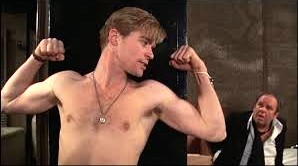


     Furthermore, although the film features some of the best comedians imaginable—Jack Weston, Kaye Ballard, and Jerry Stiller for starters—except for Treat Williams, the go-go boys Tiger and Duff played by John Everson and Christopher J. Brown, and Rita Moreno(1) the movie, most strangely since it supposedly occurs in a gay bathhouse filled with men determined to visually attract the members of their own sex, is stuffed with some of the least attractive actors to post their faces, bellies, and butts upon the silver screen. Perhaps the fact that the three major comedians are portraying heterosexuals might comically explain that fact except that the Ritz Baths seem also to be a major attraction to the least attractive men in town, including other excellent thespians like F. Murray Abraham and Paul B. Price.

     Moreno, playing the washed-up would-be musical actress Goggie Gomez, moreover, speaks Spanglish as if she had studied with the Spanish-born guitarist and former wife of Xavier Cugat, Charo; and Williams playing Detective Michael Brick inexplicably speaks like a squeaky voiced Baby June (“my body developed but my voice didn’t develop with it”), renders them both quite sexless, particularly since Moreno is mistaken for a transvestite, while detective Williams is totally improbable as a “dick.” In short, for a hidden retreat of forbidden lust and queer passion, The Ritz is without a sexual groan stirring in the house.

     With this film’s director Richard Lester(2) at the helm it might have been wonderful to see what chaos the Beatles, playing the four straight intruders, might have imposed upon this gay haven—I can just imagine Ringo playing the discombobulated singer Googie with a Scouse accent; George subbing for Weston’s character, Gaetano Proclo, the Beatle dubbed as “the quiet one” forced to switch type to become a loud and rambunctious interloper; John playing the Mafia-involved Garbage King Carmine Vespucci, the Jerry Stiller figure who has put out Proclo’s death warrant; with Paul playing the high-voiced pretty boy Brick; and I am sure Brian Epstein might have been more than happy to take over Murray’s role as Chris, desperately seeking sexual contact with anyone is this god-forsaken den of inequity(3); isn’t this perhaps something like what playwright Joe Orton imagined for his script of a third Beatle’s flick?(4)

      You get the idea. The only way I can even talk about McNally and Lester’s work is in terms the farce it desires to become. Surely, the playwright originally imagined his work to be a Feydeau-like sex romp with people spinning in and out of beds, hiding, sometimes en masse under them, and mistaking everyone for someone else of which they were either desirous or terrified.

      To clue you in to what has to be an utterly convoluted plot, because of his increasing mafia business dealings Carmine Vespucci (Stiller), on orders from his dying father, has ordered his brother-in-law, Gaetano Proclo (Weston) to be murdered because of his unknowing interference with the family’s plans. In an attempt to escape the contract on his life, Proclo jumps into the first taxi he can hail, demanding to be taken somewhere where he can never be found. It just happens that the taxi is owned by Vespucci and family and the driver has been told to take Proclo to the Ritz, a gay bathhouse.(5) This is where first time detective Michael Brick comes in or is supposed to have been already been waiting to be discovered with Proclo in his bed by Vespucci so that, it stands to reason in heterosexual heaven, the man could not be blamed for killing a brother-in-law found in the arms of a gay man.


      But a funny thing happens on the way to this forum(6) as none of the participants perform according to script, the local songstress Googie mistaking Proclo—who has taken the name of Vespucci as a cover—for a famous producer who might give her a job in the bus-and-truck tour of Oklahoma!; Brick mistakes Proclo for his employer Vespucci; and the local bath denizen, the chubby chaser Claude Perkins mistakes him for the heavyset gay man he’s been looking for his all of his life—and coincidentally he has, in fact, found the man he was looking for since Claude, serving long ago in the army with Proclo as a young man, even then tried to lure him into bed. The three, each in their own way, chase after the doomed man. As the love-starved denizen of The Ritz, Chris (Murray), describes the absurd situation: “It’s just beginner’s luck.”

      In between and amidst this hither and thither racing up and down floors, in and out of rooms (including the notorious steam room), Googie performs her hilariously malapropic and maladroit Broadway musical numbers(7); Chris calls out for love, at one point shouting that Joe Namath is in “room number----,” his own room obviously(8), which proves to Proclo that this truly is not a gay bath; and Claude decides to enter the talent contest, demanding that Proclo and Chris join him in a lip-sync performance of a song by The Andrews Sisters, a contest which they indisputably win!

       Too bad Proclo is such a dim wit that it took him what seems like half of the movie to realize that not only has he mistakenly chosen to hide out in a gay bath, but that the shocking things he can’t believe he’s encountering are all actually quite fun.

       By film’s end the real Vespucci and Proclo’s wife Vivian (Ballard) have joined the frolics at The Ritz, eventually unraveling the yarn of absurd events, with Vivian, realizing how her brother has tricked her husband into a false instance of in flagrante delicto threatening to reveal how Vespucci has raked off the profits of a local bingo game if he doesn’t cancel the contract for Proclo’s life. Even if no one will admit it, all seemed to have learned that life is a bit more exciting at The Ritz than in New Jersey or Cleveland to which the straight folks are sentenced to return. 
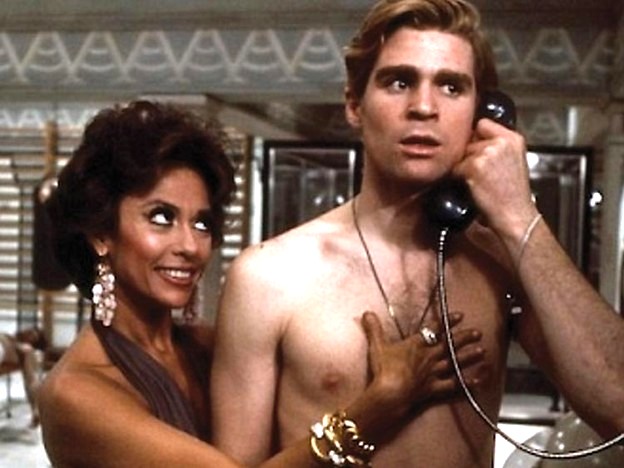

      The “siren-voiced”(8) Brick gets the girl, the goofy Googie after he reveals that he has an uncle who is a theater producer, and off they go down the yellow brick road of utter perdition without knowing that it was Brick’s uncle who fired Googie from all of her previous musical gigs. 


notes

(1) Just because of her role of Anita in the film version of West Side Story Moreno will always remain beautiful to me.

(2) In case you were born after the Beatles two movies, you may not know that Richard Lester was the director of both

A Hard Day's Night (1964) and Help! (1965).

(3) In Christopher Münch’s film The Hours and the Times (1991), the director hints that Brian Epstein, the gay manager of the Beatles, who traveled with John Lennon to Barcelona on holiday in 1963, may have engaged or attempted to engage Lennon in sex. See my review above.

(4) In 1967 English playwright Joe Orton was asked to write a script for The Beatles’ third film. by then Orton had become a celebrated playwright in the London theatre. The Beatles’ manager Brian Epstein thought he might be the perfect writer for a Beatles film, and Paul McCartney had previously invested £1,000 in Orton’s other play Loot. The resulting script was titled Up Against It. Orton met with Shenson and began writing the script. He also met McCartney and Epstein on the day before Christmas, and a contract was drawn up, which allowed Orton to buy back the script rights if it were rejected. Orton delivered an initial draft in February. He expected it to be rejected, which it was, noting in his diary that “the boys, in my script, have been caught in-flagrante, become involved in dubious political activity, dressed as women, committed murder, been put in prison and committed adultery.” This script is referenced in Stephen Frear’s film on Orton Prick up Your Ears (1987). See my review above.

(5) Any upstanding gay boy in New York in the 1960s and 1970s knew that nearly all the gay bars and clubs were Mafia owned.

(6) Richard Lester directed the film version of Stephen Sondheim A Funny Thing Happened on the Way to the Forum (1966), starring Zero Mostel, Jack Gilford, and Phil Silvers, with a cameo appearance by Buster Keaton.

(7) Among Googie’s numbers is a song from West Side Story. You can imagine what she does to her Cole Porter songs she sings.

(8) As a card-carrying gay boy in New You in 1969, I was told by many friends that Namath was a regular patron of gay establishments such as Julius’ and other such bars.

(9) By putting this phrase in quotations I am suggesting that my statement is ironic, the opposite of what it seems to be saying. Such linguistic usages are often used in gay camp talk.


Los Angeles, December 14, 2020

Reprinted from My Queer Cinema blog and World Cinema Review (December 2020).

Eloy de la Iglesia | Los placeres ocultos (Hidden Pleasures) / 1977

the right to be what we are

by Douglas Messerli


Rafael Sánchez Campo, Eloy de la Iglesia, and Gonzalo Goicoechea (screenplay), Eloy de la Iglesia (director) Los placeres ocultos (Hidden Pleasures) / 1977


Gay Spanish director Eloy de la Iglesia is one of the most important of LGBTQ directors of the 1970s and 80s, of the stature of Rainer Werner Fassbinder and Luchino Visconti. De la Iglesia’s works are far more politically concerned than either Fassbinder’s or Visconti’s, and his subjects in his gay trio of films in the early 1970s, Los placeres ocultos, El diputado, and El sacerdote and in quinqui and films of adolescent street delinquents in the 1980s (Navajeros, Colegas, El pico, and El pico 2) seem far more psychologically and narratively complex and nuanced than many of Fassbinder’s works. The later de la Iglesia films are often compared to the 1960s films of Pier Paolo Pasolini and to the earlier Mexican based film by Luis Buñuel Los olvidados (1950).


     Certainly, de la Iglesia does not have the rich textures and images of Visconti, nor did he have the resources of the incredible acting team with whom Fassbinder regularly worked, and his his output as not as monumental as Fassbinder’s oeuvre. For 15 years after La Estanquera de vallecas in 1987, de la Iglesia stopped making films as he struggled with heroin addiction before making his last work Los novios bulgaros in 2003. But his importance as a gay, communist activist, and filmmaker, particularly in the early post-Franco days, is extraordinarily significant even while it has been basically ignored by many in the film world. De la Iglesia made it possible for a director such as his fellow countryman Pedro Almodóvar to come into being in the late 1980s, the very period when de la Iglesia grew silent.

     Perhaps the first Spanish film to deal head-on with homosexuality, Hidden Pleasures centers upon a handsome middle-aged closeted gay man Eduardo (Simón Andreu) who picks up barrio school boys such as Nes (Ángel Pardo), who work the streets at night to pick up money for their personal expenses and families. Apparently, he has been stalking another schoolboy, Miguel (Tony Fuentes) whom, one day, he “accidentally” encounters outside a motorbike shop, with the boy eagerly eyeing the bikes through the window.


       Given his position as head of a major bank, Eduardo quickly arranges for the boy to be hired by his former protégé Raúl (Antonio Corencia), now an adult gay man who, unlike Eduardo, is involved as a gay activist who attends liberation meetings, to whose invitations Eduardo repeatedly rejects.

    Gradually discovering that Miguel is heterosexual with a girlfriend Carmen (Beatriz Rossat), Eduardo, nonetheless, becomes nearly infatuated with the boy and attempts to keep him close to him by offering him a regular job in his apartment to type up a manuscript upon which he is supposedly working. He also takes him to a gay bar, which Eduardo finds to be fun (“fags always make me laugh”) and in response to that attitude, takes him instead to a straight pick-up bar where they bring home two prostitutes, Eduardo paying more attention to the sounds of his young friend with a girl in his bedroom than he does to his own female partner, who he pays extra to declare their sex (which never happens) was pleasurable.


      Soon, Eduardo has also bought Miguel the motorbike in the window, and when Miguel returns home with it, the local boys who gather round naturally presume Miguel has provided plenty of sex for the gift.

      Things are made even more complex given the fact that a married woman, Rosa (Charo López), has long been regularly inviting the boy to her house to help with “plumbing problems,” keeping him as a kind secret lover who weekly satisfies the sexual needs which obviously her husband cannot.

       As Eduardo grows more and more obsessed with Miguel—and simultaneously is sexually frustrated by the situation—Miguel comes increasingly to admire the man who almost inexplicably has chosen to help the willing and hardworking young man, who refuses the alternatives chosen by many of his neighborhood classmates. Indeed, we observe that gradually Miguel has turned his patron/mentor, perhaps unknowingly to Eduardo, into a father figure.

       Meanwhile, Eduardo’s elderly mother grows ill, confessing on her deathbed to her son that she has long known he was “different” and pleading with him not to remain alone. Eduardo’s brother Ignacio (Germán Cobos), also an executive in the bank, knows of his brother’s homosexuality, and is willing to ignore it as long as it does not become obvious to any of his business associates.


       Finally, Eduardo, unable to control himself any longer, confesses his love to Miguel, expressing his guilt for having long lured him into the situations, jobs, and other involvements in hoping to seduce him. Understandably angered with what he learns and crushed by the fact that he has lost his fantasy father, the boy leaves Eduardo, vowing never to return.

     Eduardo has no choice but to turn back to his old patterns, jacking off boys in public lavatories, sucking off boys in movie theaters, and picking up Nes on the street one night. But this time, mostly in anger for his many months of rejection and Eduardo’s preference for Miguel, Nes has planned with his hustler friends to rob and loot Eduardo’s apartment, beating him before they leave.

    Hearing of the beating, Miguel quickly returns to Eduardo, after beating Nes severely for his treatment of the banker. Eduardo promises to accept the boy as a heterosexual without attempting to ask for any sexual involvement and even encourages Miguel to introduce him to Carmen, the three of them playing out a different kind of family unit as they party and travel on short day trips together, offering the older man, for the first time in his life, a sort of replacement family unit.


      What no one might have imagined is the anger and ultimate determination to revenge the loss of her Sunday lover by Rosa, who first comes to Eduardo in his bank office, pleading for him to release Miguel so that he might return to her. And when Eduardo righteously refuses to involve himself in that way in Miguel’s life, she plots with Nes and his gang for Miguel’s fall.

       Together they spread the rumor throughout the barrio that Miguel is gay, and she personally visits Carmen’s father, convincing him that his daughter’s boyfriend is queer. Nes and the others cut the tires of Miguel's motorbike and, soon after, while the other’s hold Miguel, he beats the boy severely.


       Without anything and cast as an outsider, Miguel feels justifiably punished and abused for having done nothing but love Carmen and appreciate the largesse of his older friend. What he now learns is a bitter lesson that every decision one makes in one’s life has consequences, whether one’s actions were well-intended or not. And in anger the boy shows up to the bank lobby, meeting up with Eduardo and appearing to accost him, shouting and insulting the boss in front of his employees by insisting that he preys on young boys as a homosexual.

       For both man and boy, the worst that can happen has. And the film, which surely might have already disappointed LGBTQ audiences for its presentation—yet again, centered on the abuse or failure of gay life as well as presenting its audiences mostly with heterosexual love scenes instead of gay action—superficially appears to be yet another well-intended film that displays the failures of gay life. Indeed, many commentators have described de la Iglesia’s work as a sort of more pallid Death in Venice.

       But, in fact, those comparisons, I’d argue are mistaken. Unlike Gustav von Aschenbach, Eduardo makes his interests and eventually his desires for his Tadzio quite known, and accepts the consequences. At least a couple of times along the way, moreover, when first Miguel and later Carmen confront him about his sexuality—Miguel asking if there were a shot he might take to cure his homosexuality, even if it cost him everything he had, wouldn’t he immediately take it?

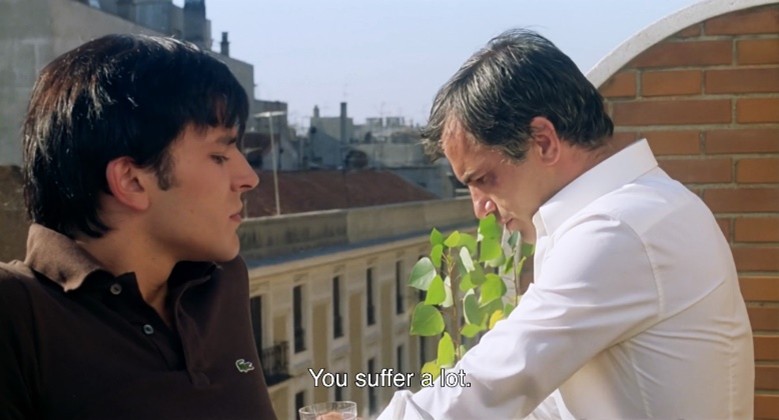
    Eduardo answers quite straightforwardly: “I wouldn’t take it even if it was free. When I was your age I would’ve paid anything. It hurts to realize that you look at other things than most boys. Or when sexy women on the screen don’t turn you on. Or when you’re ashamed of last night’s dream. You suffer a lot. …We all have a right to be what we are. And nobody has the right to change us.”

     And it is at that point that he promises Miguel that “Rest assured, I’ll never try anything with you. I don’t have the right to change you.”


      Eduardo’s statement may not be the positive cry for equal rights that his friend Raúl might propose; but it certainly sounds something close to a manifesto for gay rights, particularly in Spain in 1977, with the old Franco fascists still attempting to regain their control of the country.

      The original working title of the film was La acera de enfrente, which means literally, “the other side of the street,” a pejorative expression for “homosexual.” The title, perceived as far too controversial, was changed upon release, but even then the picture was initially banned by the Spanish censors. When it was finally released the critics, opposing censorship one year after Franco’s death gave it mostly positive, if hardly gay-friendly reviews—El Pueblo, for example, observing that the film focuses on “the sad problem of homosexuality, but with little scandal.” Far more importantly, gay liberationists gathered in the streets for massive pro-demonstrations on the film’s opening night, de la Iglesia commenting, “It was the first time a Spanish gay group came out in public, with its banners and presenting its demands.”


      And finally, unlike von Aschenbach, Eduardo does not die in Madrid or even suffer in silence for the public revelation of his sexuality. The film ends with Eduardo back in his apartment. There is a knock at the door, and he goes to it cautiously, first peeking out of the peep-hole. Suddenly, his face expresses great joy as the screen goes black.

     We can only imagine that such a look of pleasure can be provided through the reappearance of Miguel. But if it is Miguel, we have to ask, for what reason has he returned? Is he simply ready to resume his chaste friendship with Eduardo, and what might or can their relationship now entail? Or has Miguel accepted, far more problematic if so, the role to which he has been assigned, a faggot who is willing, now without any alternatives, to begin a sexual relationship with the older man? Surely that could not be among the writer’s intentions. Yet, we have to imagine all the alternatives, or at least we are encouraged to. Of course, those possibilities say more about us than about any character in the film.

      In any event, this film does not end in a gay death. Both Eduardo and Miguel are permitted go on to define their own lives in whatever manner that they are afforded. If nothing else, we can say that Hidden Pleasures ends with nearly endless potentialities, pleasure appearing where you might least might have expected it.


Los Angeles, September 28, 2023

Reprinted from World Cinema Review (September 2023).

Cain Thompson | Coming Out / 2015

different

by Douglas Messerli


Cain Thompson (screenwriter and director) Coming Out / 2015 [11 minutes]


Since the millennium a new genre has risen to which I have increasing hostility. These films usually begin as pretend gay narratives based on the coming out genre. The most common of these deal with a young man, locked in an all-gay world, in which he is finally determined to come out as straight.

     One can understand the writer’s and director’s good intentions in short films such as Different (2004) and Straight Out (2011), that by reversing the world order regarding sexuality, these creators imagine straight folk, put into the same conditions that LGBTQ people experience every day, presumably might witness the hypocrisy of attempting to demand gender and sexual norms.

     However, since these films are seen primarily in gay film festivals, one has to wonder how many heterosexuals actually get the chance to experience these straight dystopias. Moreover, the presumption in these films is that nearly all is focused on the choice of the other, the desire for gender, which is not at all the full vision of either the heterosexual or the homosexual worlds. Attraction to the same sex is only one small (if highly important) aspect of gay behavior and desire. Accordingly, in their simplistic dystopian fantasies, these “reversal” films are just as stereotypical, in some respects, as heterosexual films have been regarding LGBT behavior.


     Even so, I wasn’t quite prepared for the game-playing involved in Australian director Cain Thompson’s 2015 film Coming Out, which purposely leads its gay audiences astray into totally heterosexual territory, and does not at all belong in the list of LGBTQ films, even if it pretends to do so.

    In this ruse, Thompson presents an absolutely horrific family, who take delight daily evidently—father Keith Agius), mother (Sanda Eldridge), sister and her boyfriend, and even our so-called “hero’s” girlfriend—in homophobic statements and humor.


    The central figure, Blain (Cain Thompson) is a hirsute, handsome construction worker who appears to be spending early after-work hours with another man, arousing the curiosity and even wrath of his girlfriend. Even the man with whom he delightfully meets each afternoon wonders

when Blain is going to tell is family.

     Thompson has readied us, accordingly, for the usual encounter, for which his family even seems prepared. When Blain begins his “serious discussion,” one of them even jokes that he’s going to tell us that he’s gay, as if this homophobic cluster of losers have also been watching the dozens of gay-coming out movies I have suffered through.


    Blain isn’t gay, however, but is a dancer, not a stripper either, not a pop background terpsichorean, but an actual modern ballet-trained dancer—"like Billy Elliot” (referring to the 2000 Stephen Daldry film) one of his family member chimes up, but not gay!

     I can only say that I truly resented this wolf-in-sheep’s clothing kind of movie, which uses the gay community as a come-on for what really is and by film’s end remains a rather homophobic statement. And presumably, now that Blain’s admitted his discretions to his slack-witted family, he can go back to bed with his girlfriend and fuck her into heaven, perhaps even sharing his family’s lame gay jokes.

     The best one can say about this movie is that perhaps Blain has learned something in the process about what it means to be labelled as “different.”


Los Angeles, June 23, 2025

Reprinted from My Queer Cinema blog (June 2025).  

Sunday, June 22, 2025

Yarne Van Elsen | Silent Secrets / 2024

double confession

by Douglas Messerli


Yarne Van Elsen (screenwriter and director) Silent Secrets / 2024 [13 minutes]


It seems almost unbelievable that the well-worn genre of the “coming out” film, version B, has not lasted for about has now lasted for about 25 years. And it seems almost impossible that anyone could make a new rendition of it that is as excellent at the very earliest such films, Get Real and Edge of Seventeen, both from 1998.

    Belgian director’s Yarne Van Elsen’s version is a slimmed down and now rather predictable telling, although it is amazing how emotionally fulfilling the genre still feels, perhaps because in each generation most of the gay young men and women still must “come out” to friends, parents—and most importantly to themselves.


     In this case a young teen (in almost all such tales that young male is around 17 or 18) Beau (Stijn Van De Bloock) is secretly in love with his best friend Liam (Cédric Galle). Liam, however, despite his loyalty to Beau, appears to be straight, freeing him from the constant bullying of the school “gay bashers” led by Rick (Jarne Van Wemmel), who have targeted Liam simply because he proclaims to be an artist (from the look of his drawing of Beau, he has a long way to go).

    Just when the two seem most to be enjoying each other’s company, the bullies enter in, in one case taking Liam himself temporarily away as they claim him to be “one of them.”

     Liam tries to convince Beau just to ignore them, but it’s difficult when they manhandle him and his drawing book, often tossing his other books to the ground as well; and it’s always easier, no matter how much you love the other, to look on than to be the actual subject of the attacks.

     At one point, Beau even tries to tell Liam of his feelings, but Liam himself interrupts with the deadly observation that “after all, we’re just friends.” Clearly Beau was hoping to take their friendship to the next level.

     Finally, frustrated by his inability to verbally express his love to Liam, Beau pens a letter to his friend, which is easily discerned by the bullies, who not only read his pained private epistle, but disdainfully hand it over to Liam to read.

     With this action, the teen finally snaps, racing to a highway overpass to throw himself off, Liam following him and begging him to come down, in the end pulling him off the railing of the overpass which Beau has begun to climb.


     This time, however, Liam finally admits that that “he cannot live without him,” and that he “loves Beau” just as much as his friend loves him, a sudden and rather late outing for Liam, who seems only to have been able to fully realize his full feelings when he is about to lose his friend.

      There’s nothing utterly new here, but the very survival of the battered genre represents its power to still communicate to members of the queer community, making it surely one of the most useful cinematic and literary forms for representing the angst of young primarily gay boys (lesbians seldom have appropriated this genre, although in 1995 lesbian Mitch McCabe in her documentary Playing the Part almost played out what would have been the first of this genre, had she not backed out of her intentions to actually tell her family of her sexual orientation.)

      Surely, however, we keep hoping that someday people won’t have to wait until 17 to declare their sexual feelings, but comfortably live with them, along with family and friends, from the first age of discovery.   


Los Angeles, June 22, 2025

Reprinted from My Queer Cinema blog (June 2025).


Ell Mazer | Golden Goose/ 2023

sweet teeth

by Douglas Messerli


Addie Atwell and Wes Malmont (screenplay, based on a story by Ryan Lasky), Elle Mazer (director) Golden Goose / 2023 [21 minutes]


Atlas (Thomas Robie) is a handsome young gay boy, ready to rise and enjoy each day, despite the fact that he is hooked up to an oxygen tank and, as we soon discover, has a cancer for which there is no cure. He runs a candy shop for his father, working as the front man and cashier for 4 years.


     Dalton (Spencer Marsten) is a totally disorganized and sleep-in fellow, who has to be reminded to seek out and pay his bills. He does just that one morning—the morning which begins US director Elle Mazer’s Golden Goose—stopping by the candy store after, at the very moment Phil has just dropped a display bowl of Golden Goose candy bars. Dalton purchases a bar of that very candy, the first sale of that brand, notes Atlas, since he’s been working there, although it is his own favorite as well.

     From the quick glance of Dalton’s eyes of Atlas’ Rainbow pin (“Love Is Love”) and the black nail paint of his own hands hints they also have something else in common.

     By the time he gets home, however, Dalton is furious, having lost his billfold somewhere along the route of his morning activities. Fortunately, Atlas brings the wallet Dalton left on the candy counter. Although Dalton is somewhat appreciative and certainly relieved, he wonders why Atlas hadn’t just called, and when Atlas suggests that he’s got a nice place, he slams the door in his face.

      His behavior gives him (and the movie) the opportunity of his returning to the candy store the next morning to apologize, explaining that the chaotic look of the place of which Phil got a look “freaked him out.” On top of that, he explains, he has just lost his job on account of “customer abuse” despite the fact the owner knew he was his best employee, hinting that he may have been fired because he was gay.

      Atlas seems interested and empathetic despite the fact that he only has worked only for his dad—the very idea of which Dalton perceives as a nightmare, but which Atlas explains has been fine, his dad being a sympathetic being. Clearly in asking for Dalton more about his awful bosses, he is pumping him for more information in order to get know to boy better. But when Atlas’ dad appears, Dalton is about to leave until Atlas, and then his father, both invite him for dinner.


     At dinner, Dalton reveals more to Atlas’ father (Howard Brennamen) than he does to his new friend, particularly regarding his estranged relationship with his own father and mother. When after dinner in his bedroom, Atlas announces that he has a song he thinks Dalton will like, the other boy challenges him, “How do you know what I might like?” Atlas answers, “Well, look at you,” finally opening up what Dalton has evidently thought of as a secret.

      Of necessity, many gays have developed their skills at noticing small details about other individuals that is often described as “gaydar,” but actually consists of just the endless tiny clues the other intentionally and unintentionally offers up as evidence of his sexuality. It helps to explain why dress and grooming are so important for gay men: their “look” is crucial in defining their identity.


     Soon these boys are best of friends, even talking about getting together for a concert. But a call from Dalton’s father again shifts the tone, and he feels compelled to leave, Atlas’ father inviting him back anytime he wants.

      Back in the store, this time with Dalton looking for jobs, a young girl and her father stop in. When the girl asks what’s on Atlas’ face, he explains it’s hooked up to the oxygen tank to help him breath. When she asks why he needs help to breathe, he explains he has cancer. And suddenly the father breaks in, talking emphatically about his uncle’s cancer and the last weeks being “so brutal” etc.

     Even though, back at Dalton’s house, the host announces that he bought some new records, including an album by “The Smiths,” Atlas is clearly depressed. When Dalton asks if was the questions the little girl asked, Atlas angrily responds, no it was her father. “No one can shut up about this thing. Wherever I go, it’s ‘Oh, I’m so sorry. That must be so hard, and blah-blah-blah.’ …What’s even their point. I know I have cancer, and I know it fucking sucks. You don’t have to remind me every 10 seconds. I have so little fucking time left to live, and I don’t want to spend the rest of my goddam life being warned like I’m already dead.” He’s also just been to the doctor who suggests he doesn’t have long.

     Dalton puts on a record by “The Smiths” and they dance, the rest of the film showing them living out the last days of Atlas’ life—until suddenly he disappears from Dalton’s side.


     The film ends with Dalton working at the counter of the candy store, hugging Phil, obviously the symbolic replacement of his son.

      Although the film involves a growing love relationship between two gay boys, its real subject concerns how does one wanting to live a full life respond to the knowledge that he’s soon to die, another of the new breed of films that assumes its characters’ homosexuality while focusing on other aspects of life and love. The only trouble with this work is that, a bit like its central location, it is too sweet and predictable to be truly believable. Would that all young gay men dying of cancer should stumble across a fellow “Grey Goose” afficionado who gently helps them to die with grace and love.


Los Angeles, July 25, 2023

Reprinted from World Cinema Review (July 2023).

Index O-Z

Dave O'Brien Straight Boys / 2005 Nick Oceano El primo ( The Cousin ) / 2008  Ken Ochiai Phoenix / 2006 Carlos Ocho Relación Abierta ...